A complete domestic Etsy fee stack worked example
Last updated: 2026-07-30
Written and reviewed by Seller Profit Guard Editorial Team.
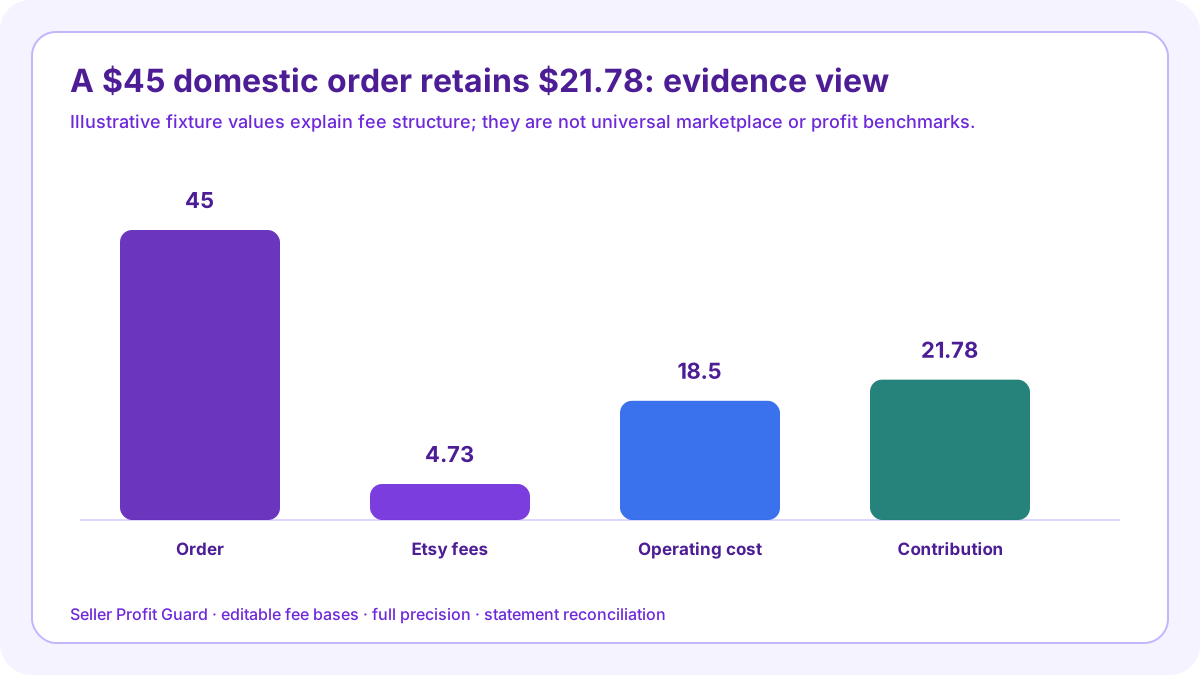
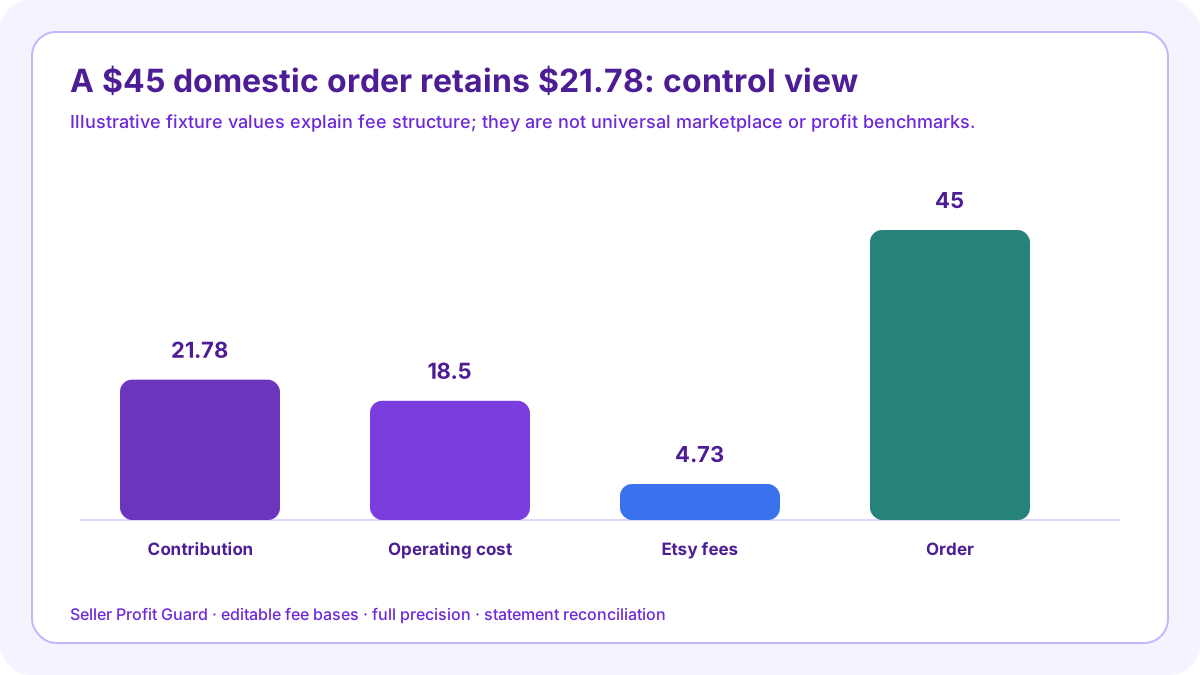
For a $40 item plus $5 shipping, one $0.20 listing renewal, a 6.5% transaction fee, and US domestic processing at 3% plus $0.25, modeled Etsy fees are $4.73. After $12 product and labor, $1.50 packaging, and a $5 label, estimated contribution is $21.78, or 48.4%.

domestic order worked example: scope and decision
The fixture uses a United States bank account and domestic order, USD model, listing, and Payment currencies, one unit, one listing-fee event, no gift wrap, no seller-collected tax, no Offsite Ads attribution, no currency conversion, no regulatory fee, and an explicit none scope with a zero seller-fee-tax base and rate. The source and statement review date is July 30, 2026.
Revenue is $45. The listing row is $0.20. The transaction row is 6.5 percent of $45, or $2.925. Processing is 3 percent of $45 plus $0.25, or $1.60.
Build the US planning fixture before changing price
Rounded display totals are $2.93 for transaction, $1.60 for processing, and $4.73 for all modeled Etsy fees. The calculation retains full precision before formatting, avoiding a cent of drift from rounding every intermediate too early.
Entered operating costs are $12 product and labor, $1.50 packaging, and a $5 shipping label. $45 minus $4.725 minus $18.50 equals $21.775, displayed as $21.78 and 48.4 percent of revenue.
Step 1: freeze the domestic scenario
Record seller bank country, order type, listing currency, Payment account currency, attribution state, quantity, refund state, tax treatment, source date, and reviewer before entering dollars.
At worked step 1, show the before amount, arithmetic, unrounded value, displayed value, and target consequence for “Step 1: freeze the domestic scenario.” Reproduce $40 item plus $5 shipping and retain a receipt reduced by an unexplained fee total as a failed reconciliation case until another operator can obtain $21.78 estimated contribution from the same inputs.
The worked log for “Step 1: freeze the domestic scenario” should preserve the $45 revenue, $0.20 listing row, $2.925 transaction row, $1.60 processing row, $18.50 operating cost, and $21.775 full-precision contribution only where they apply to $40 item plus $5 shipping. Replace them for a real order. Retain a receipt reduced by an unexplained fee total to prove that an unexplained total cannot establish $21.78 estimated contribution.
Step 2: reconcile buyer-paid revenue
Use $40 item revenue and $5 buyer-paid shipping. Do not subtract the $5 label here; buyer charge and seller carrier cost are different economic rows.
At worked step 2, show the before amount, arithmetic, unrounded value, displayed value, and target consequence for “Step 2: reconcile buyer-paid revenue.” Reproduce $40 item plus $5 shipping and retain a receipt reduced by an unexplained fee total as a failed reconciliation case until another operator can obtain $21.78 estimated contribution from the same inputs.
The worked log for “Step 2: reconcile buyer-paid revenue” should preserve the $45 revenue, $0.20 listing row, $2.925 transaction row, $1.60 processing row, $18.50 operating cost, and $21.775 full-precision contribution only where they apply to $40 item plus $5 shipping. Replace them for a real order. Retain a receipt reduced by an unexplained fee total to prove that an unexplained total cannot establish $21.78 estimated contribution.
Step 3: enter the listing event
Use one $0.20 event for the fixture. Keep the event count independent of quantity sold because initial listing coverage, extra quantities, remaining inventory, and auto-renew state determine actual rows.
At worked step 3, show the before amount, arithmetic, unrounded value, displayed value, and target consequence for “Step 3: enter the listing event.” Reproduce $40 item plus $5 shipping and retain a receipt reduced by an unexplained fee total as a failed reconciliation case until another operator can obtain $21.78 estimated contribution from the same inputs.
The worked log for “Step 3: enter the listing event” should preserve the $45 revenue, $0.20 listing row, $2.925 transaction row, $1.60 processing row, $18.50 operating cost, and $21.775 full-precision contribution only where they apply to $40 item plus $5 shipping. Replace them for a real order. Retain a receipt reduced by an unexplained fee total to prove that an unexplained total cannot establish $21.78 estimated contribution.
Step 4: calculate transaction fee
Multiply the $45 order total by 6.5 percent. Preserve $2.925 internally and display $2.93 without changing the downstream full-precision subtotal.
At worked step 4, show the before amount, arithmetic, unrounded value, displayed value, and target consequence for “Step 4: calculate transaction fee.” Reproduce $40 item plus $5 shipping and retain a receipt reduced by an unexplained fee total as a failed reconciliation case until another operator can obtain $21.78 estimated contribution from the same inputs.
The worked log for “Step 4: calculate transaction fee” should preserve the $45 revenue, $0.20 listing row, $2.925 transaction row, $1.60 processing row, $18.50 operating cost, and $21.775 full-precision contribution only where they apply to $40 item plus $5 shipping. Replace them for a real order. Retain a receipt reduced by an unexplained fee total to prove that an unexplained total cannot establish $21.78 estimated contribution.
Step 5: calculate processing
Multiply $45 by 3 percent and add $0.25. The $1.60 result applies only to the documented US domestic fixture and must not be generalized to other countries or order types.
At worked step 5, show the before amount, arithmetic, unrounded value, displayed value, and target consequence for “Step 5: calculate processing.” Reproduce $40 item plus $5 shipping and retain a receipt reduced by an unexplained fee total as a failed reconciliation case until another operator can obtain $21.78 estimated contribution from the same inputs.
The worked log for “Step 5: calculate processing” should preserve the $45 revenue, $0.20 listing row, $2.925 transaction row, $1.60 processing row, $18.50 operating cost, and $21.775 full-precision contribution only where they apply to $40 item plus $5 shipping. Replace them for a real order. Retain a receipt reduced by an unexplained fee total to prove that an unexplained total cannot establish $21.78 estimated contribution.

Step 6: subtract operating costs
Subtract product and labor, packaging, and the actual shipping-label assumption after Etsy fees. Do not count buyer-paid shipping as a cost or omit label expense because the charge happens elsewhere.
At worked step 6, show the before amount, arithmetic, unrounded value, displayed value, and target consequence for “Step 6: subtract operating costs.” Reproduce $40 item plus $5 shipping and retain a receipt reduced by an unexplained fee total as a failed reconciliation case until another operator can obtain $21.78 estimated contribution from the same inputs.
The worked log for “Step 6: subtract operating costs” should preserve the $45 revenue, $0.20 listing row, $2.925 transaction row, $1.60 processing row, $18.50 operating cost, and $21.775 full-precision contribution only where they apply to $40 item plus $5 shipping. Replace them for a real order. Retain a receipt reduced by an unexplained fee total to prove that an unexplained total cannot establish $21.78 estimated contribution.
Step 7: compare the contribution target
The fixture target is $15. The $21.78 estimate clears it by $6.78, but that does not include every possible overhead, return, chargeback, tax, reserve, or advertising consequence.
At worked step 7, show the before amount, arithmetic, unrounded value, displayed value, and target consequence for “Step 7: compare the contribution target.” Reproduce $40 item plus $5 shipping and retain a receipt reduced by an unexplained fee total as a failed reconciliation case until another operator can obtain $21.78 estimated contribution from the same inputs.
The worked log for “Step 7: compare the contribution target” should preserve the $45 revenue, $0.20 listing row, $2.925 transaction row, $1.60 processing row, $18.50 operating cost, and $21.775 full-precision contribution only where they apply to $40 item plus $5 shipping. Replace them for a real order. Retain a receipt reduced by an unexplained fee total to prove that an unexplained total cannot establish $21.78 estimated contribution.
Step 8: reconcile one real statement
After sale, compare each modeled row with the Payment account and monthly statement. Record credits, refunds, tax, labels, ads, exchange, reserve, and transfer differences rather than forcing the fixture to match.
At worked step 8, show the before amount, arithmetic, unrounded value, displayed value, and target consequence for “Step 8: reconcile one real statement.” Reproduce $40 item plus $5 shipping and retain a receipt reduced by an unexplained fee total as a failed reconciliation case until another operator can obtain $21.78 estimated contribution from the same inputs.
The worked log for “Step 8: reconcile one real statement” should preserve the $45 revenue, $0.20 listing row, $2.925 transaction row, $1.60 processing row, $18.50 operating cost, and $21.775 full-precision contribution only where they apply to $40 item plus $5 shipping. Replace them for a real order. Retain a receipt reduced by an unexplained fee total to prove that an unexplained total cannot establish $21.78 estimated contribution.
Verification, release, and reconciliation controls
Before changing a public price, shipping charge, discount, ad assumption, or calculator default, preserve the US planning fixture, source versions, current inputs, expected rows, tests, build, public route state, and rollback identifier. Confirm the exact target and safe-stop on an unexpected production or account context.
After one bounded change, rerun $40 item plus $5 shipping and deliberately revisit a receipt reduced by an unexplained fee total. Inspect every fee row, currency, full-precision subtotal, displayed rounding, contribution, target gap, source link, desktop and mobile result, and actual statement observation. Restore the prior packet when a critical result does not support $21.78 estimated contribution.
Limits, privacy boundary, and next action
This guide and calculator use seller-entered summaries and synthetic fixtures. They do not retrieve Etsy account data, choose a bank-country rate, verify attribution, calculate tax, open statements, authenticate costs, predict returns, determine accounting profit, change prices or ads, or prove ranking, conversion, income, qualified intent, or AdSense approval.
Keep buyer identities, emails, addresses, messages, order IDs, payment rows, bank data, tax identifiers, labels, tokens, OAuth material, credentials, and raw CSV outside the US planning fixture. Verify current official sources, reconcile an approved private sample, rerun complete and broken fixtures, move the itemized stack into SKU profit analysis, and record closure or rollback.
Sources and further reading
- Etsy Help: Fees and Taxes for Selling on Etsy: Current listing, transaction, payment, currency-conversion, regulatory, advertising, deposit, tax, and other fee boundaries.
- Etsy Help: Payment Processing Fees: Current bank-country percentage and fixed processing rates, order-type distinctions, fee base, VAT note, refunds, and deposit-fee table.
- Etsy Help: Currency Conversion Fees: Current 2.5% conversion rule when listing currency differs from Payment account currency and the statement source for applied rates.
- Etsy Help: Regulatory Operating Fee: Current seller-location rates and the item, shipping, gift-wrap, and personalization fee base.
- Etsy Help: Offsite Ads: Current 15% and 12% attributed-order rates, enrollment boundary, 365-day revenue test, and policy links.
- Etsy Help: Listing Multiple Quantities: Current listing, auto-renew sold, and multi-quantity mechanics plus fixed-fee conversion context.
- Etsy Help: VAT on Seller Fees: Current VAT scope and invoice context; actual treatment depends on seller location and registration.
- Etsy Help: Sales and Use Taxes on Seller Fees in Texas: Current Texas fee-type and taxable-base boundary; the actual combined state and local rate must come from the seller's invoice context.
- Etsy Help: Manage Your Payment Account: Current Payment account rows, monthly statement export, credits, refunds, Seller Services, shipping, reserve, and transfer context.
- Seller Profit Guard methodology: Local-first calculations, source hierarchy, privacy-safe fixtures, deterministic tests, bounded release, correction, and rollback.
Related Seller Profit Guard tools
- Open the Etsy Fee Stack Calculator: Model each editable order-level fee and contribution layer in the browser.
- Review current Etsy fee references: Check current reference rates and country-dependent boundaries before entering assumptions.
- Run the main Seller Profit Guard: Combine verified marketplace fees with SKU, labor, packaging, shipping, ads, discounts, and return loss.
- Reconcile an Etsy Payment account: Compare modeled fees with actual statement rows, credits, refunds, reserves, and deposits.
- Check Etsy Ads break-even: Use retained contribution to set a safer paid-click ceiling.
- Read the local-first methodology: Keep raw buyer, order, payment, and credential data outside public content and analytics.
- Etsy Fee Stack Formula and Input Contract: Continue the fee formula, worked example, source, threshold, comparison, routine, interpretation, or audit workflow.
- Etsy Cross-Currency Fee Example: Continue the fee formula, worked example, source, threshold, comparison, routine, interpretation, or audit workflow.
- 12 Etsy Fee Calculation Mistakes: Continue the fee formula, worked example, source, threshold, comparison, routine, interpretation, or audit workflow.
- Reliable Sources for Every Etsy Fee Input: Continue the fee formula, worked example, source, threshold, comparison, routine, interpretation, or audit workflow.
- Etsy Fee Stack Decision Thresholds: Continue the fee formula, worked example, source, threshold, comparison, routine, interpretation, or audit workflow.
Next step: Open the Etsy Fee Stack Calculator.
This is operational planning help, not tax, accounting, legal, financial, or platform-policy advice. Review the Terms and disclaimer, and verify current platform rules and fee assumptions before changing prices.