How to set safe Etsy Offsite Ads contribution thresholds
Last updated: 2026-07-30
Written and reviewed by Seller Profit Guard Editorial Team.
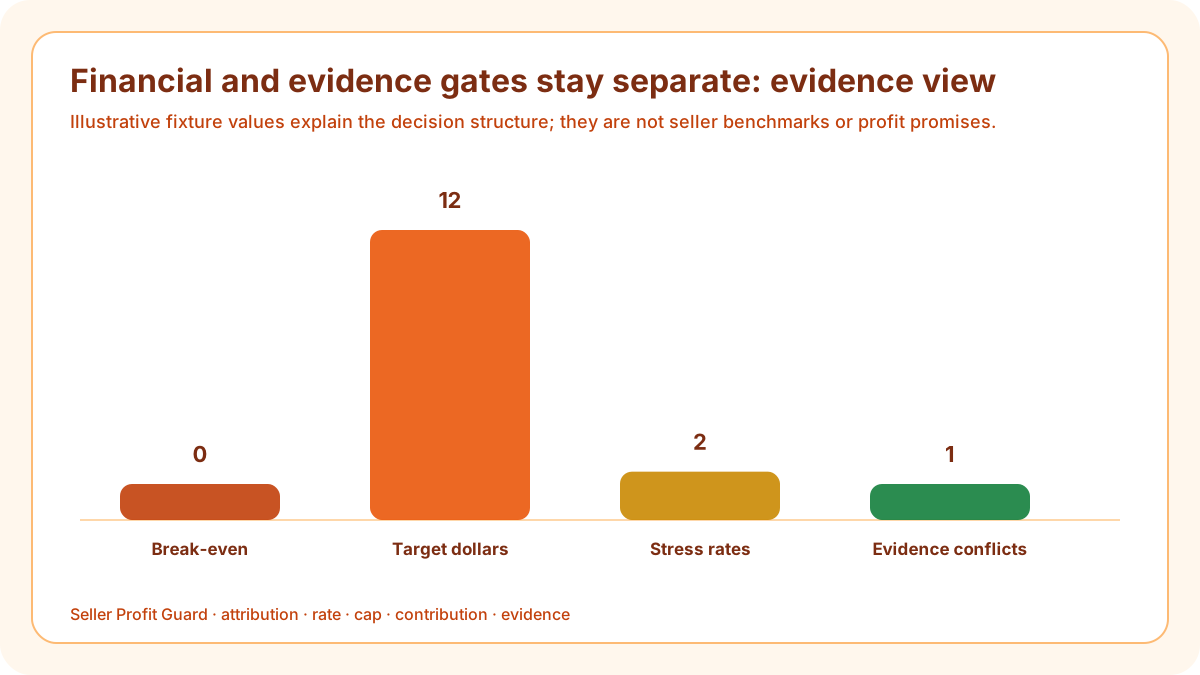
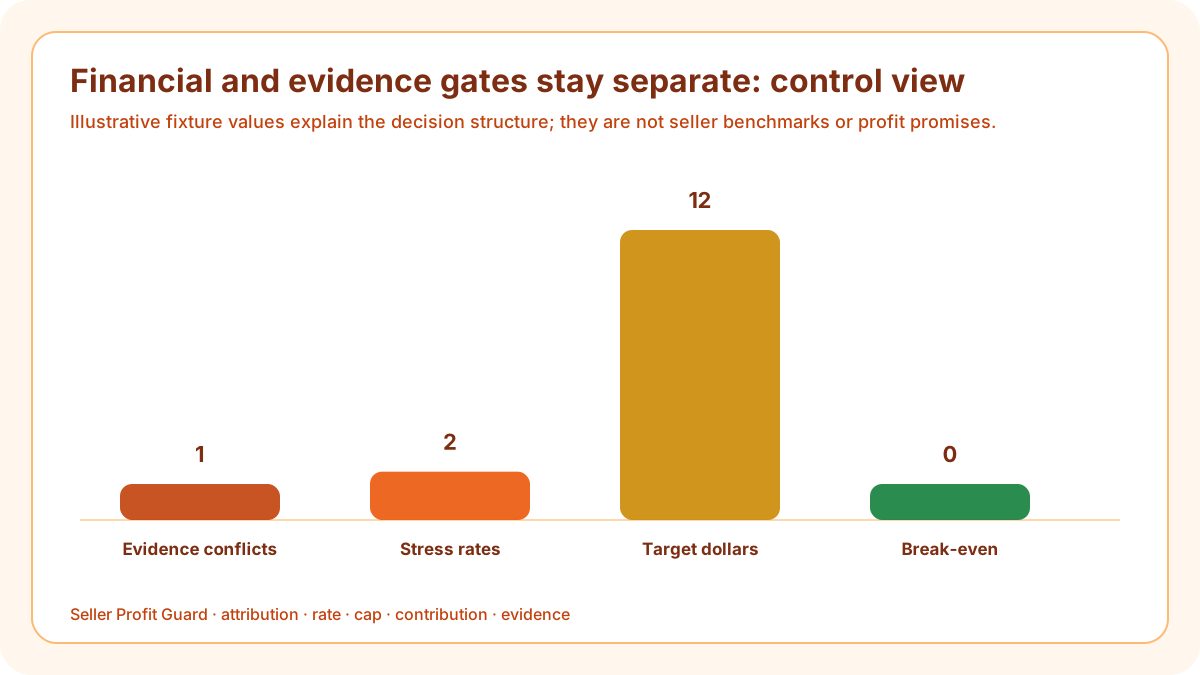
Use four gates: break-even contribution at $0, a seller-owned target that covers the intended overhead boundary, a stress case for rate, shipping, discount, and return loss, and an evidence gate for attribution, rate, cap, fee base, currency, refunds, and statement rows. Any unresolved evidence conflict should Block the decision.

financial and evidence threshold design: scope and decision
Break-even is necessary but insufficient. A contribution of one cent is positive, yet it cannot fund meaningful overhead, owner pay, taxes, uncertainty, or the cost of future returns. Set a target before viewing the result.
Stress thresholds expose assumptions that can move quickly: 15 versus 12 percent status, higher shipping labels, discounting, gift wrap, tax-base treatment, other fee changes, product cost, and expected return loss.
Build the Ready-Revise-Stop-Block decision card before acting
Evidence thresholds are non-compensating. A high financial result cannot compensate for missing attribution, wrong rate status, unconverted cap, or unsettled refund. The decision must remain Block until the accountable row is reconciled.
The output should authorize one next step: proceed to a bounded SKU review, revise price or cost assumptions, stop a losing scenario, or collect missing evidence. It does not authorize automatic marketplace changes.
Define the $0 break-even floor
Stop when order revenue minus the applied ad fee, other Etsy fees, direct costs, and expected return loss is negative. Verify zero with full precision.
Apply “Define the $0 break-even floor” before reading the overall score. The Ready-Revise-Stop-Block decision card treats financial floors and evidence gates independently: an attributed order above a $12 target may advance only when rates, bases, cap, costs, return assumptions, and account rows are current. a positive order with unresolved attribution evidence remains Block even when its arithmetic would otherwise show a bounded next action instead of false approval.
Stress “Define the $0 break-even floor” with lower revenue, 15 percent rate, higher label cost, higher product cost, expected return loss, and a declared evidence conflict. Record which single change moves the decision from Ready to Revise, Stop, or Block. Do not compensate for missing evidence by raising the numerical score.
Define a contribution-dollar target
Name the required retained dollars per attributed order and which overhead remains outside it. Use a controlled policy, not an aspirational margin copied from another shop.
Apply “Define a contribution-dollar target” before reading the overall score. The Ready-Revise-Stop-Block decision card treats financial floors and evidence gates independently: an attributed order above a $12 target may advance only when rates, bases, cap, costs, return assumptions, and account rows are current. a positive order with unresolved attribution evidence remains Block even when its arithmetic would otherwise show a bounded next action instead of false approval.
Stress “Define a contribution-dollar target” with lower revenue, 15 percent rate, higher label cost, higher product cost, expected return loss, and a declared evidence conflict. Record which single change moves the decision from Ready to Revise, Stop, or Block. Do not compensate for missing evidence by raising the numerical score.
Define a contribution-margin target
Use retained contribution divided by order revenue for comparable SKUs, but retain dollars for cash impact. Do not use fee base as the denominator by accident.
Apply “Define a contribution-margin target” before reading the overall score. The Ready-Revise-Stop-Block decision card treats financial floors and evidence gates independently: an attributed order above a $12 target may advance only when rates, bases, cap, costs, return assumptions, and account rows are current. a positive order with unresolved attribution evidence remains Block even when its arithmetic would otherwise show a bounded next action instead of false approval.
Stress “Define a contribution-margin target” with lower revenue, 15 percent rate, higher label cost, higher product cost, expected return loss, and a declared evidence conflict. Record which single change moves the decision from Ready to Revise, Stop, or Block. Do not compensate for missing evidence by raising the numerical score.
Define a 15% stress case
Even a shop currently at 12 percent can use 15 percent as a sensitivity test for scenario understanding, while preserving the actual eligibility state separately.
Apply “Define a 15% stress case” before reading the overall score. The Ready-Revise-Stop-Block decision card treats financial floors and evidence gates independently: an attributed order above a $12 target may advance only when rates, bases, cap, costs, return assumptions, and account rows are current. a positive order with unresolved attribution evidence remains Block even when its arithmetic would otherwise show a bounded next action instead of false approval.
Stress “Define a 15% stress case” with lower revenue, 15 percent rate, higher label cost, higher product cost, expected return loss, and a declared evidence conflict. Record which single change moves the decision from Ready to Revise, Stop, or Block. Do not compensate for missing evidence by raising the numerical score.
Stress shipping and cost
Increase carrier label, product input, packaging, fulfillment, and return loss independently. Identify the first variable that moves the result below target.
Apply “Stress shipping and cost” before reading the overall score. The Ready-Revise-Stop-Block decision card treats financial floors and evidence gates independently: an attributed order above a $12 target may advance only when rates, bases, cap, costs, return assumptions, and account rows are current. a positive order with unresolved attribution evidence remains Block even when its arithmetic would otherwise show a bounded next action instead of false approval.
Stress “Stress shipping and cost” with lower revenue, 15 percent rate, higher label cost, higher product cost, expected return loss, and a declared evidence conflict. Record which single change moves the decision from Ready to Revise, Stop, or Block. Do not compensate for missing evidence by raising the numerical score.

Stress discount and tax base
Model lower item revenue and any applicable tax-base difference without changing other fields. Discounts can reduce revenue while fixed or other costs remain.
Apply “Stress discount and tax base” before reading the overall score. The Ready-Revise-Stop-Block decision card treats financial floors and evidence gates independently: an attributed order above a $12 target may advance only when rates, bases, cap, costs, return assumptions, and account rows are current. a positive order with unresolved attribution evidence remains Block even when its arithmetic would otherwise show a bounded next action instead of false approval.
Stress “Stress discount and tax base” with lower revenue, 15 percent rate, higher label cost, higher product cost, expected return loss, and a declared evidence conflict. Record which single change moves the decision from Ready to Revise, Stop, or Block. Do not compensate for missing evidence by raising the numerical score.
Apply the evidence gate
Block on unresolved attribution, rate, threshold notice, cap currency, fee-base tax, refund, credit, or Payment account difference regardless of the score.
Apply “Apply the evidence gate” before reading the overall score. The Ready-Revise-Stop-Block decision card treats financial floors and evidence gates independently: an attributed order above a $12 target may advance only when rates, bases, cap, costs, return assumptions, and account rows are current. a positive order with unresolved attribution evidence remains Block even when its arithmetic would otherwise show a bounded next action instead of false approval.
Stress “Apply the evidence gate” with lower revenue, 15 percent rate, higher label cost, higher product cost, expected return loss, and a declared evidence conflict. Record which single change moves the decision from Ready to Revise, Stop, or Block. Do not compensate for missing evidence by raising the numerical score.
Record the bounded action
Ready advances to private statement reconciliation or one controlled price review. Revise changes one assumption. Stop rejects the case. Block requests named evidence.
Apply “Record the bounded action” before reading the overall score. The Ready-Revise-Stop-Block decision card treats financial floors and evidence gates independently: an attributed order above a $12 target may advance only when rates, bases, cap, costs, return assumptions, and account rows are current. a positive order with unresolved attribution evidence remains Block even when its arithmetic would otherwise show a bounded next action instead of false approval.
Stress “Record the bounded action” with lower revenue, 15 percent rate, higher label cost, higher product cost, expected return loss, and a declared evidence conflict. Record which single change moves the decision from Ready to Revise, Stop, or Block. Do not compensate for missing evidence by raising the numerical score.
Verification, release, and statement feedback
Before changing price, shipping, promotion, participation assumptions, or calculator defaults, preserve the Ready-Revise-Stop-Block decision card, official-source versions, account evidence pointer, current inputs, expected fixtures, tests, build, route state, and rollback identifier. Confirm the exact target environment and safe-stop on an unexpected account or production context.
After one bounded action, rerun an attributed order above a $12 target, a positive order with unresolved attribution evidence, the cap fixture, and a declared-conflict fixture. Inspect full-precision and displayed amounts, mobile results, canonical, sources, original visuals, internal links, and the approved private statement observation. Restore the prior packet if a critical result cannot support a bounded next action instead of false approval.
Limits, privacy boundary, and next action
This guide and calculator use seller-entered summaries and synthetic fixtures. They do not retrieve Etsy data, authenticate attribution, choose a rate, convert the cap automatically, settle tax, reproduce every refund or payout, estimate incrementality, change advertising, or prove ranking, traffic, qualified intent, AdSense approval, income, or final profit.
Keep buyer names, emails, addresses, messages, order IDs, payment rows, bank details, tax identifiers, labels, tokens, OAuth material, credentials, and raw CSV outside the Ready-Revise-Stop-Block decision card. Verify current Etsy sources and the seller's actual account, reconcile an approved privacy-safe sample, record closure or rollback, and obtain qualified accounting, tax, or legal advice when material.
Sources and further reading
- Etsy Help: How Offsite Ads Work: Current 30-day attribution, 15% and 12% fee rates, $100 USD per-order cap, enrollment, threshold, dashboard, and last-click boundary.
- Etsy Fees and Payments Policy: Controlling fee-base, attributed-order, 365-day sales test, tax, currency, cap, opt-out, and lifetime-participation policy language.
- Etsy Advertising and Marketing Policy: Current responsibilities and program terms for Etsy Ads and Offsite Ads.
- Etsy Help: Fees and Taxes for Selling: Current advertising-fee summary and the surrounding listing, transaction, processing, conversion, regulatory, and seller-fee tax boundaries.
- Etsy Help: How to Use Etsy Stats: Current traffic-source and Offsite Ads attribution observations available to a seller.
- Etsy Help: Manage Your Payment Account: Payment account, monthly statement, refund, credit, balance, reserve, shipping, and payout reconciliation context.
- Seller Profit Guard methodology: Local-first calculations, evidence hierarchy, privacy-safe fixtures, deterministic tests, bounded release, correction, and rollback.
Related Seller Profit Guard tools
- Open the Etsy Offsite Ads Margin Calculator: Model one attributed order under the current 15% or 12% rate and cap.
- Build the complete Etsy fee stack: Itemize every other marketplace fee before isolating the advertising consequence.
- Run the main Seller Profit Guard: Carry the reconciled ad fee into SKU-level cost, shipping, return, and target-profit analysis.
- Reconcile the Etsy Payment account: Compare modeled attribution and fees with actual statement rows, refunds, credits, and payouts.
- Read the Offsite Ads profit guide: Review the existing operating workflow for attributed orders and retained contribution.
- Read the local-first methodology: Keep buyer, order, payment, bank, contact, and credential data outside public pages and analytics.
- Etsy Offsite Ads Margin Formula and Inputs: Continue the formula, example, source, threshold, comparison, routine, interpretation, or audit workflow.
- Etsy Offsite Ads 15% Fee: Worked Example: Continue the formula, example, source, threshold, comparison, routine, interpretation, or audit workflow.
- Etsy Offsite Ads 12% Margin Scenario: Continue the formula, example, source, threshold, comparison, routine, interpretation, or audit workflow.
- 12 Etsy Offsite Ads Margin Mistakes: Continue the formula, example, source, threshold, comparison, routine, interpretation, or audit workflow.
- Reliable Etsy Offsite Ads Margin Data: Continue the formula, example, source, threshold, comparison, routine, interpretation, or audit workflow.
Next step: Open the Etsy Offsite Ads Margin Calculator.
This is operational planning help, not tax, accounting, legal, financial, or platform-policy advice. Review the Terms and disclaimer, and verify current platform rules and fee assumptions before changing prices.