How to interpret seller-funded shipping
Last updated: 2026-07-31
Written and reviewed by Seller Profit Guard Editorial Team.
Read seller-funded shipping beside postage, packaging, buyer charge, credits, fee convention, service, destination band, currency, period, and target. Ready means only that this packet clears declared evidence gates; it does not prove carrier accuracy, price, margin, conversion, delivery, tax treatment, or accounting profit.
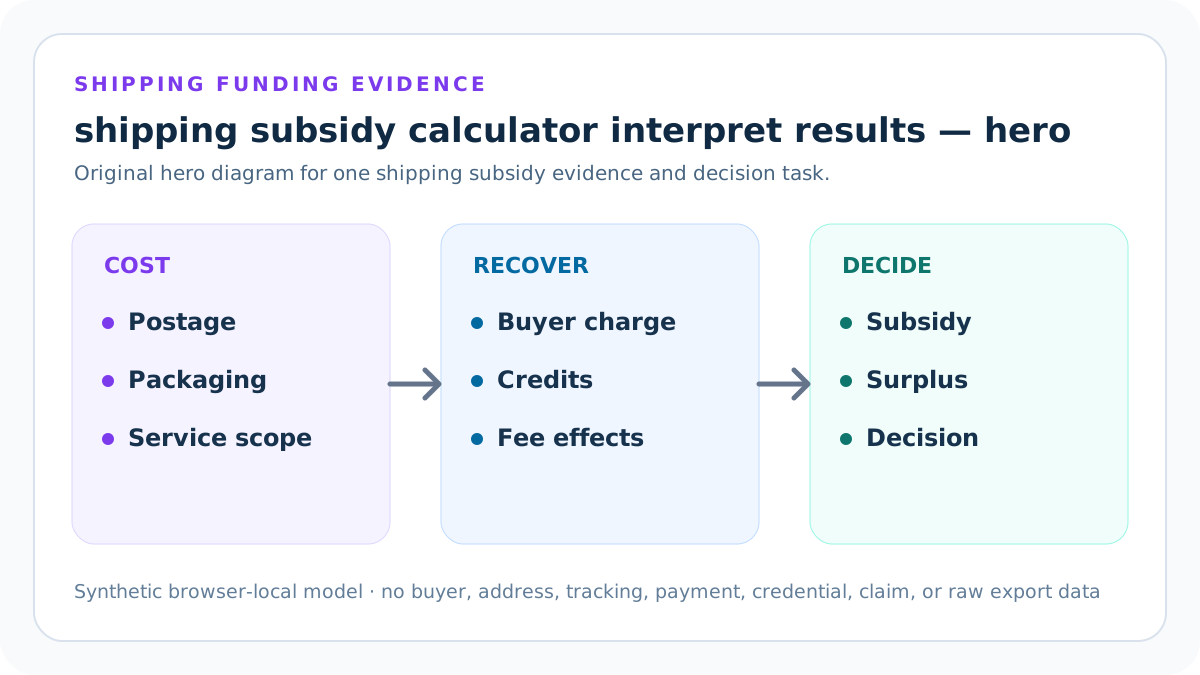
Read gross shipping cost
Interpret control 1: Treat postage plus assigned packaging as the declared shipment numerator, not complete fulfillment or order cost. The interpretation page separates what the arithmetic supports from commercial, legal, delivery, tax, accounting, and demand claims that require different evidence. For this control, save the before value, full-precision value, displayed value, units, shipment scope, source version, reviewer, and review date.
Test the nearest valid boundary and the nearest failure. State how a mismatch would alter a bounded shipping result linked to the next evidence action, what evidence would resolve it, who owns the correction, and whether the packet must be blocked, reviewed, limited, superseded, or restored.
Read fee effect
Interpret control 2: Tie percentage and fixed allocations to current seller evidence and keep unrelated order fees outside this line. The interpretation page separates what the arithmetic supports from commercial, legal, delivery, tax, accounting, and demand claims that require different evidence. For this control, save the before value, full-precision value, displayed value, units, shipment scope, source version, reviewer, and review date.
Test the nearest valid boundary and the nearest failure. State how a mismatch would alter a bounded shipping result linked to the next evidence action, what evidence would resolve it, who owns the correction, and whether the packet must be blocked, reviewed, limited, superseded, or restored.
Read net recovery
Interpret control 3: Separate buyer-paid shipping, platform funding, carrier credits, reversals, and fee effects before interpreting coverage. The interpretation page separates what the arithmetic supports from commercial, legal, delivery, tax, accounting, and demand claims that require different evidence. For this control, save the before value, full-precision value, displayed value, units, shipment scope, source version, reviewer, and review date.
Test the nearest valid boundary and the nearest failure. State how a mismatch would alter a bounded shipping result linked to the next evidence action, what evidence would resolve it, who owns the correction, and whether the packet must be blocked, reviewed, limited, superseded, or restored.
Read seller-funded subsidy
Interpret control 4: Use the positive funding gap as an order contribution input, not a price, loss, tax deduction, or profit value. The interpretation page separates what the arithmetic supports from commercial, legal, delivery, tax, accounting, and demand claims that require different evidence. For this control, save the before value, full-precision value, displayed value, units, shipment scope, source version, reviewer, and review date.
Test the nearest valid boundary and the nearest failure. State how a mismatch would alter a bounded shipping result linked to the next evidence action, what evidence would resolve it, who owns the correction, and whether the packet must be blocked, reviewed, limited, superseded, or restored.
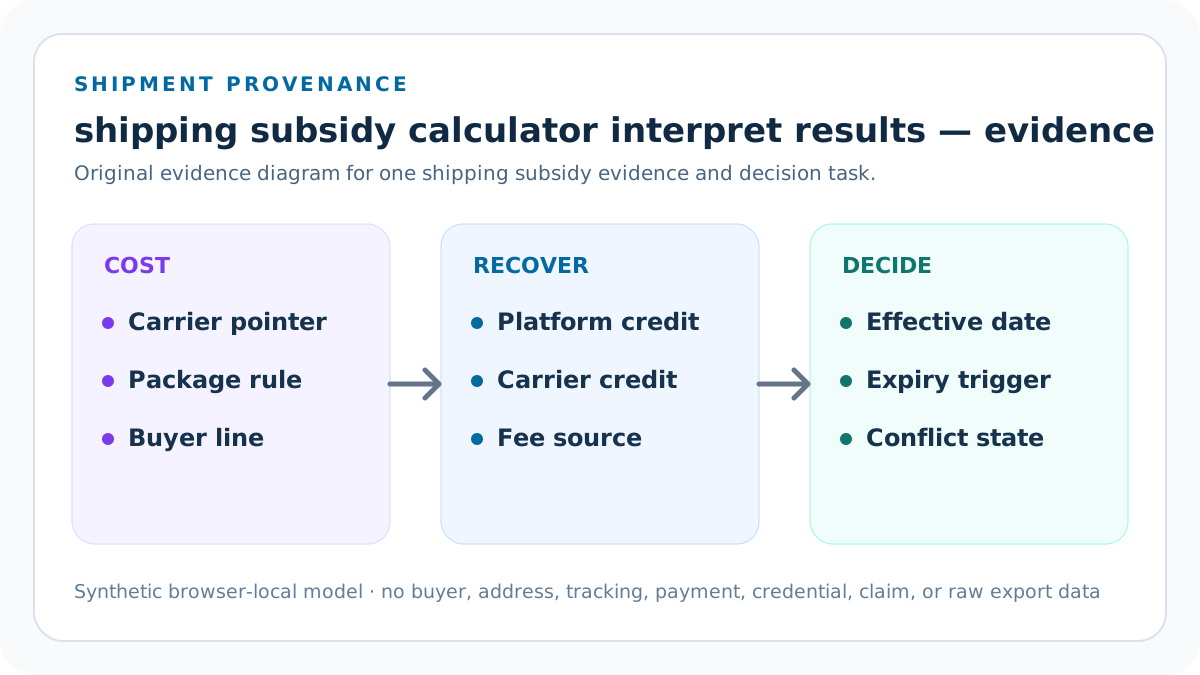
Read shipping surplus
Interpret control 5: Investigate over-recovery and preserve it separately rather than reporting a negative subsidy. The interpretation page separates what the arithmetic supports from commercial, legal, delivery, tax, accounting, and demand claims that require different evidence. For this control, save the before value, full-precision value, displayed value, units, shipment scope, source version, reviewer, and review date.
Test the nearest valid boundary and the nearest failure. State how a mismatch would alter a bounded shipping result linked to the next evidence action, what evidence would resolve it, who owns the correction, and whether the packet must be blocked, reviewed, limited, superseded, or restored.
Read recovery rate
Interpret control 6: Use cost coverage only within the chosen shipment population and never call it conversion or margin. The interpretation page separates what the arithmetic supports from commercial, legal, delivery, tax, accounting, and demand claims that require different evidence. For this control, save the before value, full-precision value, displayed value, units, shipment scope, source version, reviewer, and review date.
Test the nearest valid boundary and the nearest failure. State how a mismatch would alter a bounded shipping result linked to the next evidence action, what evidence would resolve it, who owns the correction, and whether the packet must be blocked, reviewed, limited, superseded, or restored.
Read target headroom
Interpret control 7: State the full-precision distance from one seller-owned maximum and its effective and expiry dates. The interpretation page separates what the arithmetic supports from commercial, legal, delivery, tax, accounting, and demand claims that require different evidence. For this control, save the before value, full-precision value, displayed value, units, shipment scope, source version, reviewer, and review date.
Test the nearest valid boundary and the nearest failure. State how a mismatch would alter a bounded shipping result linked to the next evidence action, what evidence would resolve it, who owns the correction, and whether the packet must be blocked, reviewed, limited, superseded, or restored.
Read Block, Review, and Ready
Interpret control 8: Repair invalid evidence, diagnose warnings, and treat Ready as one bounded planning input. The interpretation page separates what the arithmetic supports from commercial, legal, delivery, tax, accounting, and demand claims that require different evidence. For this control, save the before value, full-precision value, displayed value, units, shipment scope, source version, reviewer, and review date.
Test the nearest valid boundary and the nearest failure. State how a mismatch would alter a bounded shipping result linked to the next evidence action, what evidence would resolve it, who owns the correction, and whether the packet must be blocked, reviewed, limited, superseded, or restored.
Use the shipping subsidy interpretation card with one protected shipment packet
Open the calculator only after the shipping subsidy interpretation card has one seller alias, marketplace, origin, destination band, service, package, refund state, currency, evidence month, target, fee convention, and unresolved-issue list. Enter synthetic or aggregate values; never paste buyer, address, tracking, payment, credential, private invoice, claim, or raw export data.
Save postage, packaging, buyer charge, platform credit, carrier credit, percentage fee, fixed allocation, and target at full precision beside the visible rounded result. Preserve the prior packet whenever one source, route, package, service, currency, or rule changes.
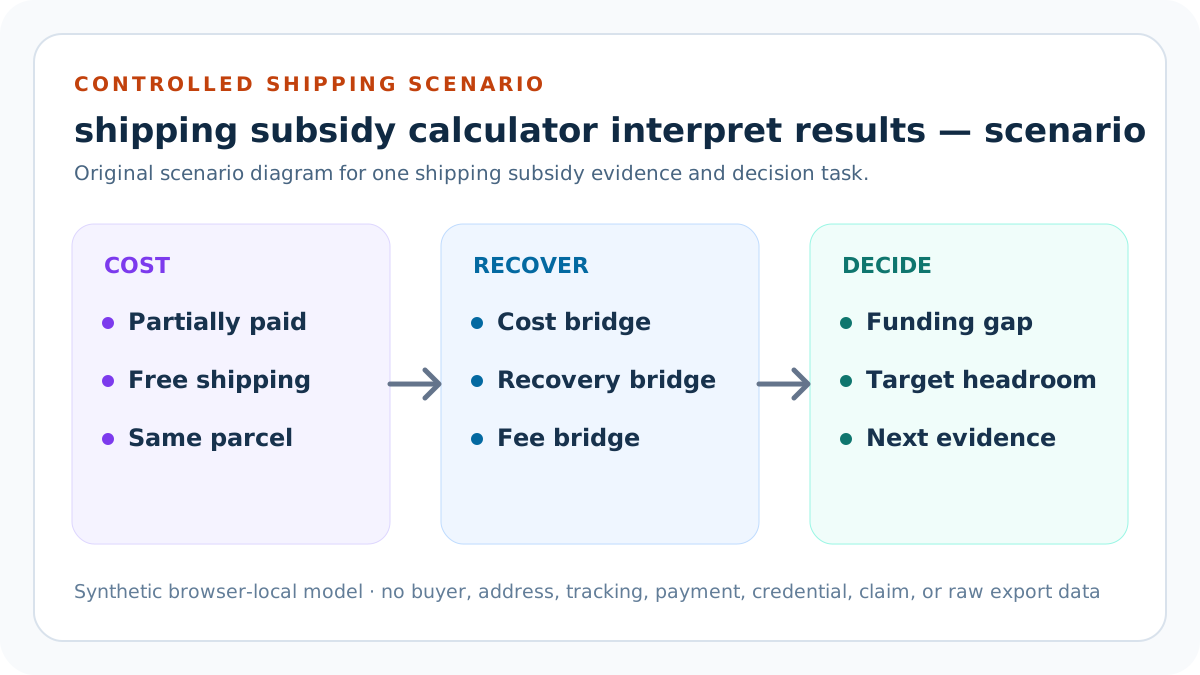
Apply evidence gates before a bounded shipping result linked to the next evidence action
Block blank, non-finite, or negative amounts, nonpositive postage or target, invalid recovery thresholds, fee percentages outside zero through 100, impossible source dates, invalid currency or month, inadequate shipment scope, incomplete confirmations, or declared conflicts. Review subsidy above target, a positive fixed shipping allocation with zero buyer charge, recovery above the seller-entered maximum share of cost, stale sources, or mismatched populations.
Ready confirms only a structurally valid shipping allocation under the declared evidence. It does not quote a carrier, certify a platform fee, select a shipping profile, set item price, promise delivery, predict conversion, or determine tax, accounting profit, margin, demand, revenue, or income.
Model route, service, and adjustment uncertainty explicitly
Change one postage, package, buyer charge, credit, fee, or target variable at a time. Keep domestic, international, closest, representative, farthest, upgraded, oversized, return, reshipment, pending-adjustment, and final-adjustment cases separate whenever their evidence differs.
Record the before state, isolated change, gross cost, fee effect, gross and net recovery, signed funding gap, subsidy, surplus, recovery rate, target headroom, decision, confidence, owner, and next evidence action. Sensitivity identifies a driver; it does not choose a commercial response.
Protect buyer, address, tracking, payment, and claim data
Public examples are synthetic. Keep buyer and order rows, names, addresses, tracking numbers, payment data, credentials, bank data, tax records, private invoices, carrier claims, account identifiers, and raw exports outside the shipping subsidy interpretation card.
Use seller aliases, aggregates, ranges, redacted source pointers, and access-controlled records. An independent reviewer should reproduce the arithmetic and decision contract without receiving personal, transaction-level, financial-account, credential, or carrier-confidential material.
Release, observe, correct, and roll back the shipping asset
Before release, preserve narrow local and remote backups and a rollback identifier. Run typecheck, focused and full unit tests, integration, build, SEO and duplicate audits, static-route validation, mobile and keyboard QA, image and link checks, source review, and live calculator scenarios.
After release, verify status, canonical, indexability, schema, answer blocks, images, guide-hub discovery, strict 404, sitemap policy, events, and production behavior. Record Day 0/7/14/28 evidence without same-day causal claims and restore the prior version if formula, privacy, accessibility, routing, content, or health regresses.
Write a result statement with five explicit boundaries
Name the shipment population, evidence period, currency, service and package scope, and seller-owned target before stating subsidy. Then report gross cost, net recovery, fee convention, signed gap, subsidy or surplus, headroom, decision, and display rule in one reproducible sequence.
Follow with separate sentences for known uncertainty, unsupported commercial inference, and the next source action. This structure prevents a reader from confusing one synthetic or aggregate shipment result with a universal shipping policy.
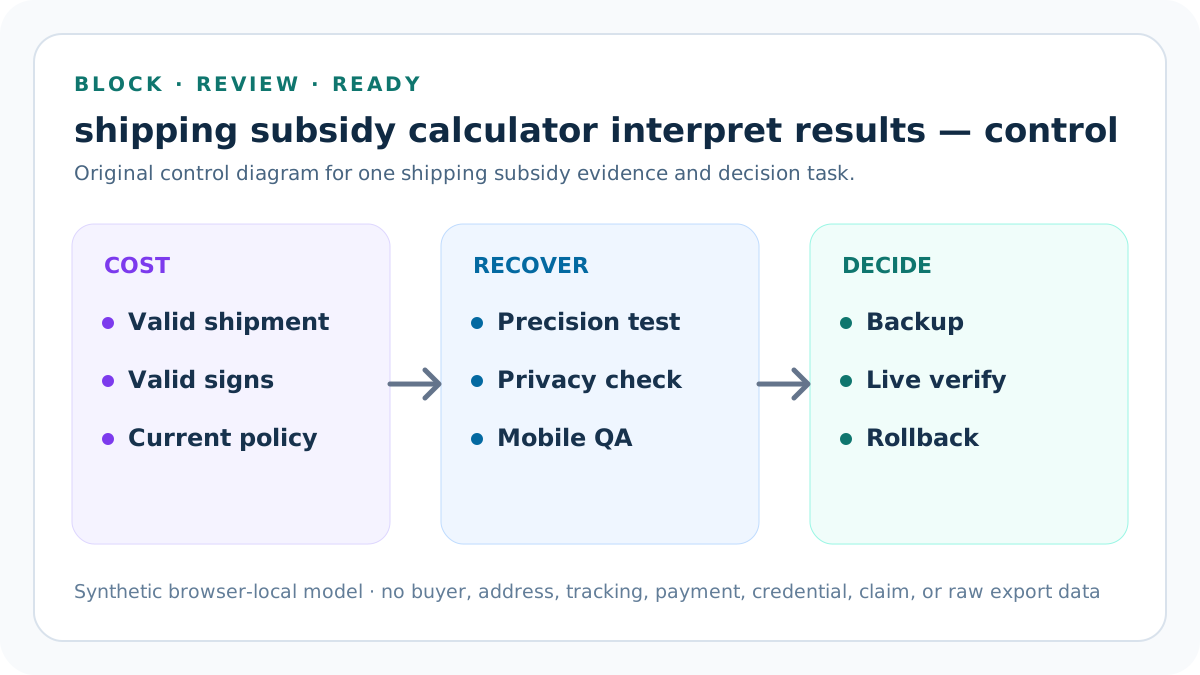
Translate a subsidy driver into the correct next model
Postage movement routes to carrier, dimensions, weight, zone, and service review. Packaging movement routes to the packaging calculator. Buyer-charge movement routes to shipping profile evidence. Fee movement routes to current official policy. Credits route to funding and settlement evidence.
Only after the shipping packet is stable should the seller carry subsidy into contribution, price-floor, free-shipping threshold, return-loss, or scenario analysis. The shipping calculator never decides those broader outcomes by itself.
Separate operational readiness from commercial success
Ready means signs, required fields, context, target, fee bounds, surplus rule, and declared conflicts clear the defined evidence gates. It says nothing about whether buyers prefer the offer, whether carrier delivery meets expectations, or whether the complete order earns an acceptable return.
Measure conversion, average order value, cancellation, return, delivery exception, contribution, qualified intent, search visibility, and revenue in their own windows and denominators. Preserve confounders and do not credit a same-day content or shipping change with causal improvement.
Supported statement
State exactly what the saved shipment evidence and deterministic arithmetic show, including units, scope, date, and rounding. Deep check 1 stores shipment alias, source version, protected pointer, full-precision arithmetic, display output, decision, reviewer, expiry condition, and correction route. Another reviewer must not guess the service, package, destination, fee base, credit relationship, target, period, or sign convention.
Find the closest counterexample and state why it would invalidate or narrow a bounded shipping result linked to the next evidence action. Preserve competing route, service, package, fee, credit, refund, adjustment, price, or target evidence as named scenarios rather than blending uncertainty into one reassuring average.
Unsupported inference
Name the delivery, conversion, search, price, margin, tax, accounting, demand, profit, or viability claim not supported. Deep check 2 stores shipment alias, source version, protected pointer, full-precision arithmetic, display output, decision, reviewer, expiry condition, and correction route. Another reviewer must not guess the service, package, destination, fee base, credit relationship, target, period, or sign convention.
Find the closest counterexample and state why it would invalidate or narrow a bounded shipping result linked to the next evidence action. Preserve competing route, service, package, fee, credit, refund, adjustment, price, or target evidence as named scenarios rather than blending uncertainty into one reassuring average.
Sensitivity statement
Change one postage, package, charge, credit, fee, or target field and report the isolated full-precision effect. Deep check 3 stores shipment alias, source version, protected pointer, full-precision arithmetic, display output, decision, reviewer, expiry condition, and correction route. Another reviewer must not guess the service, package, destination, fee base, credit relationship, target, period, or sign convention.
Find the closest counterexample and state why it would invalidate or narrow a bounded shipping result linked to the next evidence action. Preserve competing route, service, package, fee, credit, refund, adjustment, price, or target evidence as named scenarios rather than blending uncertainty into one reassuring average.
Counterexample
Identify an upgrade, international route, return, reshipment, surcharge, refund, or credit reversal that narrows the result. Deep check 4 stores shipment alias, source version, protected pointer, full-precision arithmetic, display output, decision, reviewer, expiry condition, and correction route. Another reviewer must not guess the service, package, destination, fee base, credit relationship, target, period, or sign convention.
Find the closest counterexample and state why it would invalidate or narrow a bounded shipping result linked to the next evidence action. Preserve competing route, service, package, fee, credit, refund, adjustment, price, or target evidence as named scenarios rather than blending uncertainty into one reassuring average.
Next evidence action
Connect the driver to carrier, packaging, platform policy, payment account, pricing, contribution, return, or conversion review. Deep check 5 stores shipment alias, source version, protected pointer, full-precision arithmetic, display output, decision, reviewer, expiry condition, and correction route. Another reviewer must not guess the service, package, destination, fee base, credit relationship, target, period, or sign convention.
Find the closest counterexample and state why it would invalidate or narrow a bounded shipping result linked to the next evidence action. Preserve competing route, service, package, fee, credit, refund, adjustment, price, or target evidence as named scenarios rather than blending uncertainty into one reassuring average.
Sources and further reading
- Seller Profit Guard methodology: Comparable-grain evidence, deterministic calculations, validation, correction, release, and rollback.
- Seller Profit Guard data privacy: Local-first boundaries for buyer, order, address, tracking, payment, credential, invoice, claim, and raw export data.
- Etsy Help: How to Offer Free Shipping: Official source reviewed 2026-07-31 for free-shipping guarantees, profiles, price adjustments, service levels, and recovery choices.
- Etsy Help: What are the Fees and Taxes for Selling on Etsy?: Official source reviewed 2026-07-31 explaining that transaction and payment fee bases can include shipping, subject to seller-market and order facts.
- Etsy Payments Policy: Official policy reviewed 2026-07-31 for country-specific payment-processing context; verify the applicable rate, base, and effective version before entry.
Related Seller Profit Guard tools
- Open the Shipping Subsidy Calculator: Measure seller-funded shipping after postage, packaging, buyer charges, credits, and fee effects.
- Packaging Cost per Order Calculator: Build a defensible packaging input before measuring shipping subsidy.
- Contribution Margin Calculator: Carry the shipping result into a broader order contribution view.
- Free Shipping Threshold Calculator: Compare buyer-facing free shipping with seller-owned commercial assumptions.
- Shipping Price Helper: Model a broader buyer-charge and pricing scenario.
- Methodology: Review evidence, privacy, formulas, tests, release, correction, and rollback.
- Shipping Subsidy Formula and Inputs: Continue with a distinct shipping formula, example, source, threshold, comparison, operating, interpretation, or audit task.
- Shipping Subsidy Worked Example: Continue with a distinct shipping formula, example, source, threshold, comparison, operating, interpretation, or audit task.
- Free Shipping Subsidy Scenario: Continue with a distinct shipping formula, example, source, threshold, comparison, operating, interpretation, or audit task.
- Shipping Subsidy Calculator Mistakes: Continue with a distinct shipping formula, example, source, threshold, comparison, operating, interpretation, or audit task.
- Shipping Subsidy Evidence Sources: Continue with a distinct shipping formula, example, source, threshold, comparison, operating, interpretation, or audit task.
Next step: Open the Shipping Subsidy Calculator.
This is operational planning help, not tax, accounting, legal, financial, or platform-policy advice. Review the Terms and disclaimer, and verify current platform rules and fee assumptions before changing prices.