Exchange order loss audit checklist and change log
Last updated: 2026-07-31
Written and reviewed by Seller Profit Guard Editorial Team.
Audit one exchange packet by recording original and new items, historical contribution, three shipping events, handling, fees, balance payment or refund, returned-inventory recovery, policy version, authority, privacy controls, expected fixtures, calculation result, approval, release evidence, live checks, corrections, and rollback outcome in a dated log.
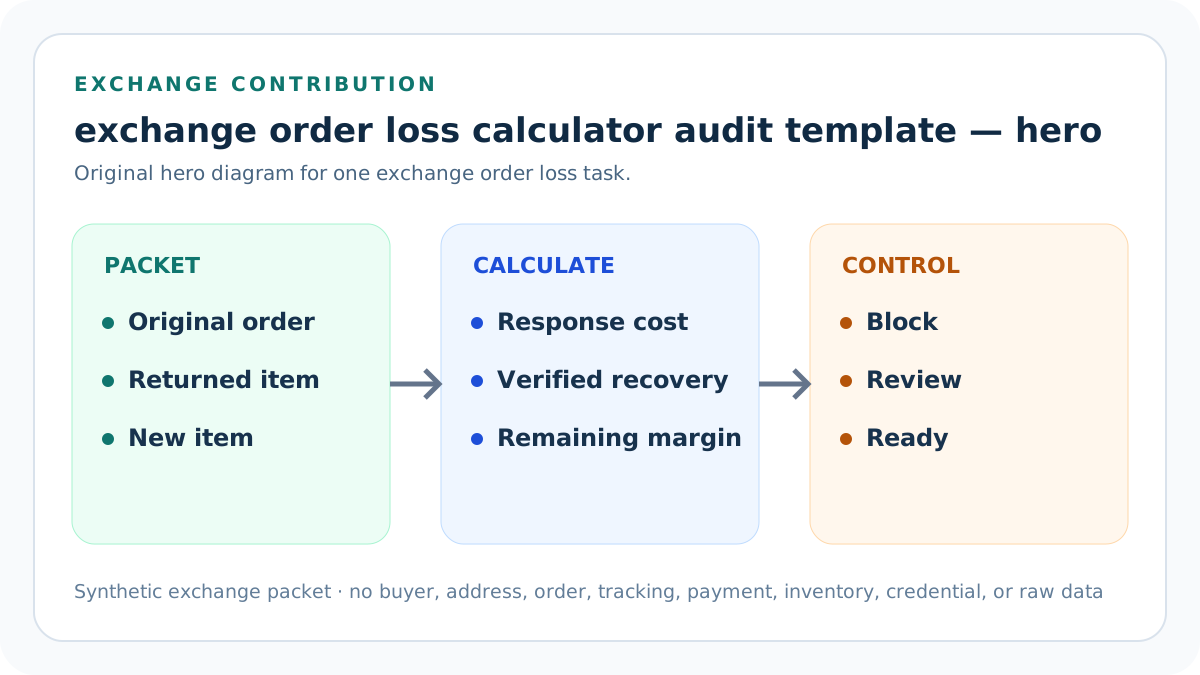
Identify the packet
Record alias, original order line, returned item, new item, quantities, variants, reason, currency, market, period, scope, and version. Add the result to the exchange audit packet with the packet alias, source version, evidence date, owner, currency, scope, and affected calculation field. This makes a reviewable exchange calculation history reproducible instead of dependent on memory or an unversioned marketplace screen.
Keep buyer and raw order identifiers in authorized systems. Review point 1 must state what is observed, what remains an assumption, which authority is outside the calculation, and what evidence would change the result. Keep returned-item, new-item, shipping, fee, payment, refund, inventory, policy, and fulfillment states separate.
Record source evidence
List order, cost, original shipping, fees, return shipping, new-item cost, second shipping, packaging, handling, payment, refund, and inventory pointers. Add the result to the exchange audit packet with the packet alias, source version, evidence date, owner, currency, scope, and affected calculation field. This makes a reviewable exchange calculation history reproducible instead of dependent on memory or an unversioned marketplace screen.
Include source timestamp, state, owner, and retention rule. Review point 2 must state what is observed, what remains an assumption, which authority is outside the calculation, and what evidence would change the result. Keep returned-item, new-item, shipping, fee, payment, refund, inventory, policy, and fulfillment states separate.
Record authority
Name policy, promise, rights, payment, refund, inventory, and fulfillment decision owners. Add the result to the exchange audit packet with the packet alias, source version, evidence date, owner, currency, scope, and affected calculation field. This makes a reviewable exchange calculation history reproducible instead of dependent on memory or an unversioned marketplace screen.
State what the calculator is explicitly not allowed to decide. Review point 3 must state what is observed, what remains an assumption, which authority is outside the calculation, and what evidence would change the result. Keep returned-item, new-item, shipping, fee, payment, refund, inventory, policy, and fulfillment states separate.
Record formula fixtures
Store default size, higher-cost product, collected-payment, negative-contribution, and invalid-packet cases. Add the result to the exchange audit packet with the packet alias, source version, evidence date, owner, currency, scope, and affected calculation field. This makes a reviewable exchange calculation history reproducible instead of dependent on memory or an unversioned marketplace screen.
Keep full-precision inputs and expected outputs. Review point 4 must state what is observed, what remains an assumption, which authority is outside the calculation, and what evidence would change the result. Keep returned-item, new-item, shipping, fee, payment, refund, inventory, policy, and fulfillment states separate.
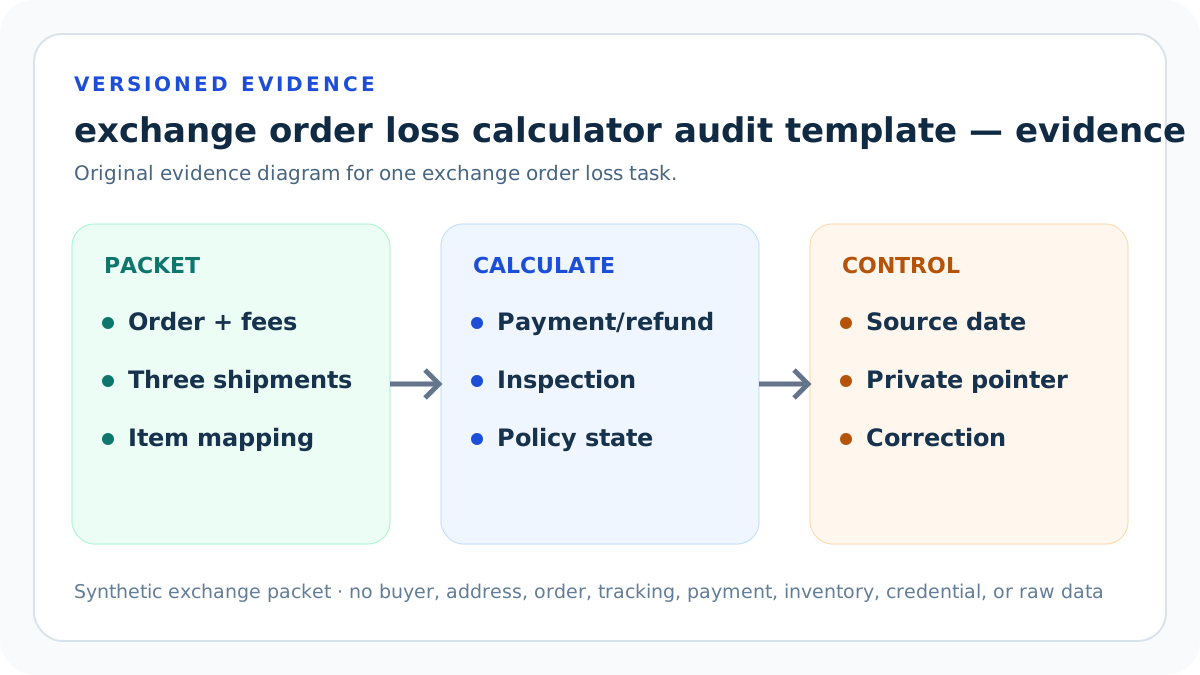
Record quality gates
Check word depth, uniqueness, sources, answers, images, alt text, links, canonical, schema, noindex or index state, mobile, keyboard, and privacy. Add the result to the exchange audit packet with the packet alias, source version, evidence date, owner, currency, scope, and affected calculation field. This makes a reviewable exchange calculation history reproducible instead of dependent on memory or an unversioned marketplace screen.
A generated page is not approved merely because it builds. Review point 5 must state what is observed, what remains an assumption, which authority is outside the calculation, and what evidence would change the result. Keep returned-item, new-item, shipping, fee, payment, refund, inventory, policy, and fulfillment states separate.
Record release evidence
Store local and remote backup, rollback identifier, tests, candidate results, origin checks, targeted purge, live routes, sitemap, and E2E. Add the result to the exchange audit packet with the packet alias, source version, evidence date, owner, currency, scope, and affected calculation field. This makes a reviewable exchange calculation history reproducible instead of dependent on memory or an unversioned marketplace screen.
Stop at the first failed critical gate. Review point 6 must state what is observed, what remains an assumption, which authority is outside the calculation, and what evidence would change the result. Keep returned-item, new-item, shipping, fee, payment, refund, inventory, policy, and fulfillment states separate.
Record correction and restore
Log defect, affected packets and pages, corrected evidence, recalculation, reviewer, customer action if authorized, retest, redeploy, and rollback. Add the result to the exchange audit packet with the packet alias, source version, evidence date, owner, currency, scope, and affected calculation field. This makes a reviewable exchange calculation history reproducible instead of dependent on memory or an unversioned marketplace screen.
Preserve the earlier version for auditability. Review point 7 must state what is observed, what remains an assumption, which authority is outside the calculation, and what evidence would change the result. Keep returned-item, new-item, shipping, fee, payment, refund, inventory, policy, and fulfillment states separate.
Validate calculation and broken fixtures
Recalculate original contribution, gross response cost, verified recovery, incremental loss, remaining contribution, retention rate, recovery share, and target headroom independently. Test valid size and product exchanges plus blank, NaN, infinite, fractional-quantity, negative, impossible-date, incomplete-confirmation, threshold, refund, credit, mapping, currency, scope, and conflict inputs.
Record full-precision expected values before formatting. A fixture passes only when numeric outputs, masking, Block/Review/Ready state, issue text, reset behavior, browser-local privacy boundary, keyboard path, mobile layout, and correction route all match the declared contract.
Confirm the dated evidence packet for a reviewable exchange calculation history
Require explicit yes confirmations for original-order economics, returned-item receipt and condition, exchange-item inventory and fulfillment, both shipping legs and handling, balance and refund state, fee credit, inventory recovery, source lineage, and planning boundaries. Record a real YYYY-MM-DD source-review date.
A plausible exchange summary without current responsible-owner confirmation is incomplete evidence. Block monetary outputs, name the missing state, and keep buyer, order, label, payment, refund, inventory-location, account, and credential data in authorized systems.
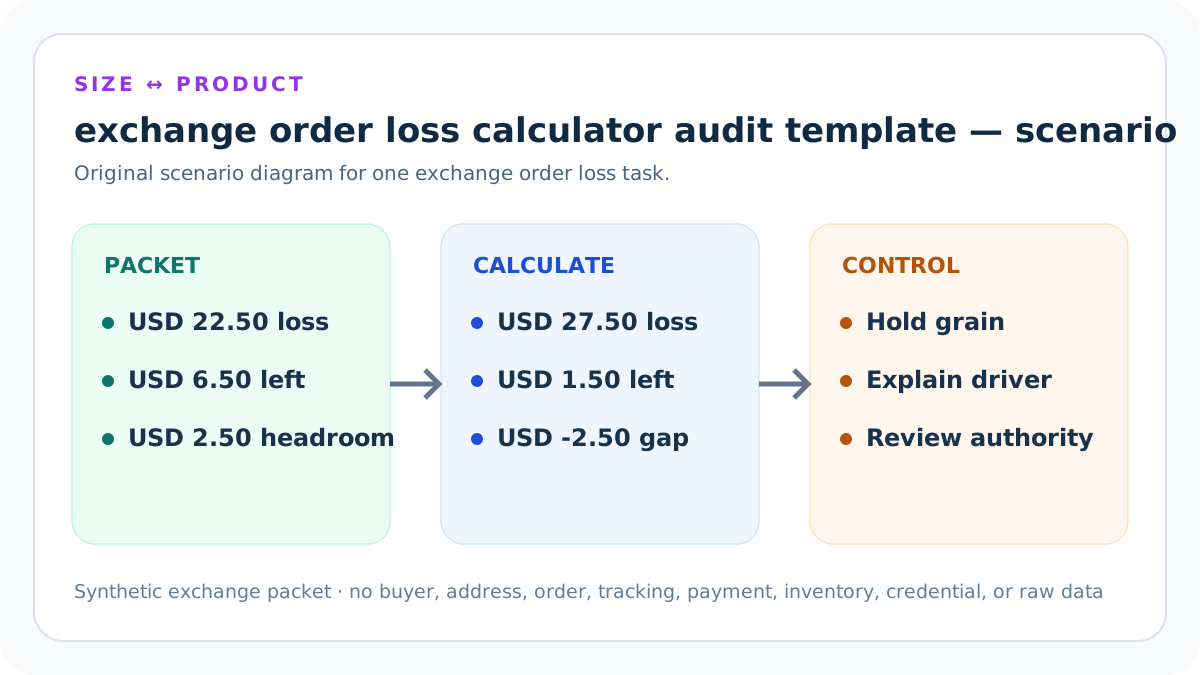
Audit packet completeness
Every required field needs a value, explicit zero, not-applicable reason, or unresolved owner. Deep review 1 for exchange audit packet stores the tested input, source state, calculation delta, authority boundary, reviewer, expiry, correction condition, and operational next action. Keep the counterexample even when it does not support the preferred exchange outcome.
Compare the result with the declared a reviewable exchange calculation history, not with a generic benchmark or another packet at a different grain. Explain which single driver moved, which fields stayed constant, what evidence remains unknown, and whether the correct response is collect, correct, review, release, close, or restore.
Audit arithmetic independently
Recalculate original contribution, response cost, recovery, loss, remaining contribution, and headroom. Deep review 2 for exchange audit packet stores the tested input, source state, calculation delta, authority boundary, reviewer, expiry, correction condition, and operational next action. Keep the counterexample even when it does not support the preferred exchange outcome.
Compare the result with the declared a reviewable exchange calculation history, not with a generic benchmark or another packet at a different grain. Explain which single driver moved, which fields stayed constant, what evidence remains unknown, and whether the correct response is collect, correct, review, release, close, or restore.
Audit state transitions
Verify payment, refund, inventory, and fulfillment timing instead of assuming simultaneous closure. Deep review 3 for exchange audit packet stores the tested input, source state, calculation delta, authority boundary, reviewer, expiry, correction condition, and operational next action. Keep the counterexample even when it does not support the preferred exchange outcome.
Compare the result with the declared a reviewable exchange calculation history, not with a generic benchmark or another packet at a different grain. Explain which single driver moved, which fields stayed constant, what evidence remains unknown, and whether the correct response is collect, correct, review, release, close, or restore.
Audit public privacy
Search content, images, schema, logs, reports, analytics, and downloads for prohibited data. Deep review 4 for exchange audit packet stores the tested input, source state, calculation delta, authority boundary, reviewer, expiry, correction condition, and operational next action. Keep the counterexample even when it does not support the preferred exchange outcome.
Compare the result with the declared a reviewable exchange calculation history, not with a generic benchmark or another packet at a different grain. Explain which single driver moved, which fields stayed constant, what evidence remains unknown, and whether the correct response is collect, correct, review, release, close, or restore.
Audit Day 0/7/14/28 evidence
Record discovery and behavior without claiming same-day causality or guaranteed ranking. Deep review 5 for exchange audit packet stores the tested input, source state, calculation delta, authority boundary, reviewer, expiry, correction condition, and operational next action. Keep the counterexample even when it does not support the preferred exchange outcome.
Compare the result with the declared a reviewable exchange calculation history, not with a generic benchmark or another packet at a different grain. Explain which single driver moved, which fields stayed constant, what evidence remains unknown, and whether the correct response is collect, correct, review, release, close, or restore.
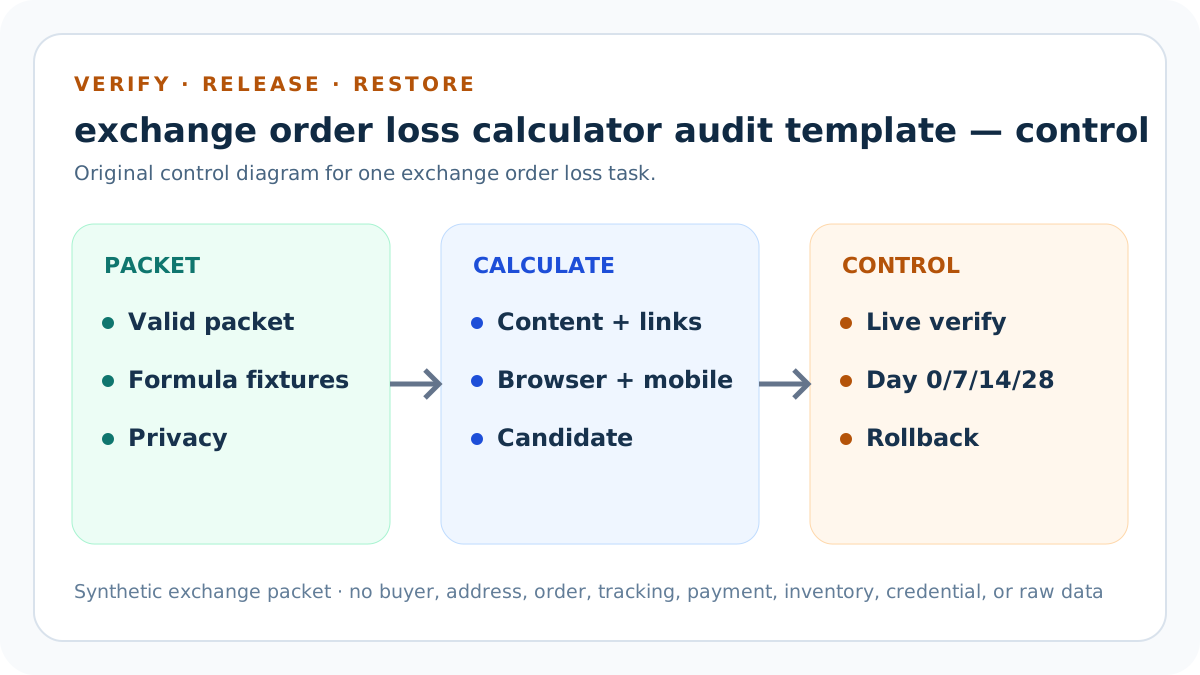
Identify the packet: verification drill
Recreate “Identify the packet” from a clean synthetic packet rather than copying the main example. Record alias, original order line, returned item, new item, quantities, variants, reason, currency, market, period, scope, and version. Change one driver, retain the other fields, calculate the before-and-after difference, and attach the source state and expected outcome to exchange audit packet.
Keep buyer and raw order identifiers in authorized systems. Drill 1 must include a supported case, a broken case, a late-evidence case, and a correction case. Explain why each path produces Block, Review, Ready, no recognized recovery, or a revised result for this specific a reviewable exchange calculation history.
Record source evidence: verification drill
Recreate “Record source evidence” from a clean synthetic packet rather than copying the main example. List order, cost, original shipping, fees, return shipping, new-item cost, second shipping, packaging, handling, payment, refund, and inventory pointers. Change one driver, retain the other fields, calculate the before-and-after difference, and attach the source state and expected outcome to exchange audit packet.
Include source timestamp, state, owner, and retention rule. Drill 2 must include a supported case, a broken case, a late-evidence case, and a correction case. Explain why each path produces Block, Review, Ready, no recognized recovery, or a revised result for this specific a reviewable exchange calculation history.
Record authority: verification drill
Recreate “Record authority” from a clean synthetic packet rather than copying the main example. Name policy, promise, rights, payment, refund, inventory, and fulfillment decision owners. Change one driver, retain the other fields, calculate the before-and-after difference, and attach the source state and expected outcome to exchange audit packet.
State what the calculator is explicitly not allowed to decide. Drill 3 must include a supported case, a broken case, a late-evidence case, and a correction case. Explain why each path produces Block, Review, Ready, no recognized recovery, or a revised result for this specific a reviewable exchange calculation history.
Record formula fixtures: verification drill
Recreate “Record formula fixtures” from a clean synthetic packet rather than copying the main example. Store default size, higher-cost product, collected-payment, negative-contribution, and invalid-packet cases. Change one driver, retain the other fields, calculate the before-and-after difference, and attach the source state and expected outcome to exchange audit packet.
Keep full-precision inputs and expected outputs. Drill 4 must include a supported case, a broken case, a late-evidence case, and a correction case. Explain why each path produces Block, Review, Ready, no recognized recovery, or a revised result for this specific a reviewable exchange calculation history.
Sources and further reading
- Seller Profit Guard methodology: Exchange-packet grain, contribution calculation, evidence versions, privacy, correction, release, and rollback.
- Seller Profit Guard data privacy: Local-first boundaries for buyer, address, message, order, tracking, label, payment, refund, inventory, credential, and raw-record data.
- Etsy Help: Set Return Policies on Listings: Official physical-listing return and exchange policy context.
- Shopify Help: Creating and processing returns and exchanges: Official returned-item, exchange-item, partial-processing, balance, payment, refund, inventory, release, and fulfillment context.
- Shopify Help: Returns and exchanges: Official distinction between refunds, returns, and alternative-item exchanges.
- Shopify Help: Return and cancellation rules: Official return-window, fee, market, product, and policy-version context.
Related Seller Profit Guard tools
- Exchange Order Loss Calculator: Run the browser-local original-contribution, exchange-cost, recovery, and target calculation.
- Refund vs Replacement Calculator: Compare two remedy paths before a specific exchange packet is committed.
- Return Shipping Cost Calculator: Allocate reverse-logistics responsibility cost across comparable outbound orders.
- Restocking Decision Calculator: Evaluate returned-inventory recovery after receipt and condition review.
- Methodology: Review evidence, privacy, calculation, correction, release, and rollback.
- Data Privacy: Protect buyer, order, tracking, label, payment, refund, inventory, and credential data.
- Exchange Order Loss Formula and Inputs: Continue with a distinct formula, example, scenario, error, source, threshold, comparison, routine, interpretation, or audit task.
- Size Exchange Loss Worked Example: Continue with a distinct formula, example, scenario, error, source, threshold, comparison, routine, interpretation, or audit task.
- Product Exchange Cost Scenario: Continue with a distinct formula, example, scenario, error, source, threshold, comparison, routine, interpretation, or audit task.
- Exchange Order Loss Calculation Mistakes: Continue with a distinct formula, example, scenario, error, source, threshold, comparison, routine, interpretation, or audit task.
- Exchange Order Loss Data Sources: Continue with a distinct formula, example, scenario, error, source, threshold, comparison, routine, interpretation, or audit task.
Next step: Open the Exchange Order Loss Calculator.
This is operational planning help, not tax, accounting, legal, financial, or platform-policy advice. Review the Terms and disclaimer, and verify current platform rules and fee assumptions before changing prices.