The exact inputs for an Etsy production partner disclosure review
Last updated: 2026-07-30
Written and reviewed by Seller Profit Guard Editorial Team.
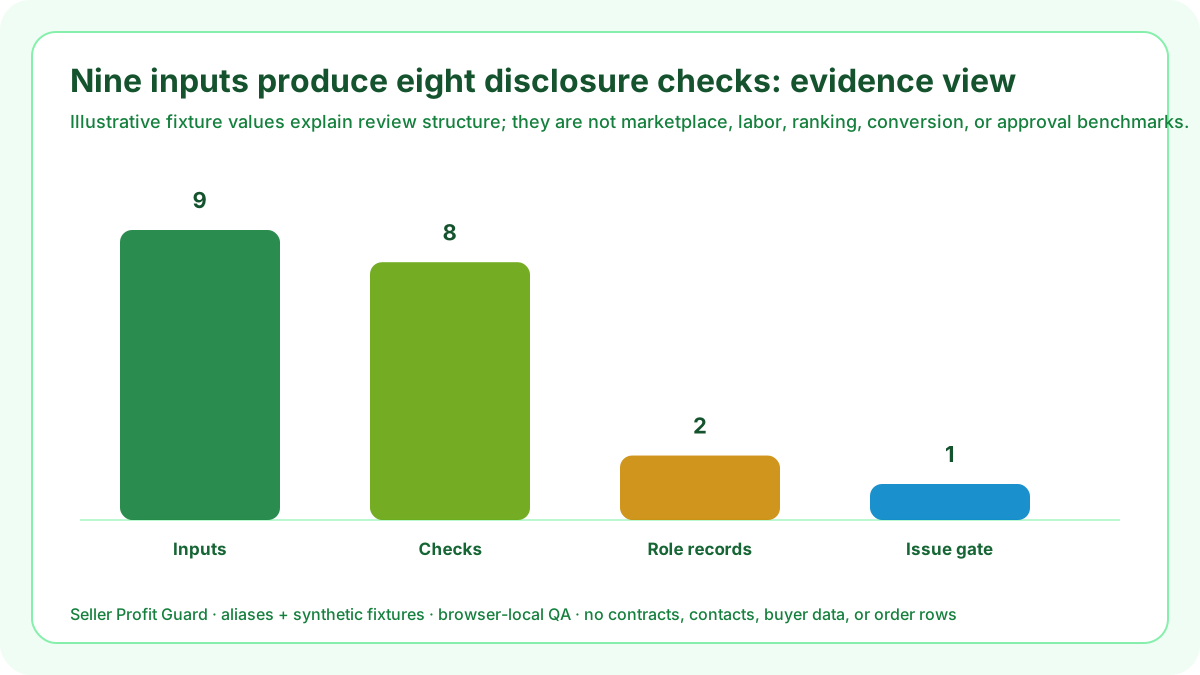
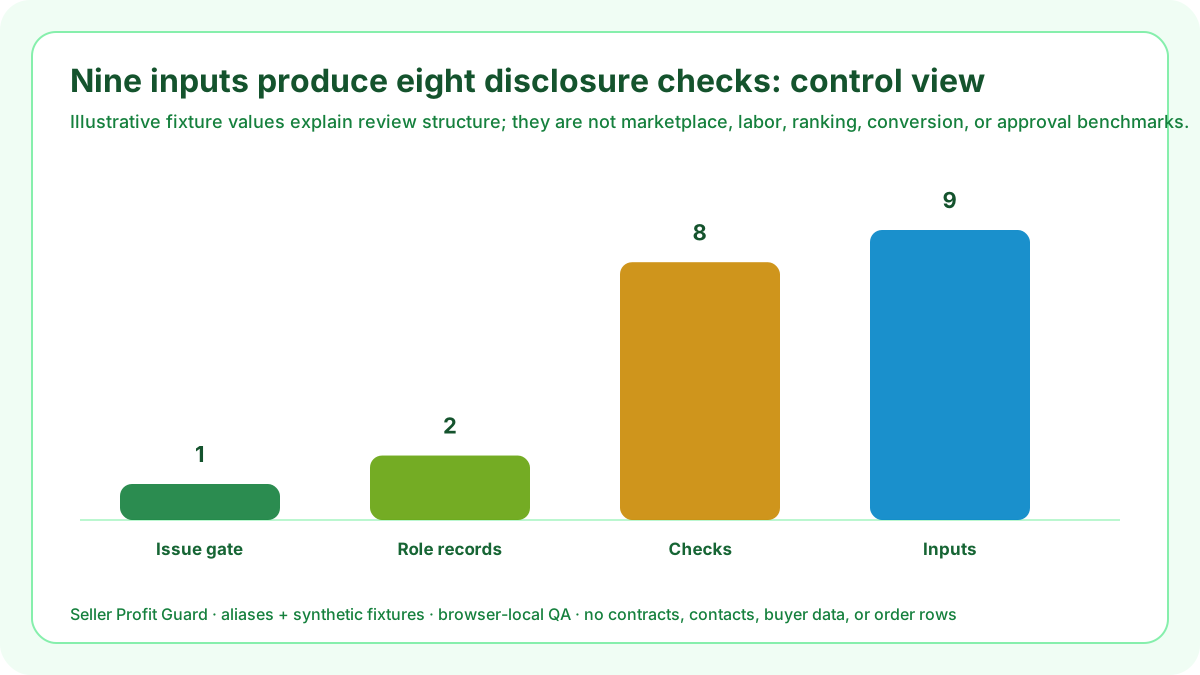
Record the applicable item and creativity path, the seller's original contribution, the outside partner's physical-production role, buyer-visible title or name and location, public relationship description, every linked or excluded listing alias, actual dispatch origin, known conflicts, and dated source evidence. Eight non-compensating checks return Ready, Revise, Hold, or Block.

disclosure input contract: scope and decision
A production-partner review starts with the item and actual work, not with a partner name typed into a profile. Freeze the seller-controlled design, product specification, physical-production transformation, approved sample, relevant listing set, public partner record, About-section presentation, dispatch origin, reviewer, and date before scoring completeness.
Classification and disclosure are separate questions. First determine whether the outside business physically produces an eligible seller-designed or buyer-personalized item. Then test whether the current public and operational records represent that relationship accurately. Polished disclosure cannot turn a supplier, wholesaler, retailer, or white-label source into a qualifying partner.
Build the production responsibility register before analysis
The register uses internal aliases, public profile text, and dated observations. It excludes private contracts, direct partner contacts, bank and tax records, buyer identities, addresses, orders, receipts, payment data, credentials, tokens, OAuth material, and raw CSV rows. Sensitive evidence stays in its controlled source system.
Known missing, inaccurate, stale, contradictory, or non-qualifying records have Block precedence. A current location note cannot compensate for an unlinked listing; a good relationship description cannot compensate for wholesale resale; and a complete profile cannot compensate for a wrong dispatch origin.
Input 1: item and creativity path
State the physical item, seller-designed original or buyer-personalized sourced contribution, and outside production step. Supplies, vintage, items physically made by the seller or shop team, digital downloads, and unrelated products do not use this production-partner path.
Inside the production responsibility register, preserve the entered claim, accountable source, source version, owner, reviewer, and date for “Input 1: item and creativity path.” Run original botanical tote printed on demand and the crossed failure generic wholesale tote with a vague helper; the expected output is a traceable eight-check disclosure decision. Resolve a mismatch at the design, product, production, profile, listing, or fulfillment source instead of weakening the rule or importing private evidence.
Input 2: seller creative contribution
Identify the original illustration, pattern, drawing, specification, customization method, sample approval, or other seller-controlled work. Record version and owner so the statement is more than an unsupported claim of authorship.
Inside the production responsibility register, preserve the entered claim, accountable source, source version, owner, reviewer, and date for “Input 2: seller creative contribution.” Run original botanical tote printed on demand and the crossed failure generic wholesale tote with a vague helper; the expected output is a traceable eight-check disclosure decision. Resolve a mismatch at the design, product, production, profile, listing, or fulfillment source instead of weakening the rule or importing private evidence.
Input 3: partner physical-production role
Name what the outside business transforms and delivers: printing, sewing, casting, machining, binding, engraving, embroidery, fabrication, quality control, packing, or dispatch. The seller, a shop member, a pet, a material supplier, a limited-assistance provider, a white-label manufacturer, or an OEM is not converted into a production partner by this field.
Inside the production responsibility register, preserve the entered claim, accountable source, source version, owner, reviewer, and date for “Input 3: partner physical-production role.” Run original botanical tote printed on demand and the crossed failure generic wholesale tote with a vague helper; the expected output is a traceable eight-check disclosure decision. Resolve a mismatch at the design, product, production, profile, listing, or fulfillment source instead of weakening the rule or importing private evidence.
Input 4: public identity and location
Record the exact buyer-visible partner name or descriptive title plus current city and wider location. A role such as Apparel printer communicates more than Partner A, while a vague Factory entry lacks both responsibility and place.
Inside the production responsibility register, preserve the entered claim, accountable source, source version, owner, reviewer, and date for “Input 4: public identity and location.” Run original botanical tote printed on demand and the crossed failure generic wholesale tote with a vague helper; the expected output is a traceable eight-check disclosure decision. Resolve a mismatch at the design, product, production, profile, listing, or fulfillment source instead of weakening the rule or importing private evidence.
Input 5: public relationship description
Explain what the seller creates or approves and what the partner physically does. The description should be accurate enough for a buyer to understand the division of work without implying seller hand-making where outside production occurs.
Inside the production responsibility register, preserve the entered claim, accountable source, source version, owner, reviewer, and date for “Input 5: public relationship description.” Run original botanical tote printed on demand and the crossed failure generic wholesale tote with a vague helper; the expected output is a traceable eight-check disclosure decision. Resolve a mismatch at the design, product, production, profile, listing, or fulfillment source instead of weakening the rule or importing private evidence.

Input 6: listing association register
List every relevant product alias and mark it linked, not applicable, or assigned to another partner. Include at least one linked physical listing and explicit exclusions; do not attach a partner shop-wide merely to eliminate review work.
Inside the production responsibility register, preserve the entered claim, accountable source, source version, owner, reviewer, and date for “Input 6: listing association register.” Run original botanical tote printed on demand and the crossed failure generic wholesale tote with a vague helper; the expected output is a traceable eight-check disclosure decision. Resolve a mismatch at the design, product, production, profile, listing, or fulfillment source instead of weakening the rule or importing private evidence.
Input 7: production and dispatch origin
Record where production, packing, and parcel dispatch happen and compare that record with listing and delivery-profile origin. Seller business location, return address, production site, warehouse, and actual shipping origin may differ.
Inside the production responsibility register, preserve the entered claim, accountable source, source version, owner, reviewer, and date for “Input 7: production and dispatch origin.” Run original botanical tote printed on demand and the crossed failure generic wholesale tote with a vague helper; the expected output is a traceable eight-check disclosure decision. Resolve a mismatch at the design, product, production, profile, listing, or fulfillment source instead of weakening the rule or importing private evidence.
Inputs 8 and 9: issues and evidence
List every unresolved role, location, listing, description, or origin conflict and cite the original design, product specification, partner role record, current profile, About section, listing set, shipping settings, reviewer, and review date.
Inside the production responsibility register, preserve the entered claim, accountable source, source version, owner, reviewer, and date for “Inputs 8 and 9: issues and evidence.” Run original botanical tote printed on demand and the crossed failure generic wholesale tote with a vague helper; the expected output is a traceable eight-check disclosure decision. Resolve a mismatch at the design, product, production, profile, listing, or fulfillment source instead of weakening the rule or importing private evidence.
Verification, release, and rollback controls
Before changing public records, preserve the production responsibility register, design and product versions, partner profile, relationship copy, internal answers, listing associations, About presentation, production and dispatch locations, shipping profiles, fixtures, approval, and rollback identifier. Confirm the correct account and target. Safe-stop on login or CAPTCHA ambiguity, a platform warning, wrong profile, missing target context, private data, or unexpected editor state.
After one bounded release, verify original botanical tote printed on demand on mobile and desktop and deliberately revisit generic wholesale tote with a vague helper. Inspect the applicable listings, About section, partner profile, and origin settings. Restore the approved prior state when a critical path does not support a traceable eight-check disclosure decision. Search and conversion signals are later measurements, not release proof.
Limits, privacy boundary, and next action
This guide and checker use seller-entered summaries, internal aliases, and synthetic fixtures. They do not retrieve Etsy data, inspect protected designs or contracts, audit a facility, approve a partner, determine originality or eligibility, certify law or policy compliance, or predict ranking, clicks, conversion, sales, refunds, delivery, income, or AdSense approval. Seller Profit Guard is independent and unaffiliated with Etsy and provides operational QA rather than legal, labor, tax, customs, intellectual-property, accounting, privacy, fulfillment, search, or marketplace advice.
Keep private contracts, partner contacts, negotiated prices, bank and tax records, buyer names, emails, addresses, messages, order IDs, receipts, payment details, credentials, OAuth data, and raw CSV rows outside the production responsibility register. The next action is to repair the named source, rerun complete and crossed fixtures, release only the approved set, inspect public and seller paths, and record whether a traceable eight-check disclosure decision was verified or rolled back.
Sources and further reading
- Etsy Help: Working with Production Partners: Current partner definition, qualifying designed and buyer-personalized sourced paths, exclusions, profile fields, listing association, public description, location, About-section display, and shipping-origin guidance.
- Etsy Creativity Standards: Current made, designed, handpicked, and sourced item paths plus seller-design and production-partner disclosure boundaries.
- Etsy Seller Policy: Seller Policy effective July 9, 2026: accurately represent how, by whom, and where an item is made and dispatched and disclose partners on relevant listings.
- Etsy Listing Image Requirements: Current finished-product image rules for seller-designed products, printed designs, and buyer-personalized items made with production partners.
- Etsy ethical expectations for production partners: Current seller due-diligence expectations and Etsy's stated boundary that it does not audit or approve production partners.
- Etsy Help: How to Create a Listing: Current listing workflow and applicable production-partner association requirement.
- Seller Profit Guard methodology: Evidence hierarchy, privacy boundary, deterministic fixtures, uncertainty, bounded release, public feedback, and recovery.
Related Seller Profit Guard tools
- Open the Etsy Production Partner Disclosure Checker: Review item path, seller contribution, partner role, public profile, listing links, dispatch origin, issues, and evidence.
- Check Etsy category fit: Keep category and item-format review separate from production disclosure.
- Check Etsy description clarity: Reconcile buyer-facing product claims with the approved production record.
- Check Etsy photo coverage: Review actual-product and production-partner image boundaries independently.
- Check Etsy personalization instructions: Keep buyer-entered customization separate from seller and partner responsibilities.
- Read the local-first methodology: Use aliases, synthetic fixtures, evidence versions, public verification, and rollback.
- Etsy POD Production Partner Example: Continue the role, evidence, scenario, decision, operating, interpretation, or audit workflow.
- Etsy Specialist Fabrication Partner Example: Continue the role, evidence, scenario, decision, operating, interpretation, or audit workflow.
- 13 Etsy Production Partner Disclosure Mistakes: Continue the role, evidence, scenario, decision, operating, interpretation, or audit workflow.
- Evidence Sources for Etsy Production Partners: Continue the role, evidence, scenario, decision, operating, interpretation, or audit workflow.
- Etsy Production Partner: Ready to Block: Continue the role, evidence, scenario, decision, operating, interpretation, or audit workflow.
Next step: Open the Etsy Production Partner Disclosure Checker.
This is operational planning help, not tax, accounting, legal, financial, or platform-policy advice. Review the Terms and disclaimer, and verify current platform rules and fee assumptions before changing prices.