What does missing SKU cost coverage mean?
Last updated: 2026-07-31
Written and reviewed by Seller Profit Guard Editorial Team.
Exact coverage shows how many entered synthetic sold lines reached one current cost record under the declared mapping. Missing means none was found, ambiguous means several remain plausible, and stale means only expired evidence was found. None of these statuses proves actual unit cost, profit, accounting treatment, or tax treatment.
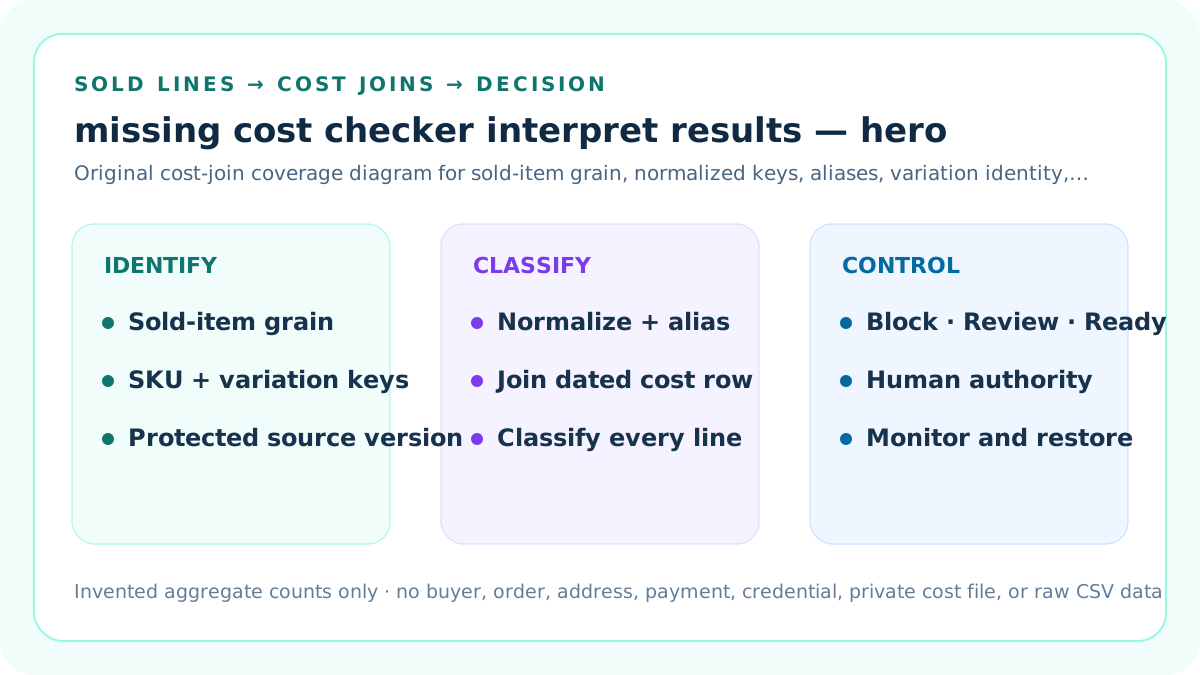
100% exact coverage
Every entered line reaches one current record. The interpretation ladder records sold-item grain, normalized SKU, listing and variation keys, alias version, cost effective window, currency, source fingerprint, exact, missing, ambiguous and stale counts, threshold, owner, reviewer, exception, and prior accepted value needed for a bounded next action.
At checkpoint 1, reperform the clean packet and one intent-specific failure. Explain whether the evidence supports Ready, Review, or Block and identify the key, source, date, currency, privacy, correction, monitoring, or restoration conclusion still outside the public worksheet.
Missing
No usable record exists. The interpretation ladder records sold-item grain, normalized SKU, listing and variation keys, alias version, cost effective window, currency, source fingerprint, exact, missing, ambiguous and stale counts, threshold, owner, reviewer, exception, and prior accepted value needed for a bounded next action.
At checkpoint 2, reperform the clean packet and one intent-specific failure. Explain whether the evidence supports Ready, Review, or Block and identify the key, source, date, currency, privacy, correction, monitoring, or restoration conclusion still outside the public worksheet.
Ambiguous
Multiple records remain plausible. The interpretation ladder records sold-item grain, normalized SKU, listing and variation keys, alias version, cost effective window, currency, source fingerprint, exact, missing, ambiguous and stale counts, threshold, owner, reviewer, exception, and prior accepted value needed for a bounded next action.
At checkpoint 3, reperform the clean packet and one intent-specific failure. Explain whether the evidence supports Ready, Review, or Block and identify the key, source, date, currency, privacy, correction, monitoring, or restoration conclusion still outside the public worksheet.
Stale
Only expired evidence matches. The interpretation ladder records sold-item grain, normalized SKU, listing and variation keys, alias version, cost effective window, currency, source fingerprint, exact, missing, ambiguous and stale counts, threshold, owner, reviewer, exception, and prior accepted value needed for a bounded next action.
At checkpoint 4, reperform the clean packet and one intent-specific failure. Explain whether the evidence supports Ready, Review, or Block and identify the key, source, date, currency, privacy, correction, monitoring, or restoration conclusion still outside the public worksheet.
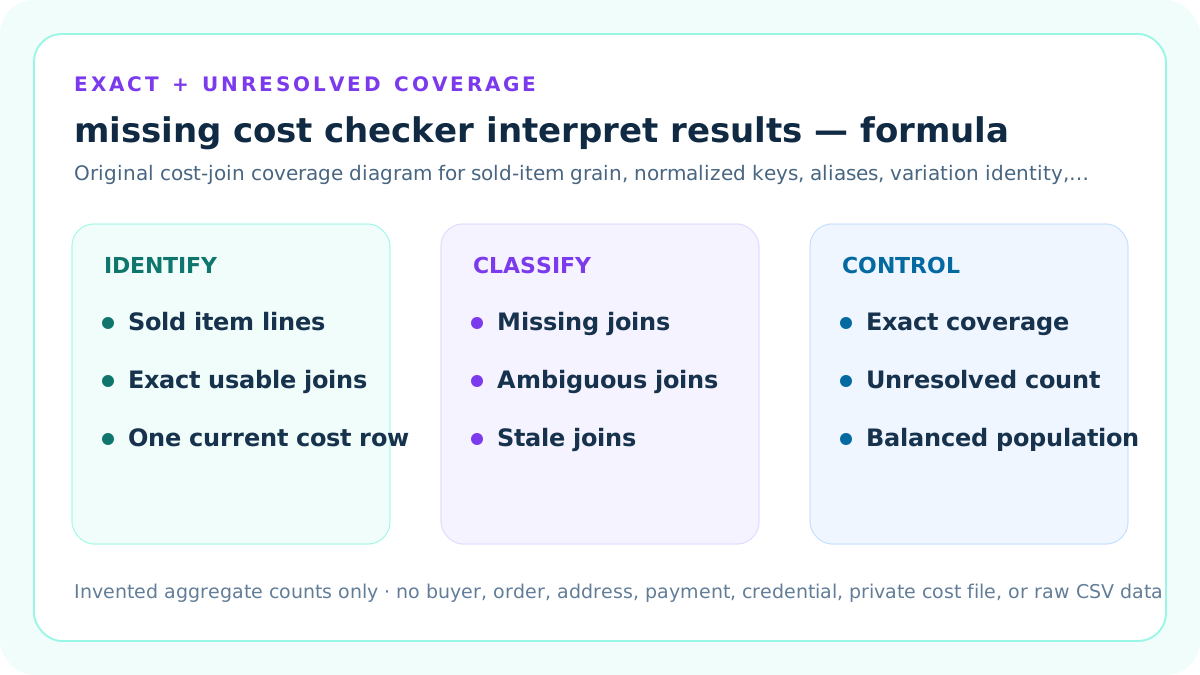
Unbalanced counts
Population control failed. The interpretation ladder records sold-item grain, normalized SKU, listing and variation keys, alias version, cost effective window, currency, source fingerprint, exact, missing, ambiguous and stale counts, threshold, owner, reviewer, exception, and prior accepted value needed for a bounded next action.
At checkpoint 5, reperform the clean packet and one intent-specific failure. Explain whether the evidence supports Ready, Review, or Block and identify the key, source, date, currency, privacy, correction, monitoring, or restoration conclusion still outside the public worksheet.
Within threshold
Temporary policy permits the gap. The interpretation ladder records sold-item grain, normalized SKU, listing and variation keys, alias version, cost effective window, currency, source fingerprint, exact, missing, ambiguous and stale counts, threshold, owner, reviewer, exception, and prior accepted value needed for a bounded next action.
At checkpoint 6, reperform the clean packet and one intent-specific failure. Explain whether the evidence supports Ready, Review, or Block and identify the key, source, date, currency, privacy, correction, monitoring, or restoration conclusion still outside the public worksheet.
Repeated gap
Escalate the mapping source. The interpretation ladder records sold-item grain, normalized SKU, listing and variation keys, alias version, cost effective window, currency, source fingerprint, exact, missing, ambiguous and stale counts, threshold, owner, reviewer, exception, and prior accepted value needed for a bounded next action.
At checkpoint 7, reperform the clean packet and one intent-specific failure. Explain whether the evidence supports Ready, Review, or Block and identify the key, source, date, currency, privacy, correction, monitoring, or restoration conclusion still outside the public worksheet.
Coverage decline
Check schema and alias drift. The interpretation ladder records sold-item grain, normalized SKU, listing and variation keys, alias version, cost effective window, currency, source fingerprint, exact, missing, ambiguous and stale counts, threshold, owner, reviewer, exception, and prior accepted value needed for a bounded next action.
At checkpoint 8, reperform the clean packet and one intent-specific failure. Explain whether the evidence supports Ready, Review, or Block and identify the key, source, date, currency, privacy, correction, monitoring, or restoration conclusion still outside the public worksheet.
Coverage increase
Verify it was not forced by fallback. The interpretation ladder records sold-item grain, normalized SKU, listing and variation keys, alias version, cost effective window, currency, source fingerprint, exact, missing, ambiguous and stale counts, threshold, owner, reviewer, exception, and prior accepted value needed for a bounded next action.
At checkpoint 9, reperform the clean packet and one intent-specific failure. Explain whether the evidence supports Ready, Review, or Block and identify the key, source, date, currency, privacy, correction, monitoring, or restoration conclusion still outside the public worksheet.
Ready
Clear the synthetic join packet only. The interpretation ladder records sold-item grain, normalized SKU, listing and variation keys, alias version, cost effective window, currency, source fingerprint, exact, missing, ambiguous and stale counts, threshold, owner, reviewer, exception, and prior accepted value needed for a bounded next action.
At checkpoint 10, reperform the clean packet and one intent-specific failure. Explain whether the evidence supports Ready, Review, or Block and identify the key, source, date, currency, privacy, correction, monitoring, or restoration conclusion still outside the public worksheet.
Review
Repair unresolved reasons. The interpretation ladder records sold-item grain, normalized SKU, listing and variation keys, alias version, cost effective window, currency, source fingerprint, exact, missing, ambiguous and stale counts, threshold, owner, reviewer, exception, and prior accepted value needed for a bounded next action.
At checkpoint 11, reperform the clean packet and one intent-specific failure. Explain whether the evidence supports Ready, Review, or Block and identify the key, source, date, currency, privacy, correction, monitoring, or restoration conclusion still outside the public worksheet.
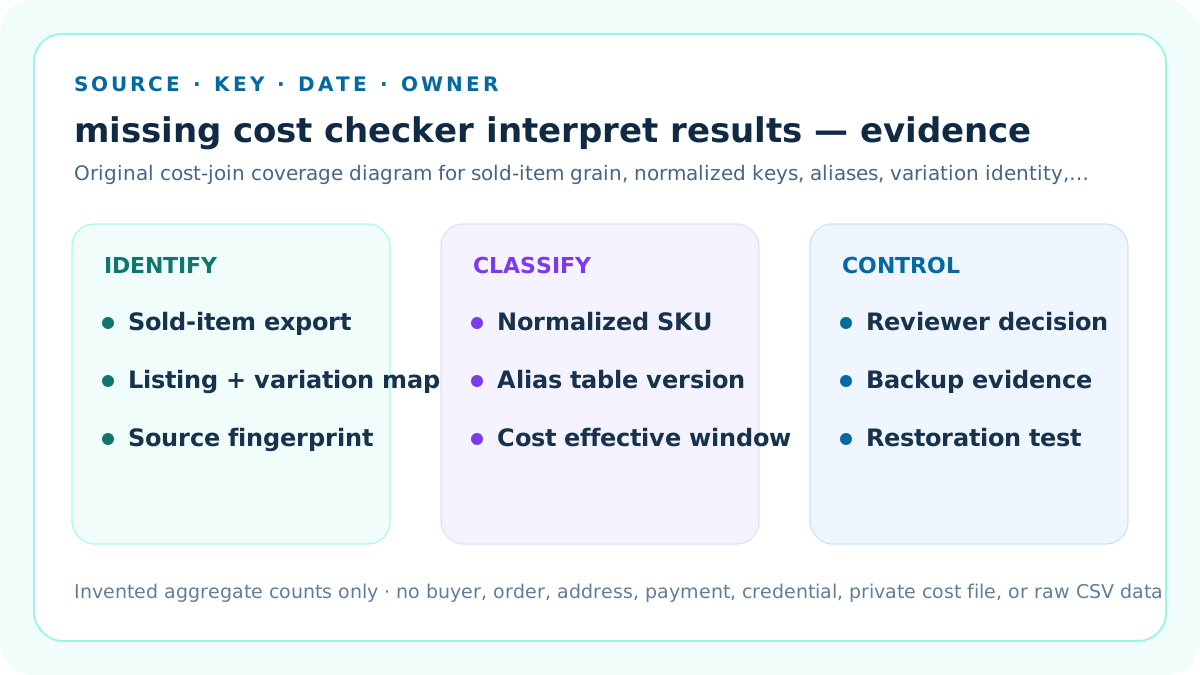
Block
Repair evidence structure first. The interpretation ladder records sold-item grain, normalized SKU, listing and variation keys, alias version, cost effective window, currency, source fingerprint, exact, missing, ambiguous and stale counts, threshold, owner, reviewer, exception, and prior accepted value needed for a bounded next action.
At checkpoint 12, reperform the clean packet and one intent-specific failure. Explain whether the evidence supports Ready, Review, or Block and identify the key, source, date, currency, privacy, correction, monitoring, or restoration conclusion still outside the public worksheet.
Interpret Missing Cost Joins Without False Precision: grain integrity control
Keep sold lines, listings, variations, aliases, and cost records aligned to one declared item-level population. Control 1 defines a pass condition, protected evidence pointer, reviewer question, correction deadline, rejected shortcut, monitoring signal, stop condition, and restoration trigger for a bounded next action.
Mixed row grains Block interpretation. Keep cost-join coverage separate from duplicate detection, payout reconciliation, contribution, accounting profit, inventory valuation, tax, legal analysis, and platform authority.
Interpret Missing Cost Joins Without False Precision: key integrity control
Version normalization and require one canonical identity without destructive string cleanup. Control 2 defines a pass condition, protected evidence pointer, reviewer question, correction deadline, rejected shortcut, monitoring signal, stop condition, and restoration trigger for a bounded next action.
A convenient text match is not evidence. Keep cost-join coverage separate from duplicate detection, payout reconciliation, contribution, accounting profit, inventory valuation, tax, legal analysis, and platform authority.
Interpret Missing Cost Joins Without False Precision: date and currency integrity control
Match alias and cost effective windows to the sold date and preserve cost currency explicitly. Control 3 defines a pass condition, protected evidence pointer, reviewer question, correction deadline, rejected shortcut, monitoring signal, stop condition, and restoration trigger for a bounded next action.
Current records cannot silently rewrite history. Keep cost-join coverage separate from duplicate detection, payout reconciliation, contribution, accounting profit, inventory valuation, tax, legal analysis, and platform authority.
Interpret Missing Cost Joins Without False Precision: privacy and minimization control
Use invented aggregate counts publicly while operational orders, buyers, addresses, payments, costs, credentials, and raw exports stay protected. Control 4 defines a pass condition, protected evidence pointer, reviewer question, correction deadline, rejected shortcut, monitoring signal, stop condition, and restoration trigger for a bounded next action.
Never echo private records. Keep cost-join coverage separate from duplicate detection, payout reconciliation, contribution, accounting profit, inventory valuation, tax, legal analysis, and platform authority.
Interpret Missing Cost Joins Without False Precision: human authority control
Require mapping owner, cost owner, independent reviewer, correction approver, monitoring owner, stop authority, and restoration owner. Control 5 defines a pass condition, protected evidence pointer, reviewer question, correction deadline, rejected shortcut, monitoring signal, stop condition, and restoration trigger for a bounded next action.
Ready cannot overwrite source data. Keep cost-join coverage separate from duplicate detection, payout reconciliation, contribution, accounting profit, inventory valuation, tax, legal analysis, and platform authority.
Interpret Missing Cost Joins Without False Precision: backup and restoration control
Preserve exports, key versions, aliases, variation maps, cost rows, classifications, exceptions, and tested recovery. Control 6 defines a pass condition, protected evidence pointer, reviewer question, correction deadline, rejected shortcut, monitoring signal, stop condition, and restoration trigger for a bounded next action.
Rollback evidence is mandatory. Keep cost-join coverage separate from duplicate detection, payout reconciliation, contribution, accounting profit, inventory valuation, tax, legal analysis, and platform authority.
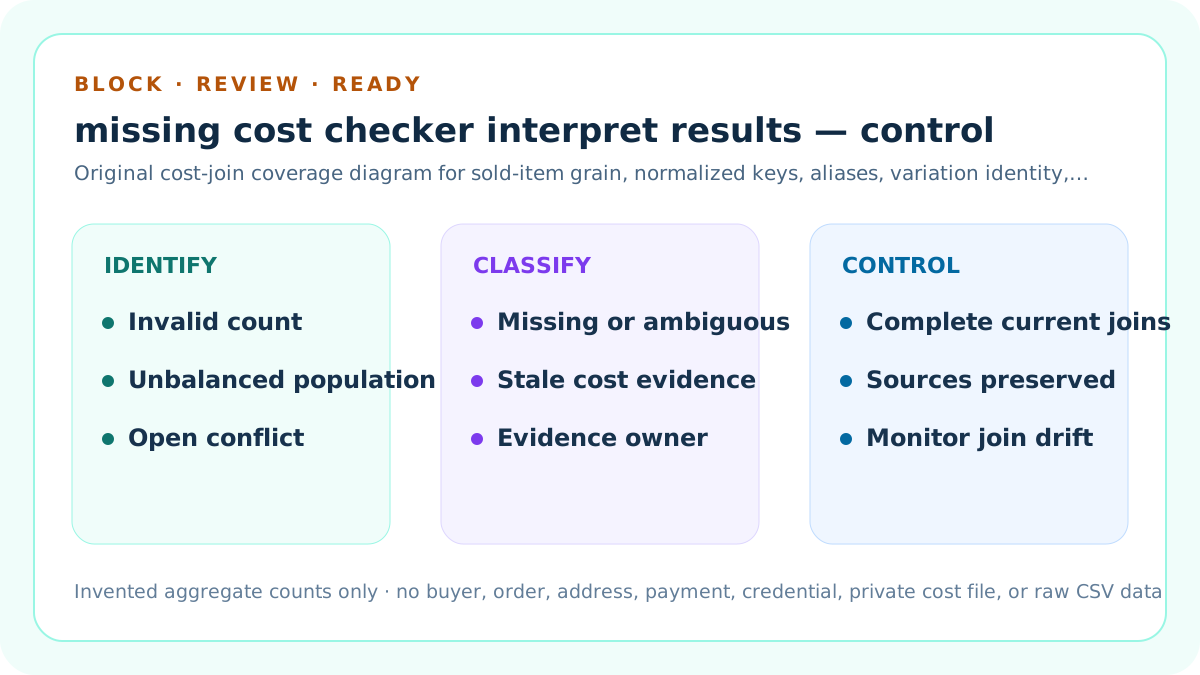
Interpret Missing Cost Joins Without False Precision: versioned governance control
Record a nonfuture source-review date covering the evidence month, policy-effective date, per-packet cost-effective and sold dates, oldest usable cost age, minimum evidence duration, maximum sold-line bound, nine required confirmations, and distinct renamed-SKU versus variation packets. Control 7 defines a pass condition, protected evidence pointer, reviewer question, correction deadline, rejected shortcut, monitoring signal, stop condition, and restoration trigger for a bounded next action.
Invalid controls mask derived outputs. Keep cost-join coverage separate from duplicate detection, payout reconciliation, contribution, accounting profit, inventory valuation, tax, legal analysis, and platform authority.
100% exact coverage: cost-join lab 1
Reperform both synthetic packets. Every entered line reaches one current record. Change one sold-line count, normalized SKU rule, alias, listing key, variation key, cost record, effective date, currency, source version, threshold, context, or conflict only; preserve all other values and record exact coverage, unresolved count, reason mix, and decision.
Use invented counts and labels only. Test clean, boundary, missing, ambiguous, stale, unbalanced, reused-SKU, overlapping-date, malformed, and open-conflict states, then state the protected evidence, named authority, downstream quarantine, monitoring signal, and restoration action required before changing a mapping.
Missing: cost-join lab 2
Reperform both synthetic packets. No usable record exists. Change one sold-line count, normalized SKU rule, alias, listing key, variation key, cost record, effective date, currency, source version, threshold, context, or conflict only; preserve all other values and record exact coverage, unresolved count, reason mix, and decision.
Use invented counts and labels only. Test clean, boundary, missing, ambiguous, stale, unbalanced, reused-SKU, overlapping-date, malformed, and open-conflict states, then state the protected evidence, named authority, downstream quarantine, monitoring signal, and restoration action required before changing a mapping.
Ambiguous: cost-join lab 3
Reperform both synthetic packets. Multiple records remain plausible. Change one sold-line count, normalized SKU rule, alias, listing key, variation key, cost record, effective date, currency, source version, threshold, context, or conflict only; preserve all other values and record exact coverage, unresolved count, reason mix, and decision.
Use invented counts and labels only. Test clean, boundary, missing, ambiguous, stale, unbalanced, reused-SKU, overlapping-date, malformed, and open-conflict states, then state the protected evidence, named authority, downstream quarantine, monitoring signal, and restoration action required before changing a mapping.
Stale: cost-join lab 4
Reperform both synthetic packets. Only expired evidence matches. Change one sold-line count, normalized SKU rule, alias, listing key, variation key, cost record, effective date, currency, source version, threshold, context, or conflict only; preserve all other values and record exact coverage, unresolved count, reason mix, and decision.
Use invented counts and labels only. Test clean, boundary, missing, ambiguous, stale, unbalanced, reused-SKU, overlapping-date, malformed, and open-conflict states, then state the protected evidence, named authority, downstream quarantine, monitoring signal, and restoration action required before changing a mapping.
Unbalanced counts: cost-join lab 5
Reperform both synthetic packets. Population control failed. Change one sold-line count, normalized SKU rule, alias, listing key, variation key, cost record, effective date, currency, source version, threshold, context, or conflict only; preserve all other values and record exact coverage, unresolved count, reason mix, and decision.
Use invented counts and labels only. Test clean, boundary, missing, ambiguous, stale, unbalanced, reused-SKU, overlapping-date, malformed, and open-conflict states, then state the protected evidence, named authority, downstream quarantine, monitoring signal, and restoration action required before changing a mapping.
Within threshold: cost-join lab 6
Reperform both synthetic packets. Temporary policy permits the gap. Change one sold-line count, normalized SKU rule, alias, listing key, variation key, cost record, effective date, currency, source version, threshold, context, or conflict only; preserve all other values and record exact coverage, unresolved count, reason mix, and decision.
Use invented counts and labels only. Test clean, boundary, missing, ambiguous, stale, unbalanced, reused-SKU, overlapping-date, malformed, and open-conflict states, then state the protected evidence, named authority, downstream quarantine, monitoring signal, and restoration action required before changing a mapping.
Repeated gap: cost-join lab 7
Reperform both synthetic packets. Escalate the mapping source. Change one sold-line count, normalized SKU rule, alias, listing key, variation key, cost record, effective date, currency, source version, threshold, context, or conflict only; preserve all other values and record exact coverage, unresolved count, reason mix, and decision.
Use invented counts and labels only. Test clean, boundary, missing, ambiguous, stale, unbalanced, reused-SKU, overlapping-date, malformed, and open-conflict states, then state the protected evidence, named authority, downstream quarantine, monitoring signal, and restoration action required before changing a mapping.
Coverage decline: cost-join lab 8
Reperform both synthetic packets. Check schema and alias drift. Change one sold-line count, normalized SKU rule, alias, listing key, variation key, cost record, effective date, currency, source version, threshold, context, or conflict only; preserve all other values and record exact coverage, unresolved count, reason mix, and decision.
Use invented counts and labels only. Test clean, boundary, missing, ambiguous, stale, unbalanced, reused-SKU, overlapping-date, malformed, and open-conflict states, then state the protected evidence, named authority, downstream quarantine, monitoring signal, and restoration action required before changing a mapping.
Coverage increase: cost-join lab 9
Reperform both synthetic packets. Verify it was not forced by fallback. Change one sold-line count, normalized SKU rule, alias, listing key, variation key, cost record, effective date, currency, source version, threshold, context, or conflict only; preserve all other values and record exact coverage, unresolved count, reason mix, and decision.
Use invented counts and labels only. Test clean, boundary, missing, ambiguous, stale, unbalanced, reused-SKU, overlapping-date, malformed, and open-conflict states, then state the protected evidence, named authority, downstream quarantine, monitoring signal, and restoration action required before changing a mapping.
Ready: cost-join lab 10
Reperform both synthetic packets. Clear the synthetic join packet only. Change one sold-line count, normalized SKU rule, alias, listing key, variation key, cost record, effective date, currency, source version, threshold, context, or conflict only; preserve all other values and record exact coverage, unresolved count, reason mix, and decision.
Use invented counts and labels only. Test clean, boundary, missing, ambiguous, stale, unbalanced, reused-SKU, overlapping-date, malformed, and open-conflict states, then state the protected evidence, named authority, downstream quarantine, monitoring signal, and restoration action required before changing a mapping.
Review: cost-join lab 11
Reperform both synthetic packets. Repair unresolved reasons. Change one sold-line count, normalized SKU rule, alias, listing key, variation key, cost record, effective date, currency, source version, threshold, context, or conflict only; preserve all other values and record exact coverage, unresolved count, reason mix, and decision.
Use invented counts and labels only. Test clean, boundary, missing, ambiguous, stale, unbalanced, reused-SKU, overlapping-date, malformed, and open-conflict states, then state the protected evidence, named authority, downstream quarantine, monitoring signal, and restoration action required before changing a mapping.
Block: cost-join lab 12
Reperform both synthetic packets. Repair evidence structure first. Change one sold-line count, normalized SKU rule, alias, listing key, variation key, cost record, effective date, currency, source version, threshold, context, or conflict only; preserve all other values and record exact coverage, unresolved count, reason mix, and decision.
Use invented counts and labels only. Test clean, boundary, missing, ambiguous, stale, unbalanced, reused-SKU, overlapping-date, malformed, and open-conflict states, then state the protected evidence, named authority, downstream quarantine, monitoring signal, and restoration action required before changing a mapping.
Interpret Missing Cost Joins Without False Precision: intent-specific implementation walkthrough
interpretation ladder checkpoint 1 addresses 100% exact coverage for a bounded next action. Every entered line reaches one current record. Record the accepted classification, rejected shortcut, evidence owner, reviewer challenge, correction boundary, follow-up date, monitoring trigger, and rollback reference.
interpretation ladder checkpoint 2 addresses missing for a bounded next action. No usable record exists. Record the accepted classification, rejected shortcut, evidence owner, reviewer challenge, correction boundary, follow-up date, monitoring trigger, and rollback reference.
interpretation ladder checkpoint 3 addresses ambiguous for a bounded next action. Multiple records remain plausible. Record the accepted classification, rejected shortcut, evidence owner, reviewer challenge, correction boundary, follow-up date, monitoring trigger, and rollback reference.
interpretation ladder checkpoint 4 addresses stale for a bounded next action. Only expired evidence matches. Record the accepted classification, rejected shortcut, evidence owner, reviewer challenge, correction boundary, follow-up date, monitoring trigger, and rollback reference.
interpretation ladder checkpoint 5 addresses unbalanced counts for a bounded next action. Population control failed. Record the accepted classification, rejected shortcut, evidence owner, reviewer challenge, correction boundary, follow-up date, monitoring trigger, and rollback reference.
interpretation ladder checkpoint 6 addresses within threshold for a bounded next action. Temporary policy permits the gap. Record the accepted classification, rejected shortcut, evidence owner, reviewer challenge, correction boundary, follow-up date, monitoring trigger, and rollback reference.
interpretation ladder checkpoint 7 addresses repeated gap for a bounded next action. Escalate the mapping source. Record the accepted classification, rejected shortcut, evidence owner, reviewer challenge, correction boundary, follow-up date, monitoring trigger, and rollback reference.
interpretation ladder checkpoint 8 addresses coverage decline for a bounded next action. Check schema and alias drift. Record the accepted classification, rejected shortcut, evidence owner, reviewer challenge, correction boundary, follow-up date, monitoring trigger, and rollback reference.
interpretation ladder checkpoint 9 addresses coverage increase for a bounded next action. Verify it was not forced by fallback. Record the accepted classification, rejected shortcut, evidence owner, reviewer challenge, correction boundary, follow-up date, monitoring trigger, and rollback reference.
interpretation ladder checkpoint 10 addresses ready for a bounded next action. Clear the synthetic join packet only. Record the accepted classification, rejected shortcut, evidence owner, reviewer challenge, correction boundary, follow-up date, monitoring trigger, and rollback reference.
interpretation ladder checkpoint 11 addresses review for a bounded next action. Repair unresolved reasons. Record the accepted classification, rejected shortcut, evidence owner, reviewer challenge, correction boundary, follow-up date, monitoring trigger, and rollback reference.
interpretation ladder checkpoint 12 addresses block for a bounded next action. Repair evidence structure first. Record the accepted classification, rejected shortcut, evidence owner, reviewer challenge, correction boundary, follow-up date, monitoring trigger, and rollback reference.
Evidence boundary for a bounded next action
The default renamed-SKU packet uses 120 invented sold lines and 120 exact joins. Its controlled failure uses 116 exact and four missing joins. The default variation packet uses 80 invented sold lines and 80 exact joins; its controlled failure uses 75 exact, three ambiguous, and two stale joins.
These invented counts demonstrate classification only. They cannot prove a production SKU mapping, actual unit cost, contribution, accounting profit, inventory value, tax treatment, source completeness, platform correctness, or authority to overwrite a library.
Release, monitor, and restore the interpretation ladder
Block invalid, negative, fractional, unbalanced, short-context, invalid-currency, invalid-period, weak-scope, privacy, or open-conflict packets. Review missing, ambiguous, or stale joins above the declared threshold. Ready clears only the entered synthetic coverage packet.
Before indexing or operational use, preserve backups and run type, unit, integration, build, content, similarity, SEO, image, link, privacy, mobile, deployment, and live checks; then monitor join drift without claiming search or financial causality.
Sources and further reading
- Etsy Help: Download sold transactions: Official sold-transaction export types and optional SKU coverage.
- Etsy Help: Download listing information: Official active-listing export and optional SKU coverage.
- Etsy Help: Use SKUs for inventory: Official SKU purpose, naming, variation, search, and duplicate-avoidance guidance.
- Shopify Help: Export orders: Official order CSV export and structure boundaries.
- Shopify Help: Product CSV files: Official product, variant, option, and SKU field semantics.
- W3C CSVW: Tabular Data Model: Standards-based primary-key and foreign-key reference model.
- Seller Profit Guard methodology: Evidence, correction, release, monitoring, and rollback controls.
- Seller Profit Guard data privacy: Synthetic public examples and protected operational-data boundaries.
Related Seller Profit Guard tools
- Missing SKU Cost Checker: Run the browser-local aggregate cost-join review.
- Seller CSV Column Mapper: Normalize synthetic headers before joining.
- Duplicate Order Checker: Separate repeated rows from legitimate line items.
- SKU Cost Library: Maintain browser-local planning costs separately.
- Weekly Profit Checklist: Operationalize cost-coverage exceptions.
- Methodology: Apply evidence and rollback controls.
- Data Privacy: Protect orders, buyers, cost files, and raw exports.
- Missing SKU Cost Formula and Input Contract: Define sold-item grain, normalized keys, dated cost records, exact, missing, ambiguous and stale joins, thresholds, and evidence.
- Missing SKU Cost Worked Example: Renamed SKU: Trace a legacy SKU through a dated alias to one canonical SKU and current cost record, including the failing no-alias case.
- Missing SKU Cost Checker for an Unmapped Variation: Use listing, option, variation and SKU evidence to resolve a child item without applying an unsafe parent-listing average cost.
- Missing SKU Cost Checker Mistakes and Corrections: Diagnose grain mismatches, blank SKUs, alias collisions, reused SKUs, stale costs, overlapping dates, currencies, and zero-cost fallbacks.
- Reliable Data Sources for Missing SKU Cost Checks: Map sold lines, listings, variations, SKUs, aliases, costs, dates and currencies to protected, versioned first-party evidence.
- Safe Thresholds for Missing and Ambiguous Cost Joins: Set zero-tolerance, operational, age, recurrence, materiality, source-confidence and stop controls without normalizing unknown costs.
- Renamed SKU vs Unmapped Variation Cost Joins: Compare alias resolution and variation resolution at the same sold-item grain and show why their evidence and repair owners differ.
- Weekly Missing SKU Cost Review Routine: Turn exports, schema checks, normalization, alias and variation review, cost dating, exceptions, approval, monitoring and restoration into a weekly control.
- Missing SKU Cost Audit Checklist and Change Log: Provide a standalone source, key, alias, variation, cost-date, classification, correction, approval, monitoring and restoration record.
Next step: Open Seller Profit Guard.
This is operational planning help, not tax, accounting, legal, financial, or platform-policy advice. Review the Terms and disclaimer, and verify current platform rules and fee assumptions before changing prices.