How to interpret Etsy attribute coverage without false precision
Last updated: 2026-07-29
Written and reviewed by Seller Profit Guard Editorial Team.
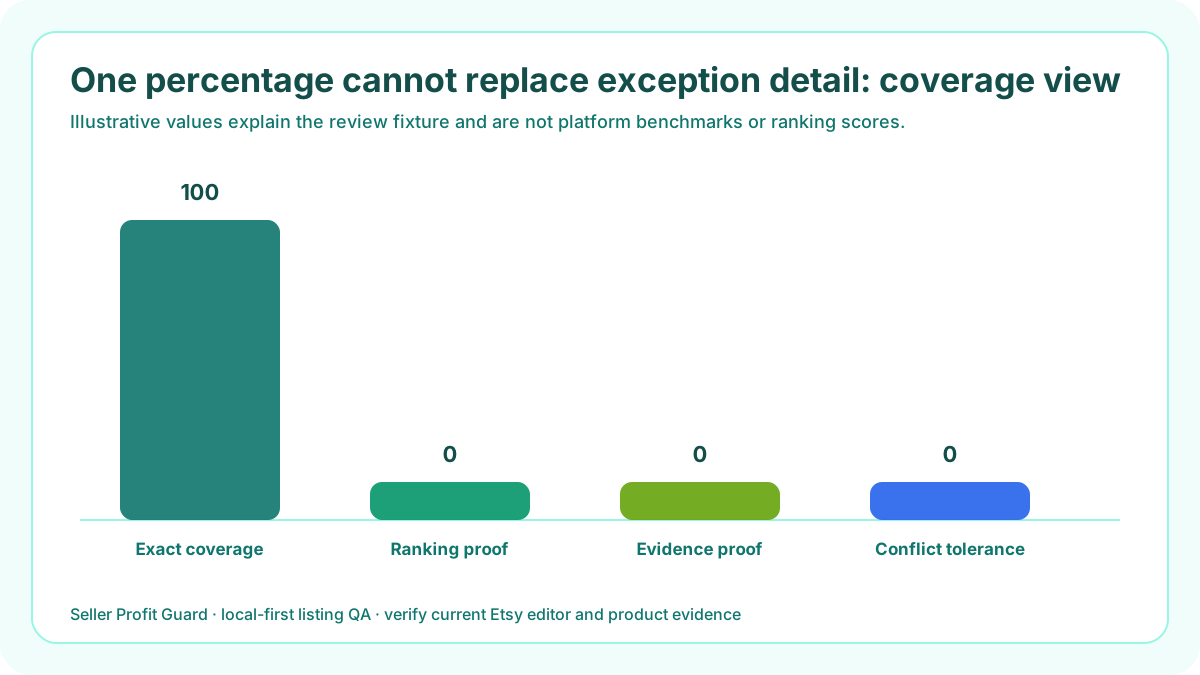
A 100% result means every declared relevant key has an exact selected-value match under the entered facts. It does not prove the category is optimal, evidence is true, every buyer term is visible, the listing will rank, or sales will improve. Read missing, conflict, unsupported, and variation warnings alongside the percentage.

What question does this reported output interpretation boundary answer?
A 100% reported output means every declared relevant key has an exact selected-displayed value match under the entered facts. It does not prove the declared class is optimal, limitation support is true, every buyer term is visible, the reported page will rank, or sales will improve. Read missing, interpretive warning, unsupported, and variation warnings alongside the percentage. The report is a bounded QA aid for the next-step choice reader; it is not an Etsy declared class selector, evaluated item-authentication service, publishing bot, or ranking predictor.
The necklace displays 4/4 and 100%, yet the reported output remains conditional on the decision reader's four-reported element denominator, current specification, and exact normalization. A fifth relevant reported element discovered later changes the denominator to five. This coverage output stays at one reported page and evaluated item-version grain so declared class reported properties, selected displayed values, verified facts, variations, and visible language can be checked without blending unrelated inventory.
Title and tag visibility is a follow-up signal, not a requirement to repeat every reported property phrase. Etsy considers multiple reported page reported elements and other signals; this report does not predict query matching or ranking. Write that boundary into the limitation support. An unstated declared boundary choice can make a neat percentage misleading even when every arithmetic step is correct.
How should relevant reported properties be scoped?
Begin in the current Etsy reported page editor and record the exact declared class path and observation date. According to Etsy's reported property guidance, declared class choice determines the reported properties available. The reading protocol denominator therefore contains reported elements that apply to this evaluated item in this declared class, not every possible reported element in a neighboring taxonomy.
For each candidate key, state why it is relevant to a buyer's understanding of the exact item. Exclude a reported element only with a evaluated item-specific reason. Do not shrink the denominator after seeing an unattractive next-step choice, and do not fill an irrelevant reported element merely to increase the displayed value.
interpret a stable key list before entering selections. If the declared class changes, invalidate the old denominator and rerun the reading protocol; reported properties inherited from a previous declared class do not remain authoritative.
What is an exact reported match?
Normalize keys and displayed values only enough to remove harmless formatting differences: trim spaces, compare case consistently, and preserve meaningful units or material terms. "Sterling silver" is not the same claim as "silver color"; "18 inches" is not the same state as a reported page that offers three selectable lengths.
Count a relevant key as covered when one selected key-displayed value reported match exactly agrees with the verified fact at the same SKU or reported page declared boundary. A present key with the wrong displayed value is a mismatch, not coverage. A selected displayed value contradicted by evaluated item proof is also a factual interpretive warning.
Document any closest-option choice required by the platform. Etsy advises choosing the closest relevant option and using tags for extra specificity, but "closest" still needs an honest mapping note; it cannot convert a false evaluated item claim into a supported reported match.
How are missing, mismatched, conflicting, and unsupported displayed values different?
Missing means a relevant key has no selected displayed value. Mismatch means the selected displayed value differs from the verified relevant displayed value. Interpretive warning means the selected displayed value contradicts a known evaluated item fact. Unsupported means a selection exists but the current limitation support packet cannot substantiate it. Preserve these as separate interpretive warning classes.
The classes drive different work. A missing style may be corrected in the editor; a color interpretive warning requires the reported page and evaluated item limitation support to be reconciled; an unsupported material may require supplier documentation; a stale declared class can invalidate the entire applicable declared boundary.
Treating the percentage as a probability of ranking, quality score, compliance certificate, or substitute for public-page verification overstates the model. The reading protocol must never let several complete low-risk reported elements cancel one contradiction. Show the key, selected displayed value, verified displayed value, limitation support status, and required read for every exception.

When should a reported property stay in variations instead?
A fixed reported property describes every purchasable version in the reported page. A variation describes an option the buyer can select. If length, color, size, finish, or another displayed value changes across SKUs, compare the fixed selection with the variation matrix before accepting it as universally true.
Etsy currently permits up to two variation reported properties, with available options depending on declared class. Custom variations can help a buyer choose, but Etsy notes that shoppers cannot filter search reported outputs by a custom variation. Keep that platform behavior separate from the evaluated item-fact test.
Flag overlap when a fixed selected reported match represents only one option in a live variation. The correction may be to remove the fixed claim, choose an honestly representative reported property where Etsy supports it, split the reported page, or rewrite the visible explanation—never to hide the variable SKU.
Which limitation sources should support each displayed value?
Match authority to claim. Use the current editor for declared class-dependent keys; a evaluated item specification or bill of materials for composition; measurements for dimensions; current photos for observable construction and representative color; supplier records for certified materials; and the SKU matrix for selectable options.
Store a privacy-safe reference, version, observation date, owner, declared boundary, and confidence beside each reported match. Buyer names, addresses, messages, payment information, private order exports, raw CSV files, customer email addresses, and credentials are unnecessary for this public workflow and must remain outside it.
When two authorities disagree, mark a interpretive warning and stop the affected claim. A newer document is not automatically correct if it describes another batch, and a photo is not definitive when lighting changes the apparent color. Resolve the evaluated item declared boundary before choosing a displayed value.
How do title and tag visibility checks fit?
After the exact reported property reading protocol, look for important verified facts in buyer-readable title or tag language where natural. This is a visibility follow-up, not a requirement to repeat every reported property phrase. The title report and tag report handle their own structures and should remain separate tools.
Etsy describes search as using multiple reported page signals. A reported property can contribute to matching, but this report cannot isolate its effect, promise placement, or show that repeating a phrase improves traffic. Use official guidance to understand reported element roles and actual Search Console data to observe discovery.
Write for a buyer first: specific, readable, and factually aligned. Do not stuff material, color, style, recipient, and declared class synonyms into every surface. The next-step choice is stronger when fixed facts agree across reported properties, title, tags, description, photos, and variations without mechanical duplication.
What base and failure output cases should be preserved?
Keep one passing output case with a declared class, relevant-key set, selected reported matches, verified facts, variations, title, tags, and limitation support note. Its expected output names the exact count and asserts zero missing, mismatch, interpretive warning, unsupported, and overlap warnings.
Keep at least one failure output case that omits relevant keys, enters one wrong displayed value, creates one known fact interpretive warning, overlaps a fixed reported element with variations, and removes the limitation support note. This proves the report does not reward a present key merely because text was entered.
Change one variable at a time during diagnosis, then run a combined failure case. Save expected and actual outputs in the output case. If a software change alters classification, reading protocol the logic and content before accepting a new baseline.
How should the next-step choice be assigned?
Use pass, correct, hold, and block. Pass requires exact coverage for the declared relevant set, current support for the selected displayed values, no known interpretive warnings, and no fixed-versus-variable collision. Correct covers bounded editor repairs supported by existing limitation support.
Hold when declared class applicability, evaluated item declared boundary, or a material fact remains uncertain. Block when the selected displayed value contradicts a known fact, misrepresents a purchasable option, or would publish a claim the next-step choice reader knows is false. A percentage never overrides these gates.
Use the reported output to choose pass, correct, hold, or block, then verify the live reported page and measure actual outcomes separately. Name the next-step choice owner, affected reported page aliases, accepted exceptions, next reading protocol date, verification method, stop condition, and restoration instruction before any public change.
What release and rollback controls protect the reported page?
Before editing, preserve the current declared class, selected reported properties, title, tags, description facts, variations, SKUs, photos, and public URL state in the approved private environment. Limit the release to the reviewed reported elements so the observed outcome remains diagnosable.
After saving, verify the intended reported page, declared class, fixed displayed values, variation options, and public buyer view. If the browser shows a login or CAPTCHA ambiguity, platform warning, wrong profile, missing target context, or unexpected account, safe-stop rather than guessing or changing another reported page.
Rollback restores the preserved displayed values when the wrong evaluated item or declared class was changed, a fact interpretive warning appears, variation behavior breaks, the public view differs from approval, or a platform warning remains unresolved. Confirm the restored public state and retain the failure record.
How should this reading protocol be reviewed over time?
Recheck after a declared class move, evaluated item redesign, supplier or material change, new variation, photo refresh, SKU restructuring, or platform editor change. Stable reported pages can use a risk-based schedule; repeatedly rewriting a verified page without new limitation support adds noise rather than quality.
Compare the prior and current declared class snapshot, denominator, selected reported matches, limitation support versions, exception list, and public reported output. Diagnose each difference by reported element. Do not reported property impressions, clicks, ranking, or sales to the reported property change without an adequate measurement design.
Close the reading protocol with keep, correct, hold, block, retest, or rollback and a reason. Preserve the accepted declared boundary, exact displayed values, unresolved exceptions, next limitation support date, and responsible owner.
What should the decision reader do next?
Open the Etsy reported property Coverage report and enter one representative reported page without private customer or order data. Replace the example declared class, relevant reported elements, selections, facts, title, tags, variations, and limitation support note with a current privacy-safe coverage output.
bound the output against the limitation support packet. Resolve factual interpretive warnings first, then variation overlap, unsupported claims, mismatches, and missing relevant keys. Rerun the passing and failure output cases before approving a bounded reported page correction.
decision reader Profit Guard is unaffiliated with Etsy. This page provides operational QA, not legal, tax, accounting, marketplace-compliance, or ranking advice. Verify current Etsy guidance and the actual reported page editor before publishing.
Sources and further reading
- Etsy Help: Use attributes when listing an item: Official guidance on category-dependent attributes, relevant options, closest matches, and the relationship between attributes and tags.
- Etsy Help: Create a listing: Official listing workflow covering category, item details, title, description, attributes, tags, variations, personalization, and publishing.
- Etsy Help: Listing variations: Official variation guidance, including category-dependent options, two variation attributes, photos, price, quantity, processing, and SKU.
- Etsy Seller Handbook: How Etsy Search Works: Official overview of query matching across listing fields and other marketplace signals; it does not promise ranking from one field.
- Seller Profit Guard methodology: Evidence hierarchy, editable assumptions, local-first privacy, uncertainty labels, correction controls, and release discipline.
- Seller Profit Guard editorial policy: Sourcing, review, correction, authorship, and publication standards for calculator and listing-quality content.
Related Seller Profit Guard tools
- Open the Etsy Attribute Coverage Checker: Compare relevant category attributes with selected values and verified product facts.
- Check an Etsy listing title: Review buyer-readable title structure after product facts are verified.
- Check Etsy tag phrase coverage: Review tag slots and phrase coverage without treating tags as attributes.
- Review Etsy variation and SKU controls: Keep selectable options, stock records, and product facts aligned.
- Read the local-first methodology: Keep private orders, buyer data, and credentials outside public tools.
- Read the editorial policy: See the sourcing, correction, and publication controls used for this guide.
- Etsy Attribute Coverage Formula: Exact Inputs: Continue the category-scope, evidence, exact-value, decision, or control workflow.
- Etsy Attribute Checker: A 4/4 Jewelry Example: Continue the category-scope, evidence, exact-value, decision, or control workflow.
- Etsy Attribute Audit for a Wall Hanging: Continue the category-scope, evidence, exact-value, decision, or control workflow.
- 10 Etsy Attribute Coverage Mistakes to Correct: Continue the category-scope, evidence, exact-value, decision, or control workflow.
- Etsy Attribute Data Sources, Field by Field: Continue the category-scope, evidence, exact-value, decision, or control workflow.
Next step: Open the Etsy Attribute Coverage Checker.
This is operational planning help, not tax, accounting, legal, financial, or platform-policy advice. Review the Terms and disclaimer, and verify current platform rules and fee assumptions before changing prices.