Twelve mistakes that distort Etsy refund contribution
Last updated: 2026-07-30
Written and reviewed by Seller Profit Guard Editorial Team.
Common errors are combining orders, using gross shop sales, hiding refund components, assuming refund equals cancellation, netting four fee credits, inventing partial processing treatment, crediting listing fees without cancellation, mixing tax periods, omitting retained fees, double-counting costs, overstating inventory recovery, and treating a model as policy eligibility.
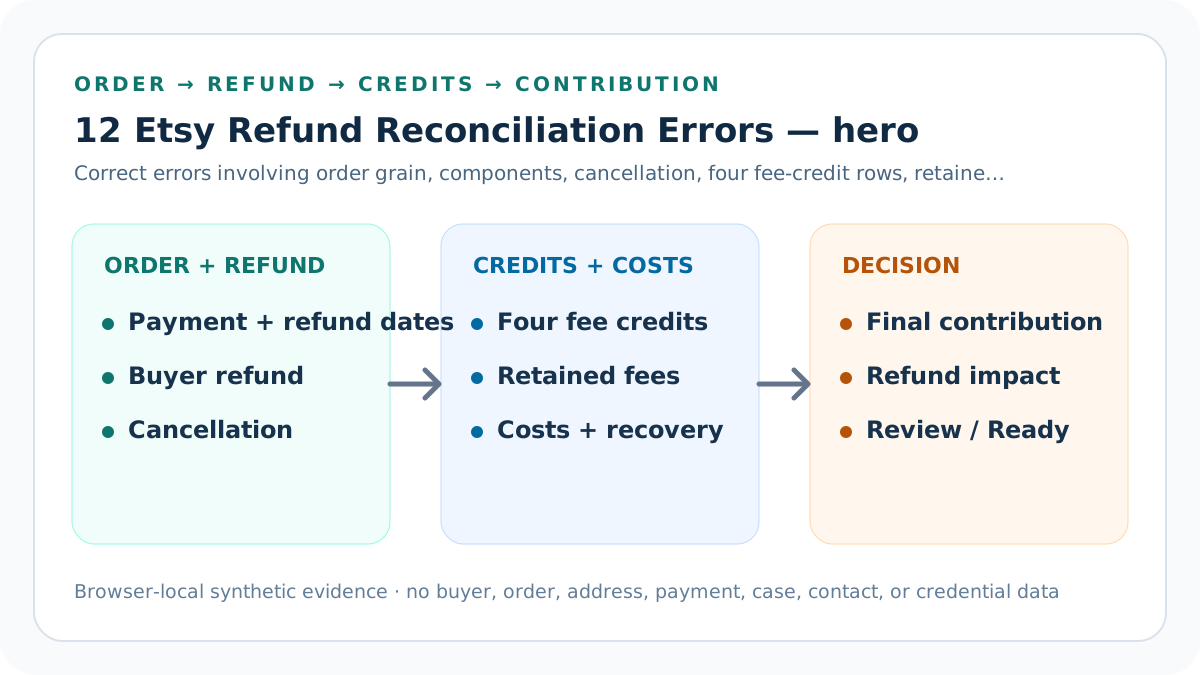
failure diagnosis: scope and direct answer
This mistakes guide is a diagnostic register, not another scenario. It identifies twelve failure modes across order grain, refund components, cancellation, credit allocation, tax periods, retained fees, cost duplication, recovery, and false policy authority, then ties each to a bounded repair.
Diagnosis stops at the first incorrect field. The repair preserves the faulty before-state, changes one accountable value, reruns exact assertions, and restores if the correction causes a new error. It rejects compensating inputs that merely make contribution look familiar.
Build the refund reconciliation defect register
Build twelve defect rows with symptom, first bad input, reason, privacy-safe evidence, corrected value, regression assertion, owner, and restore reference. Group them by grain, refund scope, cancellation, credits, tax timing, retained economics, recovery, and authority.
Inject each defect independently while all other values stay fixed. The expected state must fail for the named reason, the one-field repair must pass its assertion, and the saved before-packet must remain recoverable after the rerun.
Mistakes 1–2: wrong grain
Use one original order and its comparable refund packet, not a shop total or mixed set of orders.
Diagnose each defect at the first incorrect refund field instead of forcing total credits or contribution to match. Defect record 1 contains the misleading output, first bad field, root cause, evidence needed, one-field correction, expected assertion, actual rerun, regression owner, and restore reference. A corrected net total does not pass while any component remains wrong.
The defect test corrects only the first bad field, preserves the faulty packet for comparison, and rejects workarounds that make a net total look plausible.
Mistake 3: hidden components
Keep refunded item, shipping, and gift-wrap amounts separate and bounded by their original values.
Diagnose each defect at the first incorrect refund field instead of forcing total credits or contribution to match. Defect record 2 contains the misleading output, first bad field, root cause, evidence needed, one-field correction, expected assertion, actual rerun, regression owner, and restore reference. A corrected net total does not pass while any component remains wrong.
The defect test corrects only the first bad field, preserves the faulty packet for comparison, and rejects workarounds that make a net total look plausible.
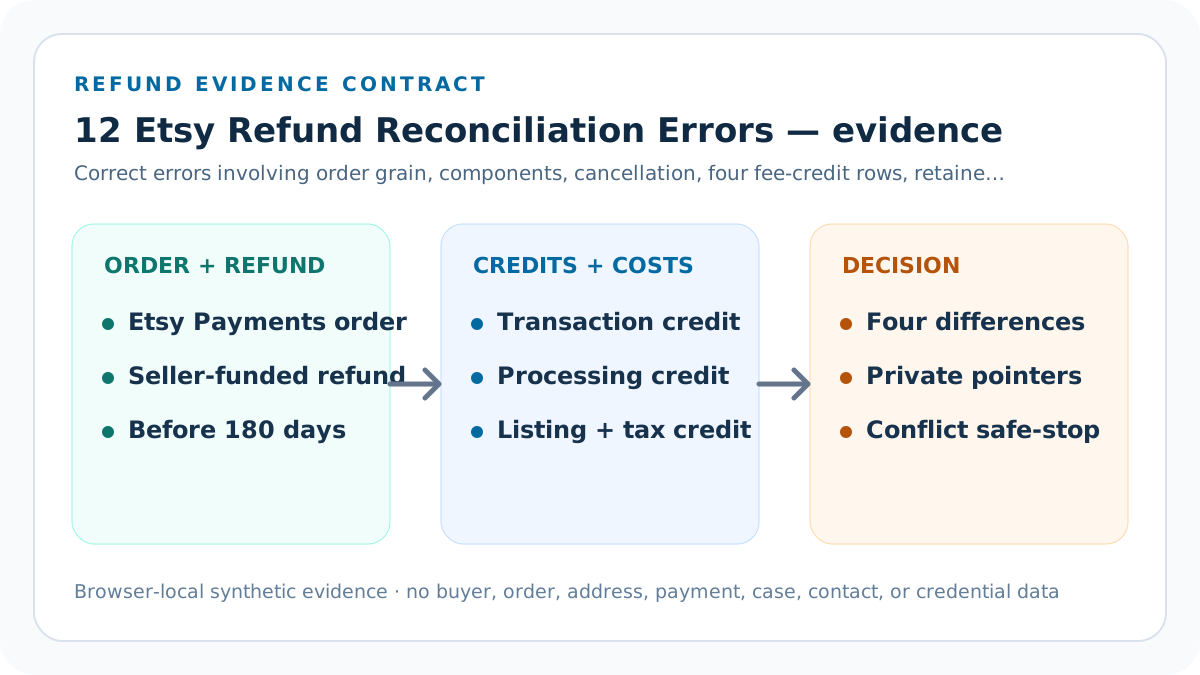
Mistake 4: refund equals cancellation
A refund does not prove the transaction was canceled or that listing credit is expected.
Diagnose each defect at the first incorrect refund field instead of forcing total credits or contribution to match. Defect record 3 contains the misleading output, first bad field, root cause, evidence needed, one-field correction, expected assertion, actual rerun, regression owner, and restore reference. A corrected net total does not pass while any component remains wrong.
The defect test corrects only the first bad field, preserves the faulty packet for comparison, and rejects workarounds that make a net total look plausible.
Mistakes 5–6: net credits and invented allocation
Reconcile four credits independently and label any proportional processing assumption.
Diagnose each defect at the first incorrect refund field instead of forcing total credits or contribution to match. Defect record 4 contains the misleading output, first bad field, root cause, evidence needed, one-field correction, expected assertion, actual rerun, regression owner, and restore reference. A corrected net total does not pass while any component remains wrong.
The defect test corrects only the first bad field, preserves the faulty packet for comparison, and rejects workarounds that make a net total look plausible.
Mistakes 7–8: listing and tax drift
Require cancellation evidence for listing credit and keep same-month or cross-month tax treatment explicit.
Diagnose each defect at the first incorrect refund field instead of forcing total credits or contribution to match. Defect record 5 contains the misleading output, first bad field, root cause, evidence needed, one-field correction, expected assertion, actual rerun, regression owner, and restore reference. A corrected net total does not pass while any component remains wrong.
The defect test corrects only the first bad field, preserves the faulty packet for comparison, and rejects workarounds that make a net total look plausible.
Mistakes 9–10: missing or duplicated costs
Retain original marketplace and direct costs once, then add return and handling costs once.
Diagnose each defect at the first incorrect refund field instead of forcing total credits or contribution to match. Defect record 6 contains the misleading output, first bad field, root cause, evidence needed, one-field correction, expected assertion, actual rerun, regression owner, and restore reference. A corrected net total does not pass while any component remains wrong.
The defect test corrects only the first bad field, preserves the faulty packet for comparison, and rejects workarounds that make a net total look plausible.
Mistake 11: excessive recovery
Recovered inventory value cannot exceed original product cost and should reflect resellable condition.
Diagnose each defect at the first incorrect refund field instead of forcing total credits or contribution to match. Defect record 7 contains the misleading output, first bad field, root cause, evidence needed, one-field correction, expected assertion, actual rerun, regression owner, and restore reference. A corrected net total does not pass while any component remains wrong.
The defect test corrects only the first bad field, preserves the faulty packet for comparison, and rejects workarounds that make a net total look plausible.
Mistake 12: false authority
The worksheet does not decide refund rights, Purchase Protection, tax treatment, legal duties, or case outcomes.
Diagnose each defect at the first incorrect refund field instead of forcing total credits or contribution to match. Defect record 8 contains the misleading output, first bad field, root cause, evidence needed, one-field correction, expected assertion, actual rerun, regression owner, and restore reference. A corrected net total does not pass while any component remains wrong.
The defect test corrects only the first bad field, preserves the faulty packet for comparison, and rejects workarounds that make a net total look plausible.
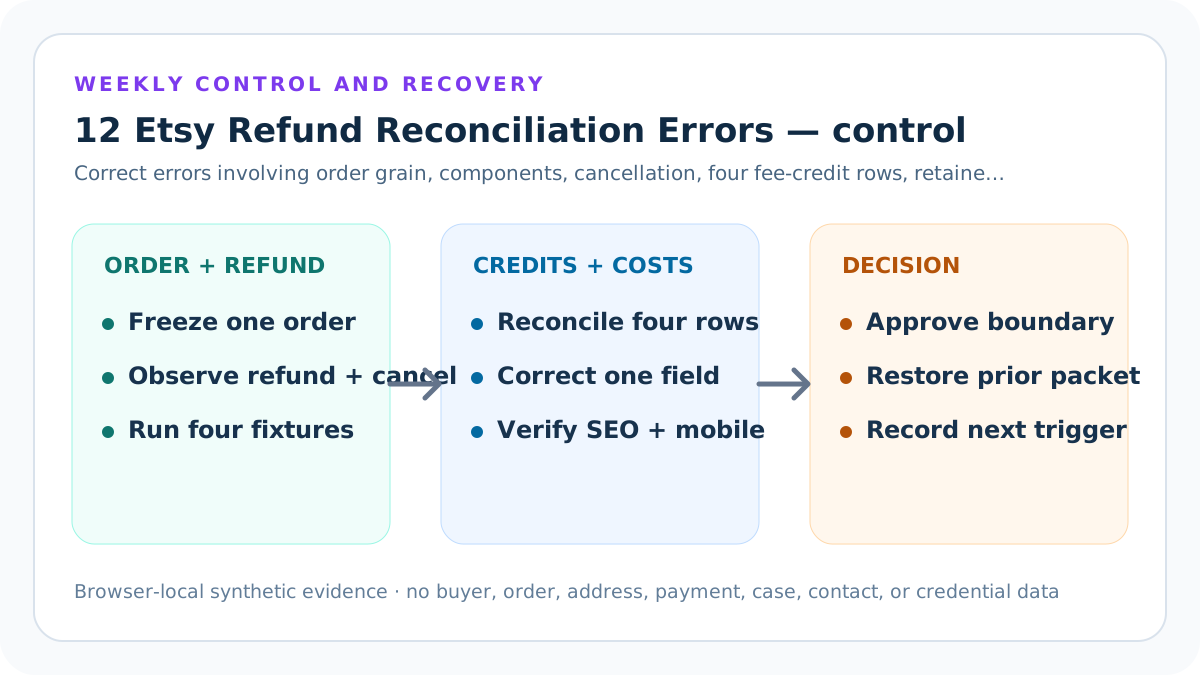
Verification, release, and refund feedback
Before changing refund guidance, fee-stack values, public routes, or defaults, preserve the refund reconciliation defect register, official sources, private evidence pointers, fixtures, tests, build output, route inventory, release manifest, and rollback identifier. Safe-stop on unexpected account, warning, authentication challenge, or target context.
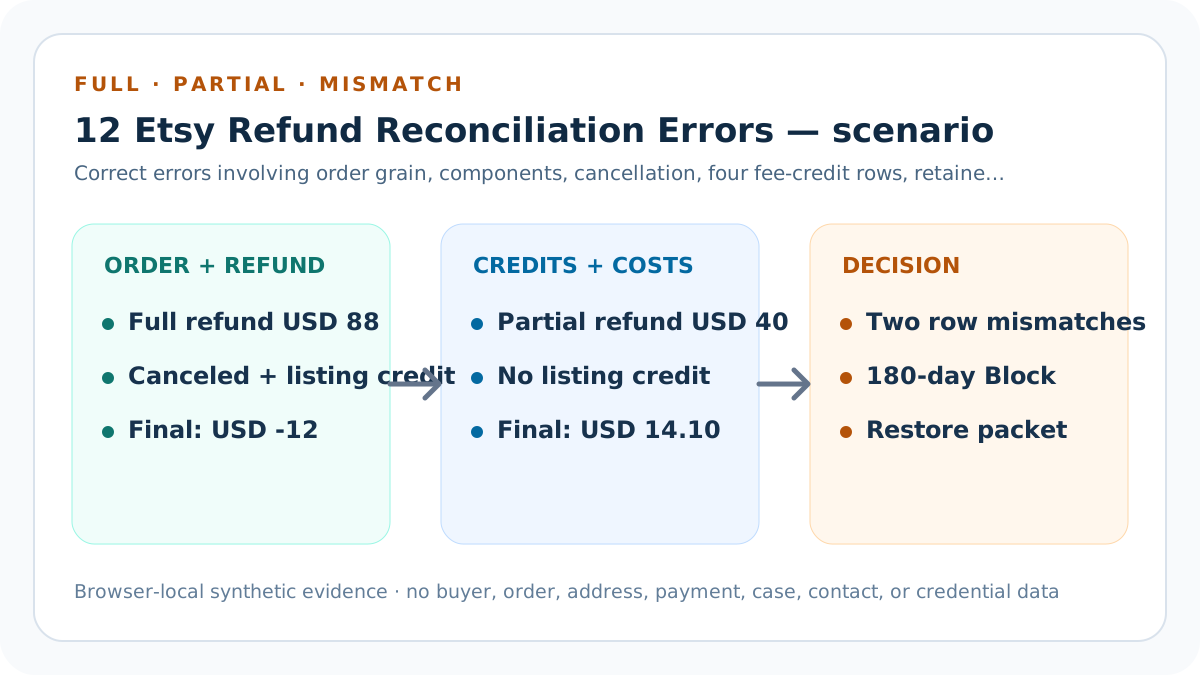
Require valid guidance, payment-processed, and refund-issued dates; a guidance review date on or after the refund event; seven explicit confirmations; the exact Etsy Shop Manager channel; the exact one seller-funded Etsy Payments order-refund scope; a refund date before 180 elapsed days; separate original seller-fee tax and expected or actual tax credits; and finite nonnegative amounts and tolerance. After a bounded correction, rerun a USD 88 full Shop Manager refund with USD 8.81 total fee credits, USD 18 inventory recovery, USD -12 final contribution, and USD -63.19 impact, a USD 40 item-only partial refund with no cancellation, proportional processing credit, zero listing credit, and USD 14.10 final contribution, separate USD 0.10 transaction-credit and processing-credit differences while every other field remains fixed, a refund exactly 180 elapsed days after payment processing, and invalid dates, an unconfirmed Etsy Payments or seller-funded path, wrong channel or scope, malformed currency, negative tolerance, or an over-refund. Inspect exact credits, differences, retained revenue, fees, costs, recovery, contribution, decision, mobile layout, canonical, schema, sources, visuals, internal links, and indexability.
Limits, privacy boundary, and next action
This guide does not reproduce every payment method, fixed-fee treatment, tax period, case, chargeback, Purchase Protection decision, return condition, external refund, currency conversion, reserve, hold, or future policy. It does not prove legal duties, tax liability, accounting profit, ranking, traffic, AdSense approval, revenue, or income.
Keep buyer names, emails, addresses, messages, order and listing IDs, payment rows, case records, bank details, tax identifiers, contacts, tokens, OAuth material, credentials, and raw exports outside the refund reconciliation defect register. Verify current Etsy order and Payment account evidence, then obtain qualified accounting, tax, legal, or customer-service advice when material.
Sources and further reading
- Etsy Help: Issue a Full or Partial Refund: Reviewed 2026-07-30: Shop Manager refund funding, transaction and processing fee credits, cancellation-conditioned listing credit, and the before-180-days limit.
- Etsy Fees and Payments Policy: Reviewed 2026-07-30: current transaction-fee base, service-fee boundaries, and Payment account treatment, including same-calendar-month withholding-tax refunds.
- Etsy Payments Policy: Reviewed 2026-07-30: seller-issued partial and full refund fee recalculation plus the no-credit rule for Etsy-funded full protection refunds.
- Etsy Help: Purchase Protection for Sellers: Reviewed 2026-07-30: current seller eligibility context and the boundary between Etsy-funded protection refunds and seller-funded refunds.
- Etsy Help: Manage Your Payment Account: Payment account activity, monthly statements, refunds, fees, taxes, reserves, amount due, and available-funds evidence.
- Etsy Help: Cancel an Order: Cancellation is separate from refunding and requires its own order-state evidence.
- Seller Profit Guard methodology: Evidence precedence, browser-local fixtures, privacy boundaries, deterministic decisions, validation, correction, release, and rollback.
Related Seller Profit Guard tools
- Open the Etsy Refund Fee Reconciliation Calculator: Reconcile buyer refund, cancellation, fee-credit rows, retained costs, and final contribution.
- Reconcile the Payment account: Compare expected fee-credit activity with privacy-safe statement observations.
- Read the Etsy Payment Account guide: Trace sales, refunds, fee credits, taxes, reserves, and amount due.
- Build the complete Etsy fee stack: Keep credited and retained fee lines separate in the wider order-cost model.
- Estimate return-window loss: Model shipping, handling, and inventory recovery separately from marketplace fee credits.
- Run Seller Profit Guard: Carry the reconciled final contribution into a broader SKU-level view.
- Read the local-first methodology: Keep buyer, order, address, message, payment, contact, credential, and raw export data private.
- Etsy Refund Fee Reconciliation Formula: Continue the formula, example, source, threshold, comparison, routine, interpretation, or audit workflow.
- Full Etsy Refund Fee Worked Example: Continue the formula, example, source, threshold, comparison, routine, interpretation, or audit workflow.
- Partial Etsy Refund Fee Scenario: Continue the formula, example, source, threshold, comparison, routine, interpretation, or audit workflow.
- Etsy Refund Fee Evidence Sources: Continue the formula, example, source, threshold, comparison, routine, interpretation, or audit workflow.
- Safe Etsy Refund Decision Thresholds: Continue the formula, example, source, threshold, comparison, routine, interpretation, or audit workflow.
Next step: Open the Etsy Refund Fee Reconciliation Calculator.
This is operational planning help, not tax, accounting, legal, financial, or platform-policy advice. Review the Terms and disclaimer, and verify current platform rules and fee assumptions before changing prices.