Domestic parcel versus mixed-cart free-shipping thresholds
Last updated: 2026-07-29
Written and reviewed by Seller Profit Guard Editorial Team.
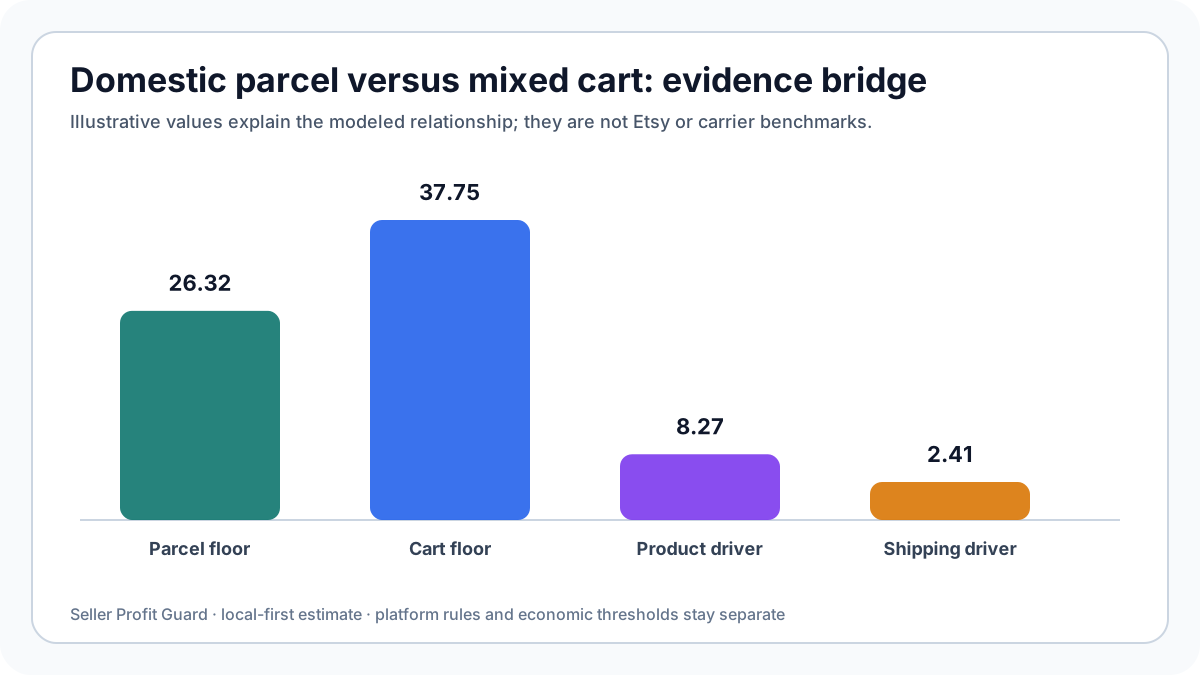
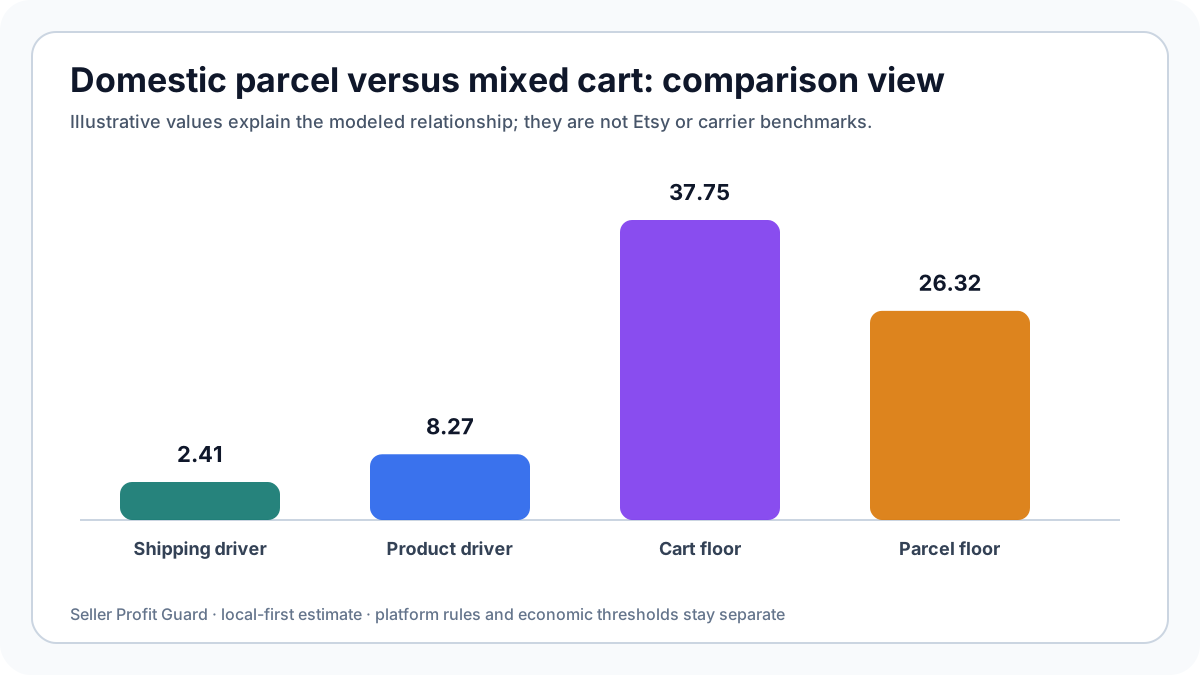
The domestic one-item example produces a $26.32 threshold from $17.50 of dollar costs, while the mixed two-item cart produces $37.75 from $25.10. Both use 8.5% fees and a 25% target. The difference comes from product, shipping, and packaging structure—not from a different formula or arbitrary markup.

How can the two scenarios be compared fairly?
Use the same currency, fee rate, target margin, cost boundary, and rounding policy. The one-item parcel has $10.50 product cost, $5.80 shipping, $0.90 packaging, and $0.30 fixed fee. The mixed cart has $16 product cost, $7.40 shipping, $1.40 packaging, and the same fixed fee. Both leave 66.5% of revenue for dollar costs.
The first numerator is $17.50 and its threshold is $26.32. The second numerator is $25.10 and its threshold is $37.75. The $11.43 difference equals the $7.60 added dollar cost divided by 0.665. This decomposition shows that the threshold moved because the modeled cart requires more cost coverage.
Do not compare one scenario with observed fees and another with a generic rate, or one with labor included and another without it. A difference is interpretable only when scope is aligned. Record every controlled field and every intentional difference.
| Field | Domestic parcel | Mixed cart | Difference |
|---|---|---|---|
| Product cost | $10.50 | $16.00 | +$5.50 |
| Shipping | $5.80 | $7.40 | +$1.60 |
| Packaging | $0.90 | $1.40 | +$0.50 |
| Fees / target | 8.5% / 25% | 8.5% / 25% | Controlled |
| Threshold | $26.32 | $37.75 | +$11.43 |
Which variable contributes most to the difference?
Product cost contributes $5.50 of the $7.60 numerator increase, shipping contributes $1.60, and packaging contributes $0.50. After division by 0.665, their threshold effects are about $8.27, $2.41, and $0.75 respectively. Product mix is therefore the largest modeled driver in this pair.
That conclusion is specific to these examples. In a lightweight high-value bundle, shipping may grow slowly while product cost dominates. In an oversized low-cost basket, postage and packaging can dominate. Use driver decomposition for every candidate rule rather than assuming free shipping is primarily a carrier problem.
Change one variable at a time to produce a sensitivity table. If lowering packaging by $0.40 only reduces the mixed-cart threshold by about $0.60, a complex packaging redesign may not solve a $5 policy gap. The decomposition keeps improvement work proportional.

How does consolidation change the comparison?
The mixed cart benefits from consolidated shipping: $7.40 rather than two labels totaling perhaps $11. If consolidation fails, its numerator rises by $3.60 and the threshold rises by about $5.41 to more than $43. The one-item parcel has no comparable consolidation gain.
Measure the actual consolidated share, package fit, service tier, production timing, and location. A mixed cart can look efficient in a spreadsheet while operations routinely split it. Conversely, a stable lightweight bundle can support a lower threshold than two independent one-item estimates suggest.
Create a paired fixture with consolidated and split fulfillment. If the public rule relies on consolidation, make it operationally enforceable and monitor multi-parcel exceptions. Do not place the burden on support staff to discover after checkout that the promised economics were impossible.
What different decisions follow from the scenarios?
The domestic parcel may support a $27 eligible-item threshold under representative evidence but need a $30 stress rule for distant zones. The mixed cart may support $38 only when specific products consolidate; a safer public policy could use $43, exclude structural exceptions, or design a bundle that fixes the product and package mix.
A shop-wide rule should not average $27 and $38. Instead, decide whether one offer mechanism can express the necessary eligibility. Separate shipping profiles, listing prices, or product groups may be clearer. Confirm customer-facing language and platform configuration match the decision.
After release, compare each cohort to its own baseline. A blended shop average can hide a failing mixed-cart offer behind profitable lightweight items. Preserve cohort counts even if a headline dashboard shows one shipping number.
- Do not average incompatible thresholds.
- Express eligibility explicitly.
- Monitor cohorts separately.
- Use bundle design when it stabilizes mix.
- Roll back the failing cohort, not unrelated offers.
Scenario-comparison questions
Why is the mixed threshold not twice the single threshold? Shipping and fixed fees can consolidate while product costs add.
Can the formula compare currencies? Only after converting all inputs consistently and accounting for conversion charges.
Which scenario should set the shop rule? The one matching the offer scope, with required stress coverage.
What if real carts differ from both? Add a third scenario before launch.
What is the comparison output? A driver-based decision, not a winner label.
Which evidence supports this free-shipping scenario comparison?
Use current carrier or Etsy label receipts for postage, adjustments, insurance, and services; packaging purchase records for mailers, boxes, inserts, tape, and protective material; product or SKU records for the cost of goods; and the Etsy Payment Account for fees tied to actual orders. Use shipping profiles and the current listing only to describe what the buyer is offered. A profile does not prove the seller's final label cost.
Record the analysis period, currency, destination cohort, package class, included costs, excluded costs, fee assumption, fixed fee, target margin, calculator version, and source dates. Reconcile a small public dummy example by hand before applying the result to a catalog. A file fingerprint proves that an input did not change; it does not prove that the input represents the next order mix.
Keep official platform rules separate from business assumptions. Etsy's US free-shipping guarantee can apply to qualifying US-bound orders of $35 or more after it is enabled, while the calculator derives a shop-specific economic threshold from entered costs and rates. Neither value proves conversion lift, tax treatment, carrier eligibility, or profit on every destination.
- Prefer actual labels and adjustments over advertised rate estimates.
- Segment heavy, remote, international, upgraded, fragile, and mixed-cart orders when costs differ.
- Treat fee percentages and target margin as explicit editable assumptions.
- Recalculate after carrier, package, fee, product-cost, or offer changes.
- Verify tax, accounting, legal, and platform-policy questions separately.
Privacy and commercial sensitivity for free-shipping scenario comparison
The threshold calculation needs costs, rates, a package or cart scenario, and a target margin. Buyer names, email addresses, phone numbers, delivery addresses, order IDs, messages, personalization, and payment credentials are unnecessary. Use aggregate destination zones or public dummy locations rather than exposing a buyer's exact address. Seller Profit Guard runs this quick calculation in the browser and does not need an Etsy login.
Supplier prices, package dimensions, negotiated carrier rates, product mix, margin targets, and exception rules can reveal commercial strategy even without buyer data. Keep detailed worksheets in controlled storage. Public reports should use rounded dummy numbers, aggregate ranges, redacted product names, and non-reversible fingerprints. Never paste a private order row or label into an article, analytics event, ticket, email draft, or community post.
How to apply this free-shipping scenario comparison in the calculator
Open the Free Shipping Threshold Calculator and enter product cost, seller-funded shipping, packaging, the combined percentage fee assumption, fixed fee, and target margin. The tool adds the four fixed-dollar costs, subtracts the fee and target-margin shares from one, and divides the cost total by the remaining revenue share. It reports no safe threshold when the denominator is zero or negative.
Round the result upward to a practical cart rule, then rerun at least a representative, adverse, and mixed-cart case. Confirm that the products likely to reach the threshold can actually produce the modeled cost mix. The output is a planning estimate, not an Etsy setting, carrier quote, conversion forecast, accounting profit statement, or promise that every qualifying order is profitable.
- Define one destination, package, product-mix, and offer cohort.
- Enter evidence-backed dollar costs and editable percentage assumptions.
- Hand-check the formula and round upward rather than down.
- Stress-test heavy, distant, upgraded, discounted, and mixed-cart cases.
- Publish only a bounded rule with owner, review date, exception, and rollback.
Sources and further reading
- Etsy Help: How to Offer Free Shipping: Official Etsy guidance for the US $35 free-shipping guarantee, shipping profiles, smart pricing, upgrades, and domestic versus international offers.
- Etsy Fees & Payments Policy: Official policy for transaction, payment-processing, Offsite Ads, regulatory, currency-conversion, shipping-label, and other seller charges.
- Etsy Help: How to Set Up Calculated Shipping: Official explanation of how origin, destination, package weight, dimensions, mail class, and package preferences affect calculated shipping.
- Etsy Help: How to Ship Your Items: Official shipping-profile, label, policy, and competitive-shipping overview for Etsy sellers.
- Seller Profit Guard calculation methodology: Definitions for contribution, editable assumptions, evidence hierarchy, local-first processing, uncertainty, and decision limits.
Related Seller Profit Guard tools
- Open the Free Shipping Threshold Calculator: Calculate the minimum order value that can absorb seller-funded shipping while preserving an editable target margin.
- Review Etsy shipping margin mistakes: Separate platform guarantees from economic thresholds and inspect funding, package, variation, replacement, and international cases.
- Calculate break-even ROAS and return loss: Add acquisition and expected incident loss after the shipping threshold is understood.
- Use the Etsy profit calculator: Validate the threshold against actual order revenue, fees, SKU cost, shipping, and margin evidence.
- Read the local-first methodology: Understand formulas, assumptions, privacy, evidence quality, and non-advice limits.
- Free Shipping Threshold Formula: 6 Inputs: Continue the free-shipping threshold evidence and decision workflow.
- Free Shipping Threshold: $26.32 Example: Continue the free-shipping threshold evidence and decision workflow.
- Mixed-Cart Free Shipping Threshold: $37.75: Continue the free-shipping threshold evidence and decision workflow.
- Free Shipping Threshold: 12 Costly Mistakes: Continue the free-shipping threshold evidence and decision workflow.
- Free Shipping Threshold Data: 7 Sources: Continue the free-shipping threshold evidence and decision workflow.
Next step: Open the Free Shipping Threshold Calculator.
This is operational planning help, not tax, accounting, legal, financial, or platform-policy advice. Review the Terms and disclaimer, and verify current platform rules and fee assumptions before changing prices.