SKU naming audit checklist and change log
Last updated: 2026-07-31
Written and reviewed by Seller Profit Guard Editorial Team.
A SKU audit records catalog scope, variant grain, codebook version, canonical pattern, sequence policy, channel aliases, active and retired registry counts, duplicate and mapping tests, platform and integration constraints, label results, migration crosswalk, exceptions, approvals, release evidence, and restoration instructions without publishing private catalog rows.
Open the audit cover sheet
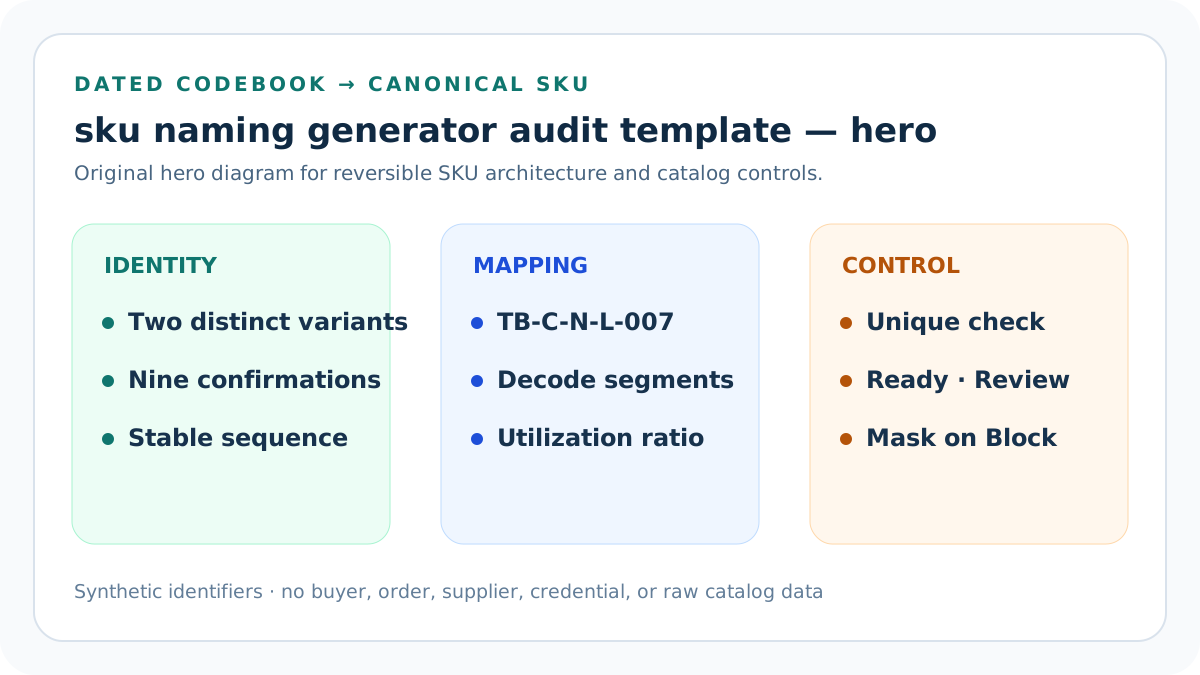
Assign one immutable packet ID to the catalog scope, codebook version, evidence month, source-review date, preparer, reviewer, connected endpoints, and proposed release. Reference private exports and registries by redacted pointer rather than copying real catalog rows into the public worksheet. This workpaper belongs to the SKU audit and change log and supports a reviewable SKU governance audit.
Every later correction receives a new version linked to the prior packet, change reason, approving role, effective timestamp, and restoration ID. A reviewer must be able to identify exactly which evidence supported each SKU decision.
Define the sellable-variant grain
Document what constitutes one commercial variant across product family, material, color, size, finish, pack, and any seller-approved option dimension. Count active, pending, archived, and draft variants at that same grain before evaluating identifiers. This workpaper belongs to the SKU audit and change log and supports a reviewable SKU governance audit.
Exclude buyer, order, campaign, warehouse-bin, and temporary listing states from canonical product identity. A changing storage location or sales channel must not silently create a new variant.
Register the codebook version
List each approved code, meaning, attribute type, status, owner, approver, effective date, deprecation date, and affected canonical SKUs. Record proposed, active, deprecated, and retired entries separately so one abbreviation cannot acquire two meanings over time. This workpaper belongs to the SKU audit and change log and supports a reviewable SKU governance audit.
Reconcile the register to the calculator codebook count and preserve the predecessor version. An undocumented shorthand or a historical reinterpretation keeps the audit open.
Test semantic code collisions
Compare codes after uppercase normalization and check whether identical strings represent different meanings, whether different strings represent the same controlled meaning, and whether a channel code can be mistaken for an attribute code. Record every conflict and its remediation owner. This workpaper belongs to the SKU audit and change log and supports a reviewable SKU governance audit.
A technically unique full SKU can still be operationally ambiguous when individual segments cannot be decoded consistently. Resolve semantic collisions before generating or importing identifiers.
Document the canonical grammar
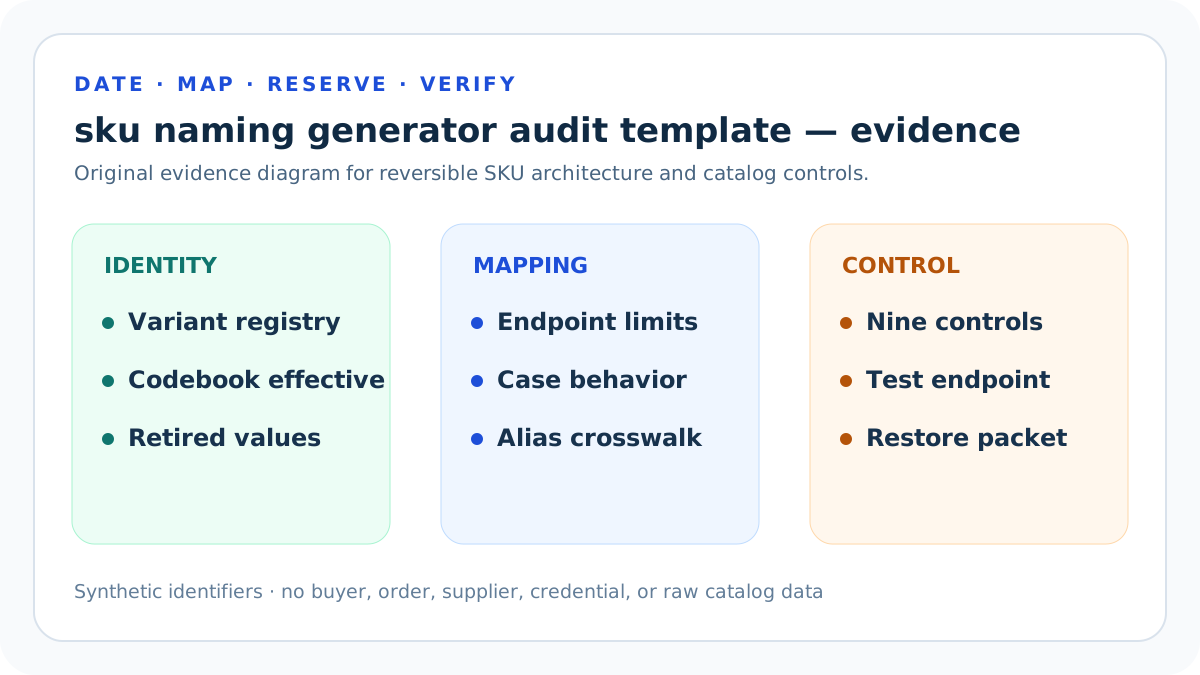
Write the exact segment order, accepted separator, sequence width, optional components, uppercase rule, blank handling, and maximum canonical length. Provide one valid synthetic example and one invalid example for every grammar rule. This workpaper belongs to the SKU audit and change log and supports a reviewable SKU governance audit.
Treat Shopify's short-code examples and Etsy's four-to-eight-character recommendation as guidance, not universal platform limits. The seller's tested endpoint matrix owns the enforceable contract.
Reconcile sequence capacity
Record the current sequence width, valid range, allocated count, reserved ranges, next allocation rule, exhaustion threshold, and extension plan for each product family. Show how leading zeros and retired values are preserved. This workpaper belongs to the SKU audit and change log and supports a reviewable SKU governance audit.
Do not infer future sales from capacity. The worksheet only proves that the declared sequence policy can allocate additional identifiers without recycling or silently changing historical width.
Reconcile the active identifier population
Count complete canonical SKUs, blanks, exact duplicates, case-only duplicates, malformed strings, overlength values, unmapped segments, and orphan product references in the current private export. Preserve the query or scan version behind a redacted evidence pointer. This workpaper belongs to the SKU audit and change log and supports a reviewable SKU governance audit.
A zero-error total is valid only for the named export and timestamp. New products, edits, imports, or integrations require a new population reconciliation.
Maintain the archived and reserved ledger
Record retired, deleted, pending, quarantined, failed-import, and intentionally reserved identifiers with status, former variant, retirement reason, owner, and retention date. Compare every proposal against this ledger as well as the active population. This workpaper belongs to the SKU audit and change log and supports a reviewable SKU governance audit.
Square's deleted auto-generated SKU non-reuse behavior illustrates the historical-reference risk; the browser does not reserve anything externally. Reuse remains blocked when returns, reports, or integrations may still reference an old code.
Run exact and case-fold collision scans
Execute one comparison preserving case and a second comparison after the case-normalization behavior of every connected endpoint. Include canonical values and aliases in both scans, then reconcile collision counts to named exceptions. This workpaper belongs to the SKU audit and change log and supports a reviewable SKU governance audit.
Shopify notes case-sensitive matching in some SKU searches and integrations, but other systems can normalize case differently. Passing one comparison does not establish cross-system uniqueness.
Audit the alias-to-canonical crosswalk
For each endpoint alias, record channel, alias, canonical SKU, product variant, status, creation reason, last reconciliation, retirement rule, and downstream references. Require exactly one canonical target for each live alias. This workpaper belongs to the SKU audit and change log and supports a reviewable SKU governance audit.
Aliases may support endpoint constraints but do not create new inventory. Orphan aliases, two-to-one mappings, and divergent product meanings block the migration packet.
Test location independence
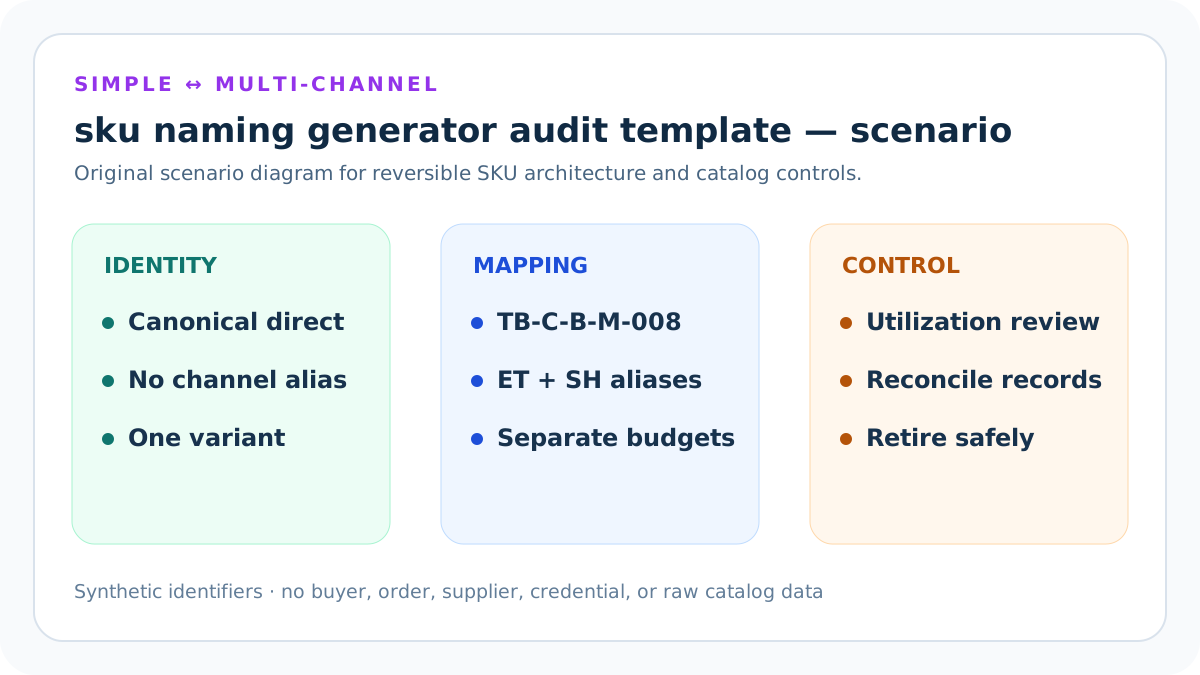
Compare the same canonical variant across every inventory location and verify that quantities, bins, and fulfillment nodes remain separate fields. Record intentional exceptions where the operating model truly treats a location-specific item as a different commercial variant. This workpaper belongs to the SKU audit and change log and supports a reviewable SKU governance audit.
Shopify recommends the same SKU for the same variant across locations. Encoding a movable shelf or warehouse location in canonical identity creates avoidable renames and historical drift.
Separate SKU, barcode, and GTIN fields
Inspect product, import, label, and integration schemas to confirm that the seller-controlled SKU is not being used as an invented UPC, EAN, ISBN, GTIN, or barcode assignment. Record field names, source authority, and sample validation results. This workpaper belongs to the SKU audit and change log and supports a reviewable SKU governance audit.
Square states that manufacturers set GTINs and its SKU generator does not create them. GS1 identifiers and their barcode representation follow a different authority and cannot be produced by this tool.
Build the endpoint constraint matrix
For Shopify, Etsy, Square, POS, ERP, 3PL, marketplace, spreadsheet, printer, and any other actual endpoint, record accepted characters, maximum length, case behavior, uniqueness scope, required fields, import method, archive behavior, and test version. This workpaper belongs to the SKU audit and change log and supports a reviewable SKU governance audit.
Unknown cells remain explicit blockers. A successful browser preview does not prove that an external endpoint, current plan, installed app, or file importer accepts the proposal.
Assemble the import and restoration package
Hash or version the untouched source export, transformation rule set, proposed crosswalk, small test cohort, import summary, row-count reconciliation, exception file, approval, and restore artifact. Store private catalogs outside public content. This workpaper belongs to the SKU audit and change log and supports a reviewable SKU governance audit.
Never overwrite the only source file. Expansion beyond the test cohort requires exact count and relationship reconciliation plus a demonstrated path back to the prior identifiers.
Record label and scanner trials
Test representative canonical SKUs and aliases at actual label size, font, printer resolution, scanner or lookup device, POS display width, fulfillment station, and return workflow. Record device, template, operator role, date, result, and observed ambiguity. This workpaper belongs to the SKU audit and change log and supports a reviewable SKU governance audit.
O and I readability is a Review condition because real fonts and devices determine the operational outcome. Text validity alone cannot establish scan, print, or staff-lookup fitness.
Attest to privacy and redaction
Confirm that the public packet contains only synthetic codes, aggregate counts, and redacted evidence pointers. Scan for buyer names, emails, addresses, order IDs, supplier terms, private costs, employee identities, credentials, tokens, passwords, exact secure locations, and raw CSV rows. This workpaper belongs to the SKU audit and change log and supports a reviewable SKU governance audit.
Any exposed private record blocks publication and triggers removal, cache review, and incident handling. A canonical SKU must never become a container for personal or security-sensitive data.
Verify source coverage and applicability
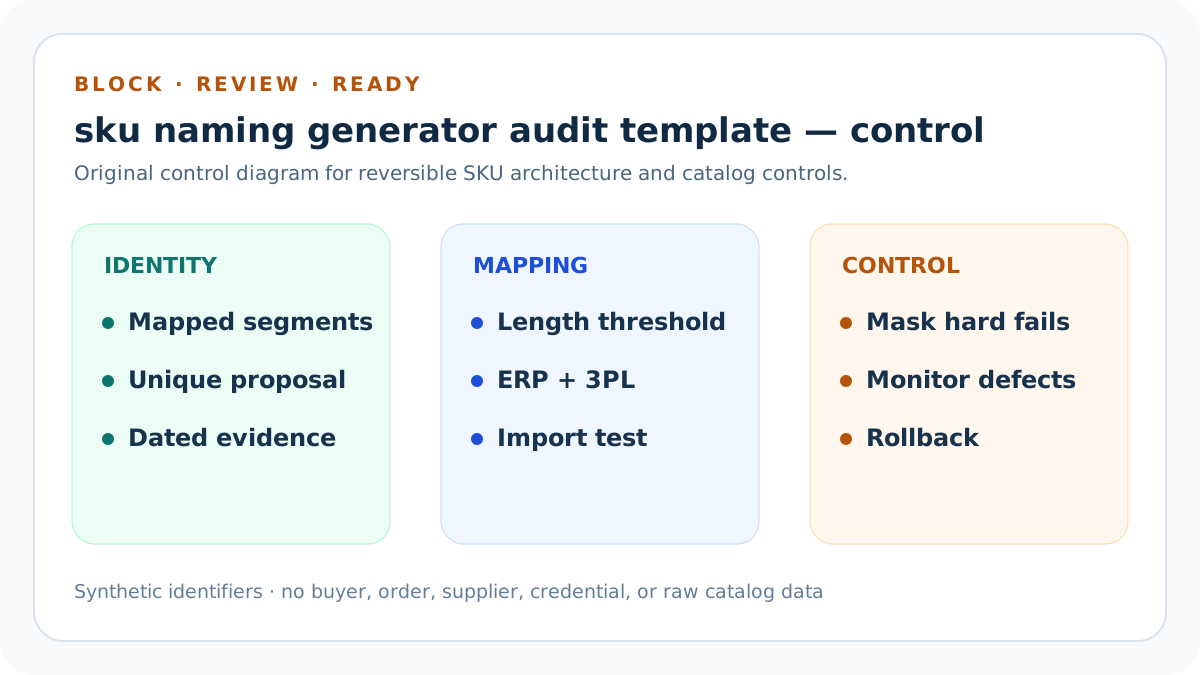
Record the title, URL, reviewed date, applicable market, product or plan, and precise claim for each Shopify, Etsy, Square, and GS1 source. Confirm that the review date covers the declared catalog evidence month. This workpaper belongs to the SKU audit and change log and supports a reviewable SKU governance audit.
Platform examples do not create one universal length or character limit. Source staleness, changed applicability, or an unsupported inferred limit keeps the decision in Block until the evidence packet is corrected.
Maintain the exception register
Give every duplicate, unmapped code, overlength value, alias mismatch, retired-value reuse, endpoint incompatibility, label failure, missing confirmation, and open migration issue a severity, owner, due date, correction, reviewer, and decision effect. This workpaper belongs to the SKU audit and change log and supports a reviewable SKU governance audit.
Do not hide accepted exceptions inside narrative notes. A named exception policy may support Review, but it cannot convert a hard uniqueness, mapping, privacy, or evidence failure into Ready.
Replay deterministic calculator scenarios
Archive the Ready base packet, ambiguous-character Review, reserved-collision Block, stale-source Block, unsupported-separator Block, overlength Block, incomplete-confirmation Block, and corrected recovery case. Store inputs, expected state, observed state, formula version, and timestamp. This workpaper belongs to the SKU audit and change log and supports a reviewable SKU governance audit.
Scenario evidence proves repeatability of the browser-local rules, not external uniqueness or migration safety. Any unexpected output stops release until code and evidence are corrected and rerun.
Write the field-level change log
For every codebook, grammar, sequence, limit, registry, alias, source, or confirmation change, record old value, new value, reason, source pointer, affected identifiers, editor, reviewer, timestamp, prior packet ID, and rollback consequence. This workpaper belongs to the SKU audit and change log and supports a reviewable SKU governance audit.
Never silently change a code's meaning or overwrite an unfavorable audit result. Historical interpretation depends on a durable change trail.
Rehearse rollback and reconciliation
Restore the test cohort to its prior identifiers, confirm product-to-SKU relationships, inventory quantities, order and return references, labels, aliases, and reports, then record the elapsed steps and unresolved exceptions. Preserve both the failed and restored evidence. This workpaper belongs to the SKU audit and change log and supports a reviewable SKU governance audit.
A backup name alone is not rollback proof. Failed counts, broken relationships, or an unavailable original export keep the release blocked.
Issue the final disposition and expiry
Summarize catalog scope, codebook version, canonical grammar, active and reserved counts, collision scans, alias status, endpoint tests, privacy result, scenarios, exceptions, reviewer, Block or Review or Ready state, and next review date. This workpaper belongs to the SKU audit and change log and supports a reviewable SKU governance audit.
Ready remains a conditional proposal under entered evidence. It does not authorize import, reserve a code, generate a GTIN, certify inventory accuracy, or guarantee platform and integration compatibility.
Sources and further reading
- Seller Profit Guard methodology: Evidence versions, formulas, privacy, correction, release, and rollback.
- Seller Profit Guard data privacy: Local-first boundaries for catalog, buyer, order, supplier, credential, and raw-record data.
- Shopify Help: Using SKUs to manage your inventory: Reviewed July 31, 2026: official uniqueness, short-code, separator, variation, location, case-sensitive matching, integration, and barcode-field guidance.
- Shopify Help: Exporting and importing inventory with CSV: Reviewed July 31, 2026: official product-variant and location identification context for private catalog operations.
- Etsy Help: How to Use SKU for Your Inventory: Reviewed July 31, 2026: official seller-defined SKU, shop search, multi-channel use, short-code recommendation, ambiguous-character warning, and comma or slash caution.
- Etsy Help: How to Add Variations for Your Listings: Reviewed July 31, 2026: official buyer-facing variation and variation-level inventory context; labels remain separate from internal identifiers.
- Square Support: Automatically generate SKUs: Reviewed July 31, 2026: official internal identifier, unique missing-variation generation, deleted auto-SKU non-reuse, and manufacturer-set GTIN boundary.
- Square Support: Create and edit item options and variations: Reviewed July 31, 2026: official option-set and item-variation operating context.
- Square Support: Bulk import items: Reviewed July 31, 2026: official variation-level import and pre-change export context for a reversible private catalog update.
- GS1: GTIN, barcode, EAN, and UPC differences: Reviewed July 31, 2026: official boundary between a globally assigned GTIN and the barcode data carrier that can encode it.
Related Seller Profit Guard tools
- SKU Naming Generator: Generate two canonical proposals and optional channel aliases.
- Etsy Variation Naming Checker: Review buyer-facing variation names separately.
- Listing Cost Library Calculator: Attach cost evidence to stable canonical variants.
- CSV Import Validator: Review a redacted structural sample before a private import.
- Methodology: Review evidence, formulas, privacy, correction, release, and rollback.
- Data Privacy: Protect catalog, supplier, buyer, order, credential, and raw-record data.
- SKU Naming Generator Formula and Inputs: Build reversible canonical SKUs from a codebook, variant attributes, sequence, length limits, reserved values, and optional channel aliases.
- SKU Naming Generator Worked Example: Follow a simple tote-bag variant from codebook and attributes to TB-C-N-L-007, decoding, uniqueness review, and approval evidence.
- SKU Naming for a Multi-Channel Catalog: Create one canonical variant code plus Etsy and Shopify aliases without duplicating the underlying inventory identity or counts.
- SKU Naming Mistakes and Corrections: Correct duplicate, unmapped, overlong, location-bound, channel-fragmented, ambiguous, recycled, and private-data SKU patterns.
- SKU Naming Generator Data Sources: Map product attributes, codebook, existing identifiers, aliases, platform limits, labels, integrations, and history to reviewable evidence.
- Safe SKU Naming Decision Thresholds: Separate blocking identity failures, readability review, target-system compatibility, uniqueness, mapping, migration, and release thresholds.
- SKU Naming: Simple vs Multi-Channel: Compare one canonical-only catalog with a canonical-plus-alias catalog at the same codebook, variant, sequence, length, and evidence grain.
- Weekly SKU Naming Operating Routine: Run a repeatable catalog review across missing codes, duplicates, mappings, aliases, retired values, labels, integrations, exceptions, and rollback.
- How to Interpret SKU Naming Results: Read canonical codes, aliases, mappings, lengths, reserved checks, and status without claiming catalog, barcode, or integration proof.
Next step: Open Seller Profit Guard.
This is operational planning help, not tax, accounting, legal, financial, or platform-policy advice. Review the Terms and disclaimer, and verify current platform rules and fee assumptions before changing prices.