Supplier MOQ mistakes that distort cash and coverage
Last updated: 2026-07-31
Written and reviewed by Seller Profit Guard Editorial Team.
The largest MOQ errors are comparing different purchase units, omitting freight or duties, using expired quotes, treating On hand as Available, hiding stockouts in demand averages, assuming linear sell-through without sensitivity, confusing MOQ with order multiple or EOQ, and calling a lower unit price a better supplier decision. Block structural defects first.
Expired quote
Verify effective dates and version. The supplier-MOQ error register records supplier-offer version, item and purchase unit, currency, incoterm, period, source, transformation, owner, reviewer, exception, and prior accepted value needed for a bounded correction queue.
Refresh evidence. At checkpoint 1, reperform both fixtures, identify the changed cash, cost, time, demand, inventory, or storage term, and state which sourcing, compliance, purchasing, accounting, tax, or privacy conclusion remains outside the calculator.
Wrong purchase unit
Convert packs, cases, length, weight, and pieces. The supplier-MOQ error register records supplier-offer version, item and purchase unit, currency, incoterm, period, source, transformation, owner, reviewer, exception, and prior accepted value needed for a bounded correction queue.
Avoid scale errors. At checkpoint 2, reperform both fixtures, identify the changed cash, cost, time, demand, inventory, or storage term, and state which sourcing, compliance, purchasing, accounting, tax, or privacy conclusion remains outside the calculator.
Freight omitted
Map incoterm and all landed-cost legs. The supplier-MOQ error register records supplier-offer version, item and purchase unit, currency, incoterm, period, source, transformation, owner, reviewer, exception, and prior accepted value needed for a bounded correction queue.
Compare like with like. At checkpoint 3, reperform both fixtures, identify the changed cash, cost, time, demand, inventory, or storage term, and state which sourcing, compliance, purchasing, accounting, tax, or privacy conclusion remains outside the calculator.
Payment timing confused with cost
Keep deposit and terms in a cash-flow schedule. The supplier-MOQ error register records supplier-offer version, item and purchase unit, currency, incoterm, period, source, transformation, owner, reviewer, exception, and prior accepted value needed for a bounded correction queue.
Do not erase liability. At checkpoint 4, reperform both fixtures, identify the changed cash, cost, time, demand, inventory, or storage term, and state which sourcing, compliance, purchasing, accounting, tax, or privacy conclusion remains outside the calculator.
On hand used as Available
Reconcile committed and unavailable units. The supplier-MOQ error register records supplier-offer version, item and purchase unit, currency, incoterm, period, source, transformation, owner, reviewer, exception, and prior accepted value needed for a bounded correction queue.
Coverage can be overstated. At checkpoint 5, reperform both fixtures, identify the changed cash, cost, time, demand, inventory, or storage term, and state which sourcing, compliance, purchasing, accounting, tax, or privacy conclusion remains outside the calculator.
Stockouts hidden in demand
Use comparable in-stock periods and explicit context. The supplier-MOQ error register records supplier-offer version, item and purchase unit, currency, incoterm, period, source, transformation, owner, reviewer, exception, and prior accepted value needed for a bounded correction queue.
Observed sales can understate. At checkpoint 6, reperform both fixtures, identify the changed cash, cost, time, demand, inventory, or storage term, and state which sourcing, compliance, purchasing, accounting, tax, or privacy conclusion remains outside the calculator.
Seasonality ignored
Run low, base, and high demand cases. The supplier-MOQ error register records supplier-offer version, item and purchase unit, currency, incoterm, period, source, transformation, owner, reviewer, exception, and prior accepted value needed for a bounded correction queue.
Linear averages are fragile. At checkpoint 7, reperform both fixtures, identify the changed cash, cost, time, demand, inventory, or storage term, and state which sourcing, compliance, purchasing, accounting, tax, or privacy conclusion remains outside the calculator.
MOQ confused with EOQ
Keep supplier floor separate from optimized quantity. The supplier-MOQ error register records supplier-offer version, item and purchase unit, currency, incoterm, period, source, transformation, owner, reviewer, exception, and prior accepted value needed for a bounded correction queue.
Constraint is not optimum. At checkpoint 8, reperform both fixtures, identify the changed cash, cost, time, demand, inventory, or storage term, and state which sourcing, compliance, purchasing, accounting, tax, or privacy conclusion remains outside the calculator.
Lower unit price called better
Compare cash, coverage, storage, and risk. The supplier-MOQ error register records supplier-offer version, item and purchase unit, currency, incoterm, period, source, transformation, owner, reviewer, exception, and prior accepted value needed for a bounded correction queue.
Price alone is incomplete. At checkpoint 9, reperform both fixtures, identify the changed cash, cost, time, demand, inventory, or storage term, and state which sourcing, compliance, purchasing, accounting, tax, or privacy conclusion remains outside the calculator.
Private terms published
Use redacted aggregates and protected pointers. The supplier-MOQ error register records supplier-offer version, item and purchase unit, currency, incoterm, period, source, transformation, owner, reviewer, exception, and prior accepted value needed for a bounded correction queue.
No bank or contact data. At checkpoint 10, reperform both fixtures, identify the changed cash, cost, time, demand, inventory, or storage term, and state which sourcing, compliance, purchasing, accounting, tax, or privacy conclusion remains outside the calculator.
Supplier MOQ Modeling Mistakes: quote and unit integrity control
Use one current written offer, purchase unit, currency, incoterm, and validity period. Control 1 defines a pass condition, evidence owner, independent reviewer, correction deadline, sensitivity range, monitoring signal, stop condition, and restoration trigger for a bounded correction queue.
Ambiguous terms block. Apply it while keeping MOQ, landed cost, payment timing, demand, inventory state, coverage, lead exposure, storage, thresholds, and purchase authority separate.
Supplier MOQ Modeling Mistakes: demand and inventory lineage control
Use comparable complete demand periods and one reconciled Available state. Control 2 defines a pass condition, evidence owner, independent reviewer, correction deadline, sensitivity range, monitoring signal, stop condition, and restoration trigger for a bounded correction queue.
Unsupported coverage reviews. Apply it while keeping MOQ, landed cost, payment timing, demand, inventory state, coverage, lead exposure, storage, thresholds, and purchase authority separate.
Supplier MOQ Modeling Mistakes: cost and timing separation control
Map landed cost once while keeping payment timing and future Incoming inventory separate. Control 3 defines a pass condition, evidence owner, independent reviewer, correction deadline, sensitivity range, monitoring signal, stop condition, and restoration trigger for a bounded correction queue.
Duplicates block. Apply it while keeping MOQ, landed cost, payment timing, demand, inventory state, coverage, lead exposure, storage, thresholds, and purchase authority separate.
Supplier MOQ Modeling Mistakes: decision authority control
Separate MOQ comparison from EOQ, forecasting, supplier qualification, negotiation, PO, payment, accounting, and tax. Control 4 defines a pass condition, evidence owner, independent reviewer, correction deadline, sensitivity range, monitoring signal, stop condition, and restoration trigger for a bounded correction queue.
Arithmetic cannot authorize. Apply it while keeping MOQ, landed cost, payment timing, demand, inventory state, coverage, lead exposure, storage, thresholds, and purchase authority separate.
Supplier MOQ Modeling Mistakes: privacy and restoration control
Use redacted aggregates, protect contracts and rows, monitor actuals, retain the prior plan, and define rollback. Control 5 defines a pass condition, evidence owner, independent reviewer, correction deadline, sensitivity range, monitoring signal, stop condition, and restoration trigger for a bounded correction queue.
Public private data is prohibited. Apply it while keeping MOQ, landed cost, payment timing, demand, inventory state, coverage, lead exposure, storage, thresholds, and purchase authority separate.
Expired quote: MOQ lab 1
Recalculate both supplier fixtures. Verify effective dates and version. Change one input only, preserve the remaining quote, demand, inventory-state, and landed-cost assumptions, and record cash commitment, landed unit cost, MOQ months, post-receipt coverage, lead-time demand, pre-arrival gap, storage, and status.
Refresh evidence. Test low, base, and high MOQ, freight, lead-time, demand, availability, and storage values. Explain the dominant exposure and protected evidence still required before any supplier or purchasing action.
Wrong purchase unit: MOQ lab 2
Recalculate both supplier fixtures. Convert packs, cases, length, weight, and pieces. Change one input only, preserve the remaining quote, demand, inventory-state, and landed-cost assumptions, and record cash commitment, landed unit cost, MOQ months, post-receipt coverage, lead-time demand, pre-arrival gap, storage, and status.
Avoid scale errors. Test low, base, and high MOQ, freight, lead-time, demand, availability, and storage values. Explain the dominant exposure and protected evidence still required before any supplier or purchasing action.
Freight omitted: MOQ lab 3
Recalculate both supplier fixtures. Map incoterm and all landed-cost legs. Change one input only, preserve the remaining quote, demand, inventory-state, and landed-cost assumptions, and record cash commitment, landed unit cost, MOQ months, post-receipt coverage, lead-time demand, pre-arrival gap, storage, and status.
Compare like with like. Test low, base, and high MOQ, freight, lead-time, demand, availability, and storage values. Explain the dominant exposure and protected evidence still required before any supplier or purchasing action.
Payment timing confused with cost: MOQ lab 4
Recalculate both supplier fixtures. Keep deposit and terms in a cash-flow schedule. Change one input only, preserve the remaining quote, demand, inventory-state, and landed-cost assumptions, and record cash commitment, landed unit cost, MOQ months, post-receipt coverage, lead-time demand, pre-arrival gap, storage, and status.
Do not erase liability. Test low, base, and high MOQ, freight, lead-time, demand, availability, and storage values. Explain the dominant exposure and protected evidence still required before any supplier or purchasing action.
On hand used as Available: MOQ lab 5
Recalculate both supplier fixtures. Reconcile committed and unavailable units. Change one input only, preserve the remaining quote, demand, inventory-state, and landed-cost assumptions, and record cash commitment, landed unit cost, MOQ months, post-receipt coverage, lead-time demand, pre-arrival gap, storage, and status.
Coverage can be overstated. Test low, base, and high MOQ, freight, lead-time, demand, availability, and storage values. Explain the dominant exposure and protected evidence still required before any supplier or purchasing action.
Stockouts hidden in demand: MOQ lab 6
Recalculate both supplier fixtures. Use comparable in-stock periods and explicit context. Change one input only, preserve the remaining quote, demand, inventory-state, and landed-cost assumptions, and record cash commitment, landed unit cost, MOQ months, post-receipt coverage, lead-time demand, pre-arrival gap, storage, and status.
Observed sales can understate. Test low, base, and high MOQ, freight, lead-time, demand, availability, and storage values. Explain the dominant exposure and protected evidence still required before any supplier or purchasing action.
Seasonality ignored: MOQ lab 7
Recalculate both supplier fixtures. Run low, base, and high demand cases. Change one input only, preserve the remaining quote, demand, inventory-state, and landed-cost assumptions, and record cash commitment, landed unit cost, MOQ months, post-receipt coverage, lead-time demand, pre-arrival gap, storage, and status.
Linear averages are fragile. Test low, base, and high MOQ, freight, lead-time, demand, availability, and storage values. Explain the dominant exposure and protected evidence still required before any supplier or purchasing action.
MOQ confused with EOQ: MOQ lab 8
Recalculate both supplier fixtures. Keep supplier floor separate from optimized quantity. Change one input only, preserve the remaining quote, demand, inventory-state, and landed-cost assumptions, and record cash commitment, landed unit cost, MOQ months, post-receipt coverage, lead-time demand, pre-arrival gap, storage, and status.
Constraint is not optimum. Test low, base, and high MOQ, freight, lead-time, demand, availability, and storage values. Explain the dominant exposure and protected evidence still required before any supplier or purchasing action.
Lower unit price called better: MOQ lab 9
Recalculate both supplier fixtures. Compare cash, coverage, storage, and risk. Change one input only, preserve the remaining quote, demand, inventory-state, and landed-cost assumptions, and record cash commitment, landed unit cost, MOQ months, post-receipt coverage, lead-time demand, pre-arrival gap, storage, and status.
Price alone is incomplete. Test low, base, and high MOQ, freight, lead-time, demand, availability, and storage values. Explain the dominant exposure and protected evidence still required before any supplier or purchasing action.
Private terms published: MOQ lab 10
Recalculate both supplier fixtures. Use redacted aggregates and protected pointers. Change one input only, preserve the remaining quote, demand, inventory-state, and landed-cost assumptions, and record cash commitment, landed unit cost, MOQ months, post-receipt coverage, lead-time demand, pre-arrival gap, storage, and status.
No bank or contact data. Test low, base, and high MOQ, freight, lead-time, demand, availability, and storage values. Explain the dominant exposure and protected evidence still required before any supplier or purchasing action.
Supplier MOQ Modeling Mistakes: intent-specific implementation walkthrough
supplier-MOQ error register checkpoint 1 addresses expired quote for a bounded correction queue. Verify effective dates and version. Record the source decision, formula effect, failed alternative, reviewer question, correction owner, monitoring signal, and restoration value. Refresh evidence.
supplier-MOQ error register checkpoint 2 addresses wrong purchase unit for a bounded correction queue. Convert packs, cases, length, weight, and pieces. Record the source decision, formula effect, failed alternative, reviewer question, correction owner, monitoring signal, and restoration value. Avoid scale errors.
supplier-MOQ error register checkpoint 3 addresses freight omitted for a bounded correction queue. Map incoterm and all landed-cost legs. Record the source decision, formula effect, failed alternative, reviewer question, correction owner, monitoring signal, and restoration value. Compare like with like.
supplier-MOQ error register checkpoint 4 addresses payment timing confused with cost for a bounded correction queue. Keep deposit and terms in a cash-flow schedule. Record the source decision, formula effect, failed alternative, reviewer question, correction owner, monitoring signal, and restoration value. Do not erase liability.
supplier-MOQ error register checkpoint 5 addresses on hand used as available for a bounded correction queue. Reconcile committed and unavailable units. Record the source decision, formula effect, failed alternative, reviewer question, correction owner, monitoring signal, and restoration value. Coverage can be overstated.
supplier-MOQ error register checkpoint 6 addresses stockouts hidden in demand for a bounded correction queue. Use comparable in-stock periods and explicit context. Record the source decision, formula effect, failed alternative, reviewer question, correction owner, monitoring signal, and restoration value. Observed sales can understate.
supplier-MOQ error register checkpoint 7 addresses seasonality ignored for a bounded correction queue. Run low, base, and high demand cases. Record the source decision, formula effect, failed alternative, reviewer question, correction owner, monitoring signal, and restoration value. Linear averages are fragile.
supplier-MOQ error register checkpoint 8 addresses moq confused with eoq for a bounded correction queue. Keep supplier floor separate from optimized quantity. Record the source decision, formula effect, failed alternative, reviewer question, correction owner, monitoring signal, and restoration value. Constraint is not optimum.
supplier-MOQ error register checkpoint 9 addresses lower unit price called better for a bounded correction queue. Compare cash, coverage, storage, and risk. Record the source decision, formula effect, failed alternative, reviewer question, correction owner, monitoring signal, and restoration value. Price alone is incomplete.
supplier-MOQ error register checkpoint 10 addresses private terms published for a bounded correction queue. Use redacted aggregates and protected pointers. Record the source decision, formula effect, failed alternative, reviewer question, correction owner, monitoring signal, and restoration value. No bank or contact data.
Evidence boundary for a bounded correction queue
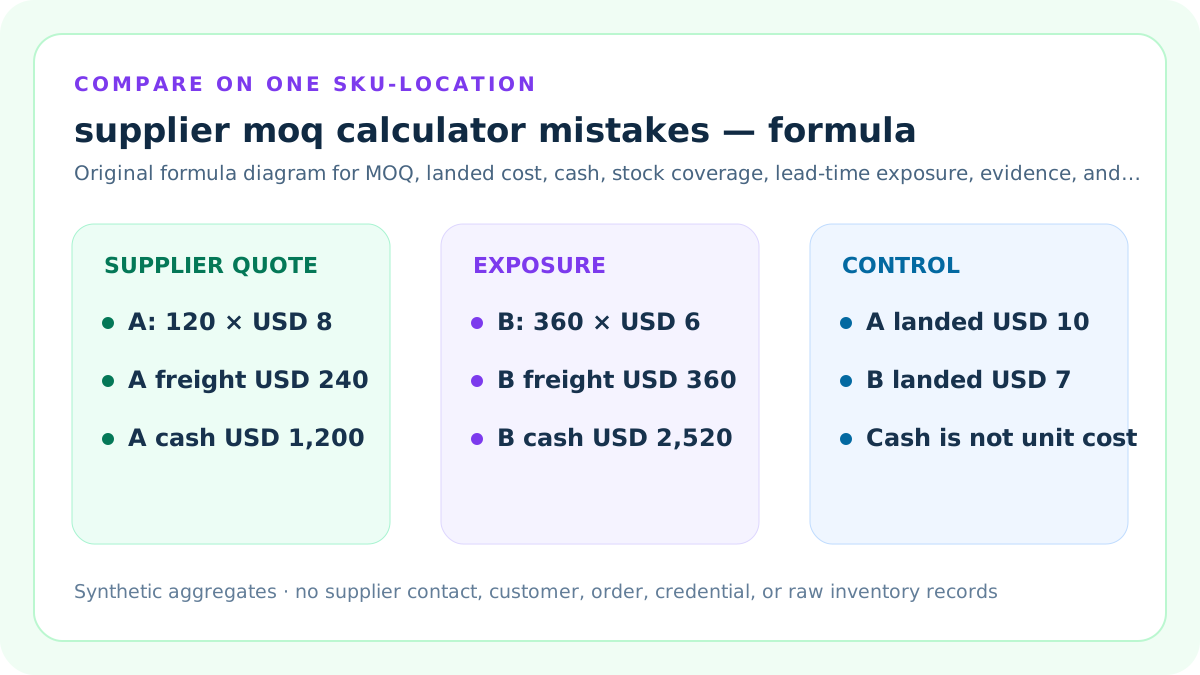
The low-MOQ fixture uses 120 units at USD 8 plus USD 240 freight, 45 lead-time days, 60 comparable monthly units, 20 existing Available units, and USD 0.20 storage per unit-month. Cash commitment is USD 1,200, landed unit cost is USD 10, post-receipt coverage is 2.33 months, and projected incremental storage is USD 24. The lower-price high-MOQ fixture uses 360 units at USD 6 plus USD 360 freight, 60 lead-time days, the same demand and existing inventory, and the same storage rate. Cash commitment is USD 2,520, landed unit cost is USD 7, post-receipt coverage is 6.33 months, and projected incremental storage is USD 216.
The packet demonstrates entered purchasing arithmetic and sensitivity. It cannot prove future demand, supplier quality or compliance, optimal order quantity, financing capacity, correct accounting or tax treatment, delivery performance, customer outcomes, or the correct business action.
Release, monitor, and restore the supplier-MOQ error register
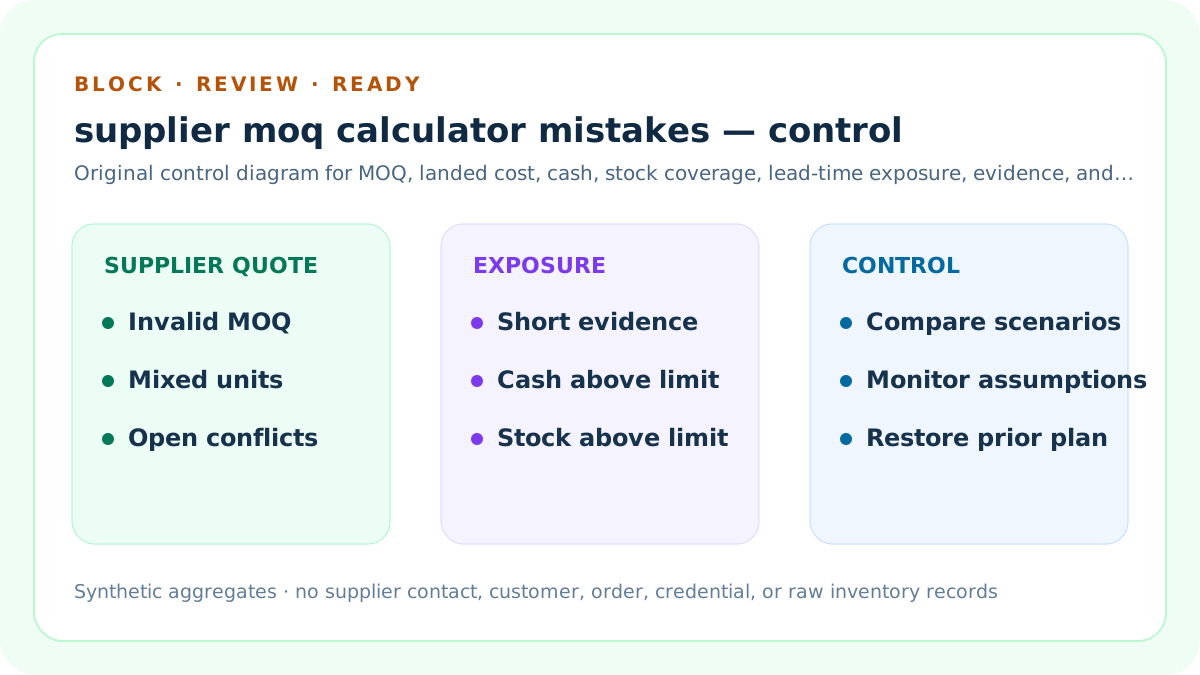
Block invalid MOQ, costs, lead time, demand, inventory, evidence, scope, currency, privacy, or conflicts. Review short evidence or exceeded cash and stock-month thresholds. Ready clears only the entered worksheet.
Before indexing or operational use, preserve evidence and rollback artifacts; run typecheck, unit, integration, build, content, similarity, SEO, image, link, mobile, strict-route, deployment, and live checks; then compare actual landed cost, receipt, and sell-through without claiming causality.
Supplier MOQ Modeling Mistakes: concrete working record
Record the full supplier-MOQ error register: supplier and item references, quote version, validity, MOQ, order multiple, purchase unit, currency, incoterm, costs, terms, lead time, demand evidence, inventory state, storage basis, formulas, thresholds, owners, approvals, monitoring, exceptions, stop rules, privacy controls, and restoration evidence for a bounded correction queue.
Sources and further reading
- Microsoft Learn: Reordering policies: Official minimum-order, maximum-order, order-multiple, lot-for-lot, and planning context.
- Shopify Help: Purchase orders: Official supplier, quantity, cost, terms, currency, transfer, receipt, and cost-adjustment fields.
- Shopify Help: Choosing suppliers: Official minimum order size and supplier-evaluation context.
- Oracle NetSuite: Inventory Management: Official supply-planning, lot-sizing, purchasing, and availability context.
- GAO: Economics of Inventory Control: Government source on ordering and inventory-holding costs.
- GAO Inventory System Checklist: Government inventory checklist for holding, ordering, unit-cost, demand, and order-quantity controls.
- Seller Profit Guard methodology: Evidence, privacy, release, monitoring, correction, and rollback controls.
Related Seller Profit Guard tools
- Supplier MOQ Calculator: Compare cash and inventory exposure under two supplier offers.
- Inventory Carrying Cost Calculator: Estimate fuller annual holding costs separately.
- Reorder Point Calculator: Evaluate replenishment timing separately.
- Stockout Cost Calculator: Estimate availability consequences separately.
- Methodology: Apply evidence and release controls.
- Data Privacy: Protect supplier, purchase, inventory, and customer data.
- Supplier MOQ Formula and Inputs: Define MOQ, purchase unit, landed costs, lead time, demand, existing availability, stock months, storage, thresholds, and evidence.
- Low MOQ Supplier Worked Example: Reperform a 120-unit supplier offer through cash commitment, landed unit cost, coverage, lead-time exposure, and storage.
- High MOQ Lower-Price Supplier Scenario: Reperform a lower-price 360-unit offer through higher cash exposure, stock months, lead time, storage, and review thresholds.
- Supplier MOQ Data Sources and Evidence: Map MOQ, multiple, cost, freight, terms, lead time, demand, inventory, storage, currency, and evidence to controlled sources.
- Supplier MOQ Decision Threshold: Set cash and stock-month thresholds with evidence, liquidity, shelf-life, concentration, approval, monitoring, stop, and restoration controls.
- Low vs High Supplier MOQ Comparison: Compare low- and high-MOQ offers across cash, landed cost, lead time, stock months, storage, uncertainty, and decision authority.
- Weekly Supplier MOQ Review Routine: Run a weekly quote, cost, lead-time, demand, inventory, threshold, approval, monitoring, exception, and restoration cycle.
- Interpret Supplier MOQ Results: Interpret cash commitment, landed cost, sell-through months, total coverage, lead-time gap, storage, threshold status, and uncertainty.
- Supplier MOQ Audit Checklist Template: Audit quote terms, units, MOQ, multiples, costs, freight, lead time, demand, inventory, storage, formula, approvals, privacy, and rollback.
Next step: Open Seller Profit Guard.
This is operational planning help, not tax, accounting, legal, financial, or platform-policy advice. Review the Terms and disclaimer, and verify current platform rules and fee assumptions before changing prices.