How to set safe Etsy refund reconciliation thresholds
Last updated: 2026-07-30
Written and reviewed by Seller Profit Guard Editorial Team.
Block invalid or over-refunded components, unsupported channels, unknown cancellation, impossible credits or recovery, missing period or currency, and declared conflicts. Reconcile any of four fee-credit rows outside tolerance. Review a reconciled contribution loss above the seller-owned ceiling. Use Ready only when evidence, rows, costs, and threshold pass.
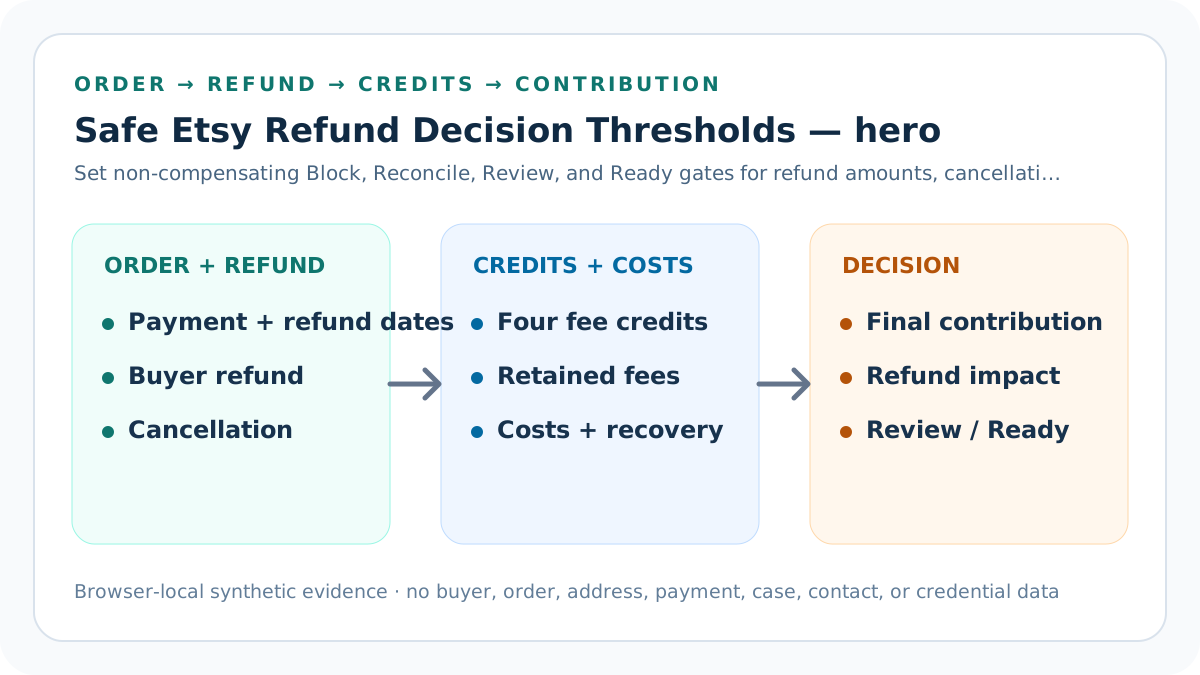
non-compensating gates: scope and direct answer
This threshold guide defines a non-compensating state machine for one refund packet. It asks whether evidence is structurally valid, whether each credit row reconciles, and whether a verified loss crosses a seller-owned review boundary; it does not describe how to build or archive an audit file.
Gate precedence is intentionally asymmetric: one Block condition outranks every favorable amount; one row difference outranks the seller loss ceiling; and the ceiling is evaluated only after evidence and credits pass. The output is a workflow state, not a risk score.
Build the Block-Reconcile-Review-Ready refund card
Build four ordered gates: Block for invalid structure or conflicts; Reconcile for transaction, processing, listing, or tax row drift; Review for a reconciled loss above the ceiling; Ready for a clean packet below or at the ceiling. Document exact predicates, not subjective confidence labels.
Test exact boundaries: refund equals original is valid; refund above original blocks; credit difference equal to tolerance passes while greater difference reconciles; recovery equal to product cost passes while greater recovery blocks; loss equal to the ceiling passes while greater loss reviews.
Gate 1: valid original order
Require positive revenue, nonnegative components, one currency, one period, and one order grain.
Apply refund gates without compensation; a favorable final margin cannot validate an over-refund or unsupported credit. Gate row 1 contains one Boolean predicate, observed value, allowable domain, precedence, failing state, owner, remediation, and exact retest. Evaluate the eight gates independently; never average them, assign a composite pass percentage, or let recovered inventory or retained revenue offset invalid evidence.
The gate test evaluates an over-refund, four independent row differences, impossible inventory recovery, reconciled high loss, and a clean packet with no compensating score.
Gate 2: bounded buyer refund
No refunded component or total may exceed its original counterpart.
Apply refund gates without compensation; a favorable final margin cannot validate an over-refund or unsupported credit. Gate row 2 contains one Boolean predicate, observed value, allowable domain, precedence, failing state, owner, remediation, and exact retest. Evaluate the eight gates independently; never average them, assign a composite pass percentage, or let recovered inventory or retained revenue offset invalid evidence.
The gate test evaluates an over-refund, four independent row differences, impossible inventory recovery, reconciled high loss, and a clean packet with no compensating score.
Gate 3: cancellation identity
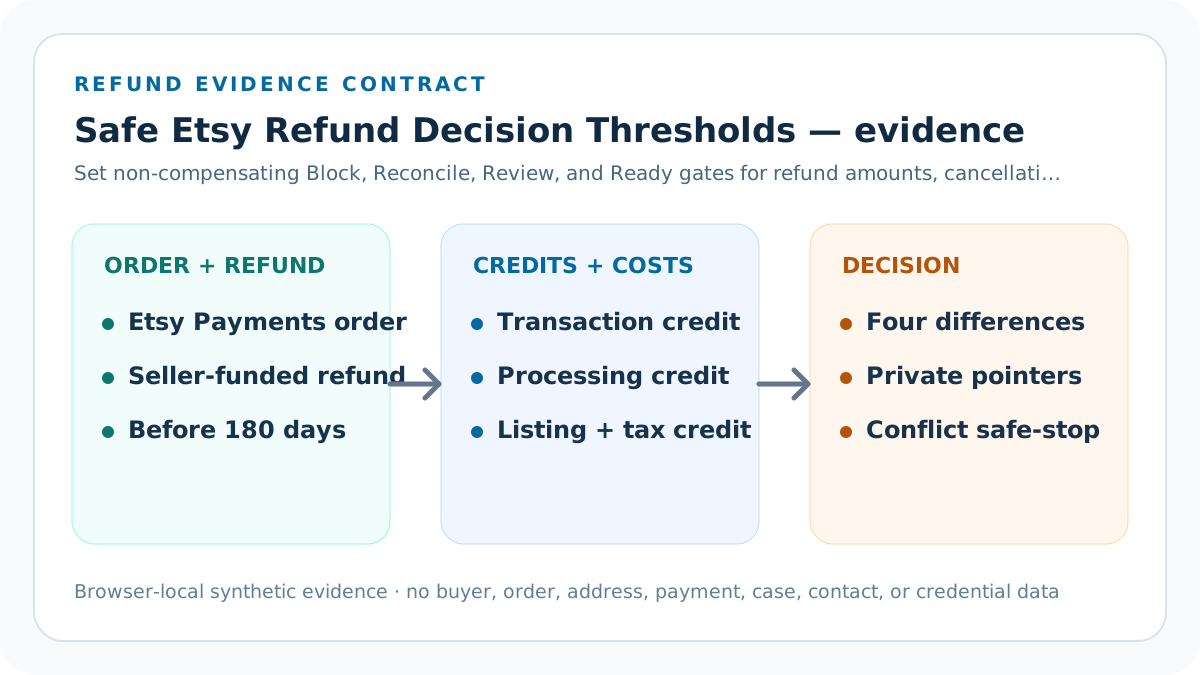
Require yes or no and allow expected listing credit only when cancellation is confirmed.
Apply refund gates without compensation; a favorable final margin cannot validate an over-refund or unsupported credit. Gate row 3 contains one Boolean predicate, observed value, allowable domain, precedence, failing state, owner, remediation, and exact retest. Evaluate the eight gates independently; never average them, assign a composite pass percentage, or let recovered inventory or retained revenue offset invalid evidence.
The gate test evaluates an over-refund, four independent row differences, impossible inventory recovery, reconciled high loss, and a clean packet with no compensating score.
Gate 4: plausible credits and recovery
Processing and listing credits cannot exceed original fees, and recovery cannot exceed product cost.
Apply refund gates without compensation; a favorable final margin cannot validate an over-refund or unsupported credit. Gate row 4 contains one Boolean predicate, observed value, allowable domain, precedence, failing state, owner, remediation, and exact retest. Evaluate the eight gates independently; never average them, assign a composite pass percentage, or let recovered inventory or retained revenue offset invalid evidence.
The gate test evaluates an over-refund, four independent row differences, impossible inventory recovery, reconciled high loss, and a clean packet with no compensating score.
Gate 5: transaction and processing rows
Compare each expected row with its own actual credit within tolerance.
Apply refund gates without compensation; a favorable final margin cannot validate an over-refund or unsupported credit. Gate row 5 contains one Boolean predicate, observed value, allowable domain, precedence, failing state, owner, remediation, and exact retest. Evaluate the eight gates independently; never average them, assign a composite pass percentage, or let recovered inventory or retained revenue offset invalid evidence.
The gate test evaluates an over-refund, four independent row differences, impossible inventory recovery, reconciled high loss, and a clean packet with no compensating score.
Gate 6: listing and tax rows
Keep cancellation-conditioned listing credit and seller-fee tax credit independent.
Apply refund gates without compensation; a favorable final margin cannot validate an over-refund or unsupported credit. Gate row 6 contains one Boolean predicate, observed value, allowable domain, precedence, failing state, owner, remediation, and exact retest. Evaluate the eight gates independently; never average them, assign a composite pass percentage, or let recovered inventory or retained revenue offset invalid evidence.
The gate test evaluates an over-refund, four independent row differences, impossible inventory recovery, reconciled high loss, and a clean packet with no compensating score.
Gate 7: contribution review
After rows reconcile, Review when negative refund impact exceeds the seller ceiling.
Apply refund gates without compensation; a favorable final margin cannot validate an over-refund or unsupported credit. Gate row 7 contains one Boolean predicate, observed value, allowable domain, precedence, failing state, owner, remediation, and exact retest. Evaluate the eight gates independently; never average them, assign a composite pass percentage, or let recovered inventory or retained revenue offset invalid evidence.
The gate test evaluates an over-refund, four independent row differences, impossible inventory recovery, reconciled high loss, and a clean packet with no compensating score.
Gate 8: declared conflicts
Give order, refund, case, timing, cancellation, tax, currency, cost, and statement uncertainty Block precedence.
Apply refund gates without compensation; a favorable final margin cannot validate an over-refund or unsupported credit. Gate row 8 contains one Boolean predicate, observed value, allowable domain, precedence, failing state, owner, remediation, and exact retest. Evaluate the eight gates independently; never average them, assign a composite pass percentage, or let recovered inventory or retained revenue offset invalid evidence.
The gate test evaluates an over-refund, four independent row differences, impossible inventory recovery, reconciled high loss, and a clean packet with no compensating score.
Verification, release, and refund feedback
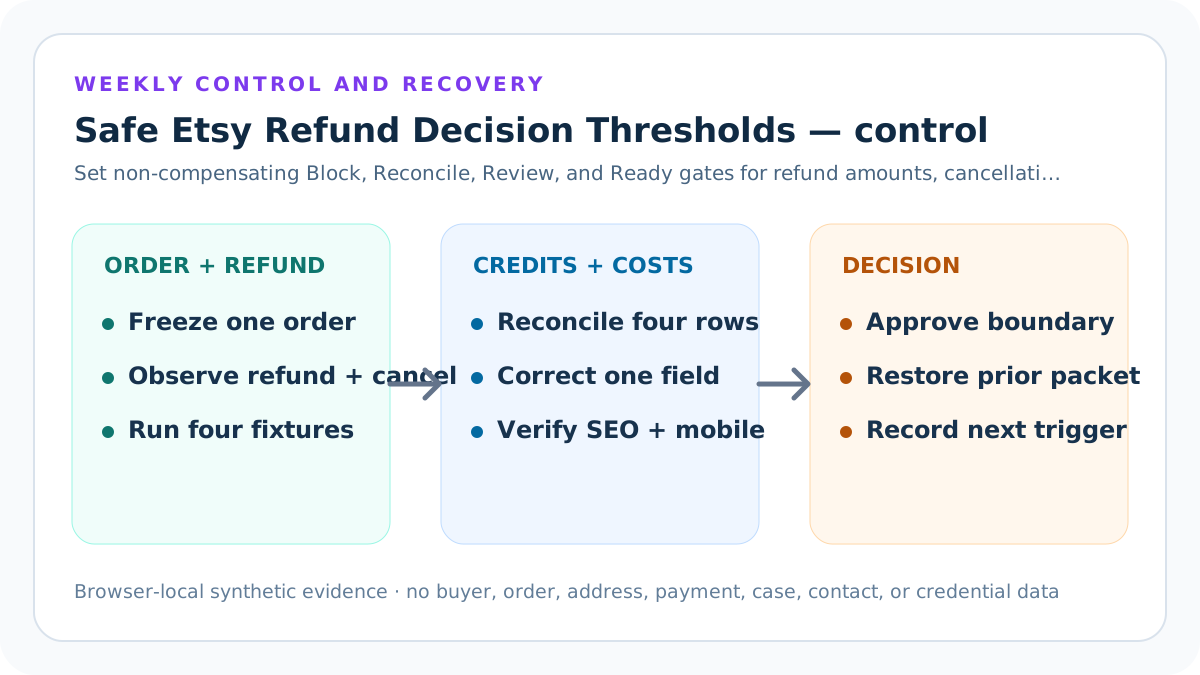
Before changing refund guidance, fee-stack values, public routes, or defaults, preserve the Block-Reconcile-Review-Ready refund card, official sources, private evidence pointers, fixtures, tests, build output, route inventory, release manifest, and rollback identifier. Safe-stop on unexpected account, warning, authentication challenge, or target context.
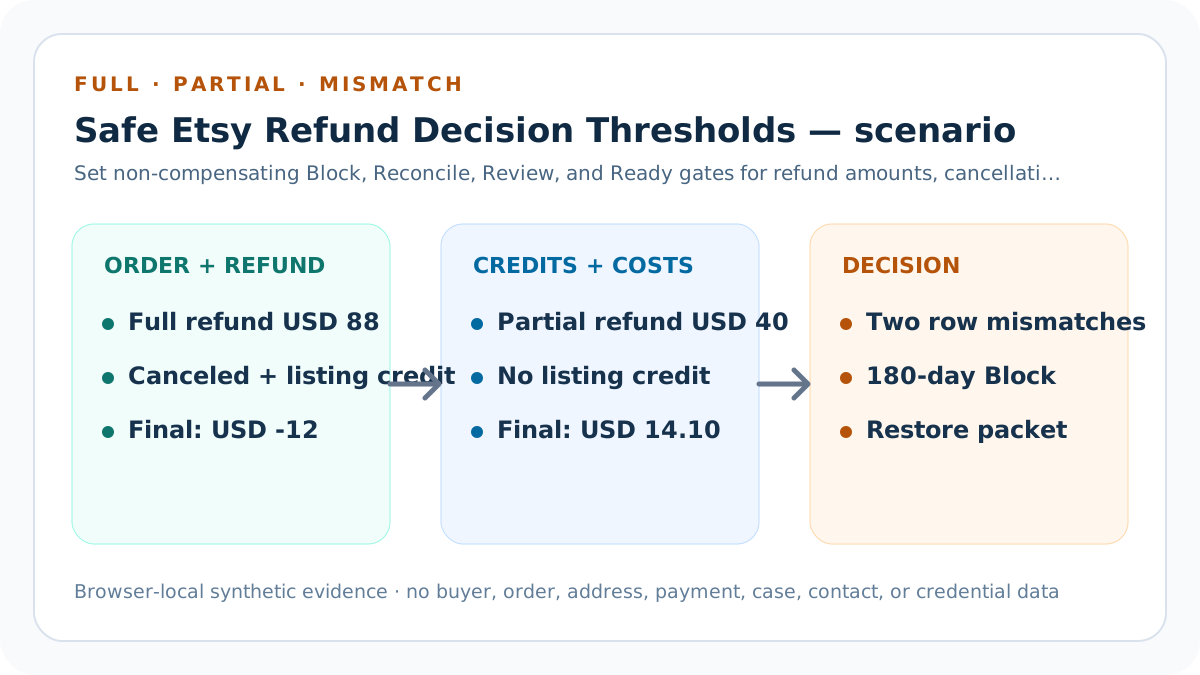
Require valid guidance, payment-processed, and refund-issued dates; a guidance review date on or after the refund event; seven explicit confirmations; the exact Etsy Shop Manager channel; the exact one seller-funded Etsy Payments order-refund scope; a refund date before 180 elapsed days; separate original seller-fee tax and expected or actual tax credits; and finite nonnegative amounts and tolerance. After a bounded correction, rerun a USD 88 full Shop Manager refund with USD 8.81 total fee credits, USD 18 inventory recovery, USD -12 final contribution, and USD -63.19 impact, a USD 40 item-only partial refund with no cancellation, proportional processing credit, zero listing credit, and USD 14.10 final contribution, separate USD 0.10 transaction-credit and processing-credit differences while every other field remains fixed, a refund exactly 180 elapsed days after payment processing, and invalid dates, an unconfirmed Etsy Payments or seller-funded path, wrong channel or scope, malformed currency, negative tolerance, or an over-refund. Inspect exact credits, differences, retained revenue, fees, costs, recovery, contribution, decision, mobile layout, canonical, schema, sources, visuals, internal links, and indexability.
Limits, privacy boundary, and next action
This guide does not reproduce every payment method, fixed-fee treatment, tax period, case, chargeback, Purchase Protection decision, return condition, external refund, currency conversion, reserve, hold, or future policy. It does not prove legal duties, tax liability, accounting profit, ranking, traffic, AdSense approval, revenue, or income.
Keep buyer names, emails, addresses, messages, order and listing IDs, payment rows, case records, bank details, tax identifiers, contacts, tokens, OAuth material, credentials, and raw exports outside the Block-Reconcile-Review-Ready refund card. Verify current Etsy order and Payment account evidence, then obtain qualified accounting, tax, legal, or customer-service advice when material.
Sources and further reading
- Etsy Help: Issue a Full or Partial Refund: Reviewed 2026-07-30: Shop Manager refund funding, transaction and processing fee credits, cancellation-conditioned listing credit, and the before-180-days limit.
- Etsy Fees and Payments Policy: Reviewed 2026-07-30: current transaction-fee base, service-fee boundaries, and Payment account treatment, including same-calendar-month withholding-tax refunds.
- Etsy Payments Policy: Reviewed 2026-07-30: seller-issued partial and full refund fee recalculation plus the no-credit rule for Etsy-funded full protection refunds.
- Etsy Help: Purchase Protection for Sellers: Reviewed 2026-07-30: current seller eligibility context and the boundary between Etsy-funded protection refunds and seller-funded refunds.
- Etsy Help: Manage Your Payment Account: Payment account activity, monthly statements, refunds, fees, taxes, reserves, amount due, and available-funds evidence.
- Etsy Help: Cancel an Order: Cancellation is separate from refunding and requires its own order-state evidence.
- Seller Profit Guard methodology: Evidence precedence, browser-local fixtures, privacy boundaries, deterministic decisions, validation, correction, release, and rollback.
Related Seller Profit Guard tools
- Open the Etsy Refund Fee Reconciliation Calculator: Reconcile buyer refund, cancellation, fee-credit rows, retained costs, and final contribution.
- Reconcile the Payment account: Compare expected fee-credit activity with privacy-safe statement observations.
- Read the Etsy Payment Account guide: Trace sales, refunds, fee credits, taxes, reserves, and amount due.
- Build the complete Etsy fee stack: Keep credited and retained fee lines separate in the wider order-cost model.
- Estimate return-window loss: Model shipping, handling, and inventory recovery separately from marketplace fee credits.
- Run Seller Profit Guard: Carry the reconciled final contribution into a broader SKU-level view.
- Read the local-first methodology: Keep buyer, order, address, message, payment, contact, credential, and raw export data private.
- Etsy Refund Fee Reconciliation Formula: Continue the formula, example, source, threshold, comparison, routine, interpretation, or audit workflow.
- Full Etsy Refund Fee Worked Example: Continue the formula, example, source, threshold, comparison, routine, interpretation, or audit workflow.
- Partial Etsy Refund Fee Scenario: Continue the formula, example, source, threshold, comparison, routine, interpretation, or audit workflow.
- 12 Etsy Refund Reconciliation Errors: Continue the formula, example, source, threshold, comparison, routine, interpretation, or audit workflow.
- Etsy Refund Fee Evidence Sources: Continue the formula, example, source, threshold, comparison, routine, interpretation, or audit workflow.
Next step: Open the Etsy Refund Fee Reconciliation Calculator.
This is operational planning help, not tax, accounting, legal, financial, or platform-policy advice. Review the Terms and disclaimer, and verify current platform rules and fee assumptions before changing prices.