A reusable Etsy listing claim audit template
Last updated: 2026-07-30
Written and reviewed by Seller Profit Guard Editorial Team.
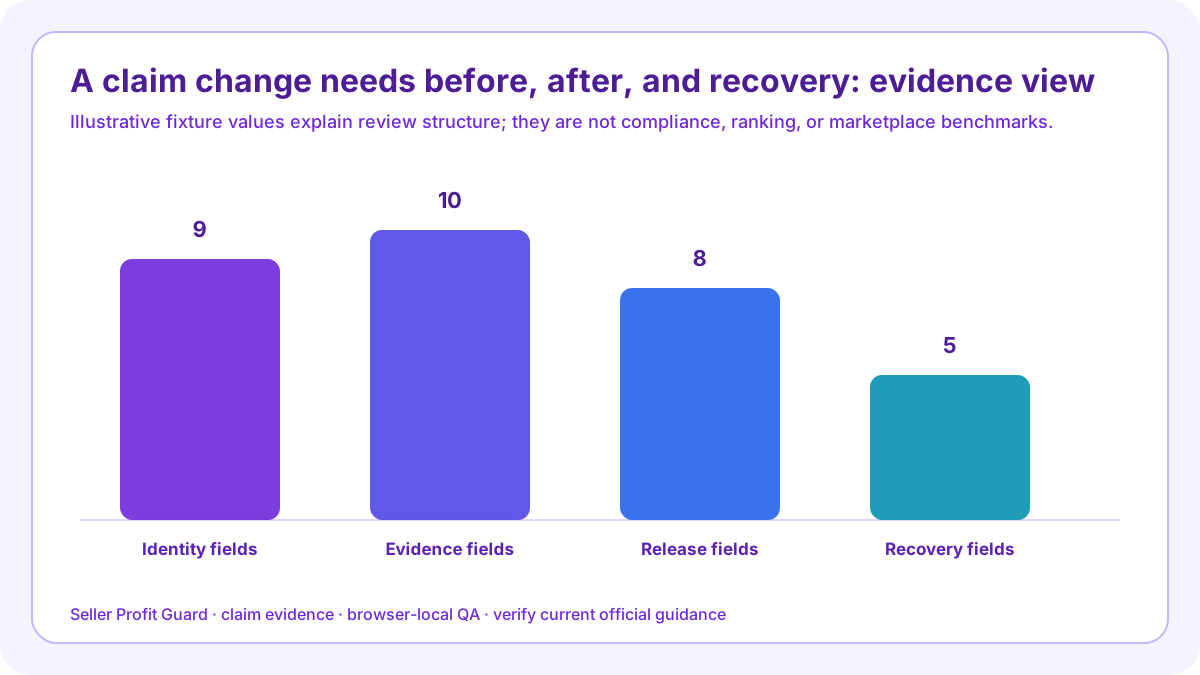
A complete audit records listing identity, exact public claims and surfaces, claim type, component or origin records, measurement or test method and result, image implications, qualifications, high-risk review, known issues, reviewer and date, before-state backup, release approval, public verification, rollback result, unresolved authority, and the next evidence-refresh trigger.

claim audit record: scope and decision
The audit sheet exists so another reviewer can reproduce the decision without reading private chat or guessing which listing, component, image, test, or source was used. It records before state, expected result, approval, after state, public feedback, and recovery.
Keep fields atomic. Claim text, public surface, evidence source, qualification, result, owner, reviewer, and date should not share one unstructured note. Atomic fields make contradictions, stale versions, missing approvals, and rollback values visible.
Build the reversible claim audit sheet before editing
Use aliases and data minimization. Store sensitive supplier, customer, order, payment, design, credential, and certificate materials only in the approved private system. The audit can reference a controlled record without copying it into public content.
An empty field means unresolved, not not applicable. Use an explicit not-applicable reason with an accountable reviewer when a layer genuinely does not apply. Preserve rejected and rolled-back candidates for regression and correction history.
Section 1: listing and product identity
Record listing alias, SKU or variant, candidate version, product format, component map, selected public surfaces, review purpose, owner, and exact date.
In the reversible claim audit sheet, “Section 1: listing and product identity” needs a before value, authority, expected fixture, reviewer, approval, after value, public observation, and rollback closure. Record a complete before-and-after evidence trail and a checkbox with no source or public observation with privacy-safe aliases. An empty field remains unresolved. A checked box without evidence, surface, version, or feedback cannot demonstrate reviewable release closure.
Section 2: claim manifest
Record one row per buyer takeaway with claim type, exact surface, wording or visual implication, evidence reference, qualification, and status.
In the reversible claim audit sheet, “Section 2: claim manifest” needs a before value, authority, expected fixture, reviewer, approval, after value, public observation, and rollback closure. Record a complete before-and-after evidence trail and a checkbox with no source or public observation with privacy-safe aliases. An empty field remains unresolved. A checked box without evidence, surface, version, or feedback cannot demonstrate reviewable release closure.
Section 3: product and component evidence
Record specification, maker or supplier source, batch or receipt reference, applicable certificate, measurement, provenance, origin, limitations, version, and freshness.
In the reversible claim audit sheet, “Section 3: product and component evidence” needs a before value, authority, expected fixture, reviewer, approval, after value, public observation, and rollback closure. Record a complete before-and-after evidence trail and a checkbox with no source or public observation with privacy-safe aliases. An empty field remains unresolved. A checked box without evidence, surface, version, or feedback cannot demonstrate reviewable release closure.
Section 4: performance and compatibility
Record method, instrument or fixture, sample or model, condition, result, tolerance, exception, reviewer, date, and whether stronger claims are explicitly excluded.
In the reversible claim audit sheet, “Section 4: performance and compatibility” needs a before value, authority, expected fixture, reviewer, approval, after value, public observation, and rollback closure. Record a complete before-and-after evidence trail and a checkbox with no source or public observation with privacy-safe aliases. An empty field remains unresolved. A checked box without evidence, surface, version, or feedback cannot demonstrate reviewable release closure.
Section 5: visual and disclosure map
Record each actual image, caption, badge, comparison, prop, quantity, variation, excluded item, component label, qualification placement, and observed buyer takeaway.
In the reversible claim audit sheet, “Section 5: visual and disclosure map” needs a before value, authority, expected fixture, reviewer, approval, after value, public observation, and rollback closure. Record a complete before-and-after evidence trail and a checkbox with no source or public observation with privacy-safe aliases. An empty field remains unresolved. A checked box without evidence, surface, version, or feedback cannot demonstrate reviewable release closure.

Section 6: risk and approval
Record health, safety, environmental, certification, guarantee, comparative, origin, or test-proven escalation; reviewer competence; decision; date; and unresolved authority.
In the reversible claim audit sheet, “Section 6: risk and approval” needs a before value, authority, expected fixture, reviewer, approval, after value, public observation, and rollback closure. Record a complete before-and-after evidence trail and a checkbox with no source or public observation with privacy-safe aliases. An empty field remains unresolved. A checked box without evidence, surface, version, or feedback cannot demonstrate reviewable release closure.
Section 7: release and public verification
Record narrow backup, rollback identifier, approved surfaces, release operator, timestamp, desktop and mobile observation, canonical state, links, and correction result.
In the reversible claim audit sheet, “Section 7: release and public verification” needs a before value, authority, expected fixture, reviewer, approval, after value, public observation, and rollback closure. Record a complete before-and-after evidence trail and a checkbox with no source or public observation with privacy-safe aliases. An empty field remains unresolved. A checked box without evidence, surface, version, or feedback cannot demonstrate reviewable release closure.
Section 8: measurement and next trigger
Record aggregate engagement and qualified intent separately from claim evidence, source-refresh date, product-change trigger, complaint category, unresolved issue, next owner, and next review.
In the reversible claim audit sheet, “Section 8: measurement and next trigger” needs a before value, authority, expected fixture, reviewer, approval, after value, public observation, and rollback closure. Record a complete before-and-after evidence trail and a checkbox with no source or public observation with privacy-safe aliases. An empty field remains unresolved. A checked box without evidence, surface, version, or feedback cannot demonstrate reviewable release closure.
Verification, release, and rollback controls
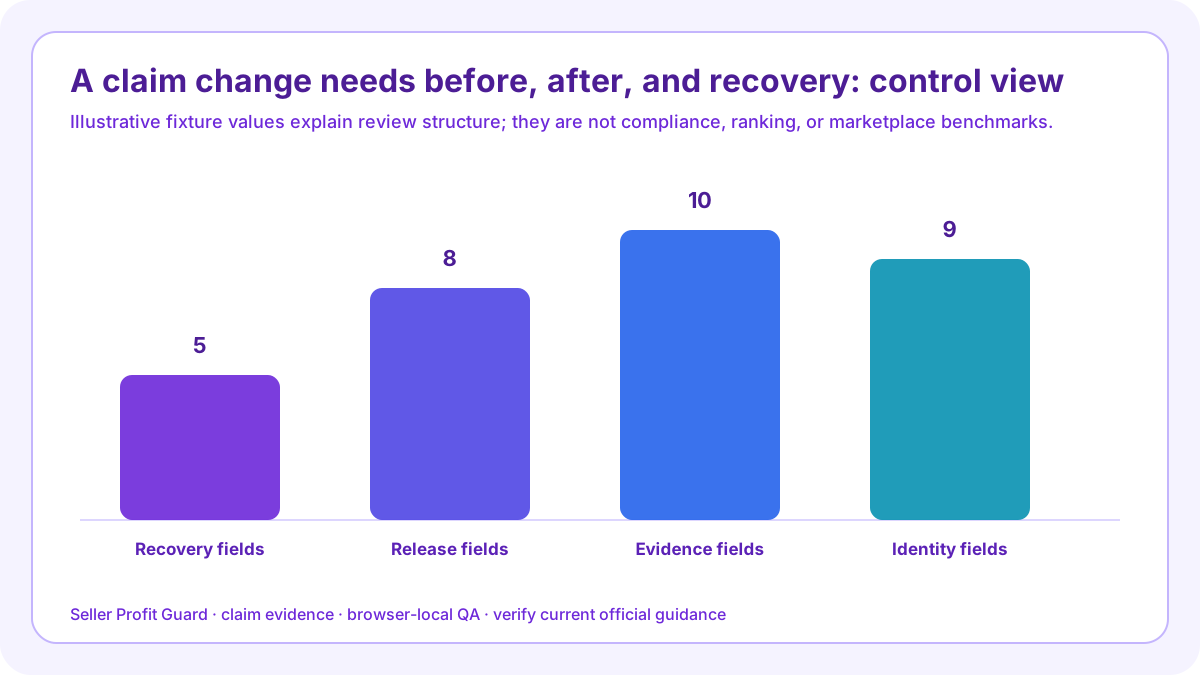
Before changing public copy or media, preserve the reversible claim audit sheet, title, description, attributes, images, captions, badges, video, component records, measurements or tests, qualifications, approvals, and rollback identifier. Confirm the correct account and listing. Safe-stop on login or CAPTCHA ambiguity, a platform warning, wrong profile, missing target context, private data, or unexpected editor behavior.
After one bounded change, verify a complete before-and-after evidence trail on desktop and mobile and deliberately revisit a checkbox with no source or public observation. Inspect every declared surface, qualification, image implication, and evidence-dependent statement. Restore the approved previous packet when a critical public observation does not support reviewable release closure.
Limits, privacy boundary, and next action
This guide and checker use seller-entered summaries, aliases, manifests, and synthetic fixtures. They do not inspect products, authenticate records, assay materials, perform laboratory tests, analyze image pixels, determine origin, certify claims, decide applicable law, reproduce Etsy review, or predict ranking, clicks, conversion, sales, complaints, refunds, income, or AdSense approval.
Keep buyer identities, emails, addresses, messages, order IDs, receipts, payment data, supplier credentials, private certificates, unreleased designs, tokens, OAuth material, and raw CSV rows outside the reversible claim audit sheet. Repair the accountable source, rerun complete and broken fixtures, obtain required human review, release only the approved packet, inspect public surfaces, and record verified closure or rollback.
Sources and further reading
- Etsy Seller Policy: Current accuracy, origin, provenance, materials, components, disclosures, legal obligations, and misleading-content responsibilities.
- Etsy Creativity Standards: Current made, designed, handpicked, sourced, AI-disclosure, and human-contribution boundaries.
- Etsy Listing Image Requirements: Current original finished-product image expectations and specified exceptions.
- Etsy Prohibited Items Policy: Current prohibited-item policy in force through August 11, 2026; recheck the effective version before release.
- Etsy Medical Claims Policy: Current disease, treatment-substitute, sensitive-health, supplement-approval, testimonial, image, and disclaimer boundaries.
- FTC Advertising Substantiation Policy Statement: Official reasonable-basis framework for objective express and implied claims before dissemination.
- FTC Advertising FAQs for Small Business: Official explanation of objective evidence, reasonable basis, and the stronger support often expected for health and safety claims.
- FTC Environmental Claims: Green Guides Summary: Official summary for specific environmental claims and clear, prominent qualifications.
- Seller Profit Guard methodology: Evidence hierarchy, privacy-safe fixtures, deterministic decisions, uncertainty, verification, correction, and rollback.
Related Seller Profit Guard tools
- Open the Etsy Listing Claims Checker: Map public claims to evidence, qualifications, visuals, risk review, and approval.
- Check Etsy description clarity: Review buyer-question completeness separately from claim substantiation.
- Check Etsy photo coverage: Audit the image set separately while reconciling visual implications.
- Check Etsy attribute coverage: Keep structured product facts aligned with public claim wording.
- Check production-partner disclosure: Review outside-production roles, public identity, location, and dispatch origin.
- Read the local-first methodology: Use aliases, synthetic fixtures, dated evidence, public verification, and rollback.
- Etsy Listing Claims Checker: 9 Inputs: Continue the claim, evidence, scenario, decision, operating, interpretation, or audit workflow.
- Etsy Material Claim: A Component Example: Continue the claim, evidence, scenario, decision, operating, interpretation, or audit workflow.
- Etsy Compatibility Claim: A Sleeve Example: Continue the claim, evidence, scenario, decision, operating, interpretation, or audit workflow.
- 14 Etsy Listing Claim Mistakes to Block: Continue the claim, evidence, scenario, decision, operating, interpretation, or audit workflow.
- Etsy Claim Evidence: Source Hierarchy: Continue the claim, evidence, scenario, decision, operating, interpretation, or audit workflow.
Next step: Open the Etsy Listing Claims Checker.
This is operational planning help, not tax, accounting, legal, financial, or platform-policy advice. Review the Terms and disclaimer, and verify current platform rules and fee assumptions before changing prices.