Seller Profit Guard · How it works · CSV privacy
Etsy variation and SKU risk checker
Use a local Etsy order-item CSV and SKU cost library to find five evidence-based variation risks: missing SKUs, missing variation text, one SKU tied to multiple variation labels, one item-and-variation tied to multiple SKUs, and high-volume SKUs without cost coverage. The checker produces a review list, not a margin score or automatic listing decision.
Maintained by Seller Profit Guard Editorial Team. Last reviewed: 2026-07-28.
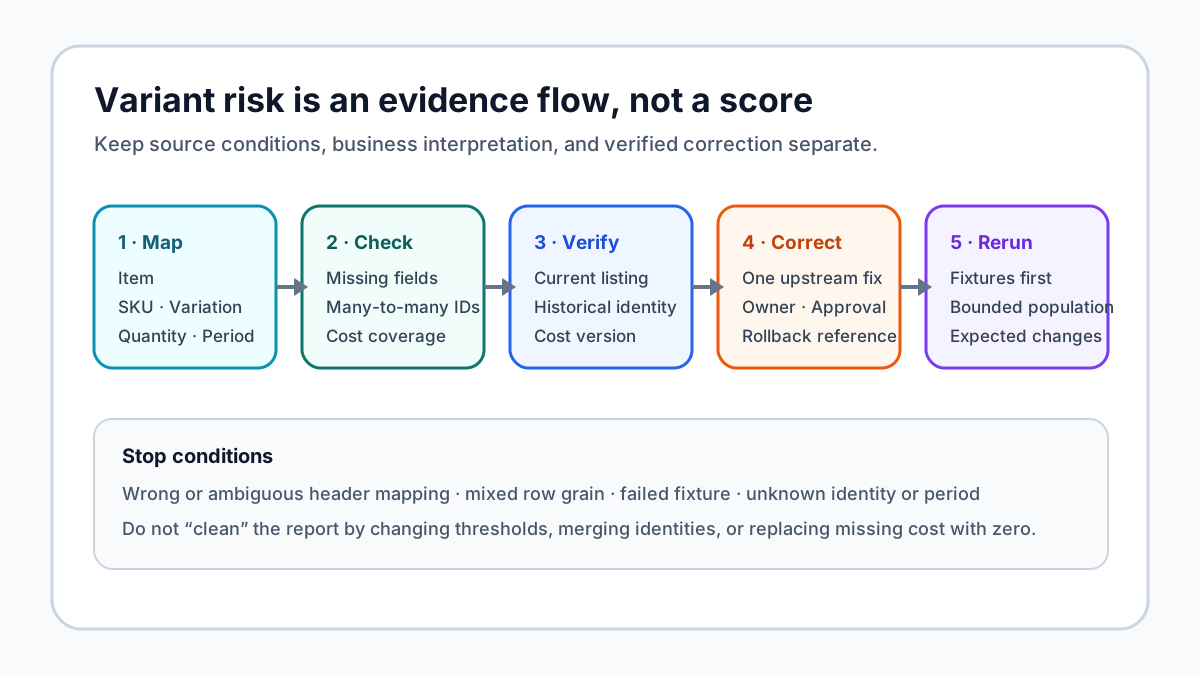
What the Etsy variant risk checker actually tests
The checker reads the item, seller-defined SKU, selected variation text, and quantity from a mapped Etsy order-item export. It groups identical item–SKU–variation combinations, sums quantity, counts source rows, and normalizes comparison text by trimming outer space, lowercasing it, collapsing repeated spaces, and standardizing spaces around colons. It does not translate labels, guess synonyms, infer a missing SKU, or decide that two differently named options are economically identical.
Five deterministic warning families are produced. A grouped row receives a missing-SKU warning when the SKU field is blank and a missing-variation warning when the selected variation text is blank. The checker also builds directed relationship maps: each normalized SKU to the normalized variation strings observed with it, and each normalized item-plus-variation to the normalized SKUs observed with it. More than one value on the opposite side creates a relationship warning that must be verified against current and historical listing evidence.
The fifth warning is a cost-coverage priority. When grouped quantity reaches the operator's selected threshold and the normalized SKU has no matching record in the browser-local cost library, the row is flagged for cost evidence. The threshold changes which missing-cost rows are prioritized; it does not turn an unknown cost into zero, prove a loss, or make lower-volume gaps safe.
- Missing SKU: the selected export contains a blank seller identifier.
- Missing variation: the selected export contains no option text for the grouped row.
- SKU to multiple variations: one normalized SKU appears with several normalized option strings.
- Variation to multiple SKUs: one normalized item-and-option identity appears with several SKUs.
- High-volume missing cost: a threshold-qualified SKU lacks a cost-library join.
Inputs, row grain, units, and validation rules
Use an Etsy sold-transactions or order-item export that represents one bounded review period. The minimum useful mapping is item title, seller SKU, selected variation text, and quantity. Quantity must be a finite non-negative number at the exported row grain. The checker counts imported rows separately from quantity so a seller can distinguish five units on one row from five source rows. Currency is not used in the identity checks; cost-library presence is tested by normalized SKU, while later margin work must validate each cost component, currency, unit, and effective date.
Confirm the detected headers before interpreting results. A column named Variant may contain personalization, a free-form choice, or a combined option string depending on the export. A column named SKU may be empty because the listing had no seller-defined identifier, because a historical export omitted it, or because the wrong field was mapped. The tool cannot distinguish those causes without source review. Reject an import when the selected columns do not describe the expected population or when mixed row grains would duplicate quantities.
Run at least one clean fixture and one negative fixture before reviewing a private file. A clean fixture should preserve a one-to-one identity and an existing cost record. Negative fixtures should separately demonstrate a blank SKU, blank variation, SKU-to-many relation, variation-to-many relation, and threshold-qualified missing cost. If a known defect does not appear, stop and correct the mapping or checker version before using any clean result.
- Required operational fields: item, SKU, variation, and quantity.
- Comparison normalization changes formatting only, not business meaning.
- Quantity threshold is a prioritization control, not a profitability threshold.
- Cost coverage means a joined record exists; it does not validate that record's value.
- Unknown, provisional, observed, and approved evidence should remain distinguishable.
Worked example: four size rows and three root issues
Assume a bounded T-shirt export contains four grouped observations. Row A is item Classic Tee, SKU TS-M, variation Size: M, quantity 2. Row B uses the same SKU TS-M with variation Size: Medium, quantity 1. Row C is Classic Tee, blank SKU, variation Size: L, quantity 1. Row D is SKU TS-XL, variation Size: XL, quantity 3, but TS-XL is absent from the selected cost library. With the missing-cost threshold set to 3, the checker produces relationship and coverage evidence without calculating a monetary loss.
TS-M appears with two normalized variation strings, so it receives a SKU-to-multiple-variations warning. That may be a harmless historical label rename, or it may reveal that two distinct options share one identifier. The blank Large row receives a missing-SKU warning. TS-XL reaches the threshold and receives a missing-cost warning. Three displayed warning rows do not necessarily equal three independent causes: a listing migration, mapping error, or incomplete cost version can create several symptoms.
The safe response is not to rename everything immediately. First verify whether M and Medium refer to the same operational and economic identity during the covered periods. Recover or create a stable identifier for Large without overwriting historical evidence. Add or approve the correct TS-XL cost version with units and an effective date. Re-export the same bounded period or rerun preserved fixtures, confirm the intended warning changes, and keep the previous mapping and cost version as rollback references.
| Observed group | Deterministic finding | Verification before action |
|---|---|---|
| TS-M · Size: M and Size: Medium · qty 3 | One SKU maps to two normalized labels | Check historical rename and whether both labels share one product and cost identity |
| Blank SKU · Size: L · qty 1 | Missing seller SKU | Verify source mapping, current listing setup, and recoverable historical identity |
| TS-XL · Size: XL · qty 3 | Threshold-qualified missing cost record | Validate SKU join, cost components, units, currency, evidence state, and effective date |
A second scenario: one material label with two SKU versions
A material-based listing exposes a different ambiguity. Suppose Walnut was sold under SKU WB-WALNUT through March and WB-WALNUT-V2 from April after a supplier and packaging change, while the buyer-facing variation label stayed Walnut. The item-plus-variation relationship now points to two SKUs. The checker correctly reports the observed many-SKU relationship, but it cannot decide whether the second SKU is a controlled version, an accidental duplicate, or a temporary migration overlap.
Compare effective dates, active status, bill of materials, packaging, fulfillment path, supplier source, and cost evidence. A clean non-overlapping replacement with preserved history may be valid. Two simultaneously active SKUs representing the same sellable option can fragment cost joins and inventory operations. Two SKUs may also be justified when the visible label hides materially different economic identities, but then the current listing and fulfillment workflow must still route orders reproducibly.
Do not merge the versions simply to remove the warning. Record the classification and downstream mapping. If history must remain split, ensure each sold period joins to the correct cost version. If an accidental duplicate is corrected, preserve the former identifier, listing snapshot, change owner, approval, and restoration path. The warning closes only when the identity rule and rerun evidence agree.
- Replacement: distinct effective periods and a documented version transition.
- Collision: overlapping active identities with no defensible operational difference.
- Intentional split: distinct economic or fulfillment identities with a stable routing rule.
- Unknown: insufficient evidence; hold SKU-level margin conclusions.
Data sources and evidence hierarchy
Use the sold-transactions or order-item export to answer what appeared in the selected historical period. Use the active-listing export or Shop Manager to answer how the listing is configured now. Use the seller's SKU cost library to answer whether an identity has dated material, labor, packaging, fulfillment, and other cost evidence. These sources have different time scopes and should not be silently collapsed into one current-state table.
For every run, preserve the export date, period, row count, selected header mapping, normalization rule, missing-cost threshold, cost-library fingerprint, and application version. A file checksum proves only that bytes did not change. It does not prove that the operator selected the right period or mapped the right columns. A screenshot can help explain a setting but is weaker than a reproducible export, versioned rule, and saved fixture result.
Etsy's official SKU and listing-variation documentation defines the platform controls available to sellers. Etsy's export documentation describes the available download workflow and fields. Seller Profit Guard adds a local operational QA layer; it does not represent Etsy, read the seller's live account, or certify marketplace compliance. Recheck official documentation when Etsy changes export fields or listing controls.
| Source | Question answered | Do not infer |
|---|---|---|
| Sold transaction or order-item export | What SKU, option text, and quantity appeared in the selected period | Current listing state or complete financial settlement |
| Active listing export or Shop Manager | Current option, quantity, price, and seller SKU configuration | What historical orders contained |
| Private SKU cost library | Whether a versioned cost record exists for the joined identity | That values are accurate merely because the row exists |
| Change log and fixtures | Why a mapping changed and whether known cases still behave | Marketplace approval or accounting correctness |
How to distinguish warnings from business decisions
A warning is evidence about a selected population and control version. It is not a forecast, probability, accounting loss, policy violation, inventory shortage, or instruction to delete a variation. Read the scope first, then the exact warning condition, relationship direction, grouped quantity, source-row count, and cost-library state. Only after that should an operator classify likely cause and operational impact.
Use a three-state decision contract. Use a result when the mapping is verified, identity is explainable, cost coverage is appropriate for the period, and a bounded fixture reproduces the condition. Hold a downstream SKU margin conclusion when identity, period, or cost version is ambiguous. Escalate repeated or high-impact ambiguity to a second operator when the proposed correction could affect active listings, fulfillment, inventory, historical joins, or pricing.
Counts need separate meanings. Warning rows describe grouped output; root issues describe classified causes; affected quantity describes selected units; affected orders describe a different grain; verified fixes describe completed upstream changes. Reporting only the largest number creates false urgency, while reporting only root causes can hide workload and affected volume.
- Use: evidence and control checks support a bounded operational conclusion.
- Hold: source identity, mapping, cost version, or period remains ambiguous.
- Escalate: recurrence or impact makes independent review proportionate.
- Never change the quantity threshold merely to make the report look clean.
Privacy and local-first handling
Variant QA needs item, seller SKU, selected variation, quantity, and cost-join context. Buyer names, email addresses, phone numbers, delivery addresses, private messages, personalization text, payment credentials, and full order identifiers are unnecessary. Seller Profit Guard processes selected CSV data in the browser and removes recognized private columns during parsing, but the operator must still inspect unknown headers before using or sharing any export.
Commercial sensitivity remains after personal fields are removed. SKU conventions, supplier terms, cost coverage, order mix, volume thresholds, exception lists, and remediation plans can reveal seller strategy. Store raw files and detailed fix lists in controlled locations. Use dummy rows, aggregate counts, redacted identifiers, and non-reversible fingerprints in public documentation, analytics, issue reports, or community drafts.
Do not upload a private buyer or order CSV to prove that a warning exists. Reproduce the condition with a dummy fixture that preserves the relevant structure. If a field is not needed for identity, grouping, quantity, or cost coverage, exclude it. Review the site's Data Privacy page and retention controls before exporting a fix list.
- Keep raw exports out of source control and public support channels.
- Use dummy identities in screenshots and worked examples.
- Do not send raw row values to analytics events.
- Treat cost and volume data as commercially sensitive even after redaction.
A reversible operating routine
Begin by preserving the source export, mapping, cost-library version, and last accepted report. Load a bounded period or public dummy fixture, confirm the four required fields, run clean and negative fixtures, and then generate the current warning list. Triage one root issue at a time so a later rerun can attribute the observed change to a specific upstream correction.
Verify each finding against the current listing and relevant history. Assign an owner, proposed correction, due date, approver, and rollback reference. Correct the upstream listing, SKU policy, import mapping, or cost record rather than editing only the downloaded fix list. Rerun the same fixtures and a bounded source population. Compare expected warning additions, removals, unchanged exceptions, and row counts before accepting the new state.
Monitor recurrence instead of declaring permanent cleanliness. Useful measures include missing-identity groups, ambiguous relations, cost coverage by active or sold SKU, exceptions by impact, reopened findings, time to verified closure, and downstream rows blocked from cost analysis. If the same defect returns, improve the input contract, listing workflow, cost-library ownership, or validation test rather than repeating manual cleanup.
- Preserve the current source, mapping, cost version, report, and restoration reference.
- Run one clean fixture and isolated negative fixtures for every warning family.
- Import a bounded review period and classify root causes separately from warning rows.
- Verify current and historical identity before changing listing or cost data.
- Apply one reversible upstream correction with an owner and approval.
- Rerun fixtures and the bounded population; record expected and unexpected changes.
- Monitor recurrence and change the control when the same defect returns.
Common failure modes the checker cannot repair
Wrong header mapping is the highest-risk failure because deterministic logic will consistently analyze the wrong fields. Mixed row grain can double-count quantity. Over-normalization can collapse distinct labels, while under-normalization can turn harmless formatting changes into apparent identity differences. Reused SKUs, bundled components, historical renames, manual fulfillment aliases, and incomplete cost imports all require seller context outside the checker.
A cost-library row is not automatically trustworthy. Zero may be a valid measured value for one component, a placeholder, or a missing value disguised as a number. Average product cost can hide variation-specific material or fulfillment differences. Currency, tax treatment, labor units, packaging units, and effective periods need independent validation before profit analysis.
A clean result means the five selected checks found no qualifying condition in the chosen population under the chosen mapping and threshold. It does not prove inventory accuracy, marketplace compliance, correct prices, positive margin, tax treatment, refund exposure, advertising efficiency, or future listing behavior. Use the Profit Guard and reconciliation workflows only after identity and cost joins are suitable for their decision grain.
- Stop on unverified headers, mixed row grain, or an unexpected fixture result.
- Keep semantic identity separate from formatting normalization.
- Do not use portfolio-average cost to close variation-level evidence gaps.
- Do not interpret a clean report beyond the five documented controls.
Audit checklist, limits, and next actions
A defensible audit records scope, source fingerprints, detected headers, confirmed mapping, row grain, normalization version, quantity threshold, cost-library fingerprint, fixture results, grouped counts, warning relationships, root-cause classification, evidence state, upstream correction, reviewer, rerun, monitoring, and rollback. Checked boxes without reproducible evidence do not prove that a finding was resolved.
Use the ten linked guides to inspect formula and inputs, a complete size example, a material-version scenario, common mistakes, data sources, decision thresholds, scenario comparison, operating routine, interpretation, and a reusable audit template. Each guide answers a distinct task and links back to this working checker. The guide set does not replace current Etsy documentation or seller-specific records.
The tool does not connect to Etsy, alter a listing, recover a missing historical identifier, value inventory, calculate accounting profit, determine tax, or authorize pricing. Its value is narrower and testable: expose selected identity and cost-coverage conditions early enough for a seller to verify them. For a material decision, preserve uncertainty, inspect current official sources, and obtain qualified advice when operational planning crosses into accounting, tax, legal, or marketplace-policy judgment.
- Review source and control versions before every material run.
- Require reproducible fixtures and a bounded rerun for closure.
- Keep private and commercially sensitive data out of public evidence.
- Move to contribution analysis only after the required SKU and cost joins are explainable.
Sources and further reading
- Etsy Help: How to Use SKU for Your Inventory: Official Etsy guidance on seller-defined SKUs and inventory identification.
- Etsy Help: How to Add Variations for Your Listings: Official controls for listing variations and option-level SKU, price, quantity, and processing settings.
- Etsy Help: Download Sold Transaction Spreadsheets: Official export workflow and seller-added SKU field context.
- Etsy Help: Download Your Listing Information: Official active-listing export fields for current setup review.
- Seller Profit Guard calculation methodology: Evidence hierarchy, editable assumptions, local-first processing, contribution scope, and uncertainty.
Related Seller Profit Guard tools
- Etsy CSV profit calculator: Run a local order profit check with editable fee and SKU cost assumptions.
- Payment reconciliation tool: Compare order rows with statement activity and flag unmatched rows.
- SKU cost library: Save or import material, labor, packaging, shipping, and target margin assumptions.
- Variant risk checker: Find missing SKUs and variation cost risks before a listing scales.
- Etsy title checker: Review listing-title clarity, repetition, keyword chains, and mobile scanning.
- Etsy tag checker: Review all 13 tag slots for duplicates, repeated meaning, and truthful coverage.
- Free shipping threshold calculator: Estimate when a shipping subsidy can still meet a target margin.
- Return window loss estimator: Model expected reverse shipping, restock work, recovery, and replacement loss.
- Etsy Ads break-even calculator: Estimate target-safe Etsy Ads spend, ACOS, and ROAS after fees, fulfillment, and expected return loss.
- CSV data privacy: Understand what the local-first workflow needs and what it does not need.
- Etsy Variant Risk: 5 Checks Before Margin Review: Map Etsy variation names, SKUs, quantity, order count, and SKU cost coverage into five deterministic risk checks before pricing or margin analysis.
- Etsy Size Variation Audit: One SKU, Two Labels: Follow a complete Etsy size-variation example that exposes one SKU mapped to two labels, a missing SKU, and a high-volume cost gap.
- Etsy Material Variations: One Label, Two SKUs: Audit a material-based Etsy variation where one item-and-option label maps to multiple SKUs and material cost coverage differs.
- Etsy Variant Audit: 12 Mistakes That Hide Risk: Correct twelve Etsy variation and SKU audit mistakes involving mapping, normalization, thresholds, historical identity, cost coverage, and interpretation.
- Etsy Variant Audit Data: 6 Sources to Reconcile: Map Etsy sold transactions, active listings, Shop Manager, SKU costs, fulfillment records, and change logs to variant-risk inputs.
- Etsy Variant Risk Thresholds: Use, Hold, Escalate: Set evidence-based use, hold, and escalation thresholds for missing SKUs, variation collisions, and high-volume cost gaps.
- Etsy Size vs Material Variants: Two Risk Patterns: Compare a size-label collision with a material SKU-version collision at the same order-item grain and choose the correct remediation.
- Weekly Etsy Variant Audit: A 40-Minute Routine: Run a repeatable weekly Etsy variation and SKU review with bounded exports, fixtures, exception ownership, reruns, and rollback.
- Read Etsy Variant Warnings Without False Precision: Interpret five Etsy variant and SKU warning families by evidence, scope, threshold, root cause, and responsible next action.
- Etsy Variant Audit Checklist and Change Log: Audit Etsy variation identity, SKU relationships, cost coverage, fixtures, privacy, corrections, approvals, and rollback with a reusable template.
Use the interactive tool
Enable JavaScript to open the calculator and process browser-local inputs. The explanatory content and source links remain available without JavaScript.
Related guide: Read the Etsy variation SKU checklist.
This tool provides operating estimates, not tax, accounting, legal, financial, or marketplace-policy advice. Verify current official sources and your own records before changing prices or operations.