Reliable data sources for an Etsy variant-risk audit
Last updated: 2026-07-30
Written and reviewed by Seller Profit Guard Editorial Team.
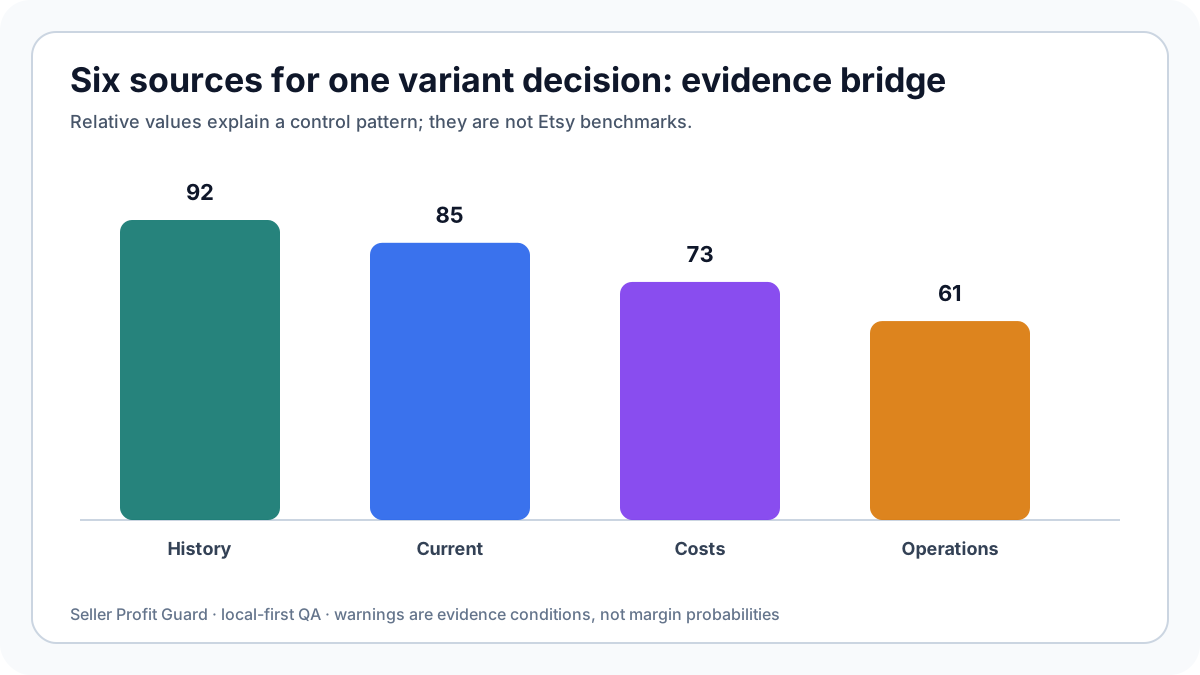
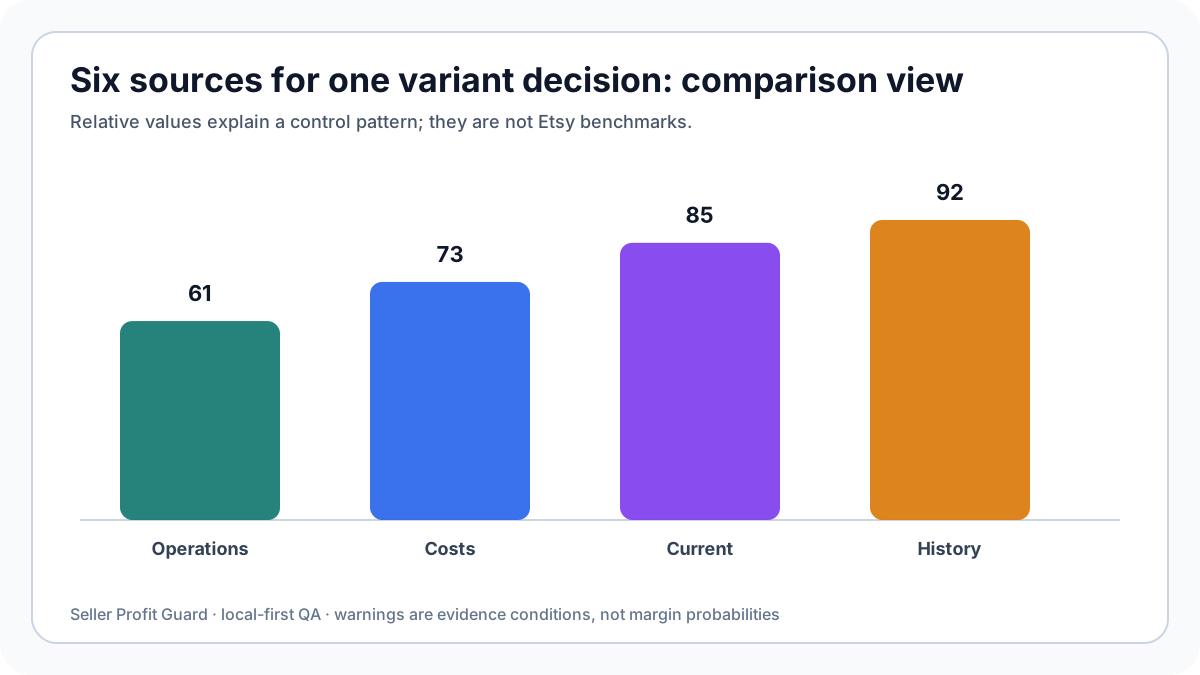
A reliable variant audit reconciles six evidence classes: sold-transaction order items, active-listing exports, current Shop Manager settings, seller-owned SKU cost records, fulfillment or inventory evidence, and a dated identity change log. No single export proves both historical mapping and current economics, so source scope must remain visible.

What does the sold-transaction export prove?
Etsy's official sold-transaction download can include item price, item title, and seller-added SKU numbers. Order-item rows are the best starting point for what sold during a selected period, which SKU and variation text were recorded, and how much quantity appeared. Preserve export type, month or year, download date, detected fields, and row count.
The export does not prove that the current listing still uses the same option label, SKU, cost, inventory, or price. It also does not supply the seller's private material, labor, packaging, and fulfillment economics. Treat missing fields as source limitations until mapping is verified.
Use bounded periods when investigating a change. A whole-year file can mix renames, replacements, and policy changes that require effective-date classification.
| Source | Strong evidence for | Weak evidence for |
|---|---|---|
| Sold transactions | Observed sold SKU/variation/quantity | Current listing state |
| Active listing export | Current title/price/quantity/SKU | Historical sold mapping |
| Shop Manager | Current option controls | Private cost |
| Cost library | Seller-owned cost layers | Etsy listing configuration |
| Fulfillment record | Operational identity | Marketplace fee |
| Change log | Why and when identity changed | Unlogged history |
How do current listing sources complement sold rows?
Etsy's active-listing information export can include title, price, currency, quantity, and SKU. Shop Manager shows the current variation configuration. Etsy's variation guidance says sellers can vary price, quantity, processing profile, or SKU by option. Compare these current controls with recent sold rows rather than assuming the storefront and export share identical text forever.
Capture only the fields needed for operational reconciliation. A listing screenshot can support a one-time review but is difficult to test in bulk. Prefer structured exports plus a small controlled visual check for edge cases such as hidden, sold-out, or newly renamed options.
Current state cannot rewrite history. When a sold row uses an old label or SKU, retain the observation and attach a dated classification instead of replacing it with today's listing value.

What belongs in the private SKU and fulfillment evidence?
The SKU cost library should record stable SKU, material, labor, packaging, fulfillment, other variable costs, target margin, source, units, effective date, and evidence state. The Variant Risk Checker uses the presence of normalized SKU coverage for one warning; later contribution work must validate the actual values and version.
Fulfillment and inventory records can explain why two visible options require distinct SKUs or why a SKU replacement occurred. Location, component, supplier, process, package, barcode, or channel identity may matter operationally. Keep these records private and reference them through controlled identifiers in the audit log.
Do not add a placeholder zero-cost record merely to clear the queue. Use provisional status with explicit unknown layers if the business must continue measuring, and keep the warning or a separate exception until sufficient evidence exists.
How should a source register be designed?
Record source ID, type, controlled location, export or effective date, covered period, row count, relevant fields, currency, mapping version, fingerprint, owner, reviewer, refresh trigger, and privacy class. Link every finding to the minimum necessary source references.
Reconcile counts across imports: source rows, usable order rows, grouped item–SKU–variation combinations, unique normalized SKUs, unique normalized item–variation keys, cost-covered SKUs, warning rows, and root issues. Explain every material difference rather than relying on one completion percentage.
- Scope and period.
- Field and mapping version.
- Controlled fingerprint.
- Privacy class.
- Refresh trigger.
- Finding references.
Variant-risk data-source questions
Can the active listing export replace sold transactions? No. It describes current listings, not necessarily historical orders.
Does the sold export contain cost? No. Cost is seller-owned evidence.
Should screenshots be the primary dataset? No. Use structured data and bounded visual confirmation.
Can a cost-library row be provisional? Yes, if uncertainty and prohibited uses remain explicit.
What source is authoritative? Authority is field-specific: use the source that directly records the claim under review.
Which evidence supports this variant-risk source map?
Use the Etsy order-item or sold-transaction export for observed item title, seller-added SKU, selected variation text, quantity, and transaction frequency. Use the active-listing export or Shop Manager for current listing, option, price, quantity, and SKU setup. Use the seller's private cost library for material, labor, packaging, fulfillment, and other cost coverage. These sources answer different questions and should not be silently merged into one truth table.
Preserve the export date, covered period, row count, detected headers, mapping version, normalization rule, cost-library fingerprint, and checker version. Verify at least one harmless dummy row from source fields through the exported fix list. A checksum can show that a file did not change; it cannot prove that the seller mapped the SKU, variation, quantity, or item columns correctly.
Classify findings by evidence: an empty SKU is observed in the selected export; one normalized SKU mapping to several normalized variation strings is a deterministic consistency warning; a high-volume SKU without a cost record is a coverage warning under the chosen quantity threshold. None of those findings alone proves accounting loss, listing-policy violation, inventory shortage, or buyer harm.
- Keep listing identity, sold-order observations, and private cost evidence separate.
- Record the period, mapping, normalization, threshold, and library fingerprint.
- Use seller-defined SKUs as identifiers, not universal marketplace product codes.
- Confirm findings in the current listing and relevant historical records before changing data.
- Treat tax, accounting, legal, and marketplace-policy questions as separate professional or official-source work.
Privacy and commercial sensitivity for variant-risk source map
The checker needs item, SKU, variation, quantity, and mapping context. Buyer names, email addresses, phone numbers, delivery addresses, private messages, personalization text, and payment credentials are unnecessary. Seller Profit Guard removes recognized private columns during parsing and performs the analysis in the browser, but the operator must still inspect unknown headers and avoid sharing raw exports.
Cost-library values, supplier terms, sell-through, variation mix, and exception lists can reveal commercial strategy even when buyer data is absent. Keep raw CSVs and detailed fix lists in controlled storage. Public reports should use dummy examples, aggregate counts, redacted identifiers, and non-reversible fingerprints. Never paste a private transaction row into an article, issue, analytics event, or community post.
How to apply this variant-risk source map in the Variant Risk Checker
Open Seller Profit Guard, load a recent Etsy order-item CSV or a public dummy fixture, confirm the detected item, SKU, variation, and quantity columns, and load the matching SKU cost library. The checker groups rows by item, SKU, and variation, normalizes case and spacing for comparison, then reports five bounded warning families: missing SKU, missing variation text, one SKU linked to multiple variation strings, one item-and-variation linked to multiple SKUs, and a high-volume SKU without a matching cost record.
Review the highest-impact warning with its source row and current listing. Correct the upstream listing, SKU policy, export mapping, or cost record; do not merely edit the downloaded fix list. Re-export a bounded period, rerun the same mapping and threshold, and compare the warning with the saved evidence. The tool is operational QA, not an Etsy connection, inventory system, accounting ledger, or guarantee of margin.
- Use a bounded export and confirm the detected mapping.
- Load or create the matching SKU cost assumptions locally.
- Review each warning code and its grouped quantity and order count.
- Verify the current listing and historical identity before making a correction.
- Rerun the same fixture and record the result, owner, date, and rollback.
Sources and further reading
- Etsy Help: How to Use SKU for Your Inventory: Official Etsy guidance on seller-defined SKUs, inventory identification, and practical SKU naming.
- Etsy Help: How to Add Variations for Your Listings: Official listing-variation workflow and controls for option-level price, quantity, processing profile, and SKU.
- Etsy Help: Processing Times, Profiles, and Ship-By Dates: Official definition of physical-item processing time and the current listing- or variation-level processing-profile workflow.
- Etsy Help: Download Sold Transaction Spreadsheets: Official order-item export workflow and confirmation that seller-added SKU numbers can appear in the downloaded data.
- Etsy Help: Download Your Listing Information: Official active-listing export fields, including price, currency, quantity, and seller-added SKU numbers.
- Seller Profit Guard calculation methodology: Definitions for editable assumptions, evidence hierarchy, local-first processing, contribution scope, and uncertainty.
Related Seller Profit Guard tools
- Open the Variant Risk Checker: Check order-item CSV rows for missing SKUs, inconsistent variation mapping, and high-volume SKUs without cost records.
- Use the SKU Cost Library: Create and reuse browser-local material, labor, packaging, fulfillment, and target-margin assumptions.
- Review the Etsy variation SKU checklist: Inspect listing setup before a variation or SKU mapping defect reaches sold-order data.
- Learn what an Etsy SKU is: Build stable seller-defined identifiers for products, variations, inventory, costs, and fulfillment.
- Read local-first CSV privacy: Understand which fields the checker needs and which buyer, address, and contact fields it removes.
- Etsy Variant Risk: 5 Checks Before Margin Review: Continue the variation identity, coverage, and evidence workflow.
- Etsy Size Variation Audit: One SKU, Two Labels: Continue the variation identity, coverage, and evidence workflow.
- Etsy Material Variations: One Label, Two SKUs: Continue the variation identity, coverage, and evidence workflow.
- Etsy Variant Audit: 12 Mistakes That Hide Risk: Continue the variation identity, coverage, and evidence workflow.
- Etsy Variant Risk Thresholds: Use, Hold, Escalate: Continue the variation identity, coverage, and evidence workflow.
Next step: Open the Variant Risk Checker.
This is operational planning help, not tax, accounting, legal, financial, or platform-policy advice. Review the Terms and disclaimer, and verify current platform rules and fee assumptions before changing prices.