How to interpret overhead per order and active SKU
Last updated: 2026-07-31
Written and reviewed by Seller Profit Guard Editorial Team.
Read overhead allocation beside the monthly business scope, seven cost categories, expected completed orders, active SKU roster, target, currency, and evidence month. Ready means only that the planning packet is structurally valid and clears declared gates; it does not prove tax treatment, product cost, price, profit, or viability.
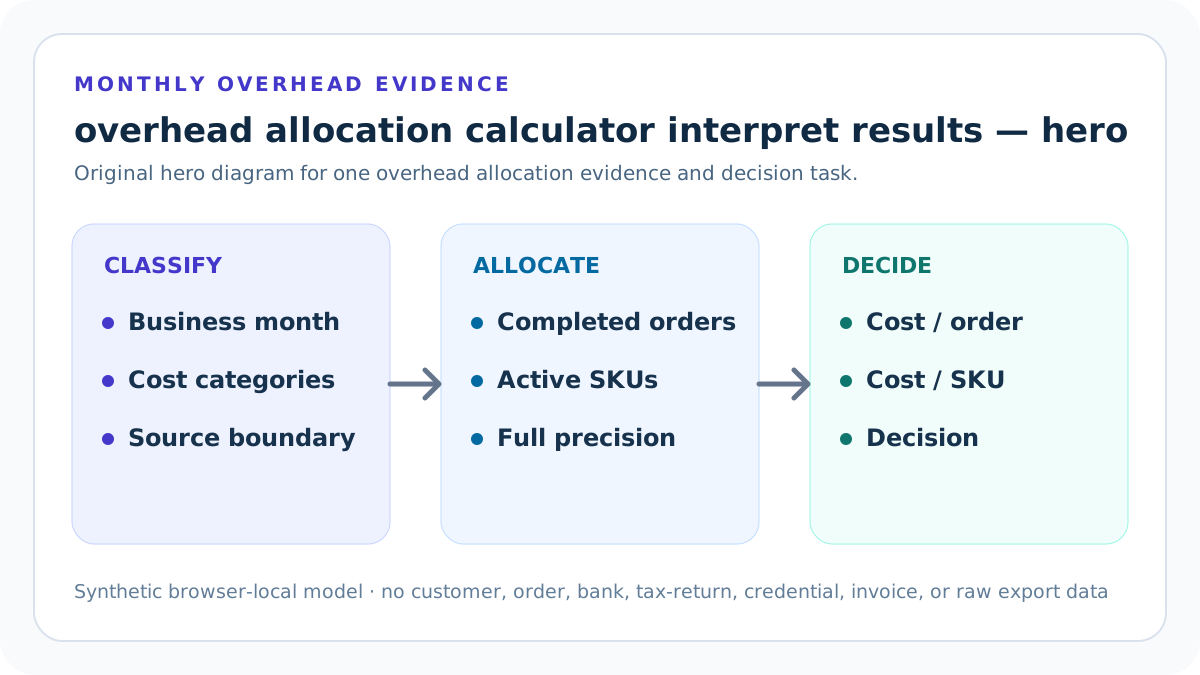
Read total recurring overhead
Use it as the selected management numerator while preserving cash, accounting, tax, inventory, and direct-cost differences. Interpretation item 1 stays beside numerator, denominator, units, full-precision value, display rule, evidence range, target purpose, and limitation.
Write one supported statement, one prohibited inference, and one next evidence action for item 1 so a bounded allocation interpretation linked to next evidence remains bounded.
Read overhead per order
Treat it as an equal period allocation whose value depends strongly on forecast or observed completed orders. Interpretation item 2 stays beside numerator, denominator, units, full-precision value, display rule, evidence range, target purpose, and limitation.
Write one supported statement, one prohibited inference, and one next evidence action for item 2 so a bounded allocation interpretation linked to next evidence remains bounded.
Read overhead per active SKU
Treat it as a portfolio breadth view, not product-level causation or an amount to add beside per-order allocation. Interpretation item 3 stays beside numerator, denominator, units, full-precision value, display rule, evidence range, target purpose, and limitation.
Write one supported statement, one prohibited inference, and one next evidence action for item 3 so a bounded allocation interpretation linked to next evidence remains bounded.
Read expected orders per SKU
Use the average to question roster scope and long-tail support, not to forecast each SKU. Interpretation item 4 stays beside numerator, denominator, units, full-precision value, display rule, evidence range, target purpose, and limitation.
Write one supported statement, one prohibited inference, and one next evidence action for item 4 so a bounded allocation interpretation linked to next evidence remains bounded.
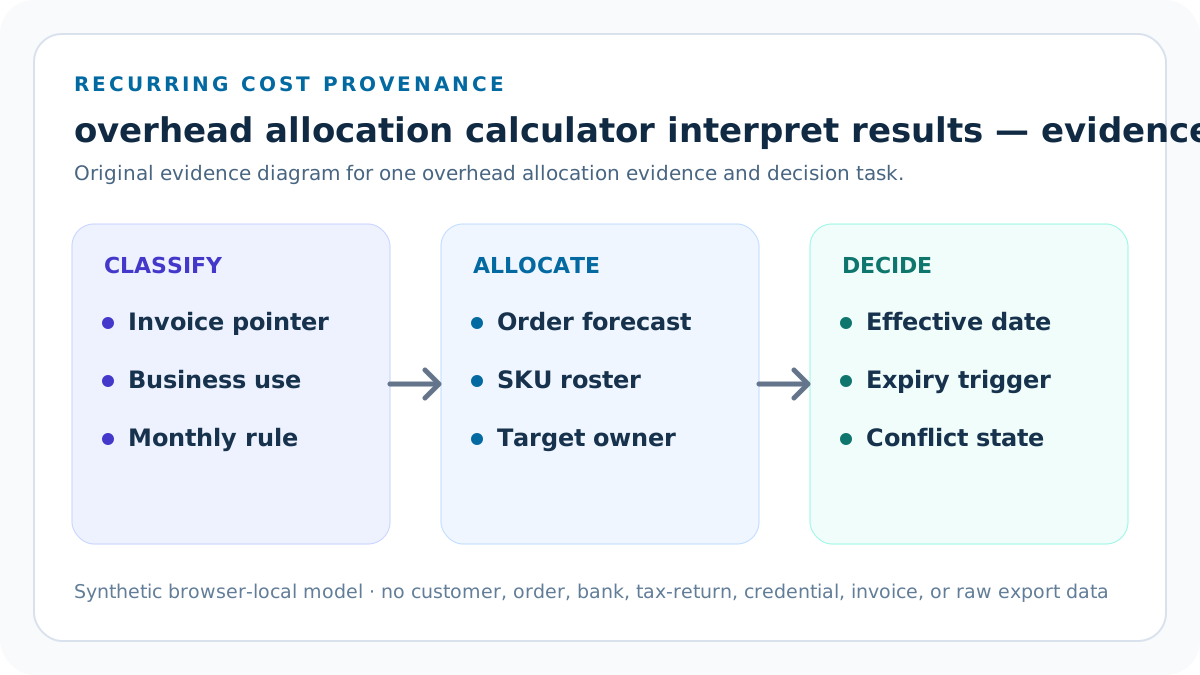
Read category shares
Form source, classification, mixed-use, duplication, contract, and cancellation questions before reducing a category. Interpretation item 5 stays beside numerator, denominator, units, full-precision value, display rule, evidence range, target purpose, and limitation.
Write one supported statement, one prohibited inference, and one next evidence action for item 5 so a bounded allocation interpretation linked to next evidence remains bounded.
Read target headroom
State the full-precision distance from one seller-owned operating threshold and its expiry. Interpretation item 6 stays beside numerator, denominator, units, full-precision value, display rule, evidence range, target purpose, and limitation.
Write one supported statement, one prohibited inference, and one next evidence action for item 6 so a bounded allocation interpretation linked to next evidence remains bounded.
Read Block, Review, and Ready
Repair invalid evidence, diagnose warnings, and pass Ready only as one planning input. Interpretation item 7 stays beside numerator, denominator, units, full-precision value, display rule, evidence range, target purpose, and limitation.
Write one supported statement, one prohibited inference, and one next evidence action for item 7 so a bounded allocation interpretation linked to next evidence remains bounded.
Read uncertainty
Keep low, expected, high, and step-cost scenarios when volume or recurring resources can change. Interpretation item 8 stays beside numerator, denominator, units, full-precision value, display rule, evidence range, target purpose, and limitation.
Write one supported statement, one prohibited inference, and one next evidence action for item 8 so a bounded allocation interpretation linked to next evidence remains bounded.
Use the overhead result interpretation card with a controlled monthly packet
Open the calculator after the overhead result interpretation card has one business, month, currency, category convention, completed-order population, active-SKU roster, target, owner, and unresolved-issue list. Enter synthetic aggregates; do not paste customer, order, payment, employee, credential, bank, tax-return, private invoice, contract, address, or raw export data.
Save full-precision inputs and outputs beside visible rounded currency. Run the low-volume fixture, high-volume fixture, below-target Review, and invalid Block conditions. Accept a changed value only when source, business-use scope, effective month, owner, and replacement trigger are recorded.
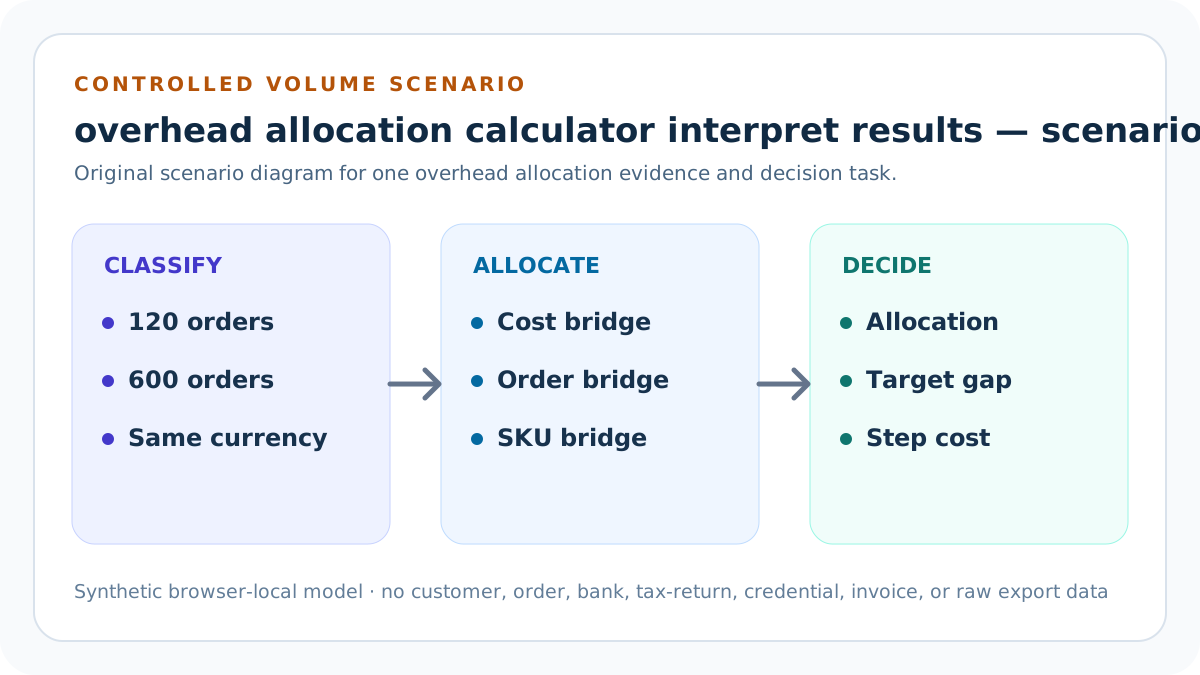
Apply evidence gates before a bounded allocation interpretation linked to next evidence
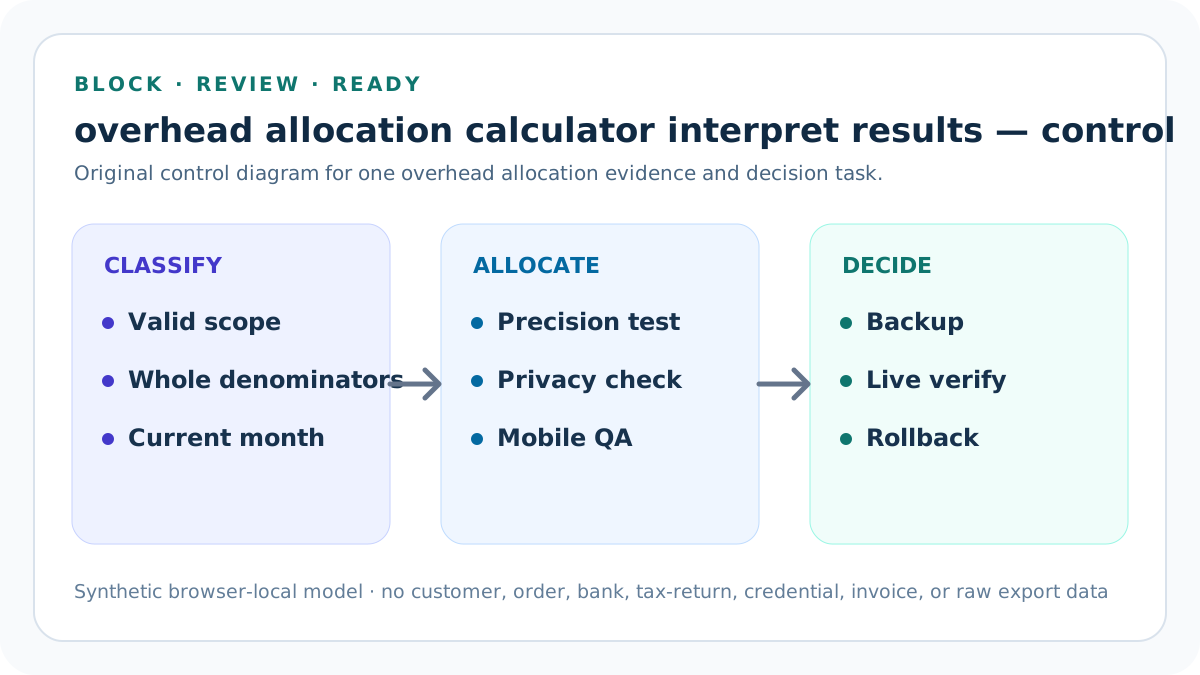
Block blank or nonfinite values, negative categories, no positive recurring total, non-whole or nonpositive order and SKU denominators, invalid seller thresholds, a nonpositive target, invalid currency, month, or source-review date, vague scope, incomplete confirmations, or a declared conflict. Review above-target overhead, portfolio ratios or category concentration beyond seller-entered limits, stale evidence, or an incompatible business population.
Ready confirms only a structurally valid planning packet. It does not determine tax deductions, accounting classification, capitalization, depreciation, cash flow, product-level causal cost, price, break-even, profit, viability, demand, revenue, or income.
Model uncertainty and step costs explicitly
Change one category, completed-order count, active-SKU count, or target at a time. Keep low, expected, and high volume cases. Add software seats, storage tiers, workspace, equipment, insurance, or service capacity only at a named trigger rather than assuming the numerator remains fixed forever.
For role 9, record the before state, isolated change, total overhead, both allocations, orders per SKU, category shares, target headroom, decision, forecast confidence, owner, and follow-up. Sensitivity identifies a driver; it does not choose the correct commercial response.
Protect billing, tax, customer, and operating information
Public examples are synthetic. Keep customer and order rows, payment data, employee or contractor records, credentials, bank data, tax returns, home addresses, private invoices, contracts, account identifiers, and raw exports outside the overhead result interpretation card.
Use business aliases, aggregates, ranges, and protected source pointers. An independent reviewer should reproduce the arithmetic and decision contract without receiving personal, transaction-level, financial-account, credential, or supplier-confidential material.
Release, observe, correct, and roll back the allocation asset
Before release, preserve narrow local and remote backups and a rollback identifier. Run syntax, typecheck, focused and full unit tests, integration, build, SEO and duplicate audits, static-route validation, mobile and keyboard QA, image and link checks, candidate-origin review, and live calculator scenarios.
After release, verify status, canonical, indexability, schema, answer blocks, images, hub discovery, strict 404, sitemap policy, and production behavior. Record Day 0/7/14/28 evidence without same-day causal claims. Restore the prior version if formula, privacy, accessibility, content, routing, analytics, or live health regresses.
Supported statement
State exactly what the monthly packet and arithmetic show, including units, denominators, date, and rounding. Deep check 1 stores business alias, monthly category or denominator evidence, full-precision calculation, displayed result, decision, reviewer, review date, expiry condition, and correction route. It is incomplete when another reviewer must guess classification, business use, period, roster, target, or source version.
Find the nearest counterexample and state why it would invalidate or narrow a bounded allocation interpretation linked to next evidence. Preserve competing category, period, forecast, roster, business-use, target, or accounting-context evidence as named scenarios rather than averaging it away.
Unsupported inference
Name the tax, accounting, depreciation, cash, product-cost, price, break-even, profit, viability, or demand claim not supported. Deep check 2 stores business alias, monthly category or denominator evidence, full-precision calculation, displayed result, decision, reviewer, review date, expiry condition, and correction route. It is incomplete when another reviewer must guess classification, business use, period, roster, target, or source version.
Find the nearest counterexample and state why it would invalidate or narrow a bounded allocation interpretation linked to next evidence. Preserve competing category, period, forecast, roster, business-use, target, or accounting-context evidence as named scenarios rather than averaging it away.
Sensitivity statement
Change one category, order count, SKU count, target, or step cost at a time and report the isolated effect. Deep check 3 stores business alias, monthly category or denominator evidence, full-precision calculation, displayed result, decision, reviewer, review date, expiry condition, and correction route. It is incomplete when another reviewer must guess classification, business use, period, roster, target, or source version.
Find the nearest counterexample and state why it would invalidate or narrow a bounded allocation interpretation linked to next evidence. Preserve competing category, period, forecast, roster, business-use, target, or accounting-context evidence as named scenarios rather than averaging it away.
Counterexample
Identify a mixed-use, direct-cost, seasonal, dormant-SKU, capacity, or source condition that invalidates the interpretation. Deep check 4 stores business alias, monthly category or denominator evidence, full-precision calculation, displayed result, decision, reviewer, review date, expiry condition, and correction route. It is incomplete when another reviewer must guess classification, business use, period, roster, target, or source version.
Find the nearest counterexample and state why it would invalidate or narrow a bounded allocation interpretation linked to next evidence. Preserve competing category, period, forecast, roster, business-use, target, or accounting-context evidence as named scenarios rather than averaging it away.
Next evidence action
Connect the observed driver to billing, workspace, equipment, utilities, services, policy, order, roster, price-floor, or contribution review. Deep check 5 stores business alias, monthly category or denominator evidence, full-precision calculation, displayed result, decision, reviewer, review date, expiry condition, and correction route. It is incomplete when another reviewer must guess classification, business use, period, roster, target, or source version.
Find the nearest counterexample and state why it would invalidate or narrow a bounded allocation interpretation linked to next evidence. Preserve competing category, period, forecast, roster, business-use, target, or accounting-context evidence as named scenarios rather than averaging it away.
Sources and further reading
- Seller Profit Guard methodology: Comparable-grain evidence, deterministic calculations, validation, correction, release, and rollback.
- Seller Profit Guard data privacy: Local-first boundaries for customer, order, payment, personnel, credential, invoice, contract, tax-return, and raw export data.
- IRS Publication 334 (2025): Primary U.S. context for business expenses and records; the calculator does not determine deductibility or accounting treatment.
- IRS: What kind of records should I keep?: Primary U.S. context for transaction summaries and supporting documents; the calculator stores no private records and does not determine substantiation.
- U.S. SBA: Break-even point calculator: Official context for fixed, variable, semi-variable, monthly, quarterly, annual, and one-time cost assumptions.
Related Seller Profit Guard tools
- Open the Seller Overhead Allocation Calculator: Allocate recurring monthly indirect costs across expected completed orders and active SKUs.
- Listing Cost Library: Keep direct SKU costs separate from recurring indirect operating resources.
- Product Price Floor Calculator: Use a deliberate cost convention in a seller-owned price boundary.
- Contribution Margin Calculator: Review order contribution before fixed overhead and accounting profit.
- Packaging Cost per Order Calculator: Allocate direct and shared packaging separately from recurring business overhead.
- Methodology: Review evidence, privacy, formulas, tests, release, correction, and rollback.
- Seller Overhead Allocation Formula and Inputs: Continue with a distinct overhead formula, example, source, threshold, comparison, operating, interpretation, or audit task.
- Low-Volume Seller Overhead Allocation Example: Continue with a distinct overhead formula, example, source, threshold, comparison, operating, interpretation, or audit task.
- High-Volume Seller Overhead Allocation: Continue with a distinct overhead formula, example, source, threshold, comparison, operating, interpretation, or audit task.
- Seller Overhead Allocation Mistakes: Continue with a distinct overhead formula, example, source, threshold, comparison, operating, interpretation, or audit task.
- Reliable Seller Overhead Allocation Data: Continue with a distinct overhead formula, example, source, threshold, comparison, operating, interpretation, or audit task.
Next step: Open the Seller Overhead Allocation Calculator.
This is operational planning help, not tax, accounting, legal, financial, or platform-policy advice. Review the Terms and disclaimer, and verify current platform rules and fee assumptions before changing prices.