Etsy free shipping: 7 margin mistakes to avoid
Last updated: 2026-07-14
Written and reviewed by Seller Profit Guard Editorial Team.
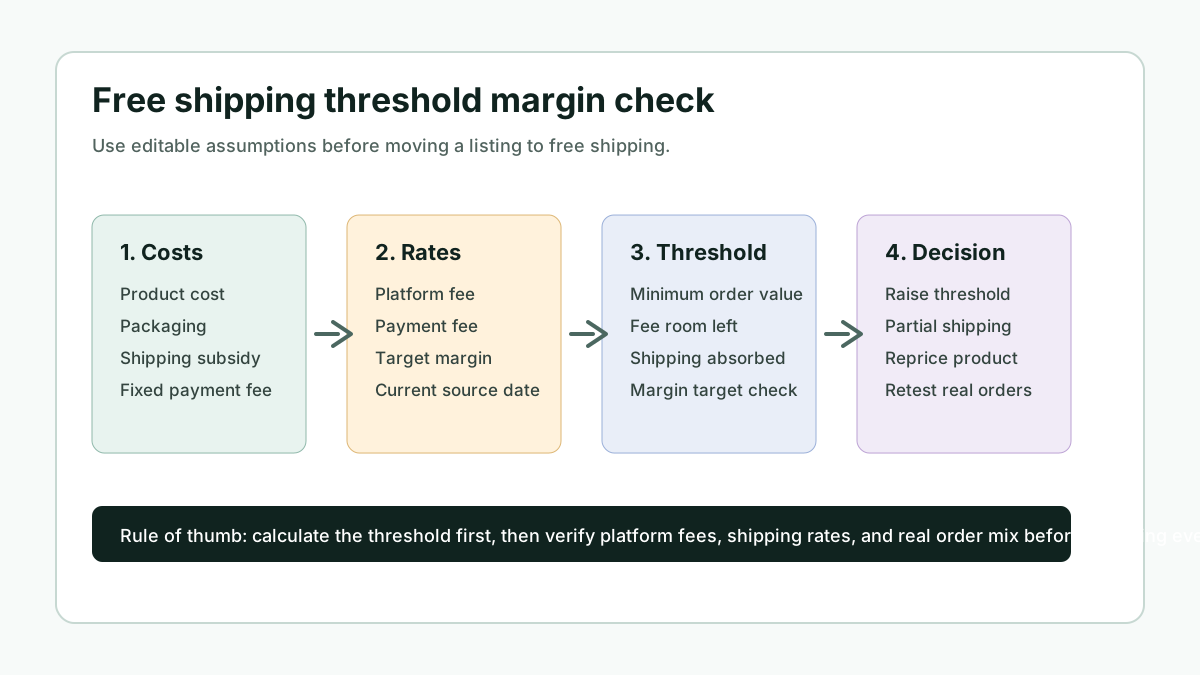
Etsy free shipping is margin-safe only when the item price or order threshold covers the label, packaging, handling, fees, variation risk, and expected replacement loss while preserving target contribution. Separate seller-funded offers from Etsy-funded promotions, and test US $35 guarantees, domestic orders, and international orders with different shipping assumptions.
How does Etsy free shipping work for sellers?
Free shipping changes what the buyer sees at checkout; it does not remove the carrier bill. Etsy's current help documentation says sellers can offer free shipping through a shop guarantee, pricing adjustments, or shipping profiles. A free-shipping guarantee applies to qualifying individual items or shop orders of $35 USD and above that ship to US buyers. Shipping upgrades can still be charged separately.
The operating question is who funds the shipping. A seller-funded offer moves the label and related fulfillment costs into the item or order economics. Buyer-paid shipping adds shipping revenue but still requires a comparison with the actual label and packaging. A temporary Etsy-funded promotion can create a later platform credit. Those three paths should not share one unexplained 'free shipping' value in a margin worksheet.
Etsy also describes building expected shipping cost into the item price as one way to recover the cost. That is a pricing choice, not a guarantee that contribution will stay healthy. Raising a price can increase the percentage-fee base, affect discounts or Offsite Ads calculations, and apply to buyers who would have paid a lower label cost. Test the complete order rather than adding one average label amount mechanically.
| Shipping path | Buyer sees | Seller should record |
|---|---|---|
| Buyer-paid | A separate shipping charge | Shipping revenue, actual label, packaging, handling, and adjustment. |
| Seller-funded free shipping | No standard shipping charge | Full shipping subsidy inside product or order contribution. |
| US $35 guarantee | Free qualifying shipping to a US buyer | Order threshold, applicable listings, label cost, and any upgrade charge. |
| Etsy-funded promotion | Temporary qualifying offer | Order notation, deducted shipping amount, and confirmed later platform credit. |
| Shipping upgrade | Optional faster service charge | Upgrade revenue and the actual upgraded label cost separately. |
What costs belong in an Etsy free-shipping threshold?
A useful threshold includes every cost that the order must fund before the seller reserves target contribution. Start with landed product or material cost, packaging, handling or fulfillment labor, the actual seller-paid shipping subsidy, percentage fees, fixed fees, and any predictable adjustment. Then add seller-funded discounts, advertising exposure, and expected replacement or return loss when they apply to the scenario.
Keep variation and destination risk visible. A framed print, larger garment, gift box, bundle, or fragile finish can change dimensions, weight, padding, service level, and replacement risk. A single threshold based on the cheapest variation or nearest shipping zone can make the offer look safer than the orders it attracts. Run at least a base case and a heavier or farther-destination case.
Do not count buyer names, addresses, messages, or other private order data in this model. The calculator needs commercial assumptions, not identity. Use aggregated or redacted label evidence, and store private SKU costs locally. Seller Profit Guard provides an operating estimate, not tax, accounting, legal, or Etsy policy advice.
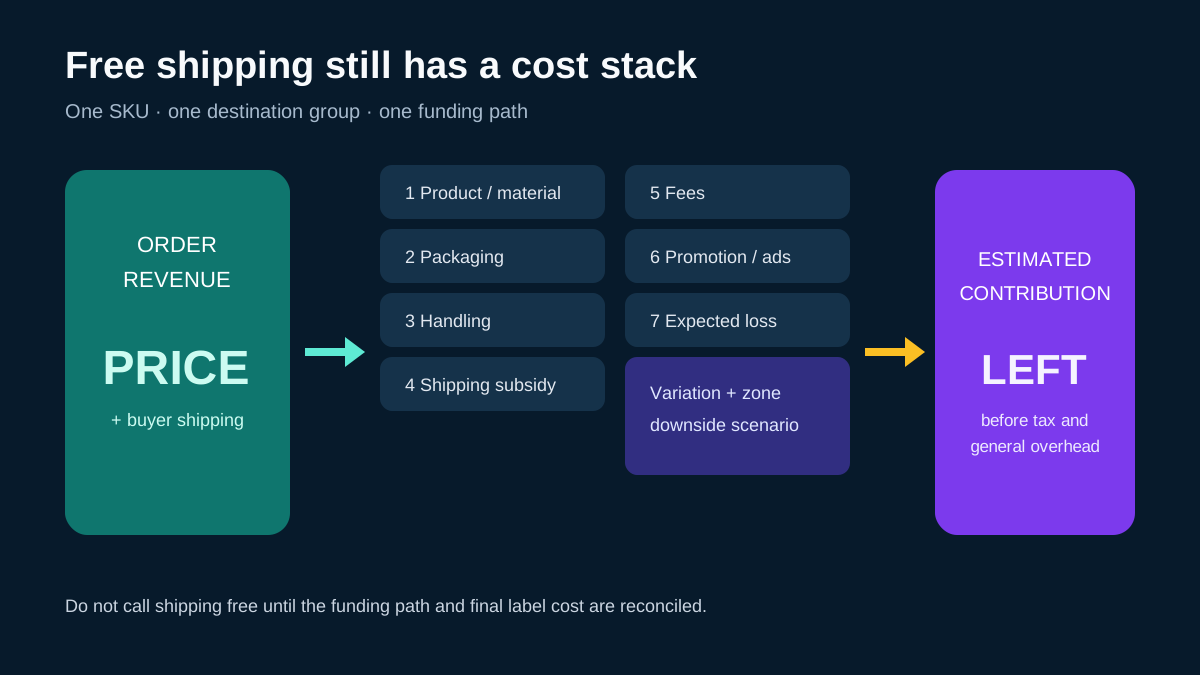
| Cost layer | Use in the threshold | Common miss |
|---|---|---|
| Product or material | Actual cost for the sold variation | Using the cheapest variant for every order. |
| Packaging | Box, mailer, padding, tape, label, and insert | Counting postage but not shipment materials. |
| Handling | 3PL charge or documented seller labor | Treating fulfillment time as free. |
| Shipping subsidy | Actual label minus buyer-paid shipping | Using one zone or old carrier rate. |
| Fees | Current percentage and fixed assumptions | Forgetting that a higher item price can change the fee amount. |
| Promotion | Seller-funded discount or attributable ad cost | Charging the seller for a platform-funded offer. |
| Risk | Expected replacement or return loss | Ignoring a second label and unrecovered product value. |
How do you calculate a margin-safe free-shipping threshold?
Add the covered costs, then divide by the share of revenue left after percentage fees and the target contribution rate. In the site's simple threshold tool, covered costs are product, shipping, packaging, and fixed fee. Minimum order revenue equals covered costs divided by one minus the fee rate minus the target contribution rate. The result is an estimate, not an Etsy-set threshold.
For example, covered costs of 19.30 with an 8% combined percentage-fee assumption and a 25% target contribution rate leave 67% of revenue available for covered costs. Dividing 19.30 by 0.67 gives a minimum estimated order value of 28.81. A practical offer may need to sit higher to account for heavier destinations, coupons, advertising, returns, rounding, or costs not included in the simple tool.
If the fee rate plus target contribution rate reaches 100%, there is no valid positive denominator. If the calculated threshold is below the price of one item, that does not prove the offer is safe; it means only that the entered assumptions fit inside the item price. If the model omits labor, replacement loss, or a high-cost variation, add those costs or run a separate scenario before changing listings.
- Covered costs = product + packaging + handling + shipping subsidy + fixed fee + applicable risk costs.
- Available cost share = 1 - percentage fee rate - target contribution rate.
- Minimum order revenue = covered costs / available cost share.
- Estimated contribution = order revenue - all seller-borne costs in the scenario.
- No positive denominator means no safe target under the entered assumptions.
Worked example: a $24 item versus a $35 order threshold
Consider a handmade item priced at 24.00. Material is 5.80, packaging is 1.10, handling labor is 3.60, and the standard label averages 4.75. Before marketplace and payment fees, the order has already consumed 15.25. With an illustrative 8% percentage-fee assumption plus a 0.30 fixed fee, estimated contribution before discounts, ads, returns, tax, and general overhead is 6.53.
Now compare a two-item order that reaches 48.00. Product and handling cost double, but the shipment may use one box and one label. Assume material of 11.60, handling of 7.20, packaging of 1.50, label cost of 6.25, the same 8% fee assumption, and a 0.30 fixed fee. Estimated contribution is 17.31 before other excluded costs. The order threshold works better here because fulfillment does not double at the same rate as revenue.
A $35 guarantee is a platform eligibility rule for qualifying US-buyer orders, not proof that 35.00 is the right economic threshold for every shop. A heavy single item could lose contribution at 35.00; a lightweight bundle may support free shipping below it. Use the official guarantee mechanics for configuration and a separate cost model for the business decision.
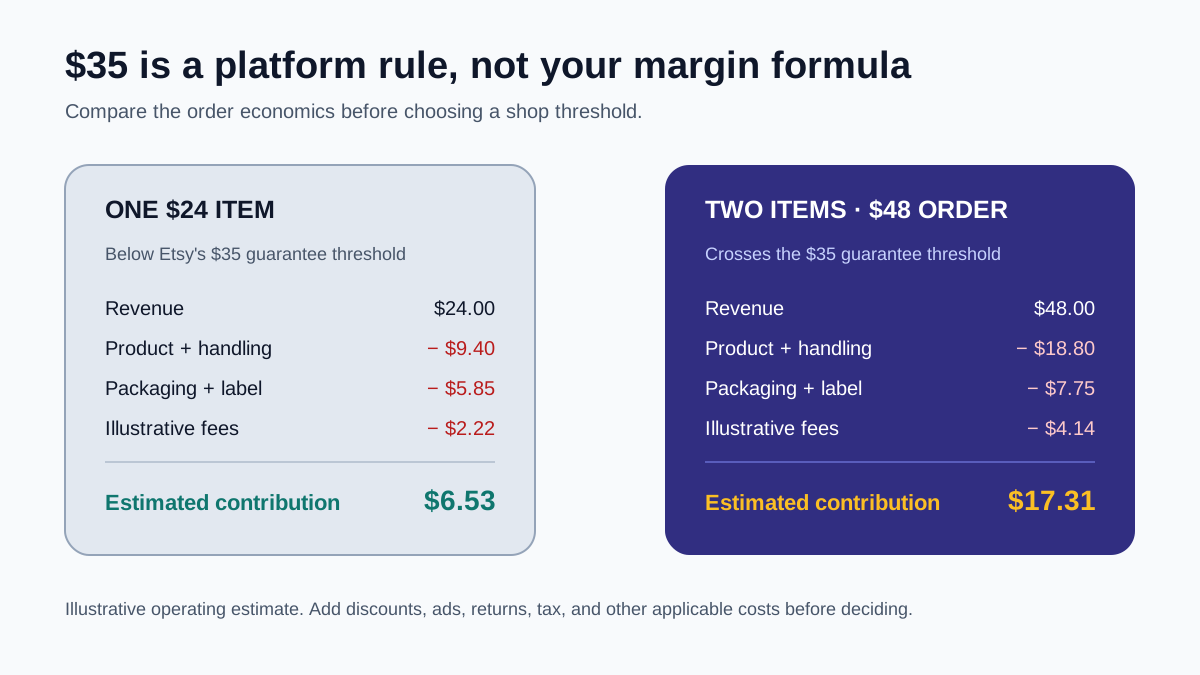
| Line | $24 single item | $48 two-item order |
|---|---|---|
| Order revenue | $24.00 | $48.00 |
| Material | $5.80 | $11.60 |
| Handling labor | $3.60 | $7.20 |
| Packaging | $1.10 | $1.50 |
| Shipping label | $4.75 | $6.25 |
| Illustrative fee + fixed | $2.22 | $4.14 |
| Estimated contribution | $6.53 | $17.31 |
Do Etsy shipping prices affect search visibility?
Etsy's current shipping help says certain US domestic listings with shipping prices higher than $6 USD can appear lower in Etsy search, with exclusions for certain listing types. The same help material says a free-shipping guarantee can give products priority placement for US shoppers. These are current platform statements, not a promise that one shipping change will increase ranking, clicks, or sales.
Search visibility is only one side of the decision. A lower displayed shipping price can improve the buyer's checkout expectation while weakening contribution if the item price does not fund the difference. A seller should compare impressions, clicks, conversion, order value, refunds, and estimated contribution before and after a controlled change. Do not move every listing at once when weight, price, or destination mix differs.
Platform rules can change. Verify Etsy's current shipping help and Seller Handbook before repricing. Keep the rule, source URL, market, review date, and affected listing types next to the experiment so a later operator can distinguish an official rule from an old shop assumption.
How should international sellers recover shipping cost?
International sellers should not use one domestic label amount for every destination. Etsy documents domestic, global, and—in eligible configurations—US-specific listing prices. Its free-shipping help also explains that international shipping prices can be adjusted when domestic shipping cost has been built into the item price. Eligibility and available pricing controls depend on seller location and account setup.
Build separate scenarios for the seller's domestic market, US buyers, and other international destinations. Record currency, destination group, package weight and dimensions, standard service, tracking or insurance, duties or taxes borne by the seller, and carrier adjustments. Do not treat buyer-paid customs charges as seller revenue or assume every country has the same delivery and return risk.
If one global item price includes a domestic shipping allowance, an international buyer can otherwise pay that built-in amount plus the full international shipping charge. Conversely, reducing international shipping by too much can leave the seller funding the extra distance. Use Etsy's current pricing controls, then reconcile several real orders by destination before expanding the offer.
Who funded the shipping discount?
Classify shipping funding from the final order and Payment Account evidence. A seller-funded free-shipping profile normally leaves the seller responsible for the label. Buyer-paid shipping produces a separate customer charge. Etsy may also run temporary platform-funded promotions: a current Seller Handbook announcement describes a limited test in which qualifying orders show shipping support and a separate credit can arrive later.
A temporary platform offer should not be hard-coded as permanent income. Match the order notation, shipping amount deducted, later credit, and settlement date. Until the credit is confirmed, keep it pending rather than reducing seller cost. If a buyer selects an upgrade or the carrier later applies a weight or dimension adjustment, record that difference separately.
This classification prevents two opposite errors: subtracting an Etsy-funded amount as if the seller paid it, or assuming the platform will reimburse an ordinary seller-funded offer. It also makes campaign and product comparisons fair because shipping support is attributed to the correct cohort and period.
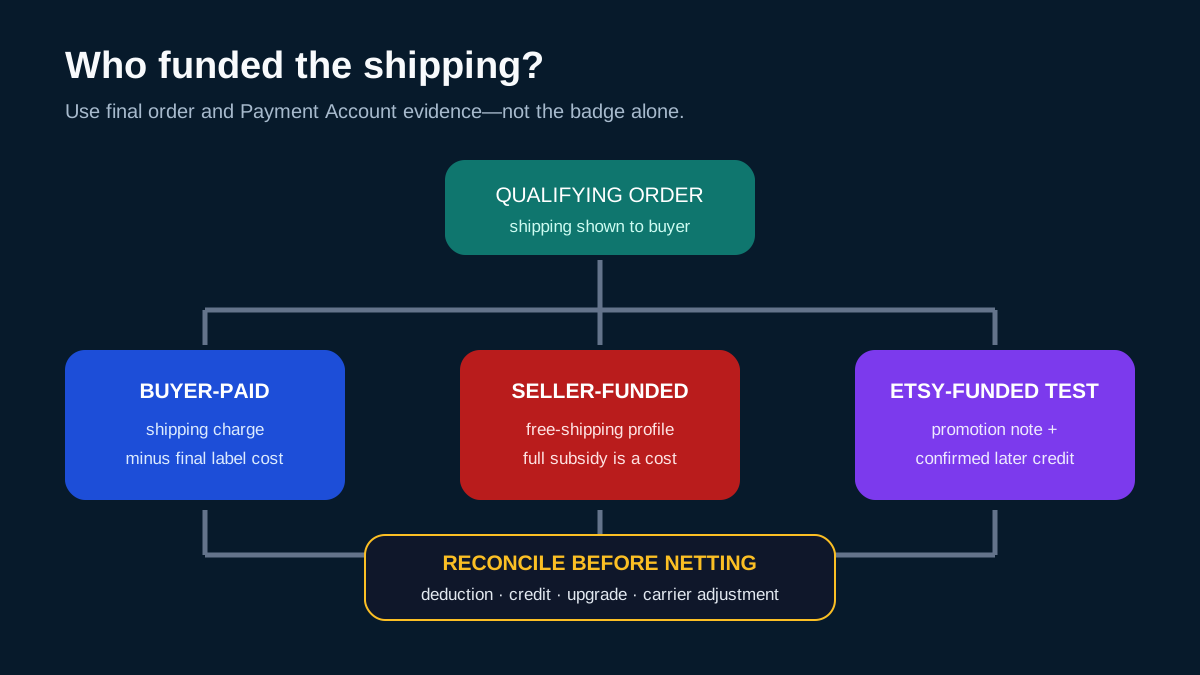
| Evidence | Funding classification | Margin treatment |
|---|---|---|
| Buyer shipping charge | Buyer-paid | Add shipping revenue, then subtract actual fulfillment cost. |
| Free-shipping profile or guarantee | Usually seller-funded | Subtract the full seller-borne shipping subsidy. |
| Etsy promotion note plus confirmed credit | Platform-funded for that qualifying order | Record deduction and credit separately before netting. |
| Upgrade selected by buyer | Buyer-paid upgrade | Compare upgrade charge with upgraded label cost. |
| Carrier adjustment | Seller-borne unless reversed | Add the final confirmed adjustment to shipping cost. |
Seven Etsy shipping margin mistakes to avoid
The first mistake is treating shipping charged as contribution before subtracting the label and materials. The second is calling a seller-funded offer free to the shop. The third is copying the US $35 platform guarantee into a calculator as if it were every product's economic threshold. The fourth is using one weight, zone, or package for all variations.
The fifth mistake is forgetting that a higher item price can change percentage fees, discount cost, or attributed advertising cost. The sixth is treating every temporary shipping promotion as seller-funded—or every platform test as permanent reimbursement. The seventh is ignoring replacement and return shipping until after a high-volume or seasonal push.
Review these risks by SKU and destination group. A small number of heavy, fragile, personalized, or repeatedly replaced products can create most of the loss. Change one lever at a time: price, threshold, buyer-paid amount, bundle design, packaging, service, or traffic exposure. Then compare a mature cohort with the original estimate.
- Reconcile shipping charged, actual label, packaging, handling, and adjustments.
- Keep the platform's $35 guarantee separate from your calculated threshold.
- Run heavy-variation and farther-destination cases.
- Include percentage-fee changes after repricing.
- Confirm whether the seller, buyer, Etsy, or carrier funded each difference.
- Add expected replacement and return loss before scaling traffic.
- Recheck official rules and real orders after every material change.
Etsy free-shipping FAQ
Does Etsy require free shipping? Etsy provides tools and a US-buyer free-shipping guarantee, but the seller chooses pricing and shipping settings. Check current Etsy help for eligibility, configuration, exclusions, and search treatment before changing a shop.
Is the Etsy free-shipping threshold always $35? The platform guarantee uses $35 USD for qualifying orders to US buyers. A shop's margin-safe threshold can be higher or lower because product, packaging, handling, label, fee, destination, and target-contribution assumptions differ.
Should shipping be added to the item price? Etsy describes building shipping cost into price as one recovery method. Test the total buyer price and the higher fee base, and use separate domestic, US-specific, or global assumptions where available rather than adding one amount blindly.
Does free shipping cover upgrades? Etsy's help says buyers can still be charged for shipping upgrades. Record upgrade revenue and the upgraded label cost separately; do not assume the standard subsidy covers every service level.
Should Offsite Ads be included in the threshold? Run a separate ad-attributed scenario when a listing can incur Offsite Ads or other acquisition cost. A threshold that works for an organic order may miss target contribution after advertising, a coupon, or both.
How often should shipping assumptions be updated? Review them after carrier, packaging, fee, product-weight, destination-mix, return, or platform-rule changes. For active promotions or high-volume listings, reconcile recent final orders rather than waiting for a quarterly average.
Related resources
- Calculate a free-shipping threshold: Estimate minimum order value from editable cost, fee, and target-contribution assumptions.
- Check Etsy SKU contribution: Compare organic, Offsite Ads, shipping, and private cost scenarios locally.
- Estimate refund and replacement loss: Add expected second-shipment and recovery assumptions before scaling.
- Review calculation methodology: Understand scope, data quality, editable assumptions, and result limits.
Sources and further reading
- Etsy Help: How to Offer Free Shipping: Official US $35 guarantee, shipping-profile, smart-pricing, recovery, upgrade, and international-shipping guidance.
- Etsy Help: How to Ship Your Items on Etsy: Official shipping profiles, calculated shipping, current shipping-price search treatment, and free-shipping guarantee overview.
- Etsy Help: Domestic, Global, and US-Specific Pricing: Official pricing options and location-dependent scope for domestic, US, and other international buyers.
- Etsy Help: Updates to Handling and Package Fees: Official reminder to review affected shipping profiles and recover seller expenses through current pricing controls.
- Etsy Seller Handbook: Limited-Time Free Shipping Offer: Time-bound example of an Etsy-funded shipping test and separate Payment Account credit; recheck status before relying on it.
Related Seller Profit Guard tools
- Free shipping threshold calculator: Estimate a margin-safe minimum order value from editable assumptions.
- Etsy CSV contribution calculator: Review SKU-level shipping, fees, Offsite Ads, and private costs locally.
- Etsy refund and fee impact: Include second shipments, support time, fee adjustments, and recovery value.
- Etsy Offsite Ads profit examples: Stress-test shipping thresholds under 12% and 15% ad-fee scenarios.
- Calculation methodology: Review contribution scope, formula boundaries, and evidence quality.
- Free Shipping Threshold Formula: 6 Inputs: Calculate a margin-safe free-shipping order threshold from four dollar costs, a fee rate, and a target margin without confusing it with Etsy's $35 rule.
- Free Shipping Threshold: $26.32 Example: Follow a domestic parcel example from product, label, packaging, fees, and target margin to a rounded $27 free-shipping order rule.
- Mixed-Cart Free Shipping Threshold: $37.75: Calculate a mixed-cart threshold from two product costs, combined packaging, parcel shipping, fees, and target margin without reusing a one-item average.
- Shipping Subsidy Formula and Inputs: Define postage, packaging, buyer-paid shipping, credits, seller-entered fee effects, target, currency, period, and comparable shipment scope.
- Shipping Subsidy Worked Example: Reproduce a partially buyer-funded parcel with USD 6.50 postage, USD 1.20 packaging, USD 4 buyer shipping, and a 6.5% fee effect.
- Free Shipping Subsidy Scenario: Model a fully seller-funded free-shipping parcel without treating zero buyer charge as zero shipping cost or guaranteed commercial benefit.
- Dimensional Weight Formula and Inputs: Define outer dimensions, actual weight, unit system, divisors, dimension rounding, billable rounding, carrier rule, target, and scope.
- Dimensional Weight Worked Example: Reproduce a compact dense 10 × 8 × 4 inch, 5 pound parcel under seller-entered 139 and 166 divisor scenarios with explicit rounding.
- Large Light Parcel Dimensional Weight: Model a 20 × 16 × 12 inch, 5 pound parcel whose dimensional weights and rounded billable scenarios exceed actual scale weight.
- Combined Shipping Margin Formula and Inputs: Define item groups, package evidence, buyer shipping, postage, packaging, handling, fees, comparison postage, target, and scope.
- Combined Shipping Margin Worked Example: Reproduce two similar USD 25 items in one parcel with buyer shipping, postage, package, handling, fees, comparison postage, and target.
- Combined Shipping Margin for Mixed-Size Items: Model a small item and a larger item whose one-parcel contribution is positive while the shipping-side subledger remains negative.
- International Landed Cost Formula and Inputs: Define parcel quantity, seller costs, fee base, customs assumptions, border responsibility, returns, target, evidence, and exclusions.
- International Landed Cost Worked Example: Reproduce a low-value seller-paid parcel with product, shipping, insurance, package, fees, duty, import tax, brokerage, returns, and target.
- Higher-Value International Landed Cost: Model a higher-value parcel whose product, shipping, protection, border-charge, fee, and return assumptions exceed the seller target.
- Shipping Zone Margin Formula and Inputs: Define frozen order fields, zone evidence, postage, fees, contribution, shipping funding, targets, and Block or Review rules.
- Shipping Zone Margin Worked Example: Reconstruct a nearby-zone order from synthetic inputs through fees, shared cost, postage, contribution, funding, and target headroom.
- Shipping Zone Margin for a Remote Zone: Model a remote destination by changing qualified postage only, then explain target failure, funding pressure, and evidence limits.
- Return Shipping Cost Formula and Inputs: Define cohort return rate, used-label cost, handling labor, packaging, pickup, customer fee recovery, buyer-paid residual cost, adjustments, and target.
- Seller-Paid Return Shipping Worked Example: Work a complete 10% return-rate example from used-label, labor, packaging, pickup, and recovery through seller-paid expected cost and target.
- Buyer-Paid Return Shipping Scenario: Model buyer-purchased return postage while retaining seller handling, supplies, support, exception, fallback-label, and policy costs.
Next step: Calculate a free-shipping threshold.
This is operational planning help, not tax, accounting, legal, financial, or platform-policy advice. Review the Terms and disclaimer, and verify current platform rules and fee assumptions before changing prices.