How Etsy variation naming changes across two product models
Last updated: 2026-07-30
Written and reviewed by Seller Profit Guard Editorial Team.
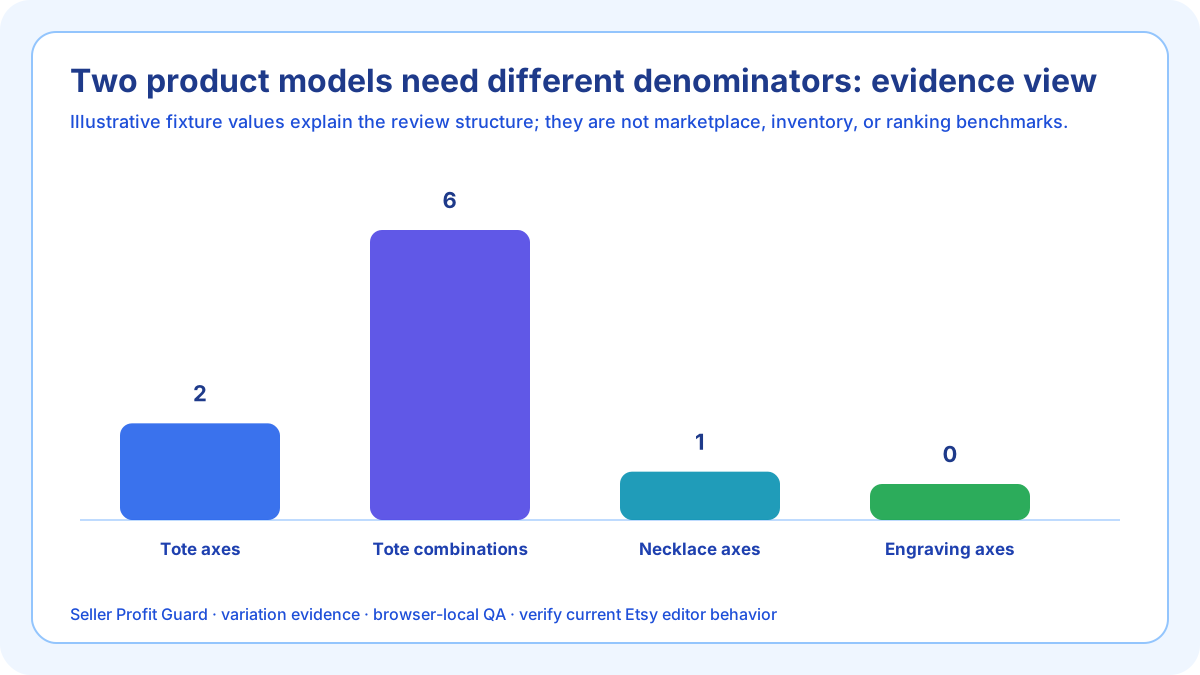
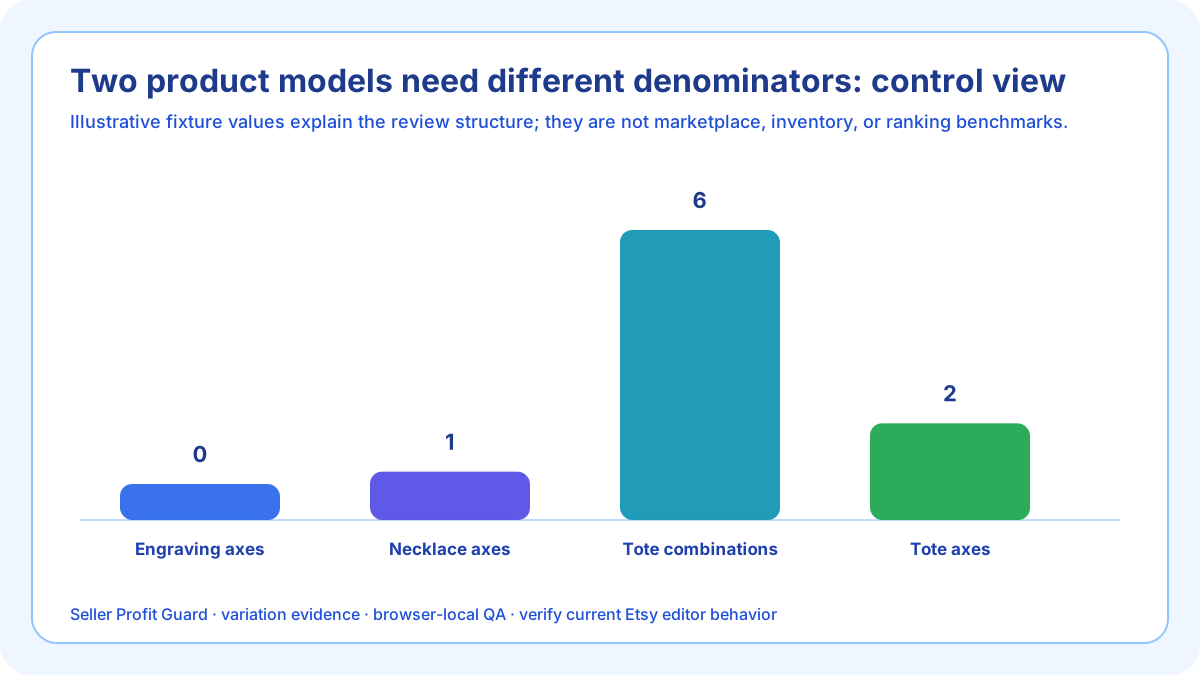
Size and Color produce a Cartesian inventory matrix: every valid combination needs clear values and usually a unique SKU, while appearance and price may map to different axes. Material plus engraving uses a fixed Material variation for selectable inventory and a separate personalization prompt for buyer-entered text. The two models should not inherit one denominator.

same-grain scenario comparison: scope and decision
Comparisons are useful only when both scenarios use the same evidence columns: product authority, axes, values, combinations, appearance mapping, total prices, SKUs, processing, buyer input, public verification, and rollback.
The tote has two fixed set-list axes and six combinations. The necklace has one fixed Material axis plus buyer-entered engraving. Treating the engraving string as another inventory value would create unbounded combinations and confuse product choice with production instructions.
Build the two-model choice matrix before analysis
Neither model is inherently better. The correct structure depends on whether buyers select from a finite product set, enter focused personalization, or request one-off custom work. The authority and fulfillment workflow must agree.
Run and release the cases separately. A passing tote matrix cannot authorize jewelry materials, and a clear engraving prompt cannot compensate for a missing or duplicated material SKU.
Compare the buyer question
The tote asks which size and color; the necklace asks which material and what exact engraving text. Axis names should reproduce those different decisions rather than forcing both products into Option 1 and Option 2.
Compare “Compare the buyer question” under both Size × Color tote and Material plus engraving necklace using identical evidence columns. The two-model choice matrix records why the structures differ, which dependencies remain separate, and what public verification closes each case. Do not inherit one verdict merely to simplify two independently justified option contracts or manufacture a universal template.
Compare the denominator
Three sizes by two colors create six complete tote combinations. Three necklace materials create three inventory choices; engraving text is variable production input, not a reusable set of product values.
Compare “Compare the denominator” under both Size × Color tote and Material plus engraving necklace using identical evidence columns. The two-model choice matrix records why the structures differ, which dependencies remain separate, and what public verification closes each case. Do not inherit one verdict merely to simplify two independently justified option contracts or manufacture a universal template.
Compare appearance evidence
Tote color values require linked finished photos; size may use a measurement comparison. Necklace materials require comparable finished images; engraving examples explain placement without exposing real buyer content.
Compare “Compare appearance evidence” under both Size × Color tote and Material plus engraving necklace using identical evidence columns. The two-model choice matrix records why the structures differ, which dependencies remain separate, and what public verification closes each case. Do not inherit one verdict merely to simplify two independently justified option contracts or manufacture a universal template.
Compare total prices
Tote price may vary by Size while Color is neutral. Necklace price may vary by Material. Each selected value receives the complete item price within the relevant scope, not an unexplained add-on.
Compare “Compare total prices” under both Size × Color tote and Material plus engraving necklace using identical evidence columns. The two-model choice matrix records why the structures differ, which dependencies remain separate, and what public verification closes each case. Do not inherit one verdict merely to simplify two independently justified option contracts or manufacture a universal template.
Compare SKU structure
Each tote size-color combination gets a unique code. Each fixed-material necklace gets its own code when chain length is fixed. Personalization text remains attached to production instructions rather than embedded in the SKU.
Compare “Compare SKU structure” under both Size × Color tote and Material plus engraving necklace using identical evidence columns. The two-model choice matrix records why the structures differ, which dependencies remain separate, and what public verification closes each case. Do not inherit one verdict merely to simplify two independently justified option contracts or manufacture a universal template.

Compare processing
Tote sizes may share one ready-to-ship profile; a necklace material or engraving workflow may be made to order. Verify the selected variation and personalization path against the current processing authority.
Compare “Compare processing” under both Size × Color tote and Material plus engraving necklace using identical evidence columns. The two-model choice matrix records why the structures differ, which dependencies remain separate, and what public verification closes each case. Do not inherit one verdict merely to simplify two independently justified option contracts or manufacture a universal template.
Compare failure severity
A wrong tote color photo, missing large-size SKU, wrong necklace material price, or engraving text placed under Material can affect different downstream decisions. Classify the exact consequence before repair.
Compare “Compare failure severity” under both Size × Color tote and Material plus engraving necklace using identical evidence columns. The two-model choice matrix records why the structures differ, which dependencies remain separate, and what public verification closes each case. Do not inherit one verdict merely to simplify two independently justified option contracts or manufacture a universal template.
Compare public verification
Select all tote combinations and all material choices, then test the personalization prompt separately. Confirm label, evidence, price, availability, processing, cart, receipt, and fulfillment mapping for each model.
Compare “Compare public verification” under both Size × Color tote and Material plus engraving necklace using identical evidence columns. The two-model choice matrix records why the structures differ, which dependencies remain separate, and what public verification closes each case. Do not inherit one verdict merely to simplify two independently justified option contracts or manufacture a universal template.
Verification, release, and rollback controls
Before changing a public listing, preserve the complete two-model choice matrix, editor values, linked assets, selected-path observations, test fixtures, approval, and rollback identifier. Confirm the correct account and listing. Safe-stop on login or CAPTCHA ambiguity, a platform warning, wrong profile, missing target context, private data, or an unexpected editor state.
After one bounded release, verify Size × Color tote on mobile and desktop and deliberately revisit the risk represented by Material plus engraving necklace. Check axis names, values, selected photo, full price, availability, processing, cart or receipt choice, and SKU for every valid combination. Restore the prior configuration when a critical path does not support two independently justified option contracts.
Limits, privacy boundary, and next action
This guide and checker use seller-entered text and synthetic examples. They do not retrieve Etsy data, alter a listing, inspect images, validate product composition, confirm inventory or receipts, certify marketplace policy, or predict ranking, clicks, conversion, sales, returns, income, or AdSense approval. Seller Profit Guard is independent and unaffiliated with Etsy and provides operational QA rather than legal, tax, accounting, inventory, search, accessibility, or platform advice.
Keep buyer names, addresses, messages, order IDs, receipts, private personalization, credentials, OAuth data, and raw CSV files outside the two-model choice matrix. The next action is to repair the named evidence layer, rerun complete and crossed fixtures, release only the approved set, inspect the public choice path, and record whether two independently justified option contracts was verified or rolled back.
Sources and further reading
- Etsy Help: How to Add Variations for Your Listings: Current official variation attributes, values, total prices, quantities, processing profiles, SKUs, linked photos, custom variations, visibility, preview, and buyer-selection behavior.
- Etsy Help: How to Create a Listing: Current official category, price, quantity, SKU, physical-listing, and variation context.
- Etsy Help: Processing Times and Processing Profiles: Current official listing- and variation-level processing-profile behavior.
- Etsy Help: How to Offer Personalized Listings: Current official Custom options fields, five-field limit, field types, test-limited add-on pricing, and the inventory-versus-personalization boundary.
- Etsy Help: How to Offer Custom Items: Current official boundary between public listing variations and one-buyer private custom listings.
- Etsy Seller Policy effective July 9, 2026: Current official accuracy, content, privacy, representation, and seller-responsibility requirements.
- Seller Profit Guard methodology: Evidence hierarchy, privacy boundary, uncertainty labels, corrections, release verification, and rollback controls.
Related Seller Profit Guard tools
- Open the Etsy Variation Naming Checker: Review axes, values, buyer selectors, linked photos, total prices, and unique SKU combinations.
- Audit Etsy variation and SKU risk: Check cost and fulfillment risk after the naming contract is coherent.
- Review Etsy attribute coverage: Keep category attributes separate from buyer-selectable options.
- Check Etsy photo coverage: Verify appearance-changing values have truthful buyer evidence.
- Read the variation SKU checklist: Connect buyer choices with stable cost and inventory controls.
- Read the local-first methodology: Preserve evidence, privacy, bounded release, feedback, and recovery.
- Etsy Variation Naming Formula and Inputs: Continue the variation evidence, mapping, decision, release, interpretation, or audit workflow.
- Etsy Variation Names: Size and Color Example: Continue the variation evidence, mapping, decision, release, interpretation, or audit workflow.
- Etsy Material and Personalization Options: Continue the variation evidence, mapping, decision, release, interpretation, or audit workflow.
- 12 Etsy Variation Naming Mistakes: Continue the variation evidence, mapping, decision, release, interpretation, or audit workflow.
- Evidence Sources for Etsy Variations: Continue the variation evidence, mapping, decision, release, interpretation, or audit workflow.
Next step: Open the Etsy Variation Naming Checker.
This is operational planning help, not tax, accounting, legal, financial, or platform-policy advice. Review the Terms and disclaimer, and verify current platform rules and fee assumptions before changing prices.