How to calculate SKU-level profit for Etsy sellers
Last updated: 2026-07-12
Written and reviewed by Seller Profit Guard Editorial Team.
SKU-level profit is the order revenue assigned to a SKU minus platform fees, payment fees, ad exposure, product cost, packaging, labor, shipping, and other per-order costs. It is more useful than shop-wide gross sales for pricing decisions.
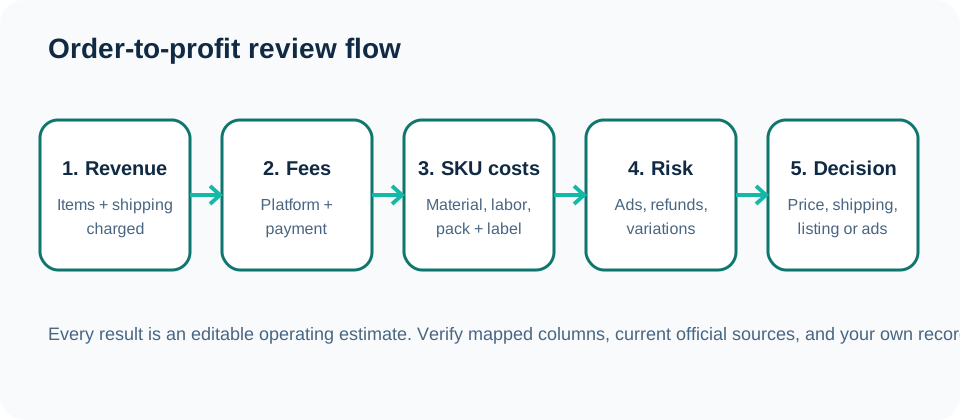
The SKU-level profit formula
The practical formula is: order revenue assigned to the SKU minus marketplace and payment fees, ad-attribution assumptions, product cost, packaging, labor, shipping, refunds or replacement assumptions, and other per-order costs. The result is not a tax number. It is an operating signal that tells you whether the product can support its price, shipping promise, and traffic source.
Shop-wide gross sales hide SKU differences. A mug, a large framed print, and a personalized bundle can all appear in the same revenue dashboard while carrying very different packaging, labor, shipping, and refund risk. SKU-level review is the only way to see which products are funding the shop and which ones are just creating activity.
Start with the fields you can get from Etsy exports, then add the fields only you know: material, packaging, labor minutes, labor rate, shipping label cost, extra transaction cost, and target margin. If a field is unknown, mark it as missing instead of pretending the cost is zero.
| Field | Where it usually comes from | Why it matters |
|---|---|---|
| SKU | Listing setup and order item CSV | Connects the sale to the right cost record. |
| Item total and shipping charged | Order item CSV | Defines revenue assigned to the order or SKU. |
| Marketplace and payment fees | Etsy fee fields or Payment Account activity | Moves the calculation from gross sales toward contribution. |
| Material and packaging | Seller cost library | Usually scales with quantity and product type. |
| Labor minutes and labor rate | Seller estimate | Prevents handmade and personalized products from looking artificially profitable. |
| Shipping label cost | Shipping records or seller estimate | Shows whether free or undercharged shipping is erasing margin. |
| Offsite Ads assumption | Seller scenario based on official Etsy guidance | Stress-tests ad-attributed orders. |
| Target margin | Seller planning assumption | Turns a profit number into a pricing decision signal. |
Example: one product, three different profit stories
Consider a personalized item with a 42.00 item price and 6.00 shipping charged. The material cost is 8.00, packaging is 1.50, labor is 22 minutes at a 20.00 hourly labor rate, and the actual label costs 5.10. Before platform fees and ad assumptions, the seller has already committed 21.93 in cost if labor is counted.
If the order is organic, the product may still have a healthy contribution. If the order is ad-attributed, a 12% or 15% Offsite Ads scenario can remove several more dollars. If the same listing has a larger variation that takes 35 minutes and ships in a heavier box, the larger variation needs its own SKU cost record.
The point is not to find one perfect margin. The point is to see the sensitivity. If a small change in labor time, shipping weight, or ad attribution erases profit, the listing deserves a review before it becomes a bestseller.
| Scenario | What changes | Likely action |
|---|---|---|
| Organic sale | No Offsite Ads estimate | Keep if target margin is met. |
| Ad-attributed sale | Add 12% or 15% stress test | Review price, bundle, or traffic exposure. |
| Large variation | Higher labor and shipping cost | Create a separate SKU cost record. |
| Personalized replacement | Extra material, labor, and postage | Add refund or replacement risk to planning. |
How to build a SKU cost library
A SKU cost library is a small table that maps each SKU to the costs the marketplace export will not know. It does not need to be complicated. Start with SKU, material cost, packaging cost, labor minutes, labor rate, shipping cost, transaction extra cost, other cost, target margin percent, and notes.
The most important rule is to avoid silent zeros. If a SKU has no cost record, mark it as missing. Missing cost is a risk flag, not a free product. A report that treats missing cost as zero will overstate profit and hide the products that need cleanup.
Update the library when a supplier price changes, a packaging material changes, a product gets heavier, or a personalization step gets longer. For handmade shops, labor drift can be as important as material drift.
- Use one row per SKU or cost-distinct variation.
- Separate material cost from packaging and labor.
- Record labor minutes and labor rate instead of burying labor in a vague cost field.
- Add notes for supplier changes, bundle assumptions, and packaging changes.
- Export a backup copy before making large edits.
What the result should trigger
A low-margin SKU does not automatically mean the product should be deleted. It means the seller should inspect the cause. The problem might be price, shipping, ad exposure, packaging, labor, refund rate, or a missing cost record.
Use suggested minimum price as a review signal, not an automatic pricing command. A price change can affect conversion, search performance, and customer expectations. Review competitor positioning and current platform rules before changing prices.
The best recurring habit is a weekly SKU review. Sort by revenue, then inspect the products with missing cost records, negative margin, high refund loss, or heavy Offsite Ads exposure. Those are the products most likely to mislead a seller who only watches gross sales.
- If many orders have missing cost records, clean the cost library before repricing.
- If only ad-attributed orders are weak, review traffic and coupon strategy.
- If shipping is the main problem, review actual label cost and packaging weight.
- If labor is the main problem, review personalization scope or price.
- If refunds are the main problem, review photos, sizing, packaging, or listing promises.
How to check it in Seller Profit Guard
Use the Etsy CSV profit calculator for the order review and the SKU cost library for repeat assumptions. Import the CSV, map columns, add cost records, and export the SKU summary. The summary should show missing costs, low-margin products, and products that only work in favorable scenarios.
If you also use Payment Account reconciliation, run that separately. Reconciliation explains sale, fee, refund, and deposit rows. SKU-level profit explains whether a product's private cost structure supports its price.
Related resources
- Open Etsy CSV Profit Guard: Calculate order and SKU-level margin locally.
- Open SKU cost library: Build reusable cost records for repeat checks.
- Open Payment Reconciliation: Explain statement and deposit differences separately.
Sources and further reading
- Etsy Help: What are the Fees and Taxes for Selling on Etsy?: Official overview of listing, transaction, payment, advertising, and other seller fees.
- Etsy Help: How Etsy's Offsite Ads Work: Official Offsite Ads fee, attribution, and fee-cap reference.
- Etsy Help: How to Download a Spreadsheet of Your Sold Transactions: Official CSV export workflow for order items, orders, Etsy Payments sales, and deposits.
Related Seller Profit Guard tools
- Etsy CSV profit calculator: Run a local order profit check with editable fee and SKU cost assumptions.
- Payment reconciliation tool: Compare order rows with statement activity and flag unmatched rows.
- SKU cost library: Save or import material, labor, packaging, shipping, and target margin assumptions.
- Variant risk checker: Find missing SKUs and variation cost risks before a listing scales.
- Etsy title checker: Review listing-title clarity, repetition, keyword chains, and mobile scanning.
- Etsy tag checker: Review all 13 tag slots for duplicates, repeated meaning, and truthful coverage.
- Free shipping threshold calculator: Estimate when a shipping subsidy can still meet a target margin.
- Return window loss estimator: Model expected reverse shipping, restock work, recovery, and replacement loss.
- Etsy Ads break-even calculator: Estimate target-safe Etsy Ads spend, ACOS, and ROAS after fees, fulfillment, and expected return loss.
- CSV data privacy: Understand what the local-first workflow needs and what it does not need.
- Etsy Profit Formula: Inputs Small Sellers Must Track: Build an Etsy contribution formula from settled revenue, official fee evidence, SKU costs, fulfillment, ads, returns, and a dated target.
- Etsy Profit Example: Trace a $74 Order Step by Step: Follow a complete Etsy order contribution example from CSV revenue and fee evidence through SKU cost, labor, shipping, risk, and decision.
- Etsy Discount Profit: Test Coupons and Free Shipping: Model an Etsy discounted order after seller-funded coupons, shipping subsidy, fees, SKU cost, labor, ads, returns, and target contribution.
- SKU Cost Formula: 8 Inputs Etsy Sellers Need: Build a reusable Etsy SKU cost record from materials, labor, packaging, fulfillment, variable extras, allocation, risk, and evidence dates.
- Etsy SKU Cost Example: A $18.35 Handmade Item: Trace an illustrative handmade SKU through material, labor, packaging, fulfillment preparation, overhead allocation, and target review.
- Etsy Variation Costs: Stop Averaging Every Option: Build separate cost records for size, material, personalization, weight, packaging, and fulfillment differences across Etsy variations.
- Etsy Digital File Checker Inputs: Define delivery mode, file manifest, package contents, compatibility, license, preview match, support, known issues, and current evidence.
- Etsy Printable PDF File Example: Follow a four-file printable package through naming, limits, clean-device tests, previews, license, buyer instructions, release, and recovery.
- Etsy Design Template Bundle QA: Model a ZIP-based design-template bundle with source formats, fonts, links, versions, extraction, licensing, previews, and failure recovery.
- Etsy Fee Stack Formula and Input Contract: Model account context, listing events, transaction, processing, ads, currency, regulatory, tax, cost, and reconciliation layers.
- Etsy Fees on a $45 Order: Worked Example: Reproduce a domestic US planning fixture from order revenue through listing, transaction, processing, cost, and contribution rows.
- Etsy Cross-Currency Fee Example: Separate listing currency, Payment account currency, bank-country processing, conversion, regulatory, and statement exchange-rate evidence.
- Contribution Margin Formula and Inputs: Define ecommerce net revenue, every order-variable cost, contribution amount, margin percentage, target gap, and stress case without mixing fixed overhead.
- Single-Item Contribution Margin Example: Trace a complete USD 50 single-item ecommerce order from revenue and variable-cost inputs to USD 11 contribution, 22% margin, target, and stress result.
- Multi-Item Contribution Margin Example: Model a three-unit USD 88 ecommerce order with shared shipping, per-unit costs, order fees, acquisition cost, return allowance, and an 11% contribution margin.
- Product Price Floor Formula and Inputs: Derive a target list-price floor from variable costs, seller-funded discount, buyer shipping, fee and target bases, and expected loss.
- Standard Product Price Floor Example: Trace a synthetic standard order from USD 36 variable costs through required charged revenue to a USD 43.65 target list-price floor.
- Promotion Product Price Floor Example: Show why a 20% promotion raises the same synthetic order's required list price from USD 43.65 to USD 54.56 before discount.
- Markup vs Margin Formulas and Inputs: Define cost, price, gross-profit amount, denominator, equivalent rate, converted price, evidence scope, and validation boundaries.
- Markup vs Margin Worked Example: Trace USD 40 cost and USD 60 price through USD 20 gross profit, 50% markup, 33.33% margin, price reconstruction, and a Ready decision.
- Price-Based Margin Conversion Example: Convert a 40% margin on USD 40 cost into 66.67% markup and a USD 66.67 price, then compare a USD 60 current price and decision.
- Bundle Margin Formula and Inputs: Define component quantities, bundle-level costs, discounted revenue, contribution, target margin, and target-safe discount headroom.
- Fixed Bundle Margin Worked Example: Trace a four-piece fixed bundle from USD 34 component cost and USD 55 variable-cost pool to USD 15.84 contribution and 10.76% safe discount.
- Mix-and-Match Bundle Margin Example: Replace the fixed composition with a USD 38 mix-and-match component basket and trace the resulting USD 11.84 contribution and Review decision.
- Volume Discount Formula and Inputs: Define increasing quantity rows, proposed discounts, unit and per-order costs, fees, contribution targets, and tier-safe discount equations.
- Three-Unit Volume Discount Example: Trace a three-unit tier from USD 90 full-list revenue and USD 43 variable cost to USD 31.52 contribution and a 33.64% safe discount.
- Wholesale-Size Volume Discount Tier: Model a twelve-unit or larger tier with changed packaging, handling, freight, payment terms, loss severity, capacity, and discount evidence.
- Wholesale Price Formula and Inputs: Define landed unit cost, direct labor, packaging, MOQ, order costs, payment fees, target margin, and target-safe wholesale price equations.
- Small-Retailer Wholesale Price Example: Trace a twelve-unit retailer order from USD 13 unit cost and USD 196.30 order cost to USD 22.72 target-safe price and USD 71.42 contribution.
- Distributor Wholesale Price Scenario: Model a sixty-unit distributor order with separate handling, freight, payment fees, expected loss, payment terms, target, and capacity evidence.
- Custom Order Quote Formula and Inputs: Define custom scope, materials, production and design time, revisions, rush cost, fulfillment, reserve, fees, target margin, deposit, and quote equations.
- Standard Custom Order Quote Example: Trace a standard request from USD 206 direct cost and USD 20.60 reserve to a USD 315.14 target-safe quote and USD 93.20 contribution.
- Rush Custom Order Quote Scenario: Model a five-day rush request with different material, production, design, revision, shipping, expedite, reserve, fee, and target evidence.
- Handmade Labor Cost Formula and Inputs: Define active minutes, setup, attempted and sellable counts, rework, hourly rate, unit labor cost, throughput, target, and evidence boundaries.
- One-Off Handmade Labor Cost Example: Calculate a one-off hand-finished unit from 45 active minutes, 20 setup minutes, 10% rework, USD 24 per hour, one sellable unit, and an USD 30 target.
- Batch Handmade Labor Cost Scenario: Allocate setup and rework across twelve sellable units using 18 active minutes per unit, 30 setup minutes, 8% rework, USD 24 per hour, and an USD 10 target.
- Packaging Cost per Order Formula and Inputs: Define direct materials, waste allowance, shared batch cost, completed-order denominator, target, context, and packaging decision boundaries.
- Lightweight Packaging Cost per Order Example: Reproduce a lightweight 50-order parcel example with USD 0.85 direct materials, 5% waste, USD 6 shared cost, and a USD 1.25 target.
- Gift-Ready Packaging Cost Scenario: Model a 40-order rigid gift package with USD 2.75 direct materials, 10% waste, USD 12 shared cost, and a USD 3.50 target.
- Seller Overhead Allocation Formula and Inputs: Define recurring monthly cost categories, completed orders, active SKUs, target, currency, evidence month, scope, and allocation boundaries.
- Low-Volume Seller Overhead Allocation Example: Reproduce USD 750 of recurring monthly overhead across 120 completed orders and 24 active SKUs, with a USD 7 per-order target.
- High-Volume Seller Overhead Allocation: Allocate the same USD 750 monthly recurring overhead across 600 completed orders and 30 active SKUs with a USD 2 per-order target.
- Reorder Point Formula and Input Rules: Define SKU-location demand, lead time, safety stock, inventory position, seasonality, evidence, and trigger-date assumptions.
- Reorder Point Worked Example: Stable Demand: Calculate a 66-unit reorder point and dated trigger for a stable SKU with four daily units, twelve lead-time days, and safety stock.
- Seasonal Reorder Point Worked Example: Convert monthly demand, apply a 1.40 seasonal factor, and calculate a 182-unit threshold for a longer replenishment lead time.
- Safety Stock Formula and Input Rules: Define SKU-location demand, variability, lead-time samples, service z-scores, population formulas, evidence windows, and rounding.
- Safety Stock Worked Example: Stable Lead Time: Calculate a nine-unit buffer from four daily units, 1.50 demand deviation, twelve-day lead time, zero timing deviation, and 95% service.
- Safety Stock Example with Variable Lead Time: Calculate a 41-unit buffer when six-unit demand, demand deviation, receipt timing deviation, and a 98% service target interact.
- Inventory Carrying Cost Formula and Inputs: Define average inventory value, annual capital, storage, insurance, shrink, obsolescence, administration, carrying rate, and evidence rules.
- Inventory Carrying Cost Worked Example: Calculate USD 4,750 annual carrying cost and a 19% rate for fast-moving inventory with explicit capital, storage, loss, and aging inputs.
- Inventory Carrying Cost for Slow-Moving Stock: Calculate USD 19,800 annual carrying cost and a 33% rate for slow-moving inventory with higher storage, loss, and obsolescence exposure.
- Dead Stock Markdown Formula and Inputs: Define markdown price, sell-through probability, selling costs, storage, disposal recovery, cost basis, and expected net recovery.
- Dead Stock Markdown Worked Example: Reperform a moderate markdown example from aged inventory through expected units, selling costs, storage, disposal, and recovery rate.
- Clearance Markdown Recovery Scenario: Reperform a clearance markdown example with higher expected sell-through, lower storage, deeper price reduction, and unsold-unit recovery.
- Stockout Cost Formula and Inputs: Define affected demand, stockout days, substitution, delayed recovery, contribution, response costs, scope, and evidence.
- Stockout Cost Calculator Worked Example: Reperform a three-day interruption through affected demand, substitution, delayed recovery, permanent loss, and total cost.
- Seasonal Stockout Cost Scenario: Reperform a seasonal stockout with elevated demand, lower substitution and recovery, contribution loss, remediation, and mitigation.
- Bundle Component Capacity Formula: Define Available, additional reservations, commitments, recipe quantities, locations, variants, bottlenecks, and competing allocation.
- Bundle Component Worked Example: Reperform a three-component fixed bundle from inventory states through tied bottlenecks, maximum complete sets, and ties.
- Competing Bundle Component Scenario: Allocate a shared component to priority Bundle X, then calculate Bundle Y capacity from shared and unique constraints and controls.
- Supplier MOQ Formula and Inputs: Define MOQ, purchase unit, landed costs, lead time, demand, existing availability, stock months, storage, thresholds, and evidence.
- Low MOQ Supplier Worked Example: Reperform a 120-unit supplier offer through cash commitment, landed unit cost, coverage, lead-time exposure, and storage.
- High MOQ Lower-Price Supplier Scenario: Reperform a lower-price 360-unit offer through higher cash exposure, stock months, lead time, storage, and review thresholds.
- Purchase Quantity Formula and Inputs: Define one review period, demand plan, Available inventory, eligible inbound, safety stock, MOQ, case pack, evidence, and controls.
- Monthly Purchase Quantity Example: Reperform a monthly review from demand and inventory netting through MOQ, case-pack rounding, closing stock, and decision status.
- Seasonal Purchase Quantity Scenario: Reperform a seasonal buy with a larger demand plan, eligible inbound, safety stock, MOQ, case pack, overage, and review threshold.
- Date and Currency Normalizer Formula Contract: Define source pattern, calendar validation, UTC offset, decimal convention, currencies, rate direction, observation date, rounding, and evidence.
- Date and Currency Normalizer US Worked Example: Reperform one MM/DD/YYYY event, negative UTC offset, comma-grouped decimal-point amount, USD source, EUR target, and dated rate.
- Mixed-Locale Date and Currency Normalization: Resolve a DD.MM.YYYY event, positive UTC offset, period-grouped decimal-comma amount, EUR source, USD target, and dated rate.
- Refund to Order Matcher Formula Contract: Define direct references, UTC events, currency, original and refund components, prior refunds, line coverage, tolerance, match window, and evidence.
- Refund to Order Matcher Full-Refund Example: Reperform a 94.00 USD original order and full refund using direct reference, UTC events, components, zero prior refunds, and complete line coverage.
- Partial Multi-Item Refund Matching: Match a 32.40 EUR partial refund to an 89.00 EUR three-line order while preserving allocation, remaining eligibility, and future events.
- Export Schema Contract: 9 Inputs Before Automation: Define expected and observed headers, types, required fields, aliases, additions, version dates, row grain, and rollback before automating an export.
- Export Schema Checker Example: One Added Column: Work a complete export schema example where an optional field is added without breaking a name-based parser or exposing seller rows.
- Required Column Renamed: Controlled Alias Example: Handle a renamed required export column with an explicit one-to-one alias, affected-consumer tests, version evidence, and rollback.
- Shopify Plan Fee Allocation Formula and Inputs: Define the fixed plan charge, billing cycle, closed period, two cost centers, allocation basis, aggregates, thresholds, and evidence before assigning cost.
- Shopify Plan Fee Allocation Example for a Low-Volume Group: Calculate a low-volume cost center's share, allocated charge, per-order amount, per-unit amount, threshold state, and reconciliation.
- Shopify Plan Fee Allocation for a High-Volume Group: Allocate the same fixed charge to a high-volume cost center and explain scale, mixed baskets, reversals, and basis sensitivity.
- Shopify Payment and Transaction Fee Formula: Define the shared order base, two payment paths, provider processing rates, Shopify transaction rates, source context, thresholds, and limitations.
- Shopify Payments Fee Example Without a Third-Party Fee: Calculate processing and Shopify transaction components for a sole-Shopify-Payments path using one editable same-order fixture.
- Third-Party Shopify Payment Fee Example: Calculate a direct provider's processing fee and the additional Shopify third-party transaction component on the same invented order.
- Shopify App Cost per Order Formula: Define app identities, independent cycles, recurring, usage, one-time, credit, external-charge, retained-order, threshold, and evidence inputs.
- Shopify App Cost per Order Worked Example: Calculate a small app stack from recurring, usage, normalized one-time, credit, external, retained-order, and review inputs.
- Expanded Shopify App Stack Cost Example: Model a larger stack with separate recurring, usage, one-time, credit, external, and retained-order evidence under the same period.
- Shopify Product Page QA Inputs and Decision Logic: Define product, variant, media, price, shipping, returns, trust, claims, search, storefront, and governance fields.
- Shopify Product Page QA Single-Variant Example: Work a complete one-configuration product through every critical and advisory check.
- Shopify Product Page QA Multi-Variant Example: Review option structure and per-variant SKU, price, and media coverage without reusing the single-product logic.
- Shopify Discount Stack Formula and Inputs: Define a same-cart model for product, order, and shipping discounts, eligibility, fees, costs, target, and evidence.
- Shopify Automatic Product Discount Example: Work one automatic 10% eligible-product discount through cart total, fee, contribution, margin, and decision.
- Shopify Discount Plus Free Shipping Example: Add an eligible order discount and one shipping discount after the product discount under the same cart.
- Shopify Free Shipping Threshold Formula: Derive a zone-specific threshold from retained contribution, shipping, handling, payment fees, target margin, and documented Shopify scope.
- Shopify Domestic Free Shipping Example: Work the domestic USD 28 threshold from a documented zone packet, then test an entered USD 35 proposal.
- Shopify International Shipping Threshold: Solve the international USD 69 threshold while separating market, currency, duties, package, and destination evidence.
- Shopify Refund Loss Formula and Inputs: Define the bounded refund-loss equation, payment-cost recovery, fulfillment and return costs, recovered inventory, evidence states, and exclusions.
- Shopify Full Refund Loss: A Worked Example: Work a complete invented full-refund packet with cash, retained fee, shipping, handling, app cost, inventory recovery, result, and decision.
- Shopify Partial Refund Loss Example: Model a partial refund without disguising it as a scaled full refund, including retained fees, consumed fulfillment, handling, and no-return evidence.
- Shopify Bundle Margin Formula and Inputs: Define fixed-bundle and separate subscription-product price, discount, component, payment, fulfillment, app, return, compatibility, and margin evidence.
- Shopify Fixed Bundle Margin: A Worked Example: Work an invented fixed-bundle packet with component value, discount, selling price, costs, inventory, payment, result, target, and decision.
- Shopify Subscription Product Margin Without Bundle Conflict: Model one recurring order as a separate subscription product and selling-plan packet rather than claiming a native Shopify bundle supports subscriptions.
- Shopify Subscription Margin Formula and Inputs: Define monthly and prepaid price, fulfillment, product, payment, app, reserve, churn, CAC, policy, and evidence inputs safely.
- Monthly Shopify Subscription Margin: Worked Example: Calculate one invented pay-as-you-go packet from recurring charge through churn-based expected shipments and CAC payback.
- Prepaid Shopify Subscription Margin by Fulfillment: Allocate one prepaid charge across six scheduled fulfillments without treating checkout cash as first-shipment revenue or profit.
- Shopify Multi-Currency Margin Formula and Inputs: Define the rate directions, price transformation, capture event, fees, duties, refund reserve, costs, threshold, and evidence before comparing markets.
- Shopify Multi-Currency Margin: Stable Pair Example: Reperform a complete stable USD-to-EUR packet from local display price through contribution, threshold testing, and a documented evidence decision.
- Shopify Multi-Currency Margin Under an Adverse Move: Stress the settlement rate and seller-absorbed duty packet without pretending that a fixed customer price protects contribution.
- TikTok Shop Listing QA Formula and Inputs: Define the PDP, category, title, description, image, attribute, variation, package, contents, claim, approval, and evidence checks.
- TikTok Shop Listing QA: Beauty Example: Reperform a complete invented beauty-product packet with ingredient, quantity, shade, media, package, contents, and claim controls.
- TikTok Shop Listing QA: Home Product Example: Audit a distinct home-product packet emphasizing material, dimensions, capacity, assembly, use environment, package, hardware, and claims.
- TikTok Shop Fee Calculator Formula and Inputs: Define the referral base, category rate, invoice lines, affiliate commission, costs, reserve, threshold, and evidence required for a review.
- TikTok Shop Fee Calculator: Organic Order Example: Reperform an invented organic self-selling order from customer payment and platform discount through fees, costs, reserve, and contribution.
- TikTok Shop Fee Calculator: Affiliate Order Example: Model a distinct affiliate-attributed order with protected creator rate, actual-paid-price base, refunds, invoice lines, and contribution.
- How do you calculate a TikTok Shop Ads CPA limit?: Calculate pre-ad contribution from retained revenue minus verified non-ad variable costs. Break-even CPA equals pre-ad contribution per attributed retained purchase. Target CPA subtracts required contribution dollars, while minimum platform gross-revenue ROAS equals attributed gross revenue divided by total allowable advertising spend.
- What is a safe TikTok Shop Ads CPA for a product-card order?: In the invented product-card packet, USD 61 retained revenue minus USD 34.66 of non-ad variable cost leaves USD 26.34 pre-ad contribution. A 20% target margin leaves USD 14.14 target CPA and requires about 4.60 gross-revenue ROAS on USD 65 attributed revenue.
- How does affiliate creative change TikTok Shop Ads CPA?: The invented affiliate-creative packet adds USD 5.60 creator commission while holding attributed revenue, refund, purchases, fees, and seller costs constant. Pre-ad contribution falls to USD 20.74, target CPA falls to USD 8.54, and the minimum platform gross-revenue ROAS rises to approximately 7.61.
- How do you calculate TikTok Shop GMV versus profit?: Start with one named platform revenue definition, then separate customer payment, platform-funded discounts, tax, matured refunds, fees, creator commission, ads, product cost, fulfillment, other variable cost, and return reserve. The remainder is contribution, not accounting net profit, payout, tax income, or proof of incremental sales.
- What does a TikTok Shop GMV-to-profit example look like?: In the invented Seller Center packet, USD 100 customer payment plus USD 8 platform discount minus USD 6 tax produces USD 102 calculated platform revenue. After a USD 5 refund and USD 68 of fees, ads, and seller costs, retained contribution is USD 29.
- How should Ads Manager gross revenue be reconciled to profit?: Treat Ads Manager gross revenue as a named attribution report, not payout or profit. Align market, currency, attribution window, reporting date, order grain, discount and tax scope, then bridge matured refunds, fees, commission, ads, and seller costs to contribution under a dated evidence packet.
- How do you calculate a TikTok Shop return reserve?: Calculate loss per return from seller refund responsibility, forward-shipping loss, seller-paid return shipping, handling, product write-down after recovery, commission effects, and other nonrecoverable cost. Multiply that loss by a matured return rate to estimate reserve per delivered order, then multiply by delivered orders for the cohort.
- What is a TikTok Shop return reserve for a low-return category?: In the invented low-return packet, a 5% matured rate and USD 75 loss per return produce USD 3.75 expected loss per delivered order. Across 100 delivered orders, the modeled reserve is USD 375. A separate 8% stress rate raises reserve to USD 6 per order.
- How does a high-return category change the TikTok Shop reserve?: In the invented high-return packet, a 20% matured rate and USD 96 loss per return produce USD 19.20 reserve per delivered order and USD 1,920 for 100 delivered orders. Lower product recovery, full return-shipping responsibility, and higher handling make this scenario economically distinct.
- How do you calculate TikTok Shop seller-funded shipping?: Reconcile listed shipping with buyer payment, platform checkout support, and seller checkout discount. Then calculate net retained platform funding from verified shipping credits minus offsets. Seller-funded shipping equals actual shipping plus packaging minus retained buyer shipping and net platform funding. Keep checkout and settlement evidence separate.
- How does a platform-supported TikTok Shop shipment affect margin?: In the invented supported packet, USD 6 platform checkout support and USD 2 seller checkout support explain an USD 8 free-shipping display. A separately verified USD 4 retained platform credit reduces USD 8 of shipping and packaging cost to USD 4 seller-funded shipping, producing USD 25 contribution.
- What happens when a TikTok Shop seller funds all shipping?: In the invented seller-funded packet, the shop waives the full USD 8 listed shipping amount and receives no platform shipping credit. USD 7 actual shipping plus USD 1 packaging creates USD 8 seller-funded shipping and USD 21 contribution, four dollars below the otherwise matched supported packet.
- How do you calculate a TikTok Shop promotion stack?: Reconcile customer item payment to original item amount less seller product discount, seller coupon, platform incentive, and platform coupon. Reconcile listed shipping to buyer, platform, and seller funding. Then add only verified platform settlement credits, subtract promotion fees and every seller cost, and calculate retained contribution.
- What is the contribution after an organic TikTok Shop promotion stack?: In the invented organic packet, USD 30 of seller and platform item discounts reduce USD 100 to USD 70 customer item payment. Platform shipping support covers USD 5. A verified USD 20 platform promotion credit less USD 1 fee produces USD 89 retained revenue and USD 34 contribution.
- How does a creator-led TikTok Shop promotion stack change margin?: In the invented creator packet, customer item payment is USD 75 after USD 20 seller and USD 5 platform item discounts. Shipping support is split USD 2 platform and USD 3 seller. USD 7 platform credit less USD 1 fee, plus USD 10 commission and USD 8 ads, leaves USD 14 contribution.
- How do you reconcile a TikTok Shop payout?: Rebuild the statement from gross sales less refunds and seller discounts, plus discount refunds and retained shipping, less verified fees, plus net adjustments and reserve releases, less new reserves. Compare that result with the observed statement, then compare initiated payout less failed amounts with the bank receipt.
- How does a weekly TikTok Shop payout reconcile?: In the invented weekly packet, USD 100 gross sales less USD 10 refund and USD 5 seller discount, plus USD 5 shipping, less USD 9 total fees, plus USD 2 adjustment credit, produces USD 83 expected settlement. The observed statement, initiated payout, and bank receipt are each USD 83.
- How does a month-end TikTok Shop payout reconcile?: In the invented month-end packet, gross sales, refunds, discounts, shipping, platform and affiliate fees, adjustment credits and debits, and reserve held and released produce USD 358 expected settlement. The observed statement and mature payout both equal USD 358, and the bank receipt matches at the declared cutoff.
- How do you calculate TikTok LIVE shopping margin?: Reconcile customer payment to original item amount less seller LIVE deal, seller coupon, and platform incentive. Add buyer shipping and only verified platform settlement funding. Then subtract platform fees, creator commission, ads, samples, giveaways, host and production allocation, fulfillment, product cost, return reserve, and other variable cost per retained order.
- What is the margin on an owned TikTok LIVE stream?: In the invented owned stream, USD 65 original item amount becomes USD 55 customer payment after seller and platform promotions. A USD 2 verified platform credit produces USD 57 retained revenue. Allocating USD 220 of ads, samples, giveaway, and production across 50 retained orders leaves USD 27.60 contribution per retained order.
- What is the margin on a creator-hosted TikTok LIVE?: In the invented creator-hosted stream, USD 65 original item amount becomes USD 55 customer payment after a USD 8 deal and USD 2 coupon. USD 8 creator commission and USD 480 of activation costs allocated across 40 retained orders leave USD 10 contribution per retained order after all entered costs.
- How do you calculate break-even ROAS for TikTok GMV Max?: Reconcile reported Gross Revenue to customer payment after sales tax plus platform price discount. Build retained revenue from customer payment and verified settlement credit, subtract seller costs to get contribution before ads, then divide Gross Revenue by break-even or target ad capacity. Keep platform attribution and seller economics separate.
- What is a TikTok GMV Max catalog break-even example?: An invented catalog packet reports USD 1,100 Gross Revenue and retains USD 1,080. After USD 630 non-ad costs, contribution before ads is USD 450. A 15% target leaves USD 288 target ad spend and a 3.82× target Gross Revenue ROAS; USD 250 observed cost remains Ready.
- What is a TikTok GMV Max product break-even example?: An invented product packet reports USD 660 Gross Revenue and retains USD 650. After USD 450 non-ad costs, contribution before ads is USD 200. A 15% target leaves USD 102.50 target ad spend and a 6.44× target Gross Revenue ROAS; USD 90 observed cost remains Ready.
- How do you compare marketplace fees correctly?: Align one product, currency, customer-revenue definition, evidence period, product cost, fulfillment, and mature returns. Then calculate each channel's marketplace, payment, creator, advertising, and allocated fixed costs from explicit bases and rates. Compare retained contribution and margin—not one headline fee percentage.
- What is an Etsy versus Shopify fee comparison example?: An invented USD 65 order carries USD 30 of common seller costs. Editable Etsy transaction and payment charges leave about USD 27.88 contribution, while editable Shopify payment and allocated fixed costs leave about USD 31.32. The USD 3.44 difference is conditional on the entered packet.
- How can Shopify and TikTok Shop fees be compared?: Align the same customer revenue and seller costs, then separate Shopify payment, advertising, and fixed allocation from TikTok Shop funding, marketplace fee, creator commission, advertising, and fixed allocation. The invented defaults illustrate contribution mechanics; they are not a current universal rate card.
- How do you calculate marketplace price parity?: Hold the product, currency, common costs, and contribution target constant. For each channel, subtract the target share of verified funding from fixed costs, divide by one minus target margin and percentage costs, subtract buyer shipping, then reverse the seller discount. Reperform contribution before interpreting the price.
- What is an Etsy versus TikTok Shop price parity example?: An invented packet targets a 20% retained-revenue contribution margin. Editable Etsy costs solve to about USD 44.57 list price, while a TikTok Shop packet with discount, funding, commission, ads, and other editable costs solves to about USD 58.75. The difference is conditional, not a universal rate claim.
- How do you compare marketplace and owned-store prices?: Use the same product, currency, common cost, return, and target definitions. Solve the marketplace price with its fees, then solve the owned-store price with payment, advertising, and allocated plan and app costs. Keep demand, conversion, customer acquisition, tax, and overhead outside the arithmetic unless modeled explicitly.
- How do you calculate sales channel contribution?: For one closed, mature cohort, subtract product cost, platform and payment fees, acquisition and commission, fulfillment, return loss, software, support labor, and other declared channel costs from retained net revenue. Divide contribution by retained revenue for margin and by retained orders for a comparable unit result.
- What is an organic marketplace contribution example?: An invented closed Etsy cohort retains USD 6,000 across 100 orders. After USD 4,100 of product, fee, fulfillment, mature return, software, support, and other costs, contribution is USD 1,900, margin is 31.67%, and contribution per retained order is USD 19.00.
- How do you calculate paid owned-store contribution?: An invented closed Shopify cohort retains USD 6,400 across 80 paid orders. After USD 5,000 of product, payment, attributable acquisition, fulfillment, mature return, plan and app, support, and other costs, contribution is USD 1,400, margin is 21.88%, and contribution per retained order is USD 17.50.
- How do you normalize channel contribution across currencies?: For each closed cohort, subtract source-currency refunds, fees, and deductions from gross retained revenue; subtract the explicitly modeled conversion fee; multiply by base-currency units per source unit; then subtract costs already in the base currency. Compare normalized contribution, margin, and contribution per mature retained order.
- What is a same-day channel currency conversion example?: An invented EUR 10,000 Etsy cohort has EUR 500 of non-conversion deductions and a 2.5% editable fee on the EUR 10,000 sale amount. At 1.08 USD per EUR, normalized revenue is USD 9,990; after USD 1,000 of base-currency costs, normalized contribution is USD 8,990.
- How does delayed payout conversion change normalized contribution?: An invented EUR 10,000 Shopify cohort has EUR 500 of non-conversion deductions and a 2% editable fee on the post-April 6, 2026 gross-order base. At 1.03 USD per EUR, normalized revenue is USD 9,579; after USD 1,000 of base costs, contribution is USD 8,579.
- How do you separate marketplace-collected tax from seller-retained revenue?: Reconcile buyer total to merchandise and shipping plus separately identified marketplace-remitted and seller-collected tax. Subtract merchandise refunds to calculate retained revenue. Keep net marketplace tax outside revenue and payout; show net seller-collected tax as a cash liability; then reconcile retained revenue, liability, fees, and adjustments to payout.
- How do you read a tax-inclusive marketplace export?: An invented USD 10,800 buyer total contains USD 10,000 of merchandise and shipping plus USD 800 of marketplace tax. After USD 500 of merchandise refunds and USD 40 of tax refunds, retained revenue is USD 9,500 and net marketplace tax is USD 760, which remains outside seller payout.
- How do you read a separate-tax marketplace export?: An invented export shows USD 10,000 merchandise and shipping plus USD 1,000 seller-collected tax. After USD 400 merchandise refunds and USD 40 seller-tax refunds, retained revenue is USD 9,600 and USD 960 remains liability cash. After USD 900 of non-tax fees, expected payout is USD 9,660.
- How do you compare self-fulfillment with third-party fulfillment?: Use the same mature retained orders, retained revenue, product mix, zones, package profile, service level, currency, and return window. For each option, add pick-pack, packaging, shipping, storage, software, minimums, receiving, returns, and other documented costs; subtract product and fulfillment cost from retained revenue; then review contribution and practical capacity.
- What is a complete self-fulfillment cost example?: An invented 100-retained-order cohort has USD 12,000 retained revenue, USD 4,000 product cost, and USD 3,000 fulfillment cost after valued seller labor, packaging, shipping, space, software, receiving, returns, and other costs. Contribution is USD 5,000, or USD 50 per retained order, at 83.3% capacity utilization.
- What is a complete third-party fulfillment cost example?: An invented provider packet uses the same 100 retained orders and USD 12,000 retained revenue. USD 4,000 product cost plus USD 3,200 fulfillment cost leaves USD 4,800 contribution, or USD 48 per retained order. Forecast utilization is 50% of declared practical provider capacity, preserving more headroom than the self-fulfilled fixture.
- How do you allocate limited inventory across channels?: Reconcile one physical whole-unit SKU pool, exclude unavailable and protected reserve units, and estimate every channel on the same forecast horizon. Give each channel a demand-capped service floor, then allocate remaining units either equally or by contribution per retained unit. Compare projected contribution, unmet demand, evidence, and restoration before any live change.
- What is a complete equal inventory allocation example?: An invented SKU has 300 physical units, 30 protected reserve units, and 270 allocatable units. Three channels demand 150, 120, and 100 units with 40-unit floors. After floors, the remaining 150 units are distributed evenly, producing 90 units per channel, 100 unmet units, and USD 4,050 projected contribution.
- What is a contribution-priority inventory allocation example?: Using the same 270 allocatable units and 40-unit channel floors, assign the remaining stock by USD 20, USD 15, and USD 10 contribution per retained unit. The result is 150, 80, and 40 units, with 100 unmet units and USD 4,600 modeled contribution while the lowest-contribution channel retains its service floor.
- How do you calculate product launch break-even units?: Add only documented one-time development, sample, creative, setup, initial advertising, inventory write-off, and other launch costs. Estimate contribution before return loss per placed unit, subtract mature return-rate loss, divide by retained rate, then divide launch cost by contribution per retained unit and round up. Keep forecast, evidence, thresholds, monitoring, and restoration explicit.
- What is a complete marketplace launch break-even example?: An invented marketplace launch totals USD 3,300. Contribution before return loss is USD 18 per placed unit; a 10% mature return rate and USD 8 returned-unit loss produce USD 17.20 net placed-unit contribution and USD 19.11 per retained unit. The quotient rounds up to 173 retained units; 220 forecast retained units leave about USD 904.44.
- What is a multi-channel launch break-even example?: An invented multi-channel rollout totals USD 6,300. Contribution before return loss is USD 24 per placed unit; a 12% mature return rate and USD 10 returned-unit loss produce USD 22.80 net placed-unit contribution and USD 25.91 per retained unit. The quotient rounds up to 244 retained units; 300 forecast retained units leave about USD 1,472.73.
- How do you calculate customer acquisition payback?: Divide attributable acquisition cost by confirmed new customers under one rule, then compare that cost with mature refund-adjusted first-order contribution. If the first order does not recover cost, add probability-weighted repeat-order contribution by declared cycle, reduce probability with an explicit retention factor, stop at a finite horizon, and report the first payback cycle and day.
- What is a complete first-order acquisition payback example?: An invented cohort assigns USD 45 acquisition cost per confirmed new customer. First-order contribution is USD 55 before refund loss; a 10% mature refund rate and USD 50 loss reduce it to USD 50. The first retained order covers acquisition cost, so modeled payback is cycle zero, day zero, with USD 5 headroom.
- What is a repeat-supported acquisition payback example?: An invented cohort starts with USD 80 acquisition cost and USD 30 net first-order contribution. Repeat contribution is USD 25 after mature refunds. A 60% first repeat probability retains 80% each 30-day cycle. Cumulative expected contribution first exceeds acquisition cost in cycle five, day 150, and reaches about USD 85.34 after six cycles.
- How do you calculate marketplace migration cost?: Add loaded labor cost, one-time tools and setup, creative adaptation, old-and-new platform overlap, and modeled lost contribution. Divide labor hours by approved weekly capacity for implementation time. Divide total migration cost by post-migration contribution per mature retained order and round up for payback volume.
- What is a complete add-an-owned-store migration cost example?: An invented plan has 160 labor hours at USD 40, USD 1,600 of one-time nonlabor cost, USD 200 of overlap, and USD 500 of lost contribution. Total migration cost is USD 8,700. At 20 hours per week it takes 8.00 weeks; at USD 30 contribution it requires 290 retained orders.
- What is a move-between-marketplaces migration cost example?: An invented move uses 210 labor hours at USD 45, USD 1,950 of one-time nonlabor cost, USD 750 of overlap, and USD 1,200 of lost contribution. Total migration cost is USD 13,350. At 25 hours per week it takes 8.40 weeks; at USD 35 contribution it requires 382 retained orders.
Next step: Build a SKU cost library.
This is operational planning help, not tax, accounting, legal, financial, or platform-policy advice. Review the Terms and disclaimer, and verify current platform rules and fee assumptions before changing prices.