Etsy tag keyword checker audit checklist and change log
Last updated: 2026-07-29
Written and reviewed by Seller Profit Guard Editorial Team.
A complete Etsy tag audit records listing and variation scope, old and proposed 13-slot sets, category, attributes, verified facts, title context, phrase sources, shop language, checker version and outputs, official-source versions, privacy review, approval, exact saved publication, unchanged context, feedback dates, observed aggregate evidence, exceptions, and a tested rollback path.

What belongs in the tag audit evidence register?
Record the private listing reference, active state, shop language, product family, variation scope, category, attributes, title, description lead, first-photo promise, price, inventory, promotion, advertising context, current tags, proposed tags, and last material edit. Keep buyer and order data out of the register.
For each current and proposed phrase, record source, meaning, verified product fact, variation coverage, category or attribute relationship, market or regional rationale, rights or policy review when needed, owner, uncertainty, and keep, replace, verify, or reject decision.
Preserve the old set and a privacy-safe fingerprint. Record aggregate baseline dates and metrics without raw exports. Confirm private files remain in the approved environment and that public examples, logs, analytics, and drafts contain no personal data.
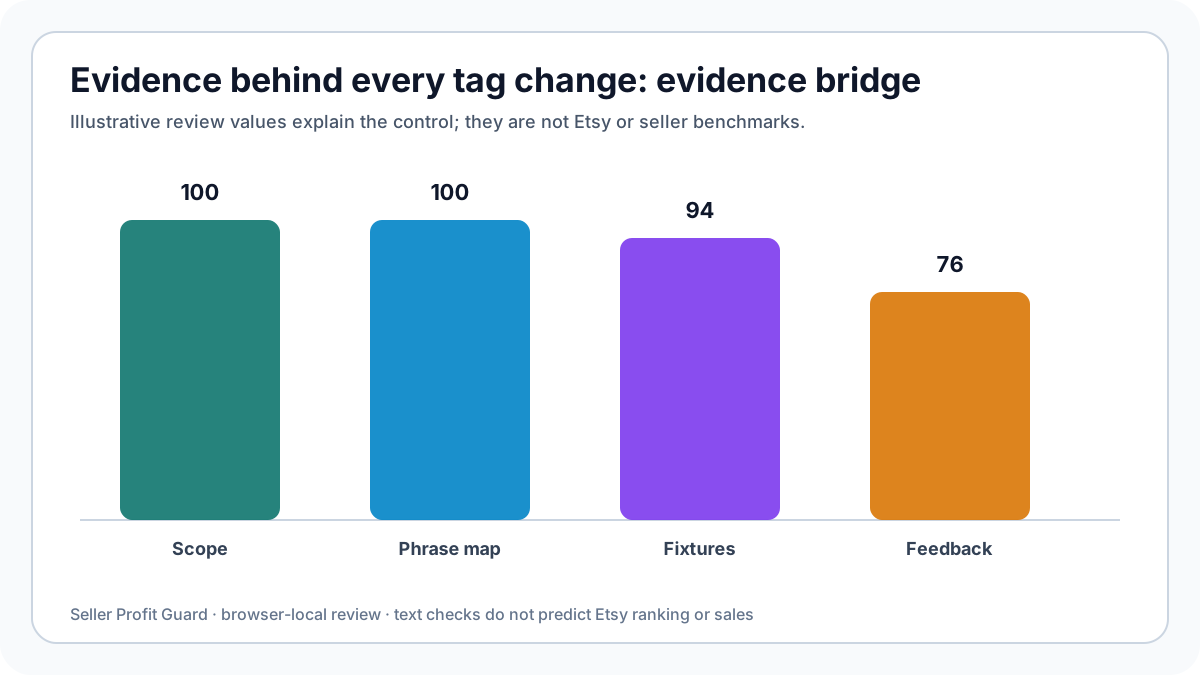
| Control | Artifact | Failure response |
|---|---|---|
| Scope | Listing + variations | Narrow |
| Phrases | Source and fact map | Reject |
| Fields | Coverage matrix | Re-route |
| Baseline | Old set + Stats | Preserve |
| Rollback | Trigger + set | No release |
Which checker fixtures and interface controls must pass?
Store all six inputs, score, slot count, multi-word count, over-limit count, exact duplicates, category or attribute duplicates, repeated terms, fact coverage, title overlap, evidence-note status, issue list, and next steps. Identify the tool, parsing, and rule version.
Test the default 13-slot fixture, empty input, fewer and more than 13 slots, exactly 20 and 21 characters, exact duplicates with case differences, one-character tags, apostrophes, internal and edge hyphens, Unicode letters, repeated terms, structured-field duplicates, absent facts, blank title, and missing evidence note.
Test keyboard entry, textarea line and comma parsing, labels, reset, mobile layout, result descriptions, and horizontal overflow. Verify no entered tags, Shop Stats note, private export, or buyer data is sent through analytics or embedded in generated public reports.

How are official sources and public claims audited?
Version the current Etsy tag Help article, Keywords 101, How Etsy Search Works, search checklist, category guidance, and Seller Policy. Record access date and the precise statement each source supports. Recheck field limits and allowed characters when the interface changes.
Search public copy for unsupported certainty. Remove claims that 13 tags guarantee ranking, every tag must be multi-word, all category overlap is harmful, a checker score predicts traffic, third-party volume is actual Etsy demand, or a simple before-and-after comparison proves causal sales.
Confirm policy language remains narrow. The audit does not certify intellectual-property rights, regulated claims, tax, legal compliance, product eligibility, or every regional requirement. Escalate uncertain brand, medical, origin, certification, environmental, cultural, or compatibility terms.
What belongs in approval and publication feedback?
Record old and proposed sets, replacement reasons, hard-gate results, phrase routing, checker output, reviewer, exact listing and shop, effective time, unchanged context, expected matching hypothesis, comparison window, minimum evidence, exceptions, and rollback.
After publication, verify the exact saved tags on the intended listing. Record platform warnings, normalization, missing slots, or bulk-edit differences. Safe-stop on wrong profile, login or CAPTCHA ambiguity, missing target context, uncertain selection, or an unexpected policy warning.
At the mature date, record aggregate observed search terms, visits, favorites, orders, conversion context, confounders, result classification, and next action. Use “observed after” rather than “caused by” unless a credible design proves causality.
How are rollback and audit closure verified?
Rollback for inaccurate or irrelevant phrases, policy or rights concern, variation mismatch, buyer confusion, publication error, or the predefined mature evidence threshold. Restore the exact preserved set and verify it in the correct live listing.
Preserve the failed candidate, evidence, reason, time, operator, and recovery proof. Do not erase the record or immediately publish an undocumented third set. Reopen product, category, attribute, or field evidence when the failure exposes a deeper listing issue.
Close only when the accepted or restored set is verified, exceptions have owners and dates, private artifacts remain controlled, feedback is classified, and the next review is scheduled. A checked template without publication and mature feedback evidence remains open.
Which evidence should support this audit and change-log control?
Preserve the exact 13-slot tag set before editing and keep the review grain at one listing. Record the most specific category, relevant attributes, verified public product facts, listing title, description lead, first-photo promise, shop language, aggregate Etsy Search visits and search terms, change date, and planned comparison window. A shop-wide keyword export is not a substitute for listing-level context.
Separate platform guidance, seller facts, and observed performance. Etsy's current public guidance supports using all 13 relevant slots, multi-word phrases up to 20 characters, specific categories and attributes, tag variety, and Shop Stats review. It does not prove demand for a phrase, establish a fixed ranking weight, or guarantee that replacing one tag will increase traffic or sales.
Freeze the prior tags, proposed tags, checker version, source-access date, listing settings, comparison dates, and a privacy-safe fingerprint. Record whether a candidate phrase came from Shop Stats, the seller's verified product vocabulary, Etsy's own interface, or a separate research process. Search suggestions and third-party estimates remain leads to validate, not facts to copy blindly.
- Use public product facts and aggregate observations only.
- Keep each phrase accurate for every affected variation.
- Separate category and attribute coverage from tag-slot coverage.
- Change a bounded set and declare the feedback window.
- Preserve the old set and an exact rollback path.
Privacy and policy boundaries for this audit and change-log control
A tag review needs listing text and aggregate search observations, not buyer identity. Do not paste names, email addresses, postal addresses, order IDs, message text, personalization requests, payment data, tracking numbers, private search histories, or raw listing and order exports into the public checker, public articles, analytics events, feedback forms, email drafts, or community posts.
Keep downloaded listing or Shop Stats files in the approved private environment. Extract only the public phrases and aggregate comparison fields needed for the review, then apply access, retention, and deletion rules. Public examples in this cluster are fictional. Seller Profit Guard runs the quick checker in the browser and does not require Etsy credentials.
Accuracy, intellectual-property, and policy review remain seller responsibilities. A mechanically valid tag can still be irrelevant, misleading, infringing, prohibited, or inconsistent with a variation. Stop when a proposed material, origin, maker, brand, compatibility, certification, health, recipient, occasion, or production-method phrase cannot be verified from the actual item and current policy.
How should the Etsy Tag / Keyword Checker be used for this audit and change-log control?
Enter the complete comma- or line-separated tag set, the most specific category phrase, relevant attribute phrases, verified product-fact phrases, related listing title, and an optional privacy-safe Shop Stats or change note. The checker counts slots, validates the 20-character rule and allowed edge characters, finds exact duplicates, measures multi-word use, and surfaces repeated terms.
The tool also highlights exact category or attribute duplication, reports how many entered product-fact phrases appear in the tag corpus, shows title-concept overlap, and records whether an evidence note exists. Those are deterministic string checks. They do not know search volume, semantic equivalence, product truth, trademark rights, ranking probability, conversion quality, or whether a phrase is useful in a particular market.
Read issues and next steps before the score. Preserve the old tag set, verify every candidate against the product and surrounding listing fields, change one listing or a controlled group, and compare mature aggregate Shop Stats. Roll back when the approved stop rule is met. Do not cycle tags daily to chase personalized search results or an arbitrary perfect score.
- Preserve the current 13-slot set and listing context.
- Verify category, attributes, product facts, and shop language.
- Run the deterministic limit, variety, and coverage review.
- Route each phrase to the field where it adds unique value.
- Release one bounded change with evidence and rollback.
Sources and further reading
- Etsy Help: How to Use Tags to Get Found in Search: Current field limits, allowed characters, and Etsy's explanation of tag-to-query matching.
- Etsy Seller Handbook: Keywords 101: Current guidance for all 13 tags, multi-word phrases, variety, categories, attributes, regional phrases, Shop Stats, and shop language.
- Etsy Seller Handbook: How Etsy Search Works: Official explanation of holistic query matching, relevancy, ranking, personalization, listing quality, and Shop Stats context.
- Etsy Seller Handbook: Search Optimization Checklist: Official category, attribute, tag, title, description, image, and search-visibility review guidance.
- Etsy Seller Handbook: Add Categories to Your Listings: Current explanation that specific categories act as tags and can unlock relevant attributes.
- Etsy Seller Policy: Current accuracy, representation, intellectual-property, privacy, spam, and search-manipulation boundaries.
- Seller Profit Guard methodology: Evidence hierarchy, local-first privacy, deterministic checks, uncertainty, change control, and non-advice limits.
Related Seller Profit Guard tools
- Open the Etsy Tag / Keyword Checker: Review tag limits, variety, listing-field duplication, product-fact coverage, and evidence context.
- Check the Etsy listing title: Keep the item noun and objective traits readable while tags carry additional relevant phrases.
- Review the variation and SKU checklist: Keep tag claims aligned with the materials, sizes, styles, and options a buyer can actually select.
- Use the listing QA checklist: Connect public listing language with cost, variation, SKU, and price records.
- Read the editorial policy: See how sources, corrections, reviews, and publication controls are handled.
- Read the local-first methodology: Keep buyer data, raw exports, and private search evidence outside public tools and articles.
- Etsy Tag Checker: Six Inputs That Matter: Continue the Etsy tag evidence, phrase-routing, release, and rollback workflow.
- Etsy Tag Checker Example: Gift Listing: Continue the Etsy tag evidence, phrase-routing, release, and rollback workflow.
- Etsy Tag Checker for a Style-Led Listing: Continue the Etsy tag evidence, phrase-routing, release, and rollback workflow.
- 9 Etsy Tag Checker Mistakes to Avoid: Continue the Etsy tag evidence, phrase-routing, release, and rollback workflow.
- Reliable Data for an Etsy Tag Checker: Continue the Etsy tag evidence, phrase-routing, release, and rollback workflow.
Next step: Open the Etsy Tag / Keyword Checker.
This is operational planning help, not tax, accounting, legal, financial, or platform-policy advice. Review the Terms and disclaimer, and verify current platform rules and fee assumptions before changing prices.