Seller Profit Guard audit checklist and change log template
Last updated: 2026-07-27
Written and reviewed by Seller Profit Guard Editorial Team.
An Etsy profit audit should prove source integrity, field mapping, formula scope, SKU cost coverage, fee and fulfillment evidence, scenario logic, decision thresholds, privacy, reviewer ownership, and rollback. Record every material change with old and new values, reason, source, effective date, affected pages or SKUs, tests, approver, and next review.

What does the audit template control?
The template connects a seller decision to the evidence and calculation that produced it. It is not a generic to-do list. Each control has an identifier, purpose, owner, evidence reference, expected result, status, exception, corrective action, and review date. A pass means the evidence meets the stated control; it does not mean the entire business or accounting process is correct.
Use the audit before a material price, shipping, promotion, advertising, supplier, labor, packaging, mapping, formula, or source change. Use a smaller weekly subset for recurring operations and the full checklist for releases or model changes. Preserve failed and not-applicable results so the history does not become artificially clean.

| Audit field | Required entry | Reason |
|---|---|---|
| Control ID | Stable unique identifier | Tracks recurrence and evidence |
| Scope | Shop, period, currency, SKU and decision | Prevents overgeneralization |
| Evidence | Source, version, date and location | Makes the result reproducible |
| Expected result | Pass condition or threshold | Prevents moving the target |
| Exception | Observed failure and impact | Preserves unresolved truth |
| Owner and due date | Named responsibility | Turns finding into action |
| Closure | Proof, reviewer and date | Distinguishes work from intent |
Source and privacy checklist
Confirm the order export type, shop, period, time zone, currency, row count, and original-file preservation. Confirm Payment Account or statement evidence when platform charges or deposits matter. Confirm private SKU, labor, packaging, shipping, advertising, and return sources. Record effective and review dates. Mark any field that uses a range or assumption.
Confirm that public artifacts, support notes, screenshots, test fixtures, and reports do not contain buyer names, addresses, private messages, payment credentials, marketplace passwords, or raw private order history. Use public dummy data for technical tests. Treat cost libraries and contribution reports as confidential operating records even when buyer data is absent.

- Original source retained read-only or by stable controlled reference.
- Shop, file type, period, currency and retrieval date recorded.
- Private cost source and owner recorded without public disclosure.
- Official platform rule URL and review date recorded.
- Public dummy fixture used for regression testing.
- No buyer, address, message, credential or raw private export exposed.
Mapping and formula checklist
Verify every required header and mapping. Record grain, sign, currency, tax treatment, discount treatment, and allocation method. Compare source row and order counts with imported counts. Check duplicate imports, repeated order-level values, missing SKU, unexpected currency, blank numeric fields, and new unmapped columns. Prove allocations sum back to their order or period.
Verify the formula includes the intended revenue, marketplace charges, product cost, labor, packaging, fulfillment, seller-funded promotion, advertising, software allocation, expected loss, and target. Confirm no field is counted twice. Confirm missing is not converted to zero. Confirm output terminology says estimated contribution and states excluded accounting or advisory scope.
| Formula control | Pass evidence | Common exception |
|---|---|---|
| Revenue reconciles | Allocated lines sum to order | List price or repeated shipping |
| Charges reconcile | Matched statement or dated assumption | Net plus duplicated fee |
| SKU cost coverage | Current record for economic weight | Blank treated as zero |
| Labor and fulfillment | Measured method and final evidence | Owner time or adjustment omitted |
| Risk allowance | Observed or dated scenario | Refund value used as loss |
| Target and scope | Written rule and exclusions | Break-even called profit |
Scenario and decision checklist
Confirm the base case represents current evidence. Confirm the conservative case changes a credible adverse driver. Confirm any improvement case corresponds to an implemented or testable operational change. Use the same SKU, quantity, currency, cost version, and attribution state when comparing offers. Explain every contribution delta.
Verify break-even, minimum, operating, stress-safe, and evidence gates. Map each result band to a predefined action. Confirm the decision is bounded by orders, time, spend, inventory, or another limit when evidence or downside is incomplete. Record confounders and a rollback condition. Do not approve a shop-wide action from one SKU or a small confounded sample.
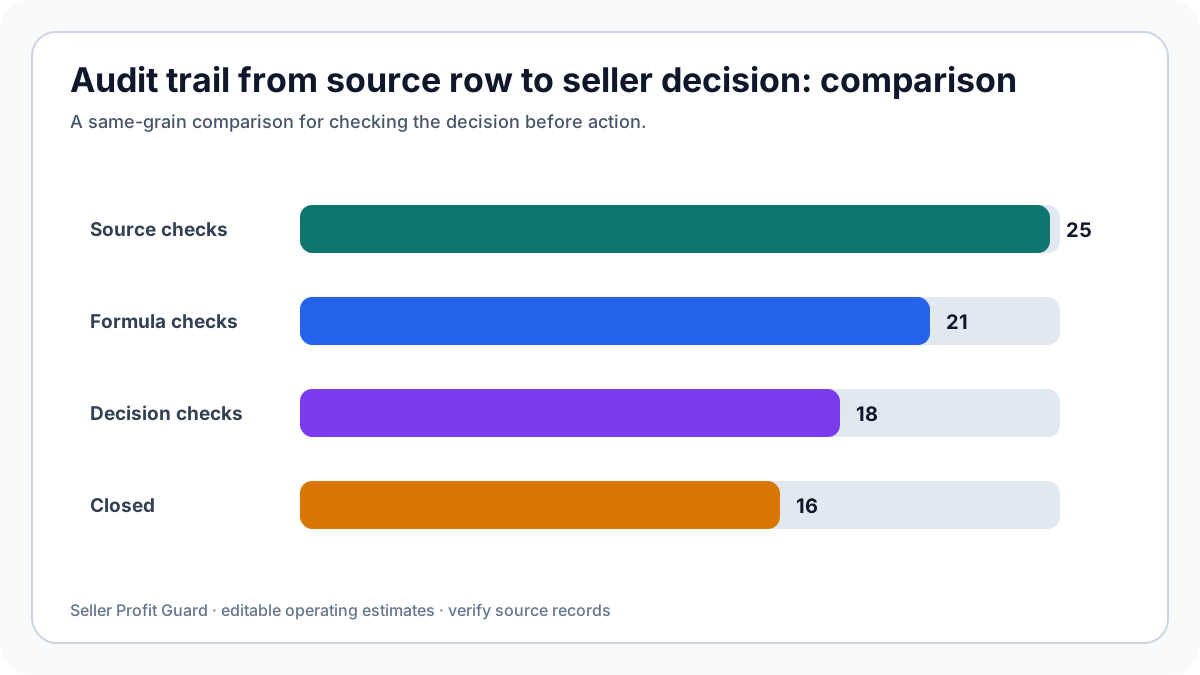
- Confirm the base case, target and evidence grade.
- Run one-variable sensitivity tests on important uncertain inputs.
- Run a credible combined downside when interactions matter.
- Map result bands to stop, hold, test or eligible actions.
- Set an exposure cap and rollback rule.
- Schedule reconciliation with matured actual evidence.
Change log template
Create one row for every material source, mapping, formula, assumption, content, tool, or operating-rule change. Record change ID, timestamp, owner, object, old value, new value, reason, source, effective date, affected SKUs or routes, migration need, test evidence, reviewer, production state, rollback reference, and next review. Link the change to relevant controls and incidents.
Do not overwrite the old value without preserving history. A new fee assumption can change prior planning results but should not rewrite what the seller knew at the time. A mapping change may require reprocessing. A source correction may require content and calculator updates. A privacy defect may require containment and artifact review. State the scope and follow-through.
| Change-log column | Example entry | Control question |
|---|---|---|
| Object | Labor minutes for SKU A | What changed? |
| Old → new | 18 → 24 minutes | Can the delta be reconstructed? |
| Reason/source | Five-order time study | Why is the new value defensible? |
| Effective date | 2026-07-26 | Which decisions use it? |
| Affected scope | SKU A and two variations | What must be recalculated? |
| Tests/reviewer | Fixture pass; operations review | Who verified the change? |
| Rollback/next review | Restore v3; review after 30 orders | How is it contained? |
Exception and corrective-action template
When a control fails, record the observed evidence, expected condition, economic or privacy impact, affected scope, containment, root-cause category, corrective action, owner, due date, retest, residual risk, and closure reviewer. Do not close an exception because a later total looks reasonable. Close it because the underlying control passes with evidence.
Classify recurring defects: source unavailable, mapping drift, missing SKU record, stale private cost, duplicate charge, wrong sign, wrong grain, privacy exposure, unsupported content claim, test gap, deployment failure, or operational non-compliance. The category helps update the generator, test, documentation, or owner process that prevents recurrence.
- Contain affected decisions and pages before correcting them.
- Preserve the failed evidence and prior version.
- Correct the root control, not only the displayed total.
- Retest a public fixture and affected private records locally.
- Record residual risk and a named closure reviewer.
Release and rollback checklist for public pages
Before a public cluster release, verify distinct intent, standalone value, source freshness, formula and example arithmetic, word depth without filler, original visuals, image signatures and dimensions, direct answer length, author and review date, canonical, indexability, schema, internal links, sitemap membership, mobile layout, accessibility, privacy, and pairwise content similarity.
Create narrow local and remote backups plus a rollback identifier. Run focused and full tests, integration, build, SEO audit, candidate and origin browser QA. Deploy one bounded batch, purge changed URLs only, verify live functionality and metadata, and roll back on a critical failure. Record Day 0 and future measurement dates without claiming same-day ranking or revenue effects.
| Release phase | Evidence | Failure action |
|---|---|---|
| Preflight | Scope, source, content and privacy audit | Keep local or noindex |
| Backup | Local, remote and rollback identifiers | Do not deploy |
| Verification | Tests, build, SEO, browser and candidate | Correct and rerun |
| Release | Bounded deploy and targeted purge | Stop on unexpected scope |
| Live gate | HTTP, tool, canonical, schema, links, assets, E2E | Automatic rollback |
| Record | Deployment, progress and Day 0 reports | No completion claim |
How should the audit be reviewed and retained?
Use an independent second review for material formula, privacy, source, or production changes when available. At minimum, separate authoring from a later checklist pass and require fresh machine evidence for syntax, tests, build, generated pages, internal links, and live behavior. A test only proves the behavior it covers; pair it with content and source inspection.
Retain the audit with the source references, mapping version, calculation version, change log, exceptions, release identifier, rollback, and measurement schedule. Set retention according to the seller's legal, accounting, privacy, and operational requirements. The public site should retain only redacted quality and deployment evidence, never raw customer or order data.
- Reviewer and review date recorded.
- Machine checks linked by fresh report or output.
- Exceptions remain open until evidence closes them.
- Audit and rollback references are durable.
- Public reports contain only privacy-safe aggregates and metadata.
Etsy profit audit questions
Does every weekly review need the full release checklist? No. Use the controls appropriate to the change, while material formula, privacy, mapping, or public releases require the full gate.
Can a checklist prove the calculation is correct? Only when each item links to evidence and the tests cover the relevant formula and examples. Checked boxes without evidence are not proof.
Who should approve a price change? The seller should define ownership appropriate to the business. The template records responsibility but does not provide accounting, tax, legal, or platform advice.
How long should change history be kept? Retain it under applicable business, legal, privacy, and accounting requirements. Do not publish private records.
What is the final completion rule? Every required control passes, every material exception is closed or explicitly accepted by the proper owner, rollback exists, and live evidence matches the intended state.
Privacy and evidence limits for profit audit and change log
A contribution review does not need buyer names, delivery addresses, private messages, payment credentials, marketplace passwords, or a public copy of the seller's order history. It normally needs a redacted transaction key, date, SKU, quantity, seller-attributable revenue, relevant fee evidence, and private cost assumptions. Keep the untouched export in controlled storage and work from a local copy.
Seller Profit Guard is designed to read supported CSV files in the browser. A report can still contain commercially sensitive prices, SKU economics, labor rates, and supplier costs, so treat exports as private operating records. For support, share column names and a made-up example row. If an account-specific reserve, fee, refund, or suspension determines the answer, use the authenticated Etsy record rather than a generic assumption.
- Do not upload buyer identity or address fields for a margin calculation.
- Do not paste raw order rows into public communities, support email, or AI prompts.
- Use public dummy data to reproduce mapping and formula issues.
- Store cost libraries, reports, and change logs as confidential business records.
- Escalate tax, accounting, legal, and account-policy questions to the appropriate official or professional source.
How to apply this profit audit and change log in Seller Profit Guard
Open the Etsy CSV profit calculator with a recent, representative order-item export or the public dummy sample. Confirm the revenue, quantity, SKU, shipping, discount, fee, and transaction mappings before importing private cost assumptions. Review missing-cost and mapping warnings first; a precise result built on an empty or misidentified field is not decision-ready.
Run the relevant base and stress scenarios, export the private review list, and record the source period, assumptions, result, decision, owner, and next review date. The useful output is not a perfect score. It is a short, evidence-backed queue of listings or SKUs that need a price, cost, shipping, promotion, or data-quality action.
- Preserve the source export and record its shop, currency, period, and file type.
- Confirm every mapped field and keep missing values unknown rather than zero.
- Attach the correct SKU-level material, labor, packaging, fulfillment, and target assumptions.
- Run a base case plus the page-specific stress or comparison case.
- Inspect the rows that fail the target or evidence-quality gate.
- Record one reversible action and a dated follow-up instead of changing the whole shop.
Related resources
- Open the Etsy CSV profit calculator: Run a browser-local order and SKU contribution review with editable assumptions.
- Build an Etsy SKU cost library: Store material, labor, packaging, shipping, and target assumptions for repeat reviews.
- Reconcile Etsy Payment Account activity: Match order and statement evidence before interpreting cash movement as product economics.
- Review CSV data privacy: Keep raw buyer and order data out of public support and community posts.
- Read the editorial policy: See how sources, corrections, AI assistance, and update dates are handled.
Sources and further reading
- Seller Profit Guard calculation methodology: Calculation scope, editable assumptions, contribution terminology, privacy boundaries, and result limits.
- Etsy Help: Fees and Taxes for Selling: Official fee categories, fee bases, country-dependent processing charges, advertising fees, and Payment Account treatment.
- Etsy Help: Download Sold Transaction Spreadsheets: Official order items, orders, Etsy Payments sales, and Etsy Payments deposits CSV workflow.
- Etsy Help: Manage Your Payment Account: Official sales, fees, refunds, seller services, shipping, monthly statements, balance, and deposit context.
- Etsy Help: How Offsite Ads Work: Official attribution, participation, fee-rate, and order-cap context; verify current shop-specific status.
- Etsy Help: Issue a Full or Partial Refund: Official refund workflow and Payment Account impact reference.
Related Seller Profit Guard tools
- Open the Etsy CSV profit calculator: Run a browser-local order and SKU contribution review with editable assumptions.
- Build an Etsy SKU cost library: Store material, labor, packaging, shipping, and target assumptions for repeat reviews.
- Reconcile Etsy Payment Account activity: Match order and statement evidence before interpreting cash movement as product economics.
- Review CSV data privacy: Keep raw buyer and order data out of public support and community posts.
- Read the editorial policy: See how sources, corrections, AI assistance, and update dates are handled.
- Etsy Profit Formula: Inputs Small Sellers Must Track: Continue the Seller Profit Guard evidence and decision workflow.
- Etsy Profit Example: Trace a $74 Order Step by Step: Continue the Seller Profit Guard evidence and decision workflow.
- Etsy Discount Profit: Test Coupons and Free Shipping: Continue the Seller Profit Guard evidence and decision workflow.
- Etsy Profit Calculator Mistakes: 12 Cost Traps: Continue the Seller Profit Guard evidence and decision workflow.
- Etsy Profit Data Sources: Build a Defensible Record: Continue the Seller Profit Guard evidence and decision workflow.
Next step: Open the Etsy CSV profit calculator.
This is operational planning help, not tax, accounting, legal, financial, or platform-policy advice. Review the Terms and disclaimer, and verify current platform rules and fee assumptions before changing prices.