What an Etsy variation naming result can and cannot prove
Last updated: 2026-07-30
Written and reviewed by Seller Profit Guard Editorial Team.
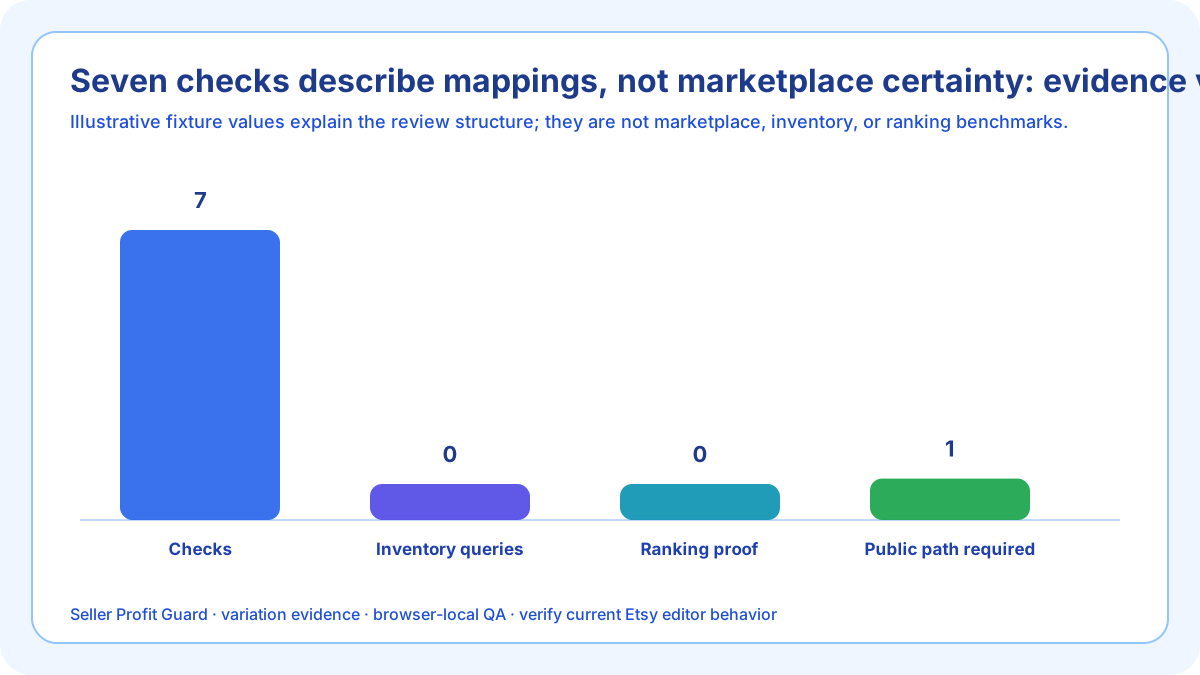
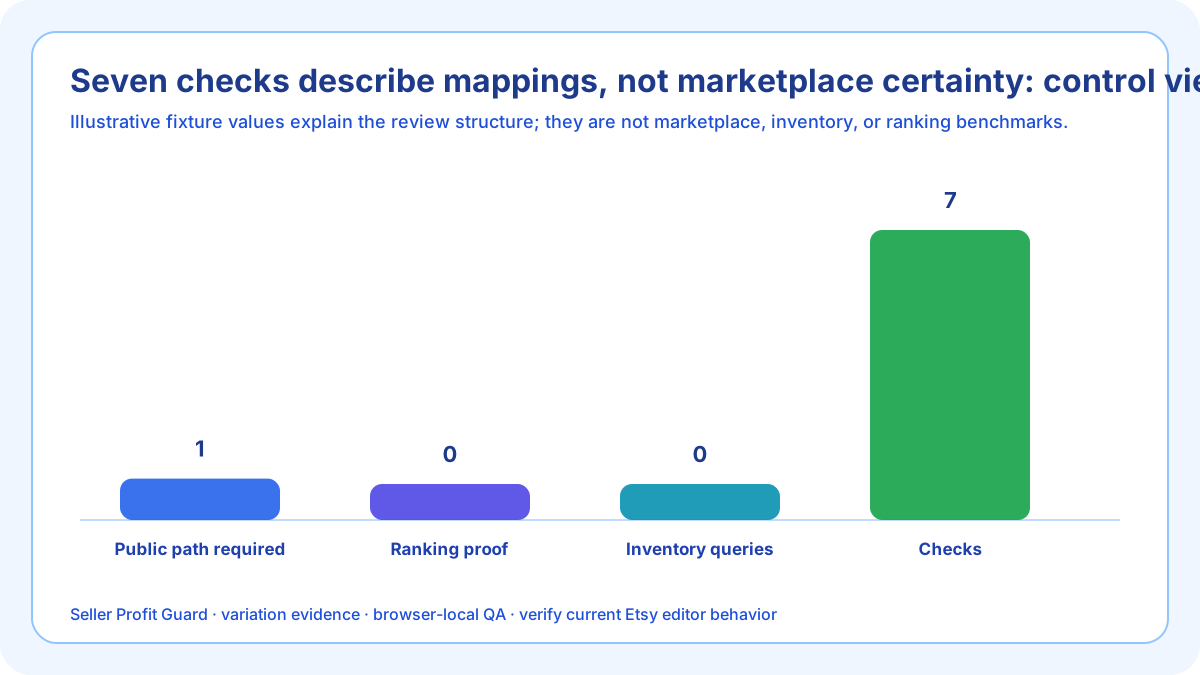
Read the report in layers: the seven-check count summarizes structure; axis and option counts define the denominator; expected combinations expose missing or extra SKU rows; photo and price checks test declared maps; known issues override compensation; and the evidence state separates Ready from Hold. None of these outputs proves product truth, inventory, ranking, or conversion.

responsible result interpretation: scope and decision
Begin with the decision, then inspect each failed or passed layer. A seven-of-seven score describes the seller-entered naming and mapping contract at one review point; it is not a probability that buyers will understand, purchase, receive, or keep the item.
Counts make the denominator visible. Two axes with three and two values imply six complete combinations. A SKU table with five rows is structurally incomplete, while seven rows may include a duplicate or invalid extra state.
Build the result meaning table before analysis
Known issues are non-compensating. A declared wrong photo or duplicate SKU produces Block even when the same textual value appears in all fields. Hold is narrower: structure passes but the evidence note is insufficient.
Use the report to choose a targeted correction and public verification path. Do not use it to justify unrelated SEO rewrites, bulk marketplace changes, or claims about ranking, conversion, revenue, returns, or AdSense.
Read the seven-check metric
The numerator counts passed axis, value, buyer-selector, photo, total-price, SKU, and evidence checks. Open each output; one failed critical mapping can matter more than the aggregate score.
Read “Read the seven-check metric” as a statement about the entered result meaning table, not about every real listing. Contrast 7/7 Ready matrix and 6/7 Hold or declared Block, inspect the underlying rows, and choose the next evidence action. The result supports a precise next action without unsupported certainty; it cannot replace image inspection, inventory verification, current marketplace rules, or later aggregate measurement.
Read variation and value counts
Axis count should reflect the intended physical listing model; value count should reconcile with the approved options. Counts cannot tell whether the product should offer fewer or more choices.
Read “Read variation and value counts” as a statement about the entered result meaning table, not about every real listing. Contrast 7/7 Ready matrix and 6/7 Hold or declared Block, inspect the underlying rows, and choose the next evidence action. The result supports a precise next action without unsupported certainty; it cannot replace image inspection, inventory verification, current marketplace rules, or later aggregate measurement.
Read expected combinations
The Cartesian count explains the required SKU coverage for complete set-list axes. Document any intentionally unavailable combination in the product authority and public configuration rather than silently omitting it.
Read “Read expected combinations” as a statement about the entered result meaning table, not about every real listing. Contrast 7/7 Ready matrix and 6/7 Hold or declared Block, inspect the underlying rows, and choose the next evidence action. The result supports a precise next action without unsupported certainty; it cannot replace image inspection, inventory verification, current marketplace rules, or later aggregate measurement.
Read photo mapping literally
Pass means every entered value for the declared appearance axis was found in the text map. It cannot prove the linked file, actual product, rights, color, crop, selected behavior, or accessibility.
Read “Read photo mapping literally” as a statement about the entered result meaning table, not about every real listing. Contrast 7/7 Ready matrix and 6/7 Hold or declared Block, inspect the underlying rows, and choose the next evidence action. The result supports a precise next action without unsupported certainty; it cannot replace image inspection, inventory verification, current marketplace rules, or later aggregate measurement.
Read price mapping literally
Pass means every entered value for the price axis appears in the total-price map. It cannot validate currency, regional pricing, discount, tax, fee, cost, profit, or the live selected price.
Read “Read price mapping literally” as a statement about the entered result meaning table, not about every real listing. Contrast 7/7 Ready matrix and 6/7 Hold or declared Block, inspect the underlying rows, and choose the next evidence action. The result supports a precise next action without unsupported certainty; it cannot replace image inspection, inventory verification, current marketplace rules, or later aggregate measurement.

Read SKU mapping literally
Pass means every entered combination appears once with a unique code. It cannot verify current stock, inventory quantity, editor persistence, warehouse mapping, cost records, fulfillment, or receipts.
Read “Read SKU mapping literally” as a statement about the entered result meaning table, not about every real listing. Contrast 7/7 Ready matrix and 6/7 Hold or declared Block, inspect the underlying rows, and choose the next evidence action. The result supports a precise next action without unsupported certainty; it cannot replace image inspection, inventory verification, current marketplace rules, or later aggregate measurement.
Read Ready, Revise, Hold, Block
Ready advances to public QA; Revise names structural gaps; Hold requests current provenance; Block stops declared discrepancies. None is a legal opinion or marketplace approval.
Read “Read Ready, Revise, Hold, Block” as a statement about the entered result meaning table, not about every real listing. Contrast 7/7 Ready matrix and 6/7 Hold or declared Block, inspect the underlying rows, and choose the next evidence action. The result supports a precise next action without unsupported certainty; it cannot replace image inspection, inventory verification, current marketplace rules, or later aggregate measurement.
Choose the next evidence action
Refresh the responsible source, repair one bounded layer, rerun crossed fixtures, preserve backup, select every public combination, record closure, and observe later aggregate outcomes without claiming immediate causation.
Read “Choose the next evidence action” as a statement about the entered result meaning table, not about every real listing. Contrast 7/7 Ready matrix and 6/7 Hold or declared Block, inspect the underlying rows, and choose the next evidence action. The result supports a precise next action without unsupported certainty; it cannot replace image inspection, inventory verification, current marketplace rules, or later aggregate measurement.
Verification, release, and rollback controls
Before changing a public listing, preserve the complete result meaning table, editor values, linked assets, selected-path observations, test fixtures, approval, and rollback identifier. Confirm the correct account and listing. Safe-stop on login or CAPTCHA ambiguity, a platform warning, wrong profile, missing target context, private data, or an unexpected editor state.
After one bounded release, verify 7/7 Ready matrix on mobile and desktop and deliberately revisit the risk represented by 6/7 Hold or declared Block. Check axis names, values, selected photo, full price, availability, processing, cart or receipt choice, and SKU for every valid combination. Restore the prior configuration when a critical path does not support a precise next action without unsupported certainty.
Limits, privacy boundary, and next action
This guide and checker use seller-entered text and synthetic examples. They do not retrieve Etsy data, alter a listing, inspect images, validate product composition, confirm inventory or receipts, certify marketplace policy, or predict ranking, clicks, conversion, sales, returns, income, or AdSense approval. Seller Profit Guard is independent and unaffiliated with Etsy and provides operational QA rather than legal, tax, accounting, inventory, search, accessibility, or platform advice.
Keep buyer names, addresses, messages, order IDs, receipts, private personalization, credentials, OAuth data, and raw CSV files outside the result meaning table. The next action is to repair the named evidence layer, rerun complete and crossed fixtures, release only the approved set, inspect the public choice path, and record whether a precise next action without unsupported certainty was verified or rolled back.
Sources and further reading
- Etsy Help: How to Add Variations for Your Listings: Current official variation attributes, values, total prices, quantities, processing profiles, SKUs, linked photos, custom variations, visibility, preview, and buyer-selection behavior.
- Etsy Help: How to Create a Listing: Current official category, price, quantity, SKU, physical-listing, and variation context.
- Etsy Help: Processing Times and Processing Profiles: Current official listing- and variation-level processing-profile behavior.
- Etsy Help: How to Offer Personalized Listings: Current official Custom options fields, five-field limit, field types, test-limited add-on pricing, and the inventory-versus-personalization boundary.
- Etsy Help: How to Offer Custom Items: Current official boundary between public listing variations and one-buyer private custom listings.
- Etsy Seller Policy effective July 9, 2026: Current official accuracy, content, privacy, representation, and seller-responsibility requirements.
- Seller Profit Guard methodology: Evidence hierarchy, privacy boundary, uncertainty labels, corrections, release verification, and rollback controls.
Related Seller Profit Guard tools
- Open the Etsy Variation Naming Checker: Review axes, values, buyer selectors, linked photos, total prices, and unique SKU combinations.
- Audit Etsy variation and SKU risk: Check cost and fulfillment risk after the naming contract is coherent.
- Review Etsy attribute coverage: Keep category attributes separate from buyer-selectable options.
- Check Etsy photo coverage: Verify appearance-changing values have truthful buyer evidence.
- Read the variation SKU checklist: Connect buyer choices with stable cost and inventory controls.
- Read the local-first methodology: Preserve evidence, privacy, bounded release, feedback, and recovery.
- Etsy Variation Naming Formula and Inputs: Continue the variation evidence, mapping, decision, release, interpretation, or audit workflow.
- Etsy Variation Names: Size and Color Example: Continue the variation evidence, mapping, decision, release, interpretation, or audit workflow.
- Etsy Material and Personalization Options: Continue the variation evidence, mapping, decision, release, interpretation, or audit workflow.
- 12 Etsy Variation Naming Mistakes: Continue the variation evidence, mapping, decision, release, interpretation, or audit workflow.
- Evidence Sources for Etsy Variations: Continue the variation evidence, mapping, decision, release, interpretation, or audit workflow.
Next step: Open the Etsy Variation Naming Checker.
This is operational planning help, not tax, accounting, legal, financial, or platform-policy advice. Review the Terms and disclaimer, and verify current platform rules and fee assumptions before changing prices.