TikTok Shop Creator Commission Calculator worked example
Last updated: 2026-07-29
Written and reviewed by Seller Profit Guard Editorial Team.
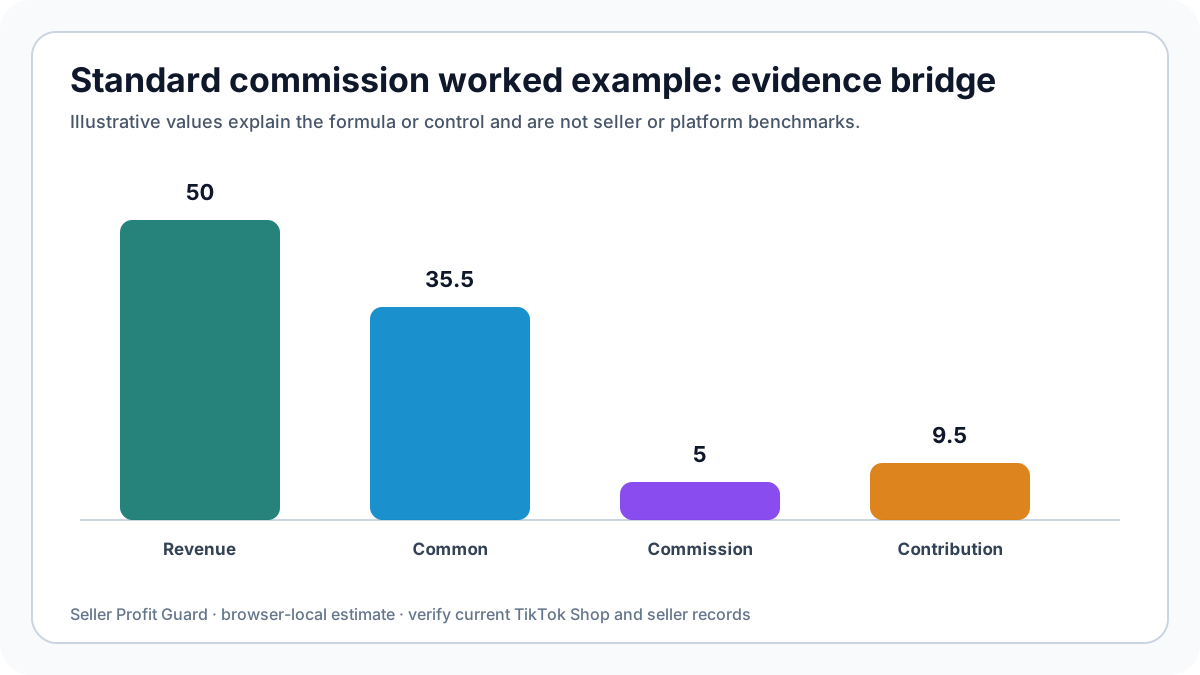
For a $50 retained order with a $50 commission base, a 10% Standard commission is $5. After $4 fees, $15 product and packaging, $6 fulfillment, $2 coupon, $1.50 sample allocation, $5 advertising, and $2 expected return loss, retained contribution is $9.50, or 19% of revenue.

What problem does this standard affiliate commission worked example solve?
The useful question is not how much GMV appeared, but what remains from a reconciled kept transaction. The calculation uses retained kept transactions for the denominator and records the proposed 10% rate beside the rate actually protected for each promoting creator. It does not assume that changing the product setting instantly changes every payable kept transaction. The page keeps Standard affiliate and Shop Ads commission visible as separate paths because the active TikTok controls, authorization, and attribution context can differ.
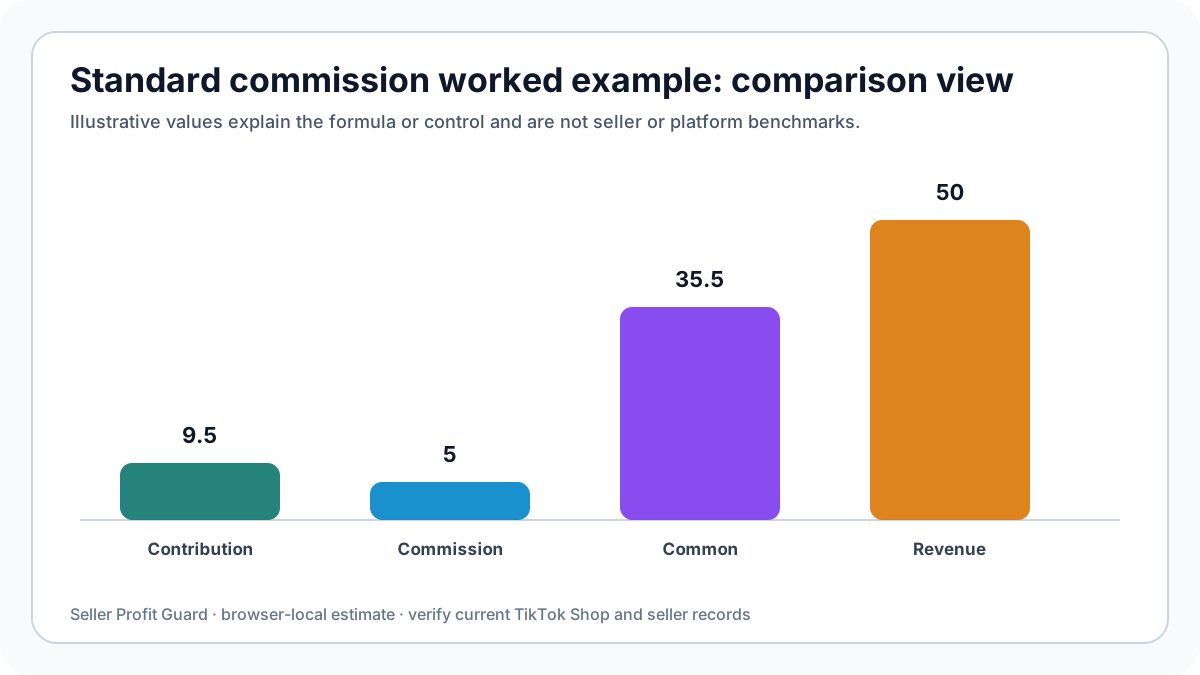
The fictional creator test ships one $30 sample and expects 20 kept attributed sales. The sample cost per kept sale is $1.50 per retained kept transaction. Common outlays before commission total $35.50, so the $5 Standard commission leaves $9.50. This is a fictional operating example, not a claim about a seller, creator, account, market average, conversion rate, or guaranteed outcome. Replace every value with the applicable first-party worked ledger or a clearly labeled planning assumption.
If only ten retained kept transactions arrive, sample cost per kept sale doubles to $3 and contribution falls to $8. If the return-loss estimate rises by $2, contribution falls again to $6 before any other change. The correction is to retain statement evidence, scope, date, formula version, and denominator beside the number. If a computed contribution cannot be reproduced from those fields, it is not ready for a pricing, commission, sample, or advertising test verdict.
| Base case | Stress case | Decision |
|---|---|---|
| Order grain | Retained attributed order | Reconcile |
| Commission | Eligible base × rate | Version |
| Samples | Landed cost ÷ retained orders | Stress |
| Decision | Contribution versus target | Record |
How is retained contribution calculated?
Use reconciled order revenue minus unit product outlay, packaging, fulfillment, Seller Center and payment fees, seller-funded discount, allocated sample outlay, advertising per attributed kept transaction, mature refund exposure, and the applicable Standard affiliate payout. Commission equals the commissionable amount multiplied by the entered rate. Contribution margin equals retained contribution divided by reconciled order revenue.
Keep revenue, commissionable amount, and fee base separate even when the default example uses the same dollar value. A refund, seller-funded discount, shipping component, tax treatment, or market-specific settlement rule can cause them to diverge. The calculator does not infer those definitions from a product price.
Round only for display. Retain unrounded example input and computed contribution values in the private worked ledger if cents matter to the test verdict. A Seller Center statement remains the reconciliation authority; the browser-local calculator is a planning and example check aid.

Which TikTok Seller Center rules must remain separate?
TikTok's active public material distinguishes a Standard commission from an optional Shop Ads commission for eligible ad-supported kept transactions. Open Collaboration documentation also describes a minimum Shop Ads rate relationship in most regions and names exceptions. Target Collaboration can use commission-only or flat-fee structures, which require different worked calculation.
Official material also describes protected-rate timing for creators already promoting a product. A newly entered lower rate is therefore not proof that every payable kept transaction instantly uses it. Worked ledger the rate visible for the specific collaboration and the effective or protected context used by the worked calculation cohort.
Affiliate creative used in Shop Ads requires authorization and can appear in Ads x Affiliate reporting. Attribution and commission settlement answer different questions. Reconcile them instead of assuming every ad-attributed kept transaction has one commission state or that attributed GMV equals retained seller revenue.
How should samples, ads, and returns be treated?
Allocate the landed sample, outbound shipping, packaging, and handling outlay across kept attributed sales expected from the relevant creator or creator test. Do not divide by impressions, video views, clicks, gross kept transactions, or all shop kept transactions when the business question is contribution per kept attributed sale.
Shop Ads commission does not replace the media bill. Keep campaign spend per attributed kept transaction in the common outlay stack unless the worked case explicitly worked calculation an organic affiliate path with no seller ad spend. Label mixed organic and paid cohorts separately before averaging.
mature refund exposure should cover the probability-weighted seller loss after refunds, reverse shipping, unrecovered fulfillment, support, handling, inventory damage, replacement, and realistic recovery. Update the estimate after the return window matures; do not count an unresolved kept transaction as retained reconciliation proof.
What base and stress cases belong in this standard affiliate commission worked example?
The base case uses the most supportable active values. Stress a smaller retained-kept transaction denominator for sample cost per kept sale, a higher payable commission rate, higher ad spend, a larger seller-funded discount, higher fulfillment, and worse return loss. Change one variable at a time before combining an ordinary downside case.
The fictional creator test ships one $30 sample and expects 20 kept attributed sales. The sample cost per kept sale is $1.50 per retained kept transaction. Common outlays before commission total $35.50, so the $5 Standard commission leaves $9.50. Recalculate with half the retained kept transactions, one or two additional return-loss dollars, and the protected rather than proposed rate. This shows whether the apparent target cushion depends on an optimistic denominator, early refund state, or a setting that is not yet effective.
Do not create dozens of arbitrary combinations. Keep the worked case set tied to observed variation, contract boundaries, product economics, inventory capacity, and the test verdict at hand. Worked ledger why each stress value is plausible and which event would activate it.
What reconciliation proof is required before action?
retain product, variation, collaboration, creator or creator test scope, market, currency, time zone, active Standard and Shop Ads settings, effective-rate context, commissionable amount, net revenue definition, outlay-worked ledger versions, retained-kept transaction rule, report filters, statement evidence access dates, and calculator version.
Use aggregate fields and privacy-safe references in the working log. Creator contact details, buyer identity, addresses, messages, payment details, raw kept transactions, private CSV exports, and ad-account credentials are unnecessary for a public calculator or article and must stay in the approved private environment.
Separate official Seller Center guidance, seller-observed records, worked calculation assumptions, and decisions. A statement evidence can support a field definition without supporting a performance forecast. Missing data stays marked unknown or assumed; it does not silently become zero.
Which test verdict and rollback controls apply?
At a 15% target target cushion, the margin requirement is $7.50. The base case passes by $2, but the combined lower-volume and higher-return case does not; the seller should cap the test, renegotiate, or improve another outlay. The action worked ledger names product, collaboration, rate path, spend or sample cap, owner, approval time, effective date, expected comparison window, unchanged context, exceptions, and stop rule.
tie out the intended product and collaboration after saving. Browser work must safe-stop for a wrong profile, login or CAPTCHA ambiguity, missing target context, unexpected Seller Center warning, unclear product selection, or a rate that does not match the approved reconciliation proof.
Rollback restores the exact preserved setting or stops the creator test when the entered threshold fails, outlays drift beyond bounds, product truth changes, attribution cannot be reconciled, or a policy or authorization concern appears. Tie out the restored state and retain the failure worked ledger.
How should results be reviewed after publication?
Wait for the declared reconciliation proof window and reconcile retained kept transactions, payable commission, advertising, samples, refunds, and outlay changes at the same grain. Worked ledger observed-after language rather than causal claims unless a credible experimental design supports incrementality.
Compare the worked calculation base, stress range, and actual reconciled distribution. Diagnose variance by example input rather than judging only the final contribution. A miss caused by lower retained kept transactions requires a different response from one caused by commission protection, ad spend, product mix, or return loss.
End with keep, cap, renegotiate, retest, hold, stop, or rollback and a reason. Schedule the next example check and retain the accepted formula, statement evidence versions, computed contribution, exceptions, and restoration path so the test verdict remains auditable.
Sources and further reading
- TikTok Business Help Center: Open Collaboration setup: Official Standard and Shop Ads commission controls, including the documented Open Collaboration minimum relationship and regional exceptions.
- TikTok Business Help Center: Target Collaboration setup: Official distinction between flat-fee and commission-only target collaborations.
- TikTok Business Help Center: Affiliate creatives for Shop Ads: Official authorization, commission, Ads x Affiliate reporting, and attribution context for affiliate creative used in ads.
- TikTok Shop Academy: How affiliate commission works: Official current explanation of Standard and Shop Ads commission-rate protection and seller change timing.
- Seller Profit Guard methodology: Evidence hierarchy, editable assumptions, local-first privacy, uncertainty labels, change control, and non-advice limits.
Related Seller Profit Guard tools
- Open the Creator Commission Calculator: Compare Standard and Shop Ads commission with the same retained-order cost stack.
- Calculate TikTok Shop margin: Map seller-attributable revenue, product cost, fees, discounts, fulfillment, ads, and expected return loss.
- Check a promotion stack: Review coupon, shipping subsidy, advertising, fees, and return exposure together.
- Estimate a TikTok paid CPA limit: Translate contribution before advertising into a target-margin-safe CPA and ROAS.
- Read the editorial policy: See how public claims, source freshness, corrections, and publication controls are handled.
- Read the local-first methodology: Keep creator contacts, order exports, customer data, and campaign files outside public tools.
- Creator Commission Formula: 14 Inputs: Continue the creator commission formula, evidence, decision, and rollback workflow.
- Shop Ads Commission: Margin Scenario: Continue the creator commission formula, evidence, decision, and rollback workflow.
- 9 Creator Commission Calculator Errors: Continue the creator commission formula, evidence, decision, and rollback workflow.
- Creator Commission Data: Source Map: Continue the creator commission formula, evidence, decision, and rollback workflow.
- Safe Creator Commission Margin Thresholds: Continue the creator commission formula, evidence, decision, and rollback workflow.
Next step: Open the Creator Commission Calculator.
This is operational planning help, not tax, accounting, legal, financial, or platform-policy advice. Review the Terms and disclaimer, and verify current platform rules and fee assumptions before changing prices.