Where to get reliable paid CPA limit data
Last updated: 2026-07-31
Written and reviewed by Seller Profit Guard Editorial Team.
Use the advertising platform for aggregate cost, conversions, selected actions, attribution window, and delay; authorized seller records for privacy-safe new-customer and retained-order reconciliation; versioned SKU, packaging, fulfillment, fee, and adverse-order records for contribution; and mature cohorts for repeat contribution evidence.
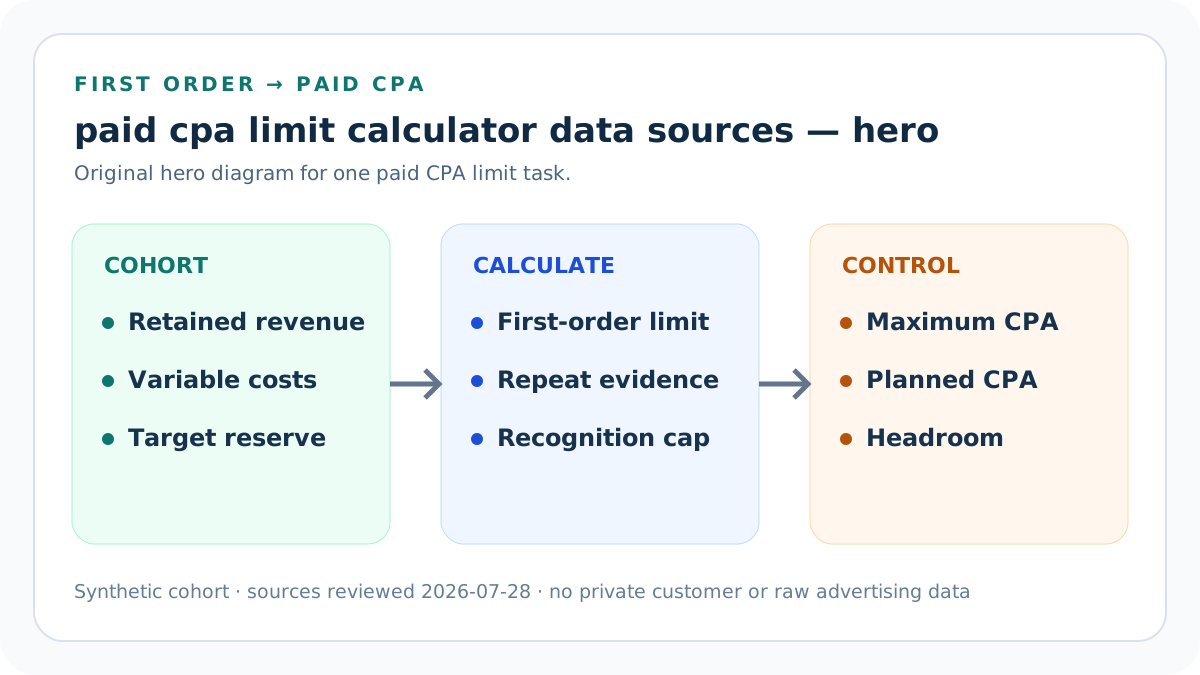
Source advertising cost
Use billed or reported cost for the exact campaign, market, conversion scope, currency, and closed period. Record the result in the paid CPA evidence source map with cohort alias, source version, acquisition date, maturity date, owner, currency, denominator, scope, and affected output. This makes an evidence-backed acquisition ceiling reproducible instead of dependent on an unversioned dashboard.
Budget, bid, click cost, and campaign cost are not interchangeable. Review point 1 separates observed data, authorized policy, unresolved evidence, and decisions outside the calculator. Keep advertising cost, acquired-customer count, first-order contribution, repeat contribution, recognition, attribution, maturity, target, and cash timing distinct.
Source conversion counts
Record selected conversion actions, attribution settings, duplicate treatment, delay, and adjustment history. Record the result in the paid CPA evidence source map with cohort alias, source version, acquisition date, maturity date, owner, currency, denominator, scope, and affected output. This makes an evidence-backed acquisition ceiling reproducible instead of dependent on an unversioned dashboard.
Do not assume every attributed conversion is a new customer. Review point 2 separates observed data, authorized policy, unresolved evidence, and decisions outside the calculator. Keep advertising cost, acquired-customer count, first-order contribution, repeat contribution, recognition, attribution, maturity, target, and cash timing distinct.
Source retained first orders
Reconcile charges, discounts, cancellations, refunds, and the seller's new-customer rule in authorized systems. Record the result in the paid CPA evidence source map with cohort alias, source version, acquisition date, maturity date, owner, currency, denominator, scope, and affected output. This makes an evidence-backed acquisition ceiling reproducible instead of dependent on an unversioned dashboard.
Public pages need aggregate values only. Review point 3 separates observed data, authorized policy, unresolved evidence, and decisions outside the calculator. Keep advertising cost, acquired-customer count, first-order contribution, repeat contribution, recognition, attribution, maturity, target, and cash timing distinct.
Source first-order cost
Use effective-dated SKU, packaging, labor, fulfillment, platform, payment, and other variable-cost records. Record the result in the paid CPA evidence source map with cohort alias, source version, acquisition date, maturity date, owner, currency, denominator, scope, and affected output. This makes an evidence-backed acquisition ceiling reproducible instead of dependent on an unversioned dashboard.
Product versions and destination mix must match the cohort. Review point 4 separates observed data, authorized policy, unresolved evidence, and decisions outside the calculator. Keep advertising cost, acquired-customer count, first-order contribution, repeat contribution, recognition, attribution, maturity, target, and cash timing distinct.
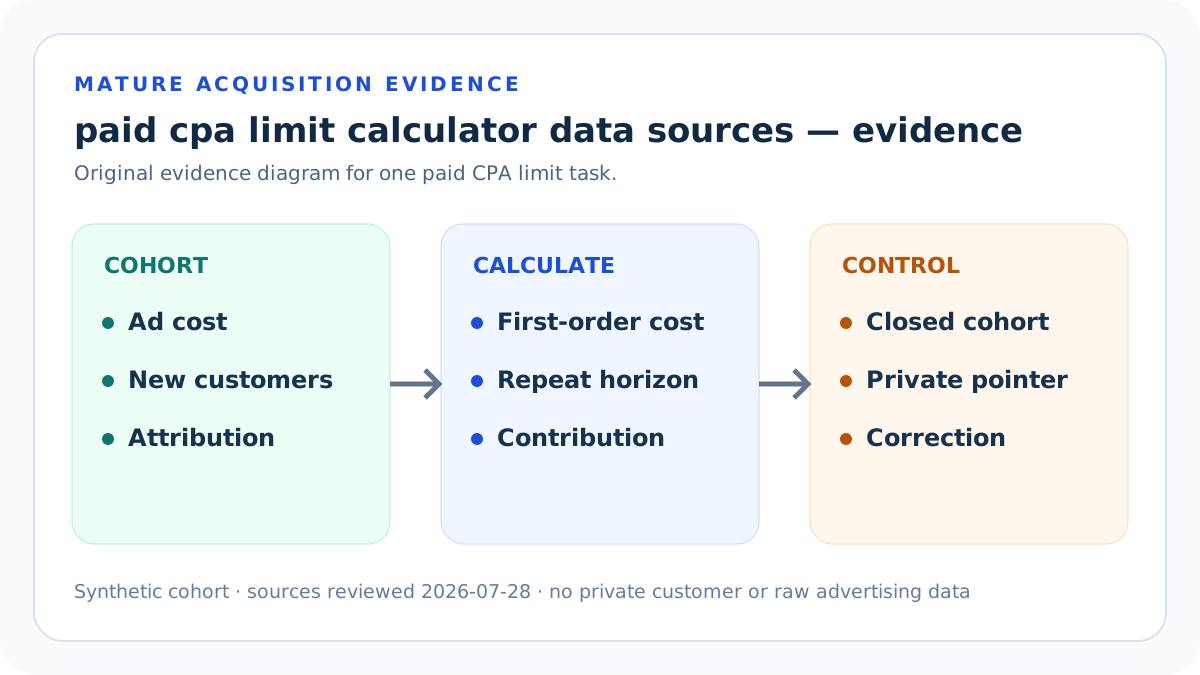
Source adverse-order loss
Use a mature comparable cohort with state, recovery, period, numerator, denominator, and product coverage. Record the result in the paid CPA evidence source map with cohort alias, source version, acquisition date, maturity date, owner, currency, denominator, scope, and affected output. This makes an evidence-backed acquisition ceiling reproducible instead of dependent on an unversioned dashboard.
Open return or dispute cases are not final loss. Review point 5 separates observed data, authorized policy, unresolved evidence, and decisions outside the calculator. Keep advertising cost, acquired-customer count, first-order contribution, repeat contribution, recognition, attribution, maturity, target, and cash timing distinct.
Source repeat contribution
Build a cohort table by acquisition date and fixed repeat horizon, then calculate retained contribution per eligible repeat order. Record the result in the paid CPA evidence source map with cohort alias, source version, acquisition date, maturity date, owner, currency, denominator, scope, and affected output. This makes an evidence-backed acquisition ceiling reproducible instead of dependent on an unversioned dashboard.
Returning-customer revenue share is not cohort contribution. Review point 6 separates observed data, authorized policy, unresolved evidence, and decisions outside the calculator. Keep advertising cost, acquired-customer count, first-order contribution, repeat contribution, recognition, attribution, maturity, target, and cash timing distinct.
Source target and recognition policy
Use a dated governance record with owner, denominator, rationale, scope, cap, review date, and expiry trigger. Record the result in the paid CPA evidence source map with cohort alias, source version, acquisition date, maturity date, owner, currency, denominator, scope, and affected output. This makes an evidence-backed acquisition ceiling reproducible instead of dependent on an unversioned dashboard.
Do not reverse-engineer policy to justify a desired CPA. Review point 7 separates observed data, authorized policy, unresolved evidence, and decisions outside the calculator. Keep advertising cost, acquired-customer count, first-order contribution, repeat contribution, recognition, attribution, maturity, target, and cash timing distinct.
Validate economic and evidence fixtures
Recalculate variable fee, fixed first-order cost, first-order contribution, break-even CPA, target reserve, first-order-only limit, measured repeat contribution, recognized repeat contribution, maximum paid CPA, post-acquisition contribution, and headroom independently.
Test valid, first-order-only, weaker-repeat, higher-loss, no-contribution, and invalid-evidence cases. A fixture passes only when outputs, Block/Review/Ready state, issue text, reset behavior, privacy boundary, keyboard path, mobile layout, and correction route match.
Apply Block, Review, and Ready consistently
Block invalid amounts, rates, horizon, scenario, customer definition, attribution context, currency, period, scope, or declared conflicts. Review nonpositive contribution, no first-order target room, weak repeat maturity, excessive recognition, planned overrun, or negative post-acquisition contribution.
Ready is calculation readiness only. It cannot approve attribution, bidding strategy, budget, audience, creative, platform eligibility, legal terms, tax, accounting treatment, customer lifetime value, or campaign launch.
Release, observe, and restore safely
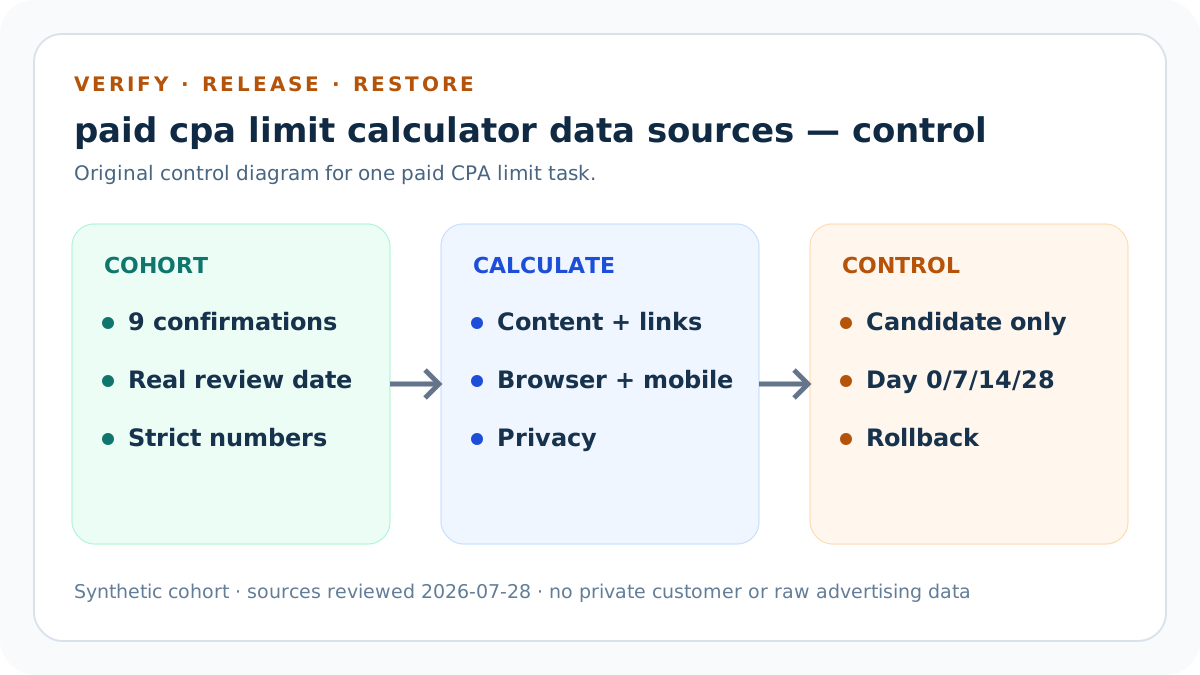
Before release, retain narrow local and remote backups plus a rollback identifier. Run typecheck, unit and integration tests, build, content and duplicate audits, SEO and static-route checks, browser interaction, four-image loading, internal links, mobile and keyboard accessibility, privacy review, and candidate validation.
After release, verify status, canonical, indexability, Article and Breadcrumb schema, direct answer, parent and sibling links, images, guide-hub discovery, strict 404, sitemap policy, events, and production scenarios. Record Day 0/7/14/28 evidence and restore on formula, privacy, accessibility, routing, or health regression.
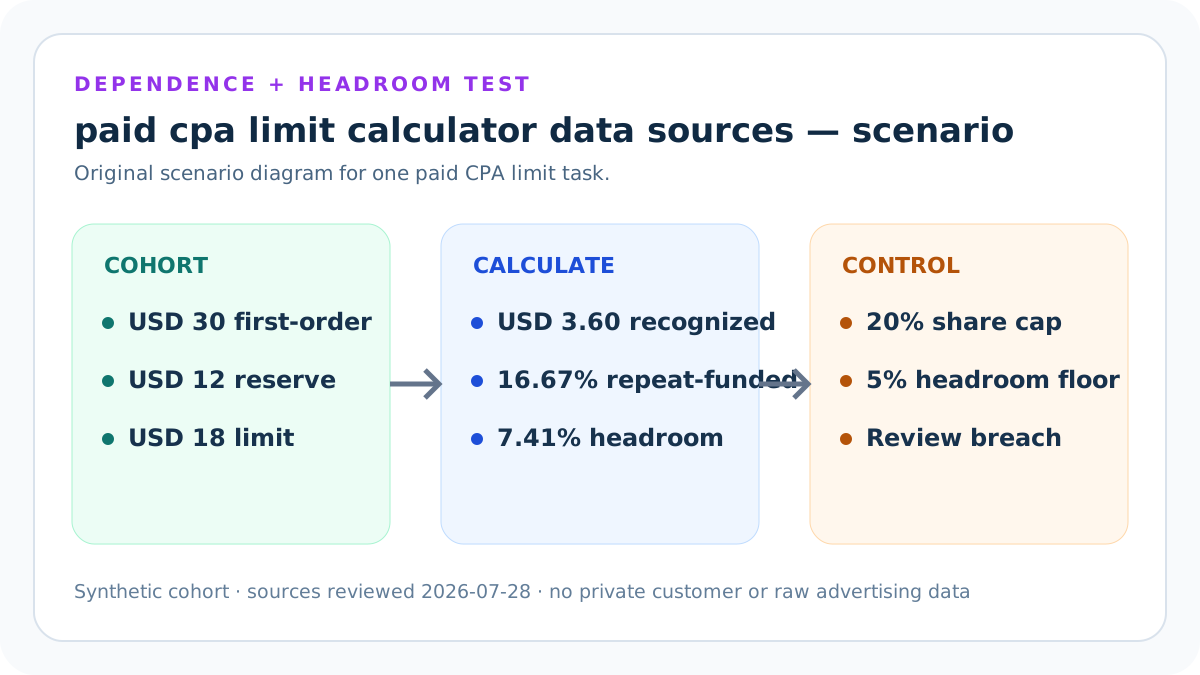
Reconcile source timestamps
Identify stale fields and quantify their effect on the limit. Deep review 1 stores the tested input, source state, numeric delta, maturity boundary, reviewer, expiry, correction condition, and next action in the paid CPA evidence source map. Preserve unfavorable counterexamples and incomplete cohorts.
Compare the result with an evidence-backed acquisition ceiling, not a generic CPA benchmark or another cohort with different products, acquisition rules, attribution, or horizon. Explain which driver moved, which fields stayed fixed, what remains unknown, and whether the response is collect, reconcile, stress, review, observe, correct, pause, release, or restore.
Reconcile currencies
Convert only with a documented rate and effective date. Deep review 2 stores the tested input, source state, numeric delta, maturity boundary, reviewer, expiry, correction condition, and next action in the paid CPA evidence source map. Preserve unfavorable counterexamples and incomplete cohorts.
Compare the result with an evidence-backed acquisition ceiling, not a generic CPA benchmark or another cohort with different products, acquisition rules, attribution, or horizon. Explain which driver moved, which fields stayed fixed, what remains unknown, and whether the response is collect, reconcile, stress, review, observe, correct, pause, release, or restore.
Reconcile customer identity
Keep matching logic private and report aggregate exceptions. Deep review 3 stores the tested input, source state, numeric delta, maturity boundary, reviewer, expiry, correction condition, and next action in the paid CPA evidence source map. Preserve unfavorable counterexamples and incomplete cohorts.
Compare the result with an evidence-backed acquisition ceiling, not a generic CPA benchmark or another cohort with different products, acquisition rules, attribution, or horizon. Explain which driver moved, which fields stayed fixed, what remains unknown, and whether the response is collect, reconcile, stress, review, observe, correct, pause, release, or restore.
Reconcile missing outcomes
Use unresolved states rather than substituting zero. Deep review 4 stores the tested input, source state, numeric delta, maturity boundary, reviewer, expiry, correction condition, and next action in the paid CPA evidence source map. Preserve unfavorable counterexamples and incomplete cohorts.
Compare the result with an evidence-backed acquisition ceiling, not a generic CPA benchmark or another cohort with different products, acquisition rules, attribution, or horizon. Explain which driver moved, which fields stayed fixed, what remains unknown, and whether the response is collect, reconcile, stress, review, observe, correct, pause, release, or restore.
Reconcile access controls
Store pointers and hashes instead of raw exports in public artifacts. Deep review 5 stores the tested input, source state, numeric delta, maturity boundary, reviewer, expiry, correction condition, and next action in the paid CPA evidence source map. Preserve unfavorable counterexamples and incomplete cohorts.
Compare the result with an evidence-backed acquisition ceiling, not a generic CPA benchmark or another cohort with different products, acquisition rules, attribution, or horizon. Explain which driver moved, which fields stayed fixed, what remains unknown, and whether the response is collect, reconcile, stress, review, observe, correct, pause, release, or restore.
Source advertising cost: verification drill
Recreate “Source advertising cost” from a clean synthetic acquisition cohort instead of copying the primary example. Use billed or reported cost for the exact campaign, market, conversion scope, currency, and closed period. Change one driver, retain all other fields, calculate the before-and-after effect, and attach the expected decision to the paid CPA evidence source map.
Budget, bid, click cost, and campaign cost are not interchangeable. Drill 1 includes a supported case, broken case, immature-evidence case, and correction case. Explain why each path produces Block, Review, Ready, no first-order room, repeat-value dependence, changed headroom, or a revised ceiling for this specific an evidence-backed acquisition ceiling.
Source conversion counts: verification drill
Recreate “Source conversion counts” from a clean synthetic acquisition cohort instead of copying the primary example. Record selected conversion actions, attribution settings, duplicate treatment, delay, and adjustment history. Change one driver, retain all other fields, calculate the before-and-after effect, and attach the expected decision to the paid CPA evidence source map.
Do not assume every attributed conversion is a new customer. Drill 2 includes a supported case, broken case, immature-evidence case, and correction case. Explain why each path produces Block, Review, Ready, no first-order room, repeat-value dependence, changed headroom, or a revised ceiling for this specific an evidence-backed acquisition ceiling.
Source retained first orders: verification drill
Recreate “Source retained first orders” from a clean synthetic acquisition cohort instead of copying the primary example. Reconcile charges, discounts, cancellations, refunds, and the seller's new-customer rule in authorized systems. Change one driver, retain all other fields, calculate the before-and-after effect, and attach the expected decision to the paid CPA evidence source map.
Public pages need aggregate values only. Drill 3 includes a supported case, broken case, immature-evidence case, and correction case. Explain why each path produces Block, Review, Ready, no first-order room, repeat-value dependence, changed headroom, or a revised ceiling for this specific an evidence-backed acquisition ceiling.
Source first-order cost: verification drill
Recreate “Source first-order cost” from a clean synthetic acquisition cohort instead of copying the primary example. Use effective-dated SKU, packaging, labor, fulfillment, platform, payment, and other variable-cost records. Change one driver, retain all other fields, calculate the before-and-after effect, and attach the expected decision to the paid CPA evidence source map.
Product versions and destination mix must match the cohort. Drill 4 includes a supported case, broken case, immature-evidence case, and correction case. Explain why each path produces Block, Review, Ready, no first-order room, repeat-value dependence, changed headroom, or a revised ceiling for this specific an evidence-backed acquisition ceiling.
Source adverse-order loss: verification drill
Recreate “Source adverse-order loss” from a clean synthetic acquisition cohort instead of copying the primary example. Use a mature comparable cohort with state, recovery, period, numerator, denominator, and product coverage. Change one driver, retain all other fields, calculate the before-and-after effect, and attach the expected decision to the paid CPA evidence source map.
Open return or dispute cases are not final loss. Drill 5 includes a supported case, broken case, immature-evidence case, and correction case. Explain why each path produces Block, Review, Ready, no first-order room, repeat-value dependence, changed headroom, or a revised ceiling for this specific an evidence-backed acquisition ceiling.
Sources and further reading
- Seller Profit Guard methodology: Contribution equations, evidence versions, privacy, correction, release, and rollback.
- Seller Profit Guard data privacy: Local-first boundaries for customer, order, advertising, payment, refund, audience, and raw-record data.
- Google Ads Help: Average CPA definition: Official definition of average CPA as conversion cost divided by conversions and its distinction from target CPA.
- Google Ads Help: About Target CPA bidding: Official context for Target CPA as a desired average conversion cost, actual CPA variation, selected conversion actions, lag-aware recommendations, and evaluation.
- Google Ads Help: About conversion delay estimates: Official explanation that conversion lag can make recent CPA appear higher and that delay-aware estimates support target and budget decisions.
- Google Ads Help: About customer lifecycle goals: Official context for new-customer acquisition modes and first-party customer definitions; seller contribution evidence remains independent.
Related Seller Profit Guard tools
- Paid CPA Limit Calculator: Run the browser-local first-order and recognized-repeat acquisition-cost calculation.
- Break-Even ROAS Calculator: Translate contribution-funded spend ceilings into value-to-cost thresholds.
- TikTok Ads CPA Limit: Use the TikTok-specific creator, sample, coupon, fee, and campaign model.
- Contribution Margin Calculator: Reconstruct retained first-order contribution before acquisition cost.
- Maximum Discount Calculator: Keep promotion headroom separate from customer-acquisition headroom.
- Methodology: Review evidence, privacy, calculation, correction, release, and rollback.
- Data Privacy: Protect buyer, order, ad-platform, audience, payment, refund, and credential data.
- Paid CPA Limit Formula and Inputs: Calculate a target-safe paid CPA from retained first-order contribution, measured repeat contribution, recognition policy, and acquisition evidence.
- Paid CPA Limit First-Order Example: Follow an USD 80 first order through variable costs, contribution reserve, first-order CPA limit, recognized repeat value, and paid CPA headroom.
- Paid CPA Limit with Measured Repeat Value: Use mature repeat-purchase contribution without turning revenue forecasts, returning-customer share, or generic lifetime value into acquisition capacity.
- Paid CPA Limit Calculation Mistakes: Correct conversion denominators, gross-margin shortcuts, repeat-value inflation, attribution mixing, delay, fee, refund, target, and payback errors.
- Set a Safe Paid CPA Decision Threshold: Separate break-even, first-order target, recognized-repeat, stress, warning, and stop thresholds with explicit maturity and ownership.
- First-Order vs Repeat-Funded Paid CPA: Compare a self-funding first-order CPA limit with a conditional repeat-funded limit at one acquisition cohort grain and maturity horizon.
- Weekly Paid CPA Evidence Review Cycle: Run a repeatable paid CPA review from cohort closure and contribution refresh through recognition policy, action, observation, correction, and rollback.
- Interpret Maximum Paid CPA Results: Read first-order contribution, target reserve, repeat recognition, maximum paid CPA, planned headroom, dependence, and decision state without false precision.
- Paid CPA Limit Audit Checklist: Audit acquisition scope, new-customer rules, first-order contribution, repeat cohorts, recognition, thresholds, fixtures, privacy, release, and rollback.
Next step: Open Seller Profit Guard.
This is operational planning help, not tax, accounting, legal, financial, or platform-policy advice. Review the Terms and disclaimer, and verify current platform rules and fee assumptions before changing prices.