A weekly markup and margin operating routine
Last updated: 2026-07-30
Written and reviewed by Seller Profit Guard Editorial Team.
Select representative products, freeze a named cost basis, refresh current price and source dates, confirm every target is labeled markup or margin, reproduce the 50%-markup and 40%-margin fixtures, test broken denominators, review cost-sensitive exceptions, approve one reversible action, then record feedback, closure evidence, and restoration criteria.
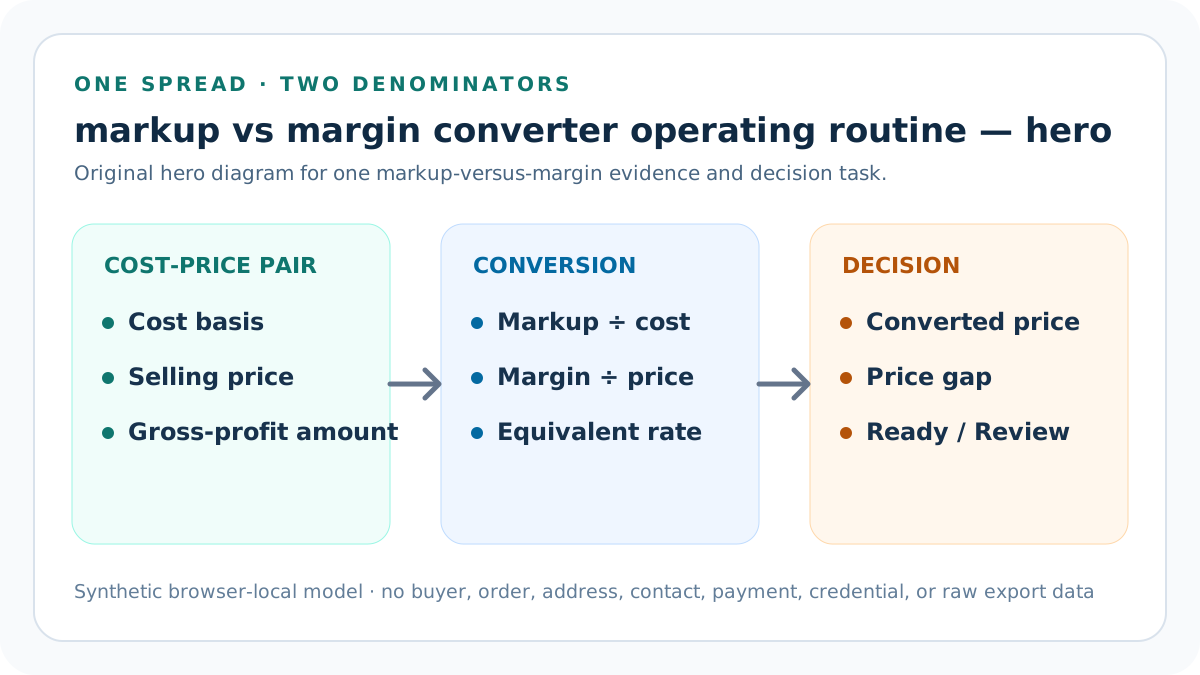
Select the roster
Choose representative unit, bundle, discount, landed-cost, and order-cost cases without buyer data. This row belongs to the dated cost-price conversion log. Preserve the original value, unit, denominator label, calculation grain, currency, effective month, source class, owner, and confidence rather than keeping only a rounded percentage.
For recurring evidence change control, checkpoint 1 must pass before it supports repeatable rate reviews with recoverable decisions. Recalculate from the source pair, compare full-precision and displayed results, and correct the accountable field instead of offsetting it with an unrelated favorable assumption.
Freeze basis definitions
Give each cost basis a version, owner, included rows, excluded rows, and effective date. This row belongs to the dated cost-price conversion log. Preserve the original value, unit, denominator label, calculation grain, currency, effective month, source class, owner, and confidence rather than keeping only a rounded percentage.
For recurring evidence change control, checkpoint 2 must pass before it supports repeatable rate reviews with recoverable decisions. Recalculate from the source pair, compare full-precision and displayed results, and correct the accountable field instead of offsetting it with an unrelated favorable assumption.
Refresh current prices
Capture exact pre-discount, checkout, or retained-revenue states as separately named fields. This row belongs to the dated cost-price conversion log. Preserve the original value, unit, denominator label, calculation grain, currency, effective month, source class, owner, and confidence rather than keeping only a rounded percentage.
For recurring evidence change control, checkpoint 3 must pass before it supports repeatable rate reviews with recoverable decisions. Recalculate from the source pair, compare full-precision and displayed results, and correct the accountable field instead of offsetting it with an unrelated favorable assumption.
Normalize rate labels
Replace every unlabeled percentage with markup on cost or margin on selling price. This row belongs to the dated cost-price conversion log. Preserve the original value, unit, denominator label, calculation grain, currency, effective month, source class, owner, and confidence rather than keeping only a rounded percentage.
For recurring evidence change control, checkpoint 4 must pass before it supports repeatable rate reviews with recoverable decisions. Recalculate from the source pair, compare full-precision and displayed results, and correct the accountable field instead of offsetting it with an unrelated favorable assumption.
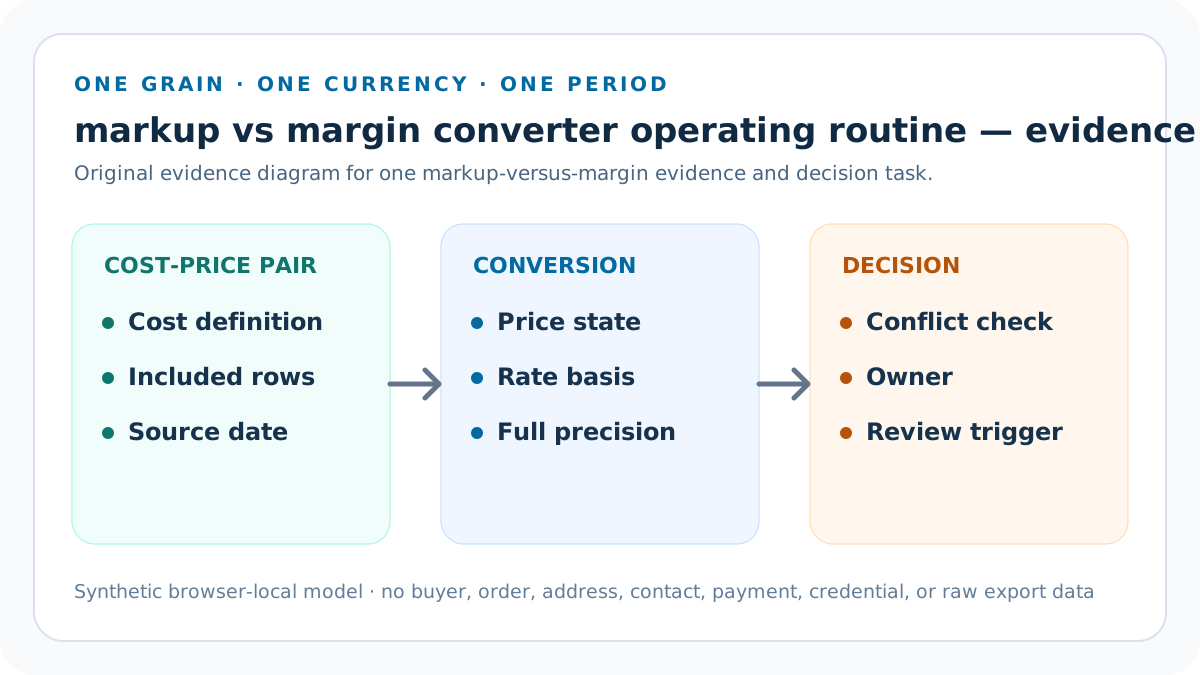
Run supported fixtures
Reproduce 50% markup, 33.33% equivalent margin, 40% margin, and USD 66.67 price. This row belongs to the dated cost-price conversion log. Preserve the original value, unit, denominator label, calculation grain, currency, effective month, source class, owner, and confidence rather than keeping only a rounded percentage.
For recurring evidence change control, checkpoint 5 must pass before it supports repeatable rate reviews with recoverable decisions. Recalculate from the source pair, compare full-precision and displayed results, and correct the accountable field instead of offsetting it with an unrelated favorable assumption.
Run broken fixtures
Confirm invalid basis, 100% margin, missing context, and declared conflicts Block. This row belongs to the dated cost-price conversion log. Preserve the original value, unit, denominator label, calculation grain, currency, effective month, source class, owner, and confidence rather than keeping only a rounded percentage.
For recurring evidence change control, checkpoint 6 must pass before it supports repeatable rate reviews with recoverable decisions. Recalculate from the source pair, compare full-precision and displayed results, and correct the accountable field instead of offsetting it with an unrelated favorable assumption.
Approve one action
Choose a source correction, price experiment, basis review, or explicit no-action conclusion. This row belongs to the dated cost-price conversion log. Preserve the original value, unit, denominator label, calculation grain, currency, effective month, source class, owner, and confidence rather than keeping only a rounded percentage.
For recurring evidence change control, checkpoint 7 must pass before it supports repeatable rate reviews with recoverable decisions. Recalculate from the source pair, compare full-precision and displayed results, and correct the accountable field instead of offsetting it with an unrelated favorable assumption.
Close or restore
Measure the approved signal and restore the prior price or packet after a regression. This row belongs to the dated cost-price conversion log. Preserve the original value, unit, denominator label, calculation grain, currency, effective month, source class, owner, and confidence rather than keeping only a rounded percentage.
For recurring evidence change control, checkpoint 8 must pass before it supports repeatable rate reviews with recoverable decisions. Recalculate from the source pair, compare full-precision and displayed results, and correct the accountable field instead of offsetting it with an unrelated favorable assumption.
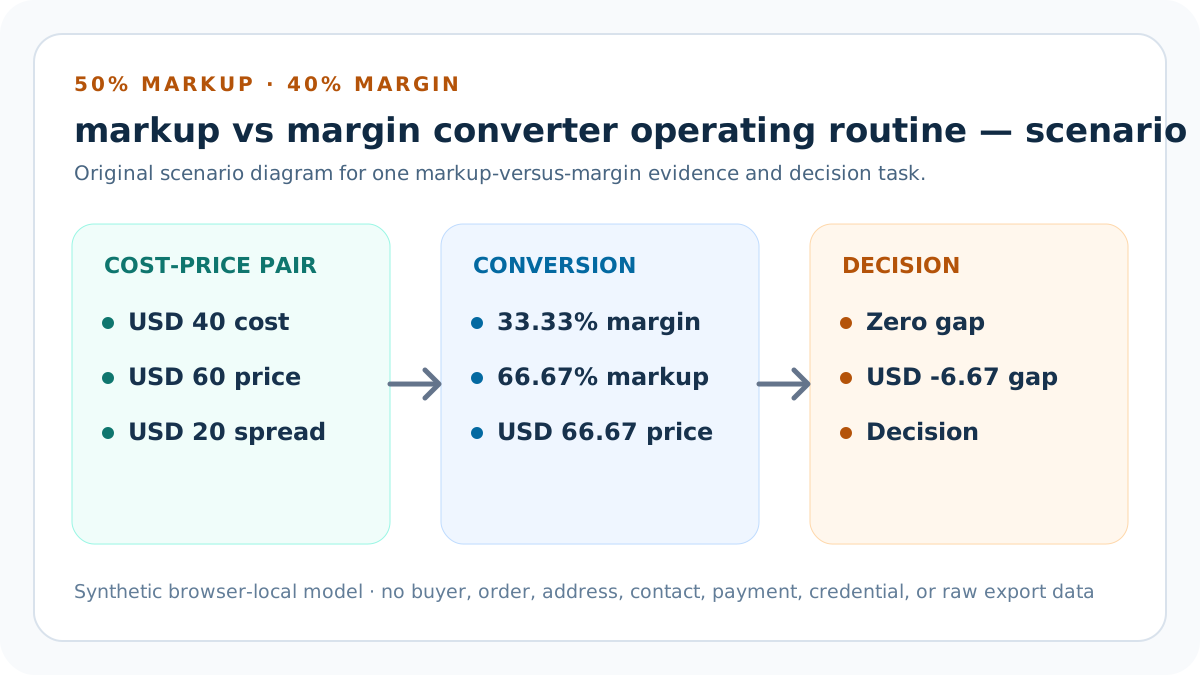
Monday roster and evidence freeze
Create a privacy-safe roster of representative unit, bundle, promotion, landed-cost, and order-variable-cost cases. Give every row a nonprivate alias, cost-basis version, price-state label, calculation currency, evidence month, owner, and next-source date.
Freeze the roster before calculating. New products enter a later packet unless a documented material exception requires reopening scope. This prevents the weekly comparison from changing simply because easy or favorable rows were added after results appeared.
Tuesday source replacement queue
Replace expired supplier invoices, freight allocations, duty estimates, packaging standards, direct-labor studies, and currency conversions in source-priority order. Keep the prior value, effective date, and reason beside the proposed replacement.
Do not update every cost because one component changed. Recalculate only the cost bases and product aliases that depend on the changed source, then compare exact before and after observed markup, observed margin, converted price, and price gap.
Wednesday denominator normalization
Review every target-rate label and reject percentage fields that do not say markup on cost or margin on selling price. Ask the policy owner to resolve ambiguous labels rather than guessing from the numeric value or prior spreadsheet column name.
Translate approved rates into equivalent values for communication, but preserve the original basis as the authoritative input. Never replace a 50% markup policy with its rounded 33.33% margin equivalent and later convert the rounded value back.
Thursday fixture and exception run
Run the USD 40 cost, USD 60 price, 50% markup fixture; the 40% margin Review fixture; the USD 70 current-price Ready fixture; invalid-basis Block; 100%-margin Block; and declared-conflict Block before reviewing live aggregate inputs.
Queue exceptions by decision movement, number of affected products, source age, inventory exposure, price-change reversibility, and customer impact. Work the highest-value evidence defect first instead of optimizing the easiest percentage.
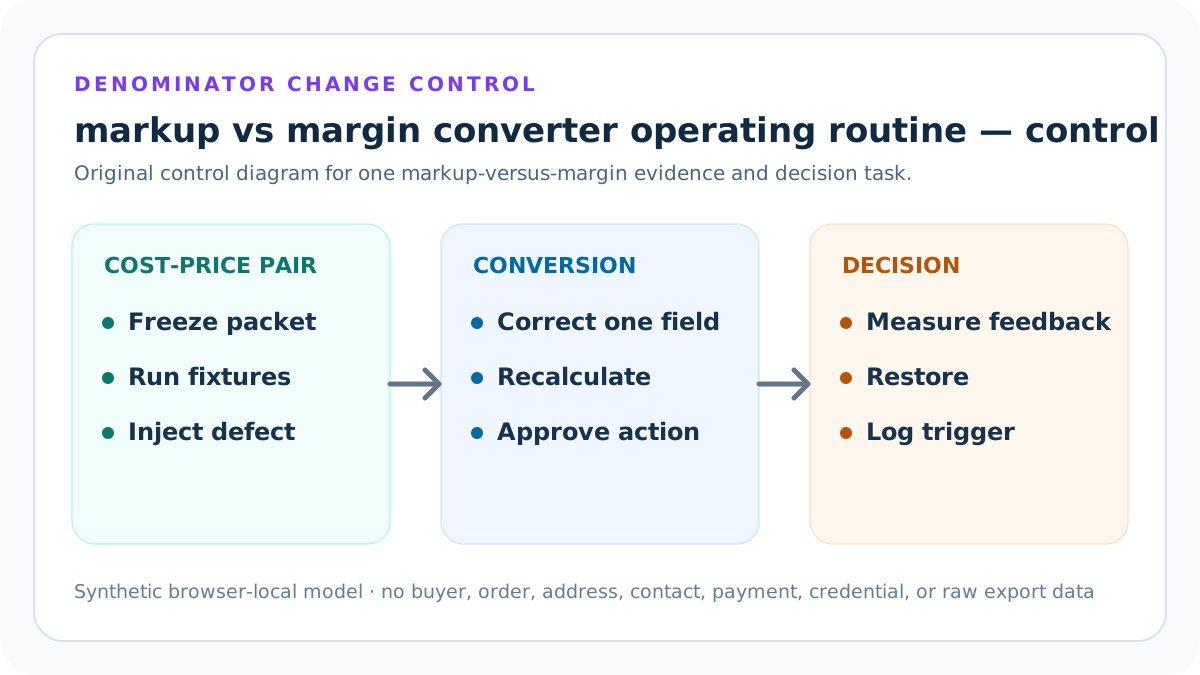
Friday bounded action review
Approve one cost-source correction, basis clarification, price experiment, bundle-scope split, or no-action conclusion per affected group. Record the hypothesis, expected converted-price movement, owner, observation window, stop condition, and restoration reference.
A Ready calculation does not require a public price change. Hold when demand evidence is absent, channel constraints are unresolved, a promotion is imminent, inventory strategy conflicts, or the cost basis is valid only for internal comparison.
Feedback measures and closure
Measure whether the approved source was reconciled, the public price was applied correctly, checkout state matched the packet, conversion or contribution feedback stayed within its separately approved boundary, and no accessibility or analytics regression appeared.
Close with observed evidence or an explicit no-action result. Keep modeled and observed outcomes separate. A conversion that calculates correctly but leads to an unsupported public change remains operationally incomplete.
Recurring trigger calendar
Schedule the next review around supplier invoices, freight or duty changes, packaging revisions, labor studies, discount launches, refund cohorts, bundle composition, exchange-rate policy, and rate-target approval rather than a content-production quota.
A quiet week can close without a price action when sources remain current. Record that no material trigger occurred so silence is distinguishable from a missed review.
Weekly rollback rehearsal
Verify that the prior cost version, price state, rate label, calculation output, public route, and analytics baseline can be restored. A rollback reference that points only to a report without recoverable values is insufficient.
Rehearse restoration with synthetic fixtures before a material release. Safe-stop when the account, profile, target context, warning state, or checkout mechanism differs from the approved packet.
Weekly exception calendar
Schedule reviews around supplier invoices, freight changes, packaging revisions, labor studies, discount launches, refunds, bundle changes, currency conversion, and rate-policy approval. A quiet week may end with no price action when sources remain current.
Rank exceptions by converted-price movement, number of affected products, source age, inventory exposure, reversibility, and customer impact. Resolve the highest-value evidence question before recalculating unrelated products.
dated cost-price conversion log completion test
A complete packet lets an independent reviewer reproduce repeatable rate reviews with recoverable decisions from the declared cost, price, entered rate, and explicit basis without private data or hidden spreadsheet state.
Closure requires exact arithmetic, source alignment, privacy-safe examples, a non-compensating decision, bounded language, one approved next step or no-action conclusion, feedback ownership, and a recoverable prior state.
Sources and further reading
- Seller Profit Guard methodology: Calculation contracts, evidence precedence, deterministic fixtures, validation, correction, release, and rollback.
- Seller Profit Guard data privacy: Local-first boundaries for seller, buyer, order, payment, contact, credential, and raw export data.
- IRS Publication 334 (2025): Primary U.S. context for net receipts, cost of goods sold, gross profit, and the selling-price denominator; this converter does not make a tax determination.
- OpenStax markup guidance: Primary educational source for markup on cost and retail price equal to cost times one plus markup.
- SBA break-even point guidance: Primary U.S. small-business source for the contribution-margin denominator and separation of fixed and variable costs.
Related Seller Profit Guard tools
- Open the Markup vs Margin Converter: Convert one rate with an explicit cost or selling-price denominator.
- Solve a product price floor: Include discount, buyer shipping, fees, order-variable costs, expected loss, and a contribution target.
- Calculate contribution margin: Run a forward order-level contribution equation from observed revenue and variable costs.
- Version SKU costs: Maintain dated product, packaging, labor, fulfillment, and expected-loss evidence.
- Check bundle margin: Compare a bundle selling price with combined item and order costs.
- Read the methodology: Review evidence, calculation, privacy, testing, release, correction, and rollback.
- Review data privacy: Keep private seller and buyer data outside public content.
- Markup vs Margin Formulas and Inputs: Continue with a distinct formula, example, source, threshold, comparison, operating, interpretation, or audit task.
- Markup vs Margin Worked Example: Continue with a distinct formula, example, source, threshold, comparison, operating, interpretation, or audit task.
- Price-Based Margin Conversion Example: Continue with a distinct formula, example, source, threshold, comparison, operating, interpretation, or audit task.
- Markup vs Margin Conversion Mistakes: Continue with a distinct formula, example, source, threshold, comparison, operating, interpretation, or audit task.
- Reliable Markup and Margin Data Sources: Continue with a distinct formula, example, source, threshold, comparison, operating, interpretation, or audit task.
Next step: Open the Markup vs Margin Converter.
This is operational planning help, not tax, accounting, legal, financial, or platform-policy advice. Review the Terms and disclaimer, and verify current platform rules and fee assumptions before changing prices.