Etsy Ads break-even for a high-return listing
Last updated: 2026-07-29
Written and reviewed by Seller Profit Guard Editorial Team.
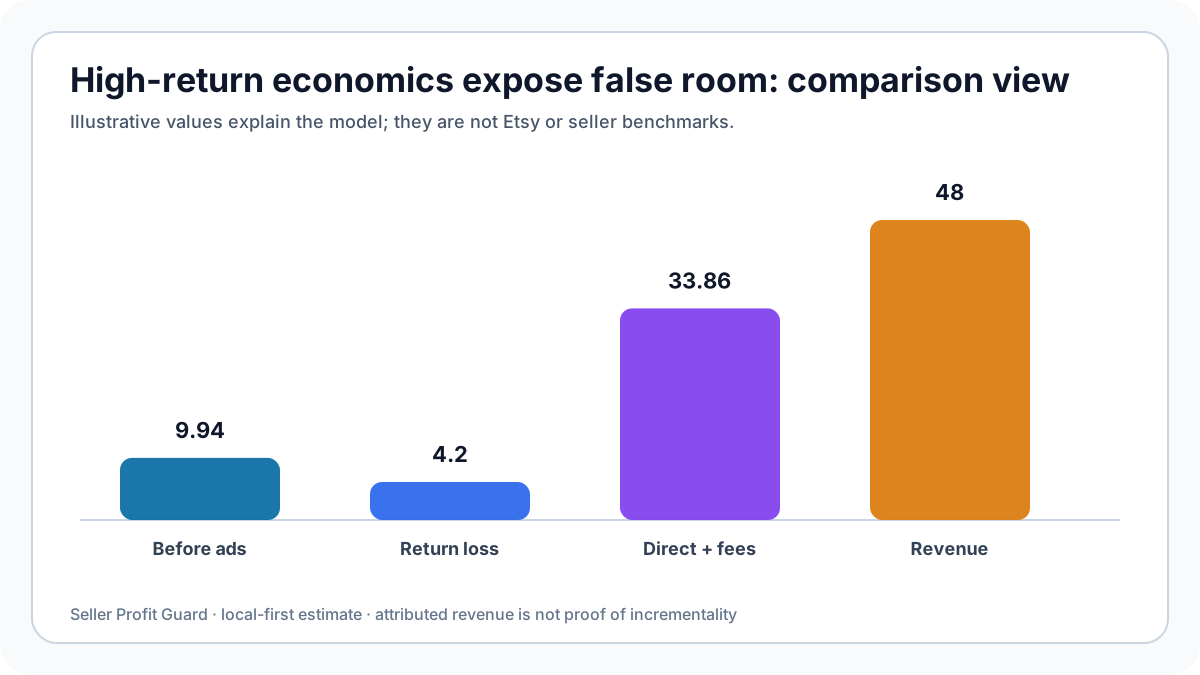
A high-return Etsy listing needs expected return loss inside non-ad cost before ad room is calculated. In this $48 example, $4.20 expected return loss leaves $9.94 contribution before ads, below the $12 target, so target-safe spend is zero even though theoretical break-even ROAS remains about 4.83x.

Why should a high-return listing use a separate scenario?
A listing with fit uncertainty, fragile fulfillment, personalization errors, or expectation mismatch can have materially different loss frequency and severity from the shop average. Combining it with low-return products produces a false ad ceiling and can shift spend toward a listing that converts but retains little contribution.
Use mature return, replacement, cancellation, and refund outcomes for the advertised SKU or a defensible product group. Build expected return loss from unrecovered product, shipping, handling, support, and inventory outcomes. Do not subtract return rate directly from revenue or treat every refund as full economic loss.
Keep unresolved recent orders outside the mature cohort. An Etsy Ads order can be attributed before its financial outcome is fully known. Match the reporting cutoff with a return-maturity cutoff or clearly label the return-loss figure as provisional.
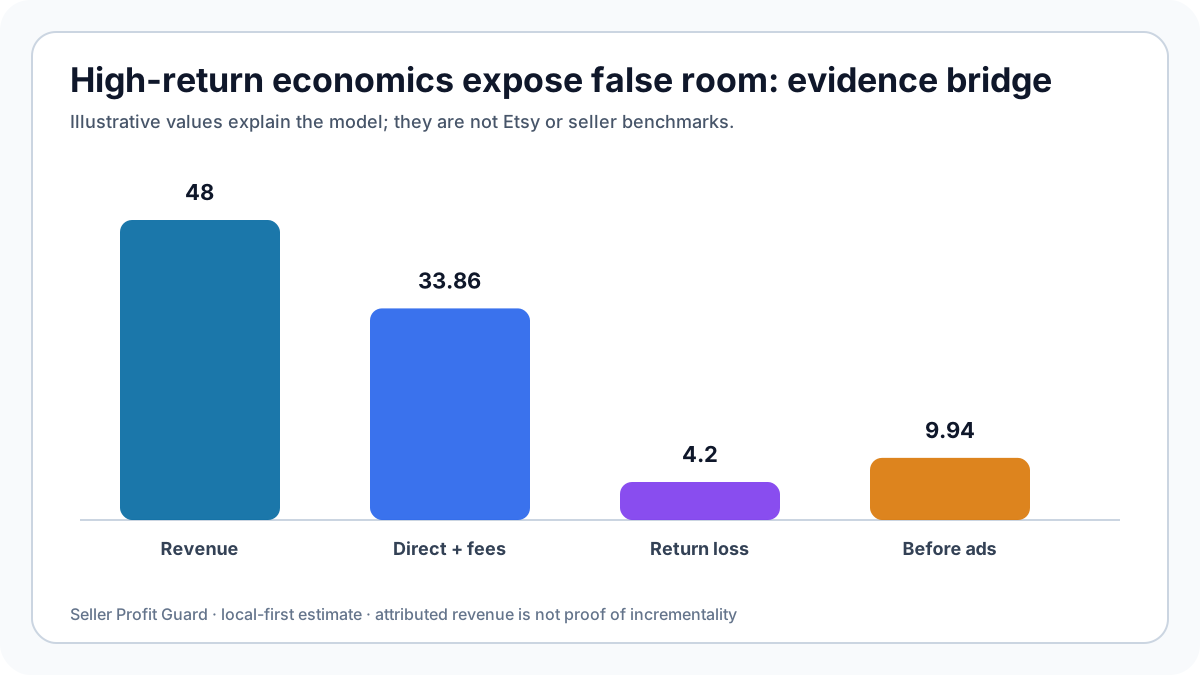
| Layer | Representative input | Why separate |
|---|---|---|
| Revenue | $48.00 | Same ratio base |
| Base direct costs | $24.50 | Product-specific |
| Fee assumption | $4.86 | Market-specific |
| Expected return loss | $4.20 | Mature outcome |
| Target contribution | $12.00 | Seller decision |
| Ad room | $1.94 | Residual only |
How does the $48 high-return fixture calculate?
Use $48 revenue, $15 product cost, $1.50 packaging, $6 labor, $6.50 shipping, a 9.5% percentage-fee assumption, $0.30 fixed fee, zero Offsite Ads in the Etsy Ads-only scenario, $4.20 expected return loss, and a 25% target.
Percentage and fixed fees total $4.56 + $0.30 = $4.86. Non-ad costs are $15 + $1.50 + $6 + $6.50 + $4.86 + $4.20 = $38.06. Contribution before ads is $9.94, not $13.94; the hand check catches the tempting arithmetic error before the scenario is used.
Target contribution is $12. Because $9.94 already misses the target before Etsy Ads, target-safe spend is zero and no target ROAS exists. Break-even ACOS is 20.71% and break-even ROAS is about 4.83x, but spending at that boundary leaves zero modeled contribution.

What change creates a narrow $1.94 target-safe ceiling?
Raise revenue to $52 while keeping the declared direct costs, expected return loss, and 25% target. Fees become $4.94 + $0.30 = $5.24. Contribution before ads is $52 − $15 − $1.50 − $6 − $6.50 − $5.24 − $4.20 = $13.56.
Target contribution is $13, leaving only $0.56 target-safe ad spend, target ACOS of 1.08%, and target ROAS near 92.86x. To obtain a $1.94 ceiling at $52, some combination of direct cost or expected return loss must fall by $1.38. Every headline result must match its exact input fixture.
This correction is the practical lesson: high-return economics are sensitive enough that an attractive rounded example can be materially wrong. Store formulas and expected outputs in tests, and reject public copy whose stated numbers do not reconcile.
Which intervention should be tested before more ad spend?
If return loss is driven by expectation mismatch, improve the listing's dimensions, variation clarity, materials, use limits, images, and processing promise before buying more traffic. If severity is driven by shipping damage, inspect package and carrier evidence. If product economics miss target without ads, advertising is not the first lever.
Pause or exclude the unsafe listing while keeping other listings unchanged, then observe mature outcomes. A shop-level campaign average can hide the intervention. Record the advertised-listing set and any automatic changes so the before/after comparison remains interpretable.
Do not treat lower spend as proof that returns will fall. Ad targeting may change buyer mix, but the calculator cannot establish that relationship. It only shows whether the entered order economics can support the advertising cost.
How should high-return uncertainty affect release criteria?
Require wider dollar headroom than the uncertainty in return loss, shipping, and attribution. If return loss could plausibly vary by $2 per order and target-safe ad room is $1, the decision is not robust even when the representative result is positive.
Use a three-case record: observed mature estimate, adverse severity or frequency, and no-return counterfactual for diagnosis. The no-return case shows whether base economics work; it is not permission to ignore returns in the campaign decision.
Close the review only after mature attributed-order economics meet the predeclared rule. If they do not, pause, change the listing, lower cost, raise price, or redefine the product scope. Preserve the failed fixture and rollback evidence.
Which records support this high-return listing scenario?
Use one listing or defensible listing group, one currency, one fee market, and one mature Etsy Ads reporting window. Reconcile item and buyer-paid shipping revenue, product cost, packaging, labor, actual shipping, percentage and fixed fees, expected return loss, Etsy Ads spend, attributed orders, and attributed revenue at the same grain. Views and clicks describe traffic; they are not converted orders.
Keep Etsy Ads and Offsite Ads evidence separate. Etsy Ads charges arise from interactions with ads on Etsy and are visible in the Ads dashboard and Payment account. Offsite Ads applies an attributed-order fee under a different program and current last-click rules. Model an Offsite Ads percentage only as a separate applicable scenario or when the resolved order record supports that path.
Freeze report dates, attribution window, selected listings, currency, fee version, cost version, return-loss method, calculation version, exclusions, and fingerprints. Reperform one public dummy fixture by hand. A matching report does not prove incrementality, and a matching fingerprint proves only that the evidence package did not change.
- Use completed, sufficiently mature attribution windows.
- Separate click spend, attributed revenue, and settled contribution.
- Treat missing cost evidence as unknown rather than zero.
- Record listing-mix and price changes inside the window.
- Recalculate after fee, product, shipping, policy, or attribution changes.
Privacy boundaries for this high-return listing scenario
The calculator needs aggregate money values and rates, not buyer identity. Do not paste names, email addresses, postal addresses, order IDs, message text, personalization, payment data, tracking numbers, search histories, or raw order exports into the public tool, an article, analytics events, feedback, email drafts, or community posts.
An operator can reconcile the model privately by listing or cohort using summarized Ads dashboard totals, Payment account totals, cost records, and mature return outcomes. Preserve source files only in the approved private environment, restrict access, follow retention rules, and use non-reversible fingerprints when proving that an evidence package remained unchanged.
Ad search terms, product economics, return rates, conversion performance, and campaign limits can be commercially sensitive even without personal data. Public examples on these pages are fictional and rounded. Seller Profit Guard runs this quick calculation in the browser and does not require Etsy credentials, but the seller remains responsible for secure evidence handling.
How should the calculator be used for this high-return listing scenario?
Enter item price plus buyer-paid shipping as modeled revenue. Add product, packaging, labor, actual shipping, combined percentage-fee assumption, fixed payment fee, an optional Offsite Ads scenario, expected return loss per order, planned Etsy Ads spend per converted order, and target margin. Use the exact cost and fee bases that match the selected listing and market.
The tool reports contribution before Etsy Ads, theoretical break-even ad spend, target-safe ad spend, break-even and target ACOS, and reciprocal break-even and target ROAS. The primary card is target-safe spend per converted order. It is not a cost-per-click bid, daily budget recommendation, conversion forecast, or instruction to scale.
Run representative, adverse, and out-of-scope fixtures. Compare the order-level ceiling with actual Etsy Ads spend divided by mature attributed orders, then reconcile attributed revenue with settled order economics. Record source uncertainty and stop conditions. Do not infer that attributed orders are incremental or that a profitable average makes every advertised listing safe.
- Choose one listing cohort and mature reporting window.
- Reconcile revenue, non-ad costs, and expected return loss.
- Calculate break-even and target-safe order-level ad room.
- Compare with Ads spend, attributed orders, ACOS, and ROAS.
- Record a bounded continue, hold, reduce, test, or stop decision.
Sources and further reading
- Etsy Advertising & Marketing Policy: Current Etsy Ads budget, click-charge, reporting, last-click, and Offsite Ads participation rules; updated June 8, 2026.
- Etsy Help: Review Etsy Ads performance: Official definitions for views, clicks, attributed orders, revenue, budget spent, ROAS, search terms, and the 30-day attribution window.
- Etsy Help: How Ads Are Placed in Etsy Search: Official explanation of Etsy Ads placement, listing quality, competition, and cost-per-click behavior.
- Etsy Fees & Payments Policy: Current seller-fee, Etsy Ads, Offsite Ads, payment, currency, and region-specific fee boundaries.
- Etsy Help: How Etsy's Offsite Ads Work: Official Offsite Ads attribution, fee-rate, enrollment, order-cap, and dashboard guidance.
- Seller Profit Guard calculation methodology: Definitions for contribution, editable assumptions, evidence hierarchy, local-first privacy, uncertainty, and non-advice limits.
Related Seller Profit Guard tools
- Open the Etsy Ads Break-Even Calculator: Calculate order-level ad room, break-even and target ACOS, and break-even and target ROAS.
- Read the nine-cost break-even ROAS guide: Use the broader cross-platform model when affiliate, app, discount, and return-severity layers must be separated.
- Review Etsy Offsite Ads profit examples: Keep Etsy Ads click spend separate from attributed-order Offsite Ads fees.
- Estimate return-window loss: Build the expected return-loss input from frequency and incident severity.
- Use the Etsy profit calculator: Reconcile actual revenue, costs, fees, advertising, returns, and retained contribution.
- Read the local-first methodology: Understand evidence, privacy, formula scope, and interpretation boundaries.
- Etsy Ads Break-Even Formula: 12 Inputs: Continue the Etsy Ads evidence, calculation, and campaign-control workflow.
- Etsy Ads Break-Even Example: Low-Cost Item: Continue the Etsy Ads evidence, calculation, and campaign-control workflow.
- Etsy Ads Break-Even: 12 Costly Mistakes: Continue the Etsy Ads evidence, calculation, and campaign-control workflow.
- Etsy Ads Break-Even Data: Source Map: Continue the Etsy Ads evidence, calculation, and campaign-control workflow.
- Set a Safe Etsy Ads ACOS and ROAS Target: Continue the Etsy Ads evidence, calculation, and campaign-control workflow.
Next step: Open the Etsy Ads Break-Even Calculator.
This is operational planning help, not tax, accounting, legal, financial, or platform-policy advice. Review the Terms and disclaimer, and verify current platform rules and fee assumptions before changing prices.