A weekly operating routine for Seller Profit Guard
Last updated: 2026-07-27
Written and reviewed by Seller Profit Guard Editorial Team.
A reliable weekly Etsy profit review preserves source exports, validates mappings, measures cost coverage, reconciles important platform activity, reviews contribution exceptions, assigns one owner per action, and archives the decision. Keep the routine bounded to representative recent data and a prioritized exception queue instead of manually inspecting every row without a control rule.

What should a weekly Etsy profit review accomplish?
The weekly routine is an exception-control process, not a second bookkeeping system. It should answer which orders or SKUs lack current cost evidence, which mapped fields changed, which products fall below the retained contribution target, which advertising or refund paths need review, and which prior actions remain open. It should not force every difference into a clean number.
A small shop can begin with the most recent complete week and the products that represent most revenue, units, labor, or risk. Preserve the source period and include a small overlap when timing can cross boundaries. Separate recurring controls from one-time research. The routine succeeds when it produces a short owned action list with evidence, limits, and follow-up dates.

| Weekly outcome | Control question | Evidence retained |
|---|---|---|
| Source integrity | Which files and periods were reviewed? | Original export, hash or stable reference, date |
| Mapping integrity | Did required columns map correctly? | Mapping version and exception list |
| Cost coverage | Which economic weight has current SKU cost? | Revenue/unit coverage by SKU |
| Contribution exceptions | Which rows fail target or stress case? | Base, target, driver and confidence |
| Action closure | Who changes what by when? | Owner, limit, rollback and next review |
Before the review: preserve and label source files
Download the relevant order items or orders CSV and, when platform-charge or cash movement matters, the appropriate Payment Account or monthly statement evidence. Do not rename fields or edit the original file. Store a working copy and record shop, export type, period, time zone, currency, retrieved date, and reviewer. Keep buyer identity out of any shared review artifact.
Record the current SKU cost-library version, labor-rate version, packaging version, shipping evidence period, and risk-assumption version. A report without its input versions cannot be compared with last week. If a supplier or fee change took effect midweek, split the period or record the effective date instead of averaging incompatible rules.

Minute 0 to 15: validate mappings and coverage
Load the working export locally and review detected headers. Confirm revenue, shipping, quantity, SKU, transaction, discount, fee, and variation fields. Compare row and order counts with the source. Look for duplicate imports, blank required fields, repeated order-level values, unexpected currencies, sign changes, and unmapped new columns. Stop the review if a material mapping defect can reverse totals.
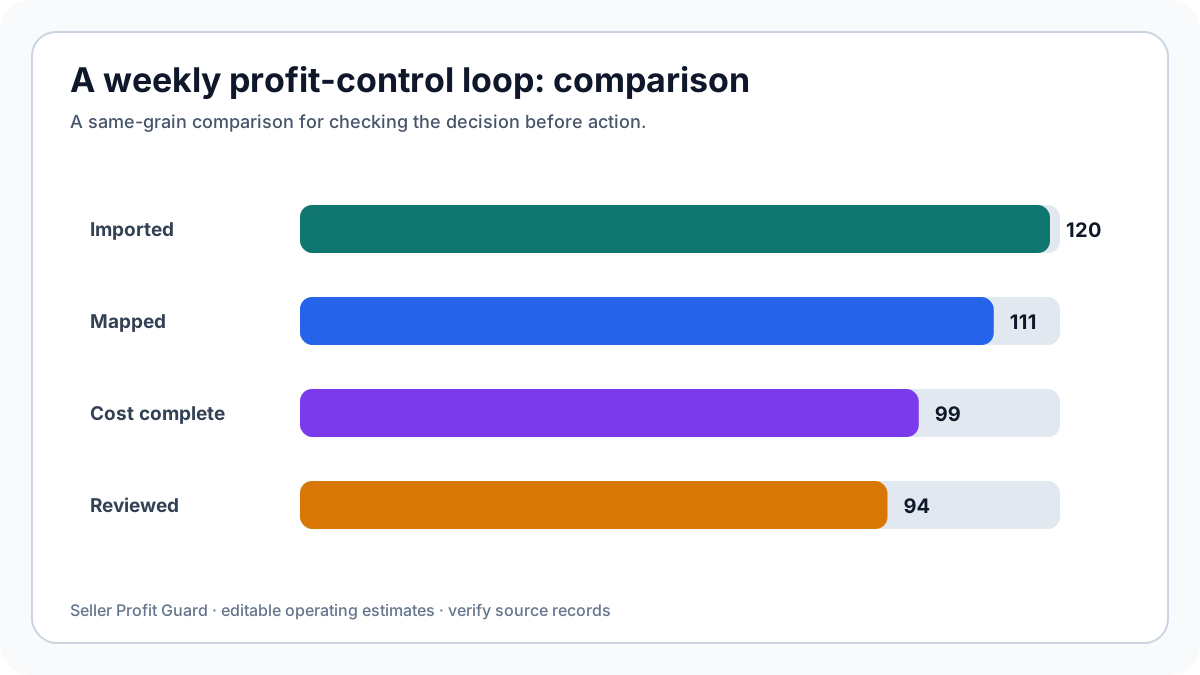
Measure evidence coverage across revenue and units. Count rows with current SKU material/provider cost, labor, packaging, fulfillment, advertising status, and return assumption. Prioritize missing evidence on bestsellers, heavy variations, custom items, high-return products, and promoted products. Do not let many well-documented low-value rows hide one large unknown SKU.
- Confirm file type, period, row count, currency and mapping version.
- Keep blank and unknown distinct from verified zero.
- Measure cost coverage by revenue and units.
- Flag new headers or sign behavior before calculating.
- Stop when a mapping defect undermines the decision.
Minute 15 to 35: review contribution exceptions
Run the base contribution model and a credible stress case for the selected period. Sort by missing cost, below-break-even, below-target, high advertising exposure, refund or replacement loss, shipping shortfall, and unusually high shown contribution. An unusually positive result can be as important as a negative one because it may indicate missing labor, duplicated revenue, or omitted fees.
Choose exceptions by economic impact and reversibility. A bestseller $2 below target may matter more than a one-off low-value loss. A product with no current material cost is not ready for a price approval even when the report looks strong. Record the primary driver and evidence gap; do not change several assumptions until the result passes.
| Exception | Priority signal | First check |
|---|---|---|
| Missing SKU cost | Revenue or units exposed | Correct SKU join and effective cost |
| Below break-even | Loss dollars and recurrence | Revenue, fee, cost and sign integrity |
| Below target | Headroom and capacity | Price, labor, shipping, promotion driver |
| Ad-sensitive | Attributed volume and delta | Current attribution and fee evidence |
| Refund-heavy | Unrecovered loss and repeat cause | Original order, recovery and workflow |
| Implausibly high | Large positive outlier | Missing or duplicated input |
Minute 35 to 50: decide and assign bounded actions
Convert each material exception into one controlled action: obtain a supplier invoice, time a workflow, correct a mapping, change one variation price, set a shipping threshold, reduce a coupon, exclude a heavy option, update packaging, pause an ad path, or investigate refund cause. State the owner, limit, due date, success measure, and rollback condition.
Do not rewrite every listing or change several commercial variables from one weekly report. Rank actions by expected economic impact, evidence quality, ease of reversal, and dependency. A mapping fix can precede a price change because it may change the diagnosis. A missing cost record can precede promotion expansion because the report cannot approve the product.
Minute 50 to 60: archive evidence and schedule follow-up
Export the private exception report and write a short decision log. Record source period, mapping version, cost version, scenario, target, affected SKU, result, evidence grade, action, owner, due date, and next review. Store the report with controlled operating records. Do not attach raw order data to public tickets, community posts, or general notes.
Compare open actions with the prior week. Close only when the evidence and expected control pass. If the seller changed price or shipping, schedule a review after enough settled orders and relevant fee/return evidence exist. If the action was a data fix, rerun the public or redacted fixture immediately and the affected private rows locally.
- Export the exception report and retain the source references.
- Write one decision-log row per material action.
- Carry unresolved items forward with owner and reason.
- Close an action only after the control passes.
- Schedule commercial follow-up on an appropriate evidence window.
- Preserve the previous result and rollback path.
What should be reviewed monthly instead of weekly?
Use a monthly control for full Payment Account balance bridge, software and overhead allocation, provider and supplier changes, labor-rate review, return and replacement segmentation, shipping-zone changes, promotion policy, evidence retention, and stale-source checks. The weekly routine catches operational exceptions; the monthly routine validates the model and denominators.
Reconcile deposits and account activity separately from product contribution. Review fixed monthly costs against actual order volume and avoid applying a forecast denominator after volume changes. Check whether the tool's official source links, public dummy schema, mappings, and privacy wording remain current. Document any calculation or source change before it affects the next weekly run.
| Cadence | Primary controls | Reason |
|---|---|---|
| Weekly | Mappings, cost coverage, contribution exceptions, actions | Fast operational correction |
| Monthly | Statement bridge, fixed-cost allocation, source and model review | Denominator and control integrity |
| Quarterly | Thresholds, product mix, capacity and policy | Strategic operating fit |
| Event-driven | Fee, supplier, carrier, export, program or workflow change | Immediate model freshness |
| After incident | Mapping, privacy, calculation or deployment defect | Containment and recurrence prevention |
How do you keep the routine useful as volume grows?
Automate validation and prioritization before automating decisions. The system can detect missing fields, stale costs, target failures, outliers, and repeated exceptions. A human should still review source meaning, unusual program treatment, customer-impacting actions, and thresholds. Scale by narrowing attention to economic impact and evidence gaps rather than removing review.
Create stable owners for SKU cost, labor method, packaging, shipping, fees, promotions, and refunds. Use a change log so the team does not silently overwrite assumptions. Sample passing rows as well as exceptions to detect a control that only appears clean. Maintain public dummy fixtures for technical tests and keep private seller data outside general debugging.
- Automate detection, not unsupported business decisions.
- Prioritize by revenue, units, contribution delta and recurrence.
- Sample passing rows to test the control itself.
- Assign data-domain owners and review dates.
- Preserve public fixtures for safe regression tests.
Weekly Etsy profit review questions
Do I need to review every order? Start with exception rules and economic coverage. Sample passing rows and investigate products representing meaningful revenue, units, labor, ad exposure, or risk.
Should I wait for the monthly statement? Use current order and private-cost evidence for provisional review, then reconcile platform charges when mature. Label the status instead of presenting a forecast as final.
What if no exception appears? Check coverage and sample several high-value and high-shown-contribution rows. A clean report with missing costs is not clean.
Can the routine replace bookkeeping? No. It is an operating contribution and data-quality control. Keep accounting, tax and statutory records under the appropriate process.
What is the best weekly metric? There is no single metric. Track evidence-covered revenue, below-target contribution, open high-impact exceptions, action closure, and whether the same defect recurs.
Privacy and evidence limits for weekly profit operating routine
A contribution review does not need buyer names, delivery addresses, private messages, payment credentials, marketplace passwords, or a public copy of the seller's order history. It normally needs a redacted transaction key, date, SKU, quantity, seller-attributable revenue, relevant fee evidence, and private cost assumptions. Keep the untouched export in controlled storage and work from a local copy.
Seller Profit Guard is designed to read supported CSV files in the browser. A report can still contain commercially sensitive prices, SKU economics, labor rates, and supplier costs, so treat exports as private operating records. For support, share column names and a made-up example row. If an account-specific reserve, fee, refund, or suspension determines the answer, use the authenticated Etsy record rather than a generic assumption.
- Do not upload buyer identity or address fields for a margin calculation.
- Do not paste raw order rows into public communities, support email, or AI prompts.
- Use public dummy data to reproduce mapping and formula issues.
- Store cost libraries, reports, and change logs as confidential business records.
- Escalate tax, accounting, legal, and account-policy questions to the appropriate official or professional source.
How to apply this weekly profit operating routine in Seller Profit Guard
Open the Etsy CSV profit calculator with a recent, representative order-item export or the public dummy sample. Confirm the revenue, quantity, SKU, shipping, discount, fee, and transaction mappings before importing private cost assumptions. Review missing-cost and mapping warnings first; a precise result built on an empty or misidentified field is not decision-ready.
Run the relevant base and stress scenarios, export the private review list, and record the source period, assumptions, result, decision, owner, and next review date. The useful output is not a perfect score. It is a short, evidence-backed queue of listings or SKUs that need a price, cost, shipping, promotion, or data-quality action.
- Preserve the source export and record its shop, currency, period, and file type.
- Confirm every mapped field and keep missing values unknown rather than zero.
- Attach the correct SKU-level material, labor, packaging, fulfillment, and target assumptions.
- Run a base case plus the page-specific stress or comparison case.
- Inspect the rows that fail the target or evidence-quality gate.
- Record one reversible action and a dated follow-up instead of changing the whole shop.
Related resources
- Open the Etsy CSV profit calculator: Run a browser-local order and SKU contribution review with editable assumptions.
- Build an Etsy SKU cost library: Store material, labor, packaging, shipping, and target assumptions for repeat reviews.
- Reconcile Etsy Payment Account activity: Match order and statement evidence before interpreting cash movement as product economics.
- Review CSV data privacy: Keep raw buyer and order data out of public support and community posts.
- Read the editorial policy: See how sources, corrections, AI assistance, and update dates are handled.
Sources and further reading
- Seller Profit Guard calculation methodology: Calculation scope, editable assumptions, contribution terminology, privacy boundaries, and result limits.
- Etsy Help: Fees and Taxes for Selling: Official fee categories, fee bases, country-dependent processing charges, advertising fees, and Payment Account treatment.
- Etsy Help: Download Sold Transaction Spreadsheets: Official order items, orders, Etsy Payments sales, and Etsy Payments deposits CSV workflow.
- Etsy Help: Manage Your Payment Account: Official sales, fees, refunds, seller services, shipping, monthly statements, balance, and deposit context.
- Etsy Help: How Offsite Ads Work: Official attribution, participation, fee-rate, and order-cap context; verify current shop-specific status.
- Etsy Help: Issue a Full or Partial Refund: Official refund workflow and Payment Account impact reference.
Related Seller Profit Guard tools
- Open the Etsy CSV profit calculator: Run a browser-local order and SKU contribution review with editable assumptions.
- Build an Etsy SKU cost library: Store material, labor, packaging, shipping, and target assumptions for repeat reviews.
- Reconcile Etsy Payment Account activity: Match order and statement evidence before interpreting cash movement as product economics.
- Review CSV data privacy: Keep raw buyer and order data out of public support and community posts.
- Read the editorial policy: See how sources, corrections, AI assistance, and update dates are handled.
- Etsy Profit Formula: Inputs Small Sellers Must Track: Continue the Seller Profit Guard evidence and decision workflow.
- Etsy Profit Example: Trace a $74 Order Step by Step: Continue the Seller Profit Guard evidence and decision workflow.
- Etsy Discount Profit: Test Coupons and Free Shipping: Continue the Seller Profit Guard evidence and decision workflow.
- Etsy Profit Calculator Mistakes: 12 Cost Traps: Continue the Seller Profit Guard evidence and decision workflow.
- Etsy Profit Data Sources: Build a Defensible Record: Continue the Seller Profit Guard evidence and decision workflow.
Next step: Open the Etsy CSV profit calculator.
This is operational planning help, not tax, accounting, legal, financial, or platform-policy advice. Review the Terms and disclaimer, and verify current platform rules and fee assumptions before changing prices.