Ready, Revise, Hold, and Block thresholds for Etsy digital files
Last updated: 2026-07-30
Written and reviewed by Seller Profit Guard Editorial Team.
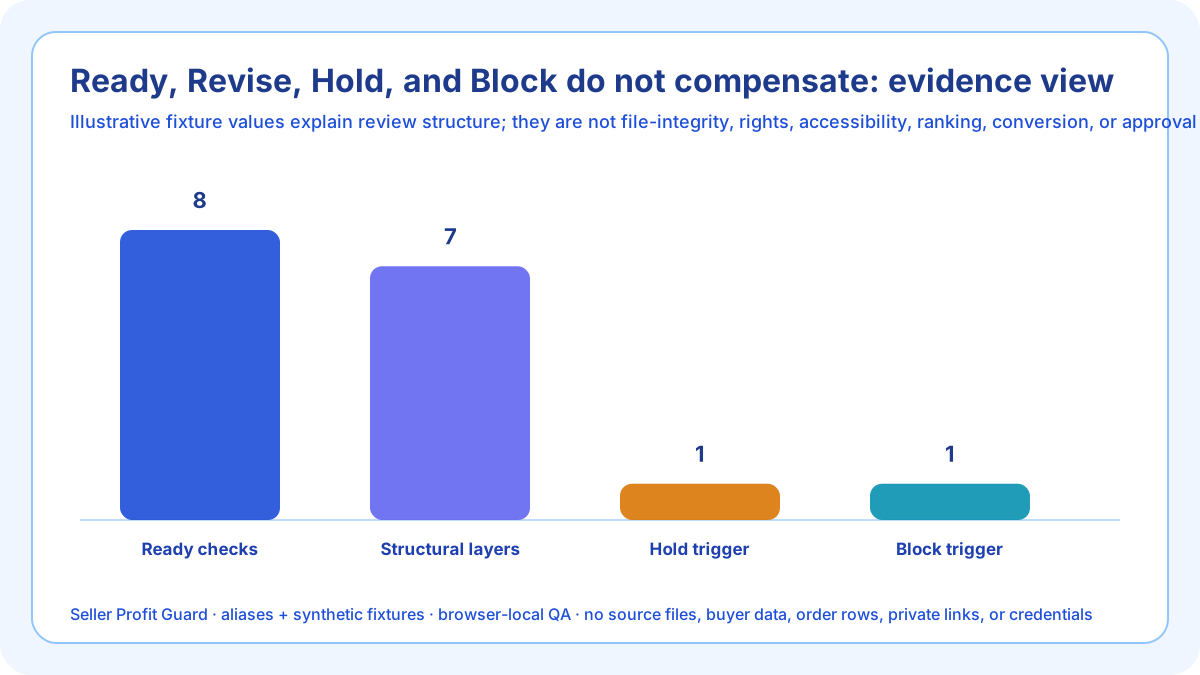
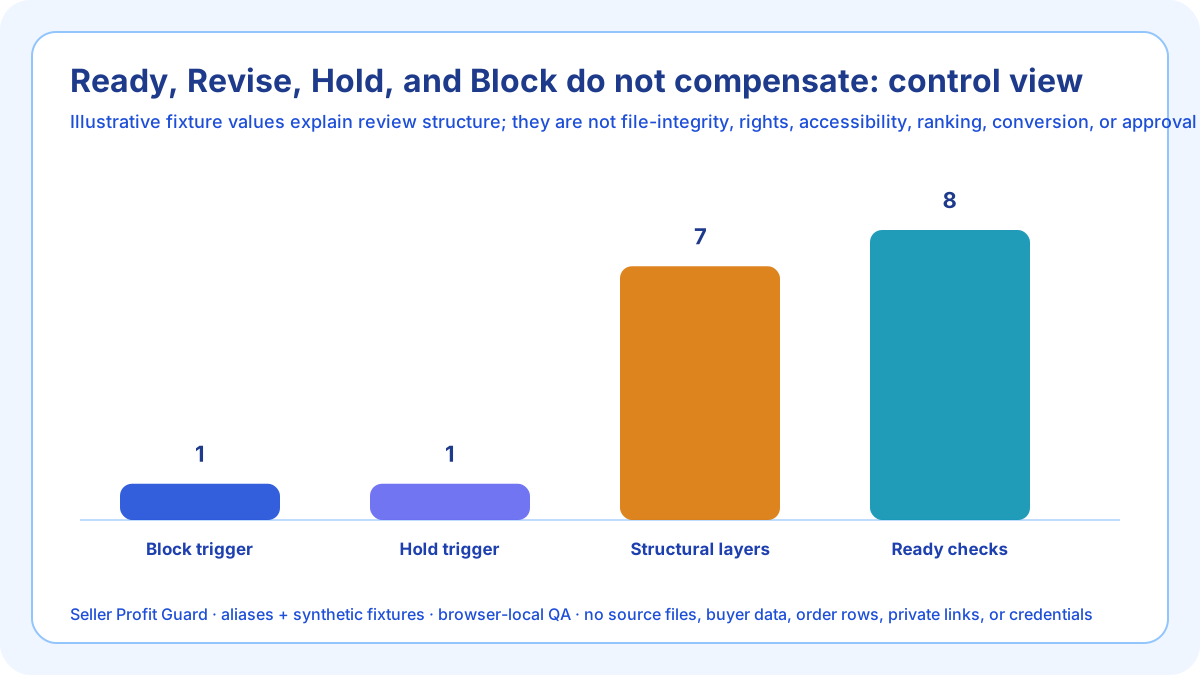
Ready requires all eight digital-package checks, one to five supported files no larger than 20MB, permitted buyer-visible names, coherent contents, compatibility, license, preview, support, current evidence, and no declared conflict. Revise means structural information fails; Hold means provenance is incomplete; Block means a known corrupt, missing, mismatched, unsafe, stale, or unlicensed record remains.

non-compensating file decision: scope and decision
Decision thresholds exist to stop an aggregate score from hiding a critical purchased-product failure. File availability, integrity, scope, usability, rights, public representation, support, and evidence are separate obligations.
Ready advances a bounded package to backup and public verification. Revise requests missing or invalid structure. Hold requests current source or clean-device evidence. Block protects a seller-declared defect or unresolved rights problem even when the text fields look complete.
Build the digital release gate before analysis
Use the same fixtures every time: one complete package, excess files, unsupported type, oversized file, invalid name, corrupt archive, missing promised asset, hidden dependency, preview mismatch, vague license, wrong access note, no evidence, and declared issue.
The tool produces an operational decision from entered facts. It does not inspect bytes, detect malware, validate accessibility, grant rights, determine tax, decide policy eligibility, reproduce purchase protection, or predict reviews, ranking, conversion, revenue, or AdSense.
Ready threshold
Require 8/8, valid manifest count and rows, current evidence, zero declared issue, and a human-confirmed clean-device path. Ready means proceed to release QA, not guaranteed buyer success.
Apply the threshold to “Ready threshold” before reading the aggregate score. The digital release gate keeps 8/8 text around a declared corrupt archive non-compensating and lets 8/8 package with current open tests advance only with current evidence and no declared conflict. The result supports a proportionate release or stop decision; it does not certify bytes, rights, accessibility, policy, delivery, search, reviews, or revenue.
Revise threshold
Use Revise when delivery mode, manifest, package scope, compatibility, license, previews, or support is too short, invalid, or contradictory. Repair the named layer before interpreting the score.
Apply the threshold to “Revise threshold” before reading the aggregate score. The digital release gate keeps 8/8 text around a declared corrupt archive non-compensating and lets 8/8 package with current open tests advance only with current evidence and no declared conflict. The result supports a proportionate release or stop decision; it does not certify bytes, rights, accessibility, policy, delivery, search, reviews, or revenue.
Hold threshold
Use Hold when structure passes but the evidence note lacks the current listing, exact candidate, clean-device observation, preview, instruction, license, buyer note, reviewer, or date.
Apply the threshold to “Hold threshold” before reading the aggregate score. The digital release gate keeps 8/8 text around a declared corrupt archive non-compensating and lets 8/8 package with current open tests advance only with current evidence and no declared conflict. The result supports a proportionate release or stop decision; it does not certify bytes, rights, accessibility, policy, delivery, search, reviews, or revenue.
Block threshold
Use Block for known corruption, missing promised content, unsupported delivery, wrong file, unsafe component, rights conflict, stale license, false preview, or another seller-declared defect.
Apply the threshold to “Block threshold” before reading the aggregate score. The digital release gate keeps 8/8 text around a declared corrupt archive non-compensating and lets 8/8 package with current open tests advance only with current evidence and no declared conflict. The result supports a proportionate release or stop decision; it does not certify bytes, rights, accessibility, policy, delivery, search, reviews, or revenue.
Count, type, size, and name gate
One to five rows must use current supported extensions, measured sizes above zero and no more than 20MB, and buyer-visible names no longer than 70 permitted characters.
Apply the threshold to “Count, type, size, and name gate” before reading the aggregate score. The digital release gate keeps 8/8 text around a declared corrupt archive non-compensating and lets 8/8 package with current open tests advance only with current evidence and no declared conflict. The result supports a proportionate release or stop decision; it does not certify bytes, rights, accessibility, policy, delivery, search, reviews, or revenue.

Usability and representation gate
Package scope, required tools, opening path, preview labels, license summary, and support steps must describe the same candidate rather than different versions.
Apply the threshold to “Usability and representation gate” before reading the aggregate score. The digital release gate keeps 8/8 text around a declared corrupt archive non-compensating and lets 8/8 package with current open tests advance only with current evidence and no declared conflict. The result supports a proportionate release or stop decision; it does not certify bytes, rights, accessibility, policy, delivery, search, reviews, or revenue.
Release threshold
Preserve current files and listing state, confirm target account, upload only the approved set, inspect buyer-visible names and copy, and repeat the download or opening path.
Apply the threshold to “Release threshold” before reading the aggregate score. The digital release gate keeps 8/8 text around a declared corrupt archive non-compensating and lets 8/8 package with current open tests advance only with current evidence and no declared conflict. The result supports a proportionate release or stop decision; it does not certify bytes, rights, accessibility, policy, delivery, search, reviews, or revenue.
Recovery threshold
Restore when a critical file, public promise, access path, or evidence observation diverges. A successful editor save or HTTP response alone does not close the release.
Apply the threshold to “Recovery threshold” before reading the aggregate score. The digital release gate keeps 8/8 text around a declared corrupt archive non-compensating and lets 8/8 package with current open tests advance only with current evidence and no declared conflict. The result supports a proportionate release or stop decision; it does not certify bytes, rights, accessibility, policy, delivery, search, reviews, or revenue.
Verification, release, and rollback controls
Before replacing listing files, preserve the digital release gate, current attachments, listing copy, previews, buyer note, manifest, source and export versions, dependencies, license, fixtures, approval, and rollback identifier. Confirm the correct account and listing. Safe-stop on login or CAPTCHA ambiguity, a platform warning, wrong profile, missing target context, private data, or unexpected editor behavior.
After one bounded change, verify 8/8 package with current open tests on a clean browser or computer and deliberately revisit 8/8 text around a declared corrupt archive. Inspect buyer-visible file names, Highlights, description, previews, note, and actual opening or use path. Restore the approved previous package when a critical observation does not support a proportionate release or stop decision.
Limits, privacy boundary, and next action
This guide and checker use seller-entered summaries, aliases, manifests, and synthetic fixtures. They do not upload, retrieve, open, extract, render, print, play, edit, scan, hash, deliver, license, approve, or certify files; determine eligibility, originality, rights, accessibility, tax, or legal compliance; reproduce Etsy systems; or predict ranking, clicks, reviews, conversion, sales, refunds, income, or AdSense approval.
Keep proprietary source assets, buyer customizations, customer names, emails, addresses, messages, order IDs, receipts, payment data, private links, license keys, credentials, OAuth material, and raw CSV rows outside the digital release gate. Repair the accountable source, rerun complete and crossed fixtures, release only the approved package, inspect public and delivery paths, and record verified closure or rollback.
Sources and further reading
- Etsy Help: How to Manage Your Digital Listings: Current instant and made-to-order paths, the applicable five-file and 20MB upload limits, supported extensions, buyer-visible naming rules, note-for-buyers behavior, and replacement workflow.
- Etsy Help: How to Download a Digital Item: Current buyer download path, payment-confirmation timing, mobile-app limitation, browser and computer access, guest access, troubleshooting, and support boundary.
- Etsy Help: How to Create a Listing: Current physical-versus-digital selection, file attachment, description, preview, personalization, and digital-variation boundaries.
- Etsy Help: How to Add Variations for Your Listings: Current explicit boundary that listing variations are not supported for digital item listings.
- Etsy Help: How to Offer Custom Items: Current boundary that private custom listings cannot be created for digital items and made-to-order digital listings are the supported custom-file path.
- Etsy Creativity Standards: Current seller-designed digital-download path and human-creative-contribution boundary.
- Etsy Intellectual Property Policy: Current seller responsibility for necessary rights and Etsy's stated legal-advice boundary.
- Seller Profit Guard methodology: Evidence hierarchy, privacy-safe fixtures, deterministic review, uncertainty, bounded release, public feedback, and recovery.
Related Seller Profit Guard tools
- Open the Etsy Digital Listing File Checker: Review delivery path, file manifest, package scope, compatibility, license, previews, support, issues, and evidence.
- Check Etsy category fit: Keep physical-versus-digital category review separate from the file-package audit.
- Check Etsy description clarity: Reconcile buyer-facing promises with the delivered digital package.
- Check Etsy photo coverage: Review previews and listing-image evidence independently from file integrity.
- Check Etsy personalization instructions: Keep buyer-entered customization inputs separate from ready-made file delivery.
- Read the local-first methodology: Use synthetic fixtures, evidence versions, public verification, and rollback.
- Etsy Digital File Checker Inputs: Continue the file, scenario, evidence, decision, operating, interpretation, or audit workflow.
- Etsy Printable PDF File Example: Continue the file, scenario, evidence, decision, operating, interpretation, or audit workflow.
- Etsy Design Template Bundle QA: Continue the file, scenario, evidence, decision, operating, interpretation, or audit workflow.
- 14 Etsy Digital File Listing Mistakes: Continue the file, scenario, evidence, decision, operating, interpretation, or audit workflow.
- Reliable Etsy Digital File QA Sources: Continue the file, scenario, evidence, decision, operating, interpretation, or audit workflow.
Next step: Open the Etsy Digital Listing File Checker.
This is operational planning help, not tax, accounting, legal, financial, or platform-policy advice. Review the Terms and disclaimer, and verify current platform rules and fee assumptions before changing prices.