How to interpret Etsy transaction versus processing results
Last updated: 2026-07-30
Written and reviewed by Seller Profit Guard Editorial Team.
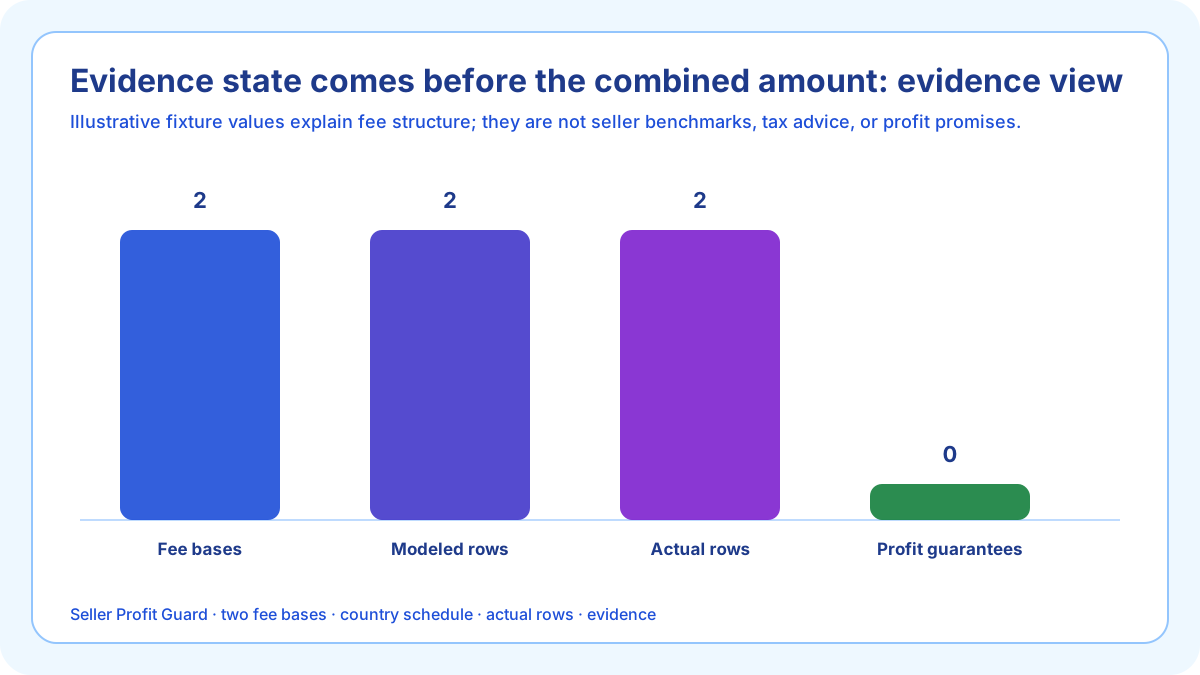
Read evidence state first, then compare transaction and processing bases, modeled fees, combined two-fee estimate, transaction share, actual-row differences, country, order type, and currency. Ready means both rows reproduce the entered evidence within tolerance; it does not mean the pair equals total Etsy fees, payout deductions, or accounting profit.

responsible two-fee interpretation: scope and decision
Start with Block and Reconcile conditions. Missing context or a row difference outranks an attractive combined total.
The transaction base and processing base may differ because applicable seller-collected tax can enter only the processing calculation.
Build the result-to-evidence map before acting
The combined estimate is useful for the fee stack, but it should never erase separate sources, formulas, actual rows, refunds, or credits.
Ready describes the entered comparison. It does not authenticate an order, settle tax, reproduce payout, or measure profit, ranking, traffic, conversion, or AdSense outcomes.
Read transaction-fee base
This is item, buyer-paid shipping, and gift-wrap revenue under the entered general rule, not payout or deposit.
Read “Read transaction-fee base” as a statement about seller-entered fee rows, not an authenticated order, tax ruling, payout, accounting period, or marketplace recommendation. Compare a clean US Ready fixture with the same total with offsetting row errors, inspect the source row, and select the next action that supports a next action bounded by the two modeled fee layers without false precision.
Interpretation evidence for “Read transaction-fee base” must state what each row can show, what remains outside the tool, and which source reduces uncertainty. A clean a clean US Ready fixture demonstrates arithmetic; the same total with offsetting row errors demonstrates why evidence conflicts outrank a combined score.
Read processing-fee base
This adds applicable seller-collected tax when in scope. A higher base should have documented tax evidence.
Read “Read processing-fee base” as a statement about seller-entered fee rows, not an authenticated order, tax ruling, payout, accounting period, or marketplace recommendation. Compare a clean US Ready fixture with the same total with offsetting row errors, inspect the source row, and select the next action that supports a next action bounded by the two modeled fee layers without false precision.
Interpretation evidence for “Read processing-fee base” must state what each row can show, what remains outside the tool, and which source reduces uncertainty. A clean a clean US Ready fixture demonstrates arithmetic; the same total with offsetting row errors demonstrates why evidence conflicts outrank a combined score.
Read modeled transaction fee
The percentage-only row preserves full precision before display rounding.
Read “Read modeled transaction fee” as a statement about seller-entered fee rows, not an authenticated order, tax ruling, payout, accounting period, or marketplace recommendation. Compare a clean US Ready fixture with the same total with offsetting row errors, inspect the source row, and select the next action that supports a next action bounded by the two modeled fee layers without false precision.
Interpretation evidence for “Read modeled transaction fee” must state what each row can show, what remains outside the tool, and which source reduces uncertainty. A clean a clean US Ready fixture demonstrates arithmetic; the same total with offsetting row errors demonstrates why evidence conflicts outrank a combined score.
Read modeled processing fee
The row combines country percentage and fixed fee once per entered order.
Read “Read modeled processing fee” as a statement about seller-entered fee rows, not an authenticated order, tax ruling, payout, accounting period, or marketplace recommendation. Compare a clean US Ready fixture with the same total with offsetting row errors, inspect the source row, and select the next action that supports a next action bounded by the two modeled fee layers without false precision.
Interpretation evidence for “Read modeled processing fee” must state what each row can show, what remains outside the tool, and which source reduces uncertainty. A clean a clean US Ready fixture demonstrates arithmetic; the same total with offsetting row errors demonstrates why evidence conflicts outrank a combined score.
Read combined estimate
Use the sum as two fee layers only. It excludes listing, ads, conversion, regulatory, VAT, labels, costs, and returns.
Read “Read combined estimate” as a statement about seller-entered fee rows, not an authenticated order, tax ruling, payout, accounting period, or marketplace recommendation. Compare a clean US Ready fixture with the same total with offsetting row errors, inspect the source row, and select the next action that supports a next action bounded by the two modeled fee layers without false precision.
Interpretation evidence for “Read combined estimate” must state what each row can show, what remains outside the tool, and which source reduces uncertainty. A clean a clean US Ready fixture demonstrates arithmetic; the same total with offsetting row errors demonstrates why evidence conflicts outrank a combined score.

Read transaction share
This ratio changes with order value and fixed fee; it is descriptive, not a universal benchmark.
Read “Read transaction share” as a statement about seller-entered fee rows, not an authenticated order, tax ruling, payout, accounting period, or marketplace recommendation. Compare a clean US Ready fixture with the same total with offsetting row errors, inspect the source row, and select the next action that supports a next action bounded by the two modeled fee layers without false precision.
Interpretation evidence for “Read transaction share” must state what each row can show, what remains outside the tool, and which source reduces uncertainty. A clean a clean US Ready fixture demonstrates arithmetic; the same total with offsetting row errors demonstrates why evidence conflicts outrank a combined score.
Read actual-row differences
A difference above tolerance requires one accountable reconciliation, even if the two differences offset in aggregate.
Read “Read actual-row differences” as a statement about seller-entered fee rows, not an authenticated order, tax ruling, payout, accounting period, or marketplace recommendation. Compare a clean US Ready fixture with the same total with offsetting row errors, inspect the source row, and select the next action that supports a next action bounded by the two modeled fee layers without false precision.
Interpretation evidence for “Read actual-row differences” must state what each row can show, what remains outside the tool, and which source reduces uncertainty. A clean a clean US Ready fixture demonstrates arithmetic; the same total with offsetting row errors demonstrates why evidence conflicts outrank a combined score.
Read decision and limits
Ready advances, Reconcile checks rows, and Block collects missing evidence. None of these decisions authorizes automatic marketplace changes.
Read “Read decision and limits” as a statement about seller-entered fee rows, not an authenticated order, tax ruling, payout, accounting period, or marketplace recommendation. Compare a clean US Ready fixture with the same total with offsetting row errors, inspect the source row, and select the next action that supports a next action bounded by the two modeled fee layers without false precision.
Interpretation evidence for “Read decision and limits” must state what each row can show, what remains outside the tool, and which source reduces uncertainty. A clean a clean US Ready fixture demonstrates arithmetic; the same total with offsetting row errors demonstrates why evidence conflicts outrank a combined score.
Verification, release, and statement feedback
Before changing price, fee assumptions, or calculator defaults, preserve the result-to-evidence map, official-source versions, private evidence pointer, current inputs, expected fixtures, tests, build, route state, and rollback identifier. Confirm the exact target environment and safe-stop on an unexpected account or production context.
After one bounded correction, rerun a clean US Ready fixture, the same total with offsetting row errors, the tax-base fixture, and a declared-conflict fixture. Inspect full-precision and displayed amounts, per-row differences, mobile results, canonical, sources, original visuals, internal links, and privacy-safe statement feedback. Restore the prior packet if a critical result cannot support a next action bounded by the two modeled fee layers.
Limits, privacy boundary, and next action
This guide and calculator use seller-entered summaries and synthetic fixtures. They do not retrieve Etsy data, authenticate bank country, decide tax, reproduce every refund or payout, include every Etsy fee, change a marketplace account, or prove ranking, traffic, qualified intent, AdSense approval, income, or final profit.
Keep buyer names, emails, addresses, messages, order IDs, payment rows, bank details, tax identifiers, labels, tokens, OAuth material, credentials, and raw CSV outside the result-to-evidence map. Verify current Etsy sources and the seller's actual account, reconcile an approved privacy-safe sample, and obtain qualified accounting, tax, or legal advice when material.
Sources and further reading
- Etsy Help: Fees and Taxes for Selling: Current transaction-fee base, 6.5% rate, separate payment-processing layer, currency, refund, and surrounding fee boundaries.
- Etsy Help: Payment Processing Fees: Current bank-country percentage and fixed-fee table, tax-inclusive processing base, refund credit, VAT, and domestic or international distinctions.
- Etsy Help: Fee Basics: Current plain-language distinction between transaction and Etsy Payments processing fees.
- Etsy Fees and Payments Policy: Controlling fee definitions, bases, currencies, taxes, deductions, refunds, and seller responsibilities.
- Etsy Help: Manage Your Payment Account: Payment account, monthly statement, fees, taxes, refunds, credits, balances, and payout-period reconciliation.
- Seller Profit Guard methodology: Evidence hierarchy, local-first calculations, synthetic fixtures, privacy boundaries, deterministic tests, release, correction, and rollback.
Related Seller Profit Guard tools
- Open the transaction vs processing fee calculator: Separate the two fee bases, rates, fixed charge, actual rows, and differences.
- Build the complete Etsy fee stack: Add listing, Offsite Ads, currency, regulatory, tax, operating-cost, and contribution layers.
- Reconcile the Etsy Payment account: Compare the modeled fee rows with actual statement and payout evidence.
- Run Seller Profit Guard: Carry reconciled fees into SKU-level product, shipping, returns, and target-profit analysis.
- Use the Etsy fee reference: Check current country and fee-layer reference boundaries.
- Read the local-first methodology: Keep buyer, order, payment, bank, contact, and credential data outside public pages.
- Etsy Transaction vs Processing Fee Formula: Continue the formula, example, source, threshold, comparison, routine, interpretation, or audit workflow.
- Etsy Transaction vs Processing Fee Example: Continue the formula, example, source, threshold, comparison, routine, interpretation, or audit workflow.
- UK Etsy Transaction vs Processing Fees: Continue the formula, example, source, threshold, comparison, routine, interpretation, or audit workflow.
- 11 Etsy Transaction and Processing Fee Mistakes: Continue the formula, example, source, threshold, comparison, routine, interpretation, or audit workflow.
- Etsy Transaction and Processing Fee Sources: Continue the formula, example, source, threshold, comparison, routine, interpretation, or audit workflow.
Next step: Open the Etsy Transaction vs Processing Fee Calculator.
This is operational planning help, not tax, accounting, legal, financial, or platform-policy advice. Review the Terms and disclaimer, and verify current platform rules and fee assumptions before changing prices.