Seller Profit Guard · How it works · CSV privacy
Free shipping threshold calculator
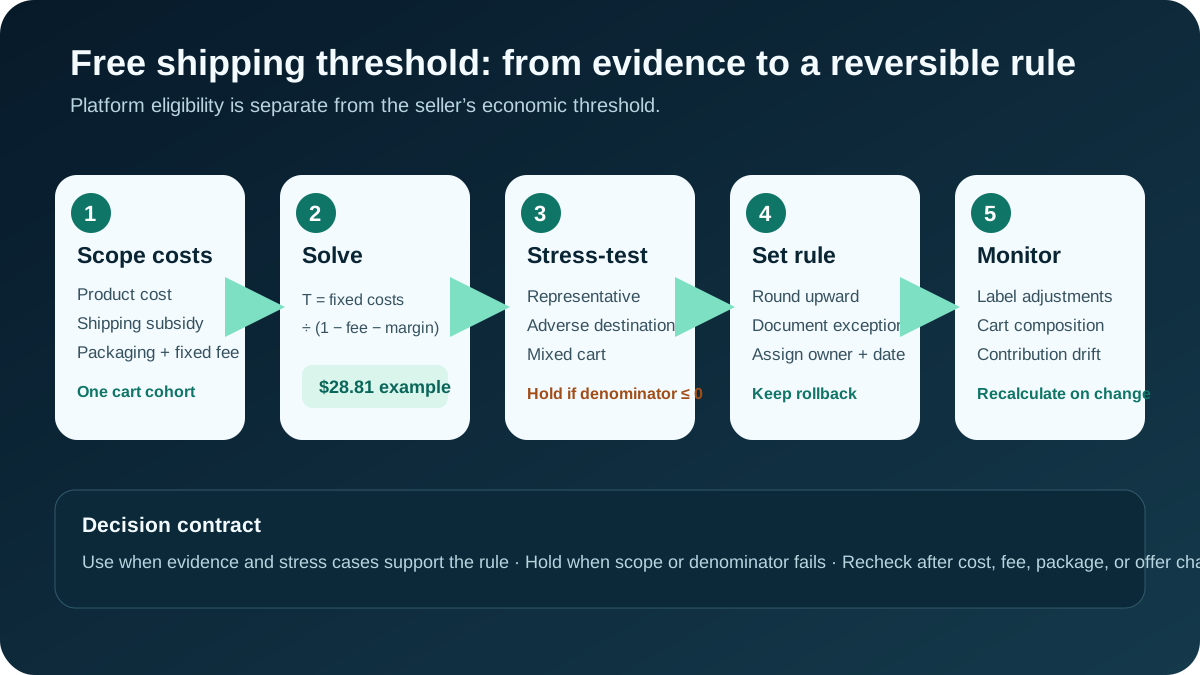
A margin-safe free-shipping threshold is the minimum modeled order value that can cover product cost, seller-funded shipping, packaging, fixed fees, percentage fees, and a chosen contribution margin. Enter one consistent cart scenario. The calculator solves T = (C + S + P + F) ÷ (1 − r − m), reports no safe threshold when the denominator is zero or negative, and keeps all calculation inputs in the browser.
Maintained by Seller Profit Guard Editorial Team. Last reviewed: 2026-07-25.
What does a free-shipping threshold calculate?
Free shipping changes who visibly pays for fulfillment; it does not remove postage, packaging, handling, insurance, carrier adjustments, or product cost. This calculator estimates the order revenue required for a seller-funded shipping scenario to retain an editable target contribution. It is useful when a seller is considering a minimum order rule, comparing buyer-paid and seller-paid shipping, or checking whether an existing offer still fits current costs.
The number is economic, not promotional. Etsy's current US free-shipping guarantee can make eligible US-bound orders of $35 or more qualify after a seller enables the program, but that platform condition does not prove that $35 covers a particular shop's product mix and shipping cost. A seller's calculated threshold can be below, equal to, or above a platform eligibility amount. Keep both values labeled so a marketplace setting is never presented as a profit result.
The output is a bounded planning estimate. It does not quote a carrier, configure an Etsy shipping profile, predict conversion, determine tax, calculate accounting profit, or guarantee that every qualifying order is profitable. Destination, dimensions, weight, service, package consolidation, coupons, ads, refunds, and mixed-cart composition can change the result. Model materially different cases separately.
- Use one declared destination, package, product-mix, currency, and offer cohort.
- Include the shipping amount the seller actually funds, not an advertised rate alone.
- Treat the target margin and percentage fee rate as visible assumptions.
- Round a calculated threshold upward and test adverse cases before publishing a rule.
The exact formula and its six inputs
Let T be the threshold order value, C product cost for the modeled cart, S the shipping cost paid by the seller, P packaging and handling materials, F a fixed per-order fee, r the combined percentage fee rate expressed as a decimal, and m the target contribution margin rate. The model starts with T − rT − C − S − P − F = mT. Rearranging gives T = (C + S + P + F) ÷ (1 − r − m).
The numerator contains four dollar amounts. Product cost should match the items expected in the modeled cart, not a shop-wide average that hides expensive variants. Shipping should reflect the seller-funded label, service, insurance, and known adjustments for the chosen cohort. Packaging can include boxes, mailers, inserts, tape, protective material, and other per-order supplies. The fixed fee should include only a charge that applies at this calculation grain and is not already inside another input.
The denominator is the share of order revenue left to cover those dollar costs after percentage fees and target contribution. Enter 8 for an eight-percent fee assumption and 25 for a twenty-five-percent target in the interface; the calculator converts those percentages to 0.08 and 0.25. Do not enter 0.08 into a field labeled percent. Do not include the same fee in both the percentage rate and fixed-fee input.
| Symbol | Input | Required scope | Preferred evidence |
|---|---|---|---|
| C | Product cost | Items in the modeled cart | Versioned SKU or bundle cost record |
| S | Seller-funded shipping | Declared package and destination cohort | Paid label, adjustment, insurance, and service evidence |
| P | Packaging | Per modeled order | Packaging bill of materials and purchase records |
| F | Fixed fee | One order at the same revenue grain | Current official fee rule and resolved account evidence |
| r | Percentage fees | Same revenue base as T | Current official policy plus reconciled transactions |
| m | Target margin | Contribution target for this bounded model | Documented seller planning assumption |
Worked example: the default $28.81 threshold
The public default uses dummy values: $12.00 product cost, $6.00 seller-funded shipping, $1.00 packaging, a $0.30 fixed fee, an 8% combined percentage fee assumption, and a 25% target margin. Fixed-dollar costs are $12 + $6 + $1 + $0.30 = $19.30. The remaining revenue share is 1 − 0.08 − 0.25 = 0.67. The exact threshold is $19.30 ÷ 0.67 = $28.805970..., displayed as $28.81.
A threshold of $28.81 is not automatically a sensible public rule. Rounding down to $28 would place the modeled order below the target. A seller might test $29, $30, or a higher merchandising value, but the choice should reflect currency increments, cart composition, uncertainty, and adverse shipping cases. The calculator does not recommend a psychological price or claim that a higher threshold will improve conversion.
A hand check closes the loop. At $28.81, an 8% fee assumption is about $2.30. Subtracting $19.30 of fixed-dollar costs and about $2.30 of percentage fees leaves about $7.21, which is approximately 25% of $28.81 after cent rounding. Preserve the unrounded calculation for audit evidence, display cents for usability, and round the operating rule upward rather than modifying inputs to obtain a preferred number.
| Step | Calculation | Result |
|---|---|---|
| Fixed-dollar cost | $12.00 + $6.00 + $1.00 + $0.30 | $19.30 |
| Revenue share available | 1 − 0.08 − 0.25 | 0.67 |
| Exact threshold | $19.30 ÷ 0.67 | $28.805970... |
| Displayed estimate | Round calculation to cents | $28.81 |
| Operating decision | Test a practical value at or above the estimate | Seller-defined and reversible |
Second scenario: a higher-cost mixed cart
Suppose a mixed cart has $18.00 of product cost, $7.50 of seller-funded shipping, $1.50 of packaging, a $0.30 fixed fee, an 8% percentage fee assumption, and a 20% target margin. The numerator is $27.30. The denominator is 1 − 0.08 − 0.20 = 0.72. The threshold is $27.30 ÷ 0.72 = $37.916666..., displayed as $37.92.
This scenario illustrates why order value alone cannot describe shipping economics. The same $38 order could contain one compact item, several lightweight items that consolidate into one parcel, or two products that must ship separately. If $7.50 represents only the consolidated case, do not apply the result to split shipments. Create separate scenarios and compare the cost driver that actually changes.
Mixed-cart modeling needs a defensible product-cost assumption. A weighted expected cart can help with portfolio planning, but it is unsafe as the only rule when high-cost or heavy combinations are common. Test a representative cart, a high-product-cost cart, a distant or upgraded shipment, and any bundle that changes package dimensions. If one published threshold cannot protect all included cases, define exclusions or use buyer-paid shipping for the outliers.
- Representative case: observed product mix and normal shipping service.
- Adverse case: heavier package, distant zone, adjustment, or upgrade.
- Mixed-cart case: observed consolidation or split-shipment behavior.
- Exception case: product or destination that cannot use the general offer safely.
When the calculator reports no safe threshold
A finite threshold exists only when 1 − r − m is greater than zero. If percentage fees plus the target margin equal or exceed 100%, no amount of revenue in this simplified model leaves a positive share to cover product, shipping, packaging, and fixed costs. The calculator returns “No safe threshold” instead of dividing by zero or displaying a misleading negative amount.
This is a validation result, not an instruction to suppress the warning. Check percentage units first: entering 70 into a field means seventy percent, not 0.70%. Check that the same fee was not counted twice. Then ask whether the target margin is compatible with the modeled fee structure. If the inputs are correct, change the offer economics, product mix, shipping funding, or target; do not force a cosmetic threshold.
A positive but very small denominator also requires caution. As fees plus target margin approach 100%, the threshold rises nonlinearly and becomes highly sensitive to small cost changes. Record sensitivity at nearby fee, shipping, and margin assumptions. If normal evidence uncertainty is larger than the headroom between the exact estimate and the proposed rule, hold the release or increase the rule.
| Denominator state | Meaning | Action |
|---|---|---|
| > 0 with adequate headroom | A finite modeled threshold exists | Round upward and stress-test |
| > 0 but near zero | Result is highly sensitive | Run sensitivity cases and add headroom |
| = 0 | No revenue share remains for dollar costs | Stop and correct scope or economics |
| < 0 | Fees plus target exceed revenue | Do not publish a threshold from this model |
How to source shipping, packaging, and fee evidence
Use actual Etsy or carrier label charges, post-purchase adjustments, insurance, and service records for shipping evidence. A displayed shipping estimate or profile describes an offer; it does not prove final seller cost. Segment records when destination, weight, dimensions, package type, mail class, or carrier behavior creates a material difference. Use a mature aggregate for a declared cohort instead of copying a single unusually cheap label.
Build packaging cost from the materials consumed by the modeled order: mailer or box, protection, tape, labels, inserts, and any per-order handling supply included in this contribution model. Keep labor treatment explicit. If labor belongs in product cost or another profit model, do not silently add it again here. Match units, currency, effective dates, and tax treatment before combining sources.
Use Etsy's current Fees & Payments Policy to identify possible charges, then reconcile the rates and fixed amounts that actually apply to the seller's country, payment setup, currency, advertising status, and transaction. A combined percentage assumption is convenient for planning but must have a written scope. Run separate cases for Offsite Ads or unusual currency and regulatory fees rather than hiding intermittent charges inside a universal rate.
- Record source dates, currency, period, cohort, and calculation version.
- Prefer resolved charges and adjustments over advertised estimates.
- Keep fixed and percentage components separate.
- Reconcile official rules with actual account evidence before a material decision.
Separate Etsy's $35 guarantee from shop economics
Etsy's official free-shipping guidance describes a US free-shipping guarantee for eligible orders of $35 or more shipped to US buyers after the seller enables the program, along with shipping profiles and related configuration. That rule determines platform offer behavior and eligibility. It is not the equation used by this calculator and should not be cited as evidence that a $35 cart meets a particular contribution target.
Compare values explicitly. If the economic threshold is $28.81 and the relevant platform threshold is $35, a properly scoped $35 case may provide modeled headroom, but the seller still needs to test qualifying cart composition and shipping exceptions. If the economic threshold is $37.92, a $35 platform offer may miss the chosen target under that scenario. The response is to revisit funding, exclusions, product prices, package design, or the offer—not to relabel $35 as profitable.
International shipping, expedited upgrades, remote destinations, oversized packages, and products excluded from a general profile can follow different rules. Read current Etsy documentation in the seller's region and inspect the current listing and shipping profile before making a configuration change. Preserve screenshots or exported settings as context, but treat reproducible cost and transaction evidence as stronger economic proof.
| Value | Question answered | Evidence needed |
|---|---|---|
| Platform eligibility amount | When a configured marketplace offer applies | Current official Etsy guidance and live profile |
| Economic threshold | When the scoped model reaches the chosen contribution | Costs, fee assumptions, formula, and scenarios |
| Published shop rule | What buyers see and which exceptions apply | Approved operating decision and rollback |
| Observed outcome | What happened after release | Mature orders, labels, adjustments, and contribution feedback |
Coupons, ads, returns, and taxes need separate scenarios
A coupon lowers collected revenue while many costs remain unchanged. Model the discounted revenue base or add a separate maximum-discount check before combining promotions with free shipping. Do not assume that a threshold calculated from list-price carts remains safe during a sale. If a coupon can push the paid order below the economic threshold, define stacking rules or calculate the combined case.
Advertising costs and Offsite Ads can materially change retained contribution but are not represented by the six base inputs unless the operator deliberately includes an applicable fee in the scoped rate. Use a separate scenario for applicable advertising fees and the break-even ROAS workflow for acquisition spend. Expected return or replacement loss also belongs in a distinct, evidence-backed layer so the shipping equation remains explainable.
Taxes collected or remitted by a marketplace, VAT on seller fees, and jurisdiction-specific accounting treatment require current official records and qualified advice. The calculator does not determine taxable revenue or deductible expense. Define whether entered values are tax-inclusive or tax-exclusive and keep that basis consistent. Never enlarge a percentage input with an unexplained blended number merely to approximate several unrelated risks.
- Run a coupon-stacked scenario at actual paid revenue.
- Model Offsite Ads or acquisition spend separately when applicable.
- Add mature expected incident loss in a clearly labeled downstream model.
- Verify tax and accounting treatment outside this calculator.
Privacy and local-first calculation
The calculation needs six numeric business assumptions. It does not need a buyer name, email, phone number, address, order ID, private message, personalization, payment credential, Etsy login, or raw order CSV. The quick calculator runs in the browser. Use aggregate shipping cohorts or public dummy locations when studying destination effects, and keep private labels and buyer data out of screenshots, analytics, support tickets, and community drafts.
Commercially sensitive data remains sensitive even when buyer fields are absent. Supplier cost, package dimensions, negotiated shipping rates, target margin, cart mix, offer exceptions, and promotional plans can reveal strategy. Store detailed worksheets in controlled storage. Public documentation should use dummy numbers, rounded ranges, redacted product names, and non-reversible fingerprints rather than live seller rows.
If evidence begins in a private export, reduce it locally to the minimum aggregate needed for the scenario. Document period, row count, cohort definition, and source fingerprint without copying the source file into the active website directory. A fingerprint proves that a file did not change; it does not prove that its rows represent future orders or that header mapping was correct.
- Do not paste private buyer or order data into the calculator.
- Keep raw exports out of source control and public reports.
- Use dummy fixtures to reproduce formula or interface behavior.
- Treat costs, volume, and target margins as confidential business data.
A reversible operating routine
Start by defining the offer, included products, destination cohort, package class, service, currency, analysis period, and target contribution. Preserve the currently published shipping settings and last accepted calculation as rollback evidence. Refresh costs from dated sources, enter the representative case, hand-check the formula, and run at least one adverse and one mixed-cart case.
Choose a practical rule at or above the highest case the offer is meant to protect. Record the exact calculated values, rounded rule, exclusions, owner, approver, review date, and restoration method. Verify the buyer-facing wording and shipping profile in a controlled preview before release. A tool result is not permission to change a live marketplace setting automatically.
After release, compare observed label cost, adjustments, package composition, paid order value, applicable fees, and contribution with the modeled cohorts. Use a mature review window rather than attributing one day's movement to the threshold. Recalculate after carrier changes, packaging redesign, supplier cost changes, fee updates, offer changes, or repeated exceptions. Roll back when the approved decision contract fails.
- Freeze current settings, sources, and the prior accepted model.
- Define one coherent representative cohort and verify six inputs.
- Hand-check the formula and run representative, adverse, and mixed-cart cases.
- Select an upward-rounded rule with documented exclusions and headroom.
- Preview wording and configuration; assign owner, approval, date, and rollback.
- Release narrowly, monitor mature evidence, and recalculate on material change.
Common mistakes and validation checks
The most common algebra error is a percentage-unit mismatch. Eight percent is entered as 8 in the interface and becomes 0.08 in the formula. Another error is rounding down, which produces a public rule below the modeled target. Duplicate costs are also common: packaging may already be embedded in product cost, or a payment fee may appear in both the combined rate and fixed fee.
Scope errors can be more dangerous than arithmetic errors. A lightweight average label cannot support a threshold that includes heavy or remote orders. A one-item product cost cannot describe a multi-item qualifying cart. A shipping profile does not prove final label cost, and a current listing cannot prove historical cart composition. Keep data grain visible and create separate cases when assumptions differ.
Interface validation should reproduce known fixtures. The default inputs must return $28.81. A 30% fee rate plus 70% target margin must return no safe threshold. Reset must restore the defaults. For a material spreadsheet implementation, preserve equivalent clean, boundary, and invalid-denominator fixtures so a formula edit cannot silently change the decision.
| Failure | Signal | Control |
|---|---|---|
| Percent entered as decimal | Implausibly low fee or margin effect | Confirm the field unit and hand-check |
| Threshold rounded down | Published rule below exact result | Round upward before scenario approval |
| Duplicated component | Unexpectedly high numerator or rate | Map each charge to one input only |
| Mixed population | Large unexplained scenario variance | Split by package, destination, or cart cohort |
| Stale evidence | Observed labels or fees drift from model | Refresh sources and effective dates |
How to interpret and communicate the result
Communicate the exact estimate, proposed operating rule, scope, evidence state, and uncertainty separately. For example: “The representative domestic cohort calculates to $28.81; the proposed $30 rule is an upward-rounded planning threshold; heavy and upgraded shipments remain excluded pending separate evidence.” This is more useful than a bare “free shipping at $30” claim.
Use a three-state decision contract. Use the result when inputs are current, formula fixtures pass, intended cart cases have adequate headroom, exceptions are enforceable, and rollback exists. Hold when scope, units, costs, fee bases, or package behavior is uncertain. Escalate when a change affects a large catalog, cross-border treatment, tax, accounting, or a platform-policy interpretation requiring specialist review.
Track leading operational measures without promising causation: qualifying-order count, average paid order value, label and adjustment distribution, exception rate, contribution under the chosen scope, rollback events, and time since source refresh. Conversion, search ranking, and revenue can move for many reasons. Evaluate those separately with mature windows and do not attribute short-term movement solely to the shipping rule.
- Exact calculation and rounded rule are different values.
- Evidence confidence limits the strength of the action.
- Exceptions and rollback are part of the offer, not afterthoughts.
- Observed outcomes validate a cohort; they do not prove universal causation.
Audit checklist and calculator limits
A defensible record includes offer scope, products, destination, package, service, currency, analysis period, product-cost version, shipping evidence, packaging bill of materials, fee sources, target assumption, formula version, exact result, rounded rule, representative and adverse fixtures, exclusions, owner, approval, release date, monitoring window, and rollback. A checked box without reproducible evidence does not prove that a threshold is safe.
Use the ten linked support guides for the equation and inputs, a complete hand calculation, a mixed-cart scenario, common mistakes, source selection, decision thresholds, scenario comparison, operating routine, result interpretation, and a reusable audit template. Each guide answers a separate operational question and returns to this calculator. The guides do not replace current Etsy documentation or seller-specific records.
Seller Profit Guard does not connect to Etsy, change a listing, buy a label, verify a carrier charge, forecast buyer behavior, calculate accounting profit, determine tax, or authorize pricing. Its value is narrower and testable: calculate one transparent threshold from editable assumptions and expose when the math has no safe result. For material decisions, preserve uncertainty, consult current official sources, and obtain qualified accounting, tax, legal, or marketplace-policy advice where needed.
- Recheck official Etsy and carrier sources before a material release.
- Preserve clean, boundary, and invalid-denominator fixtures.
- Do not expose private buyer data or commercial source files.
- Recalculate whenever costs, fees, package behavior, or offer scope changes.
Sources and further reading
- Etsy Help: How to Offer Free Shipping: Official Etsy guidance for the US $35 free-shipping guarantee, profiles, smart pricing, upgrades, and domestic versus international offers.
- Etsy Fees & Payments Policy: Official policy for transaction, payment-processing, Offsite Ads, regulatory, currency-conversion, shipping-label, and other seller charges.
- Etsy Help: How to Set Up Calculated Shipping: Official explanation of how origin, destination, weight, dimensions, mail class, and package preferences affect calculated shipping.
- Etsy Help: How to Ship Your Items: Official shipping-profile, label, policy, and competitive-shipping overview.
- Seller Profit Guard calculation methodology: Definitions for contribution, editable assumptions, evidence hierarchy, local-first processing, uncertainty, and decision limits.
Related Seller Profit Guard tools
- Etsy CSV profit calculator: Run a local order profit check with editable fee and SKU cost assumptions.
- Payment reconciliation tool: Compare order rows with statement activity and flag unmatched rows.
- SKU cost library: Save or import material, labor, packaging, shipping, and target margin assumptions.
- Variant risk checker: Find missing SKUs and variation cost risks before a listing scales.
- Etsy title checker: Review listing-title clarity, repetition, keyword chains, and mobile scanning.
- Etsy tag checker: Review all 13 tag slots for duplicates, repeated meaning, and truthful coverage.
- Free shipping threshold calculator: Estimate when a shipping subsidy can still meet a target margin.
- Return window loss estimator: Model expected reverse shipping, restock work, recovery, and replacement loss.
- Etsy Ads break-even calculator: Estimate target-safe Etsy Ads spend, ACOS, and ROAS after fees, fulfillment, and expected return loss.
- CSV data privacy: Understand what the local-first workflow needs and what it does not need.
- Free Shipping Threshold Formula: 6 Inputs: Calculate a margin-safe free-shipping order threshold from four dollar costs, a fee rate, and a target margin without confusing it with Etsy's $35 rule.
- Free Shipping Threshold: $26.32 Example: Follow a domestic parcel example from product, label, packaging, fees, and target margin to a rounded $27 free-shipping order rule.
- Mixed-Cart Free Shipping Threshold: $37.75: Calculate a mixed-cart threshold from two product costs, combined packaging, parcel shipping, fees, and target margin without reusing a one-item average.
- Free Shipping Threshold: 12 Costly Mistakes: Avoid denominator errors, missing fees, false zero costs, mixed-cart averages, wrong shipping scope, unsafe rounding, and platform-rule confusion.
- Free Shipping Threshold Data: 7 Sources: Map product cost, postage, packaging, fixed and percentage fees, margin targets, cart mix, and offer rules to reliable seller and Etsy evidence.
- Free Shipping Rules: Break-Even vs Target: Separate break-even, target-margin, stress, and rollback thresholds so a free-shipping offer is not approved from one optimistic estimate.
- Free Shipping Threshold: Parcel vs Cart: Compare a $26.32 domestic parcel threshold with a $37.75 mixed-cart threshold at consistent cost, fee, margin, and package grain.
- Weekly Free Shipping Audit: 45 Minutes: Run a weekly 45-minute control loop for shipping costs, qualifying cart mix, fees, thresholds, exceptions, actions, and rollback evidence.
- Read a Free Shipping Threshold Correctly: Interpret the calculated order floor, denominator, cost total, score, assumptions, sensitivity, and next action without false precision.
- Free Shipping Threshold Audit Template: Audit formula, source evidence, offer scope, fixtures, cart mix, configuration, live outcomes, approvals, exceptions, and rollback.
- Shopify Free Shipping Threshold Formula: Derive a zone-specific threshold from retained contribution, shipping, handling, payment fees, target margin, and documented Shopify scope.
- Shopify Domestic Free Shipping Example: Work the domestic USD 28 threshold from a documented zone packet, then test an entered USD 35 proposal.
Use the interactive tool
Enable JavaScript to open the calculator and process browser-local inputs. The explanatory content and source links remain available without JavaScript.
Related guide: Read the Etsy shipping margin guide.
This tool provides operating estimates, not tax, accounting, legal, financial, or marketplace-policy advice. Verify current official sources and your own records before changing prices or operations.