A product price floor audit checklist
Last updated: 2026-07-30
Written and reviewed by Seller Profit Guard Editorial Team.
A price-floor audit should record order grain, currency, period, source dates, units, every variable-cost row, buyer shipping, fee base and rate, discount mechanism, return-loss inputs, target owner, equations, required charged revenue, target and break-even list prices, current-price gap, decision, conflicts, reviewer, approved action, feedback, and rollback reference.
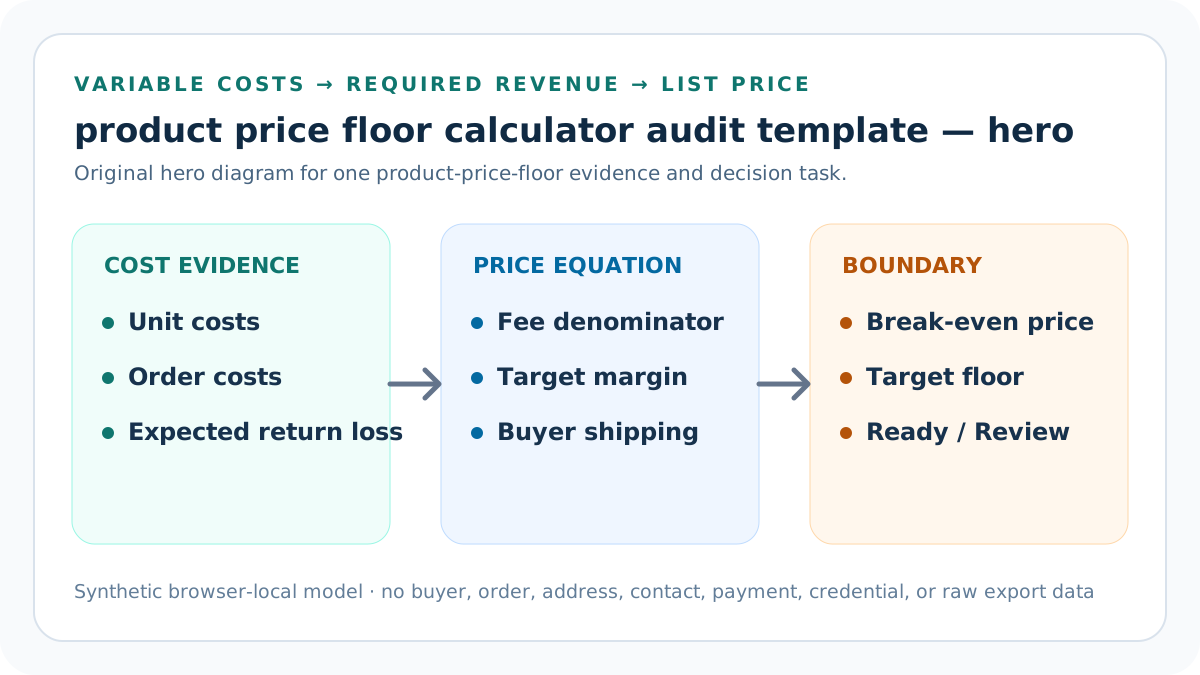
Record scope fields
Capture audit ID, order-type alias, channel, SKU class, units, currency, period, owner, reviewer, and privacy classification. This assertion belongs to the price-floor audit and change log and must remain attributable to a dated source, an explicit seller assumption, or a synthetic test fixture.
For assertion-level auditability, checkpoint 1 must pass before it can support a standalone and reversible price review packet. Record the value, unit, calculation grain, source class, effective date, and reviewer conclusion; correct the failing field instead of offsetting it with an unrelated favorable input.
Record unit costs
Capture product, packaging, direct labor, quantity extension, source pointer, effective date, unit, and confidence. This assertion belongs to the price-floor audit and change log and must remain attributable to a dated source, an explicit seller assumption, or a synthetic test fixture.
For assertion-level auditability, checkpoint 2 must pass before it can support a standalone and reversible price review packet. Record the value, unit, calculation grain, source class, effective date, and reviewer conclusion; correct the failing field instead of offsetting it with an unrelated favorable input.
Record order costs
Capture fulfillment, fixed fee, acquisition, expected loss, other cost, allocation method, source, and owner. This assertion belongs to the price-floor audit and change log and must remain attributable to a dated source, an explicit seller assumption, or a synthetic test fixture.
For assertion-level auditability, checkpoint 3 must pass before it can support a standalone and reversible price review packet. Record the value, unit, calculation grain, source class, effective date, and reviewer conclusion; correct the failing field instead of offsetting it with an unrelated favorable input.
Record revenue mechanics
Capture current list price, seller-funded discount, buyer-paid shipping, whether platform funding leaves seller revenue unchanged, eligibility, and effective dates. This assertion belongs to the price-floor audit and change log and must remain attributable to a dated source, an explicit seller assumption, or a synthetic test fixture.
For assertion-level auditability, checkpoint 4 must pass before it can support a standalone and reversible price review packet. Record the value, unit, calculation grain, source class, effective date, and reviewer conclusion; correct the failing field instead of offsetting it with an unrelated favorable input.
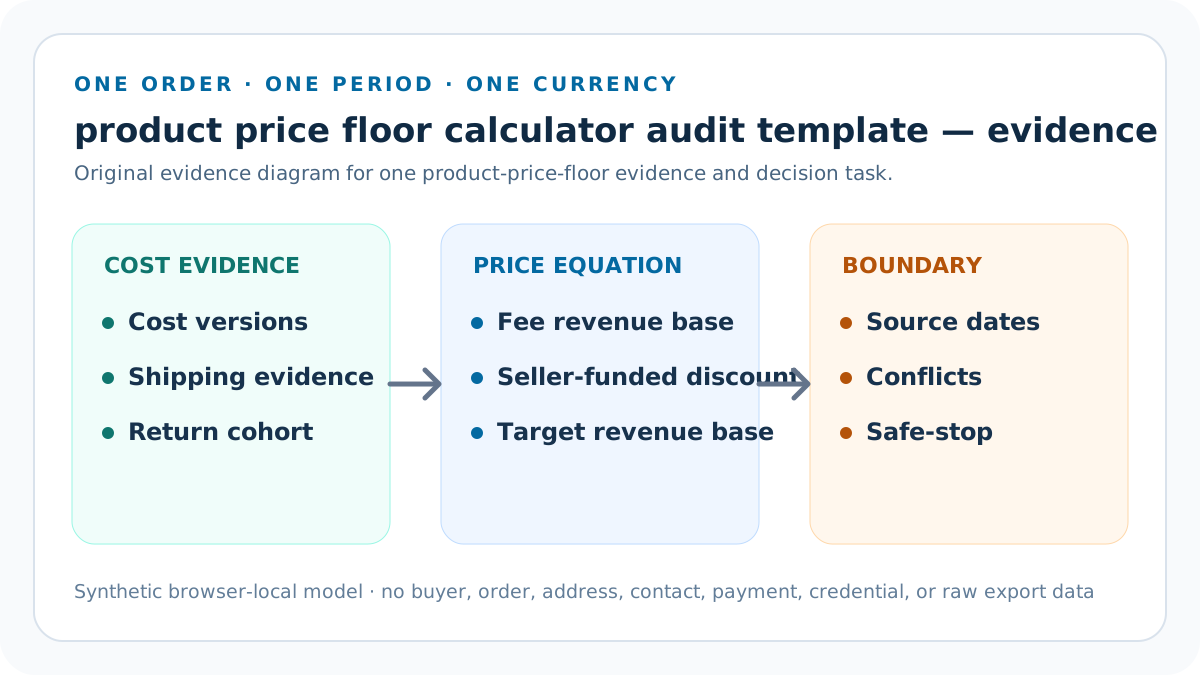
Assert denominators
Test discount retention, percentage-fee remainder, fee-plus-target remainder, and current charged revenue before solving price. This assertion belongs to the price-floor audit and change log and must remain attributable to a dated source, an explicit seller assumption, or a synthetic test fixture.
For assertion-level auditability, checkpoint 5 must pass before it can support a standalone and reversible price review packet. Record the value, unit, calculation grain, source class, effective date, and reviewer conclusion; correct the failing field instead of offsetting it with an unrelated favorable input.
Assert outputs
Record fixed variable-cost pool, required charged revenue, target floor, break-even floor, current contribution, and price gap. This assertion belongs to the price-floor audit and change log and must remain attributable to a dated source, an explicit seller assumption, or a synthetic test fixture.
For assertion-level auditability, checkpoint 6 must pass before it can support a standalone and reversible price review packet. Record the value, unit, calculation grain, source class, effective date, and reviewer conclusion; correct the failing field instead of offsetting it with an unrelated favorable input.
Record decision and change
Preserve every Block or Review reason, field before and after values, source, approver, expected effect, and rollback ID. This assertion belongs to the price-floor audit and change log and must remain attributable to a dated source, an explicit seller assumption, or a synthetic test fixture.
For assertion-level auditability, checkpoint 7 must pass before it can support a standalone and reversible price review packet. Record the value, unit, calculation grain, source class, effective date, and reviewer conclusion; correct the failing field instead of offsetting it with an unrelated favorable input.
Record verification and feedback
Attach tests, build, SEO, content, similarity, browser, mobile, release and live evidence, then close or restore. This assertion belongs to the price-floor audit and change log and must remain attributable to a dated source, an explicit seller assumption, or a synthetic test fixture.
For assertion-level auditability, checkpoint 8 must pass before it can support a standalone and reversible price review packet. Record the value, unit, calculation grain, source class, effective date, and reviewer conclusion; correct the failing field instead of offsetting it with an unrelated favorable input.
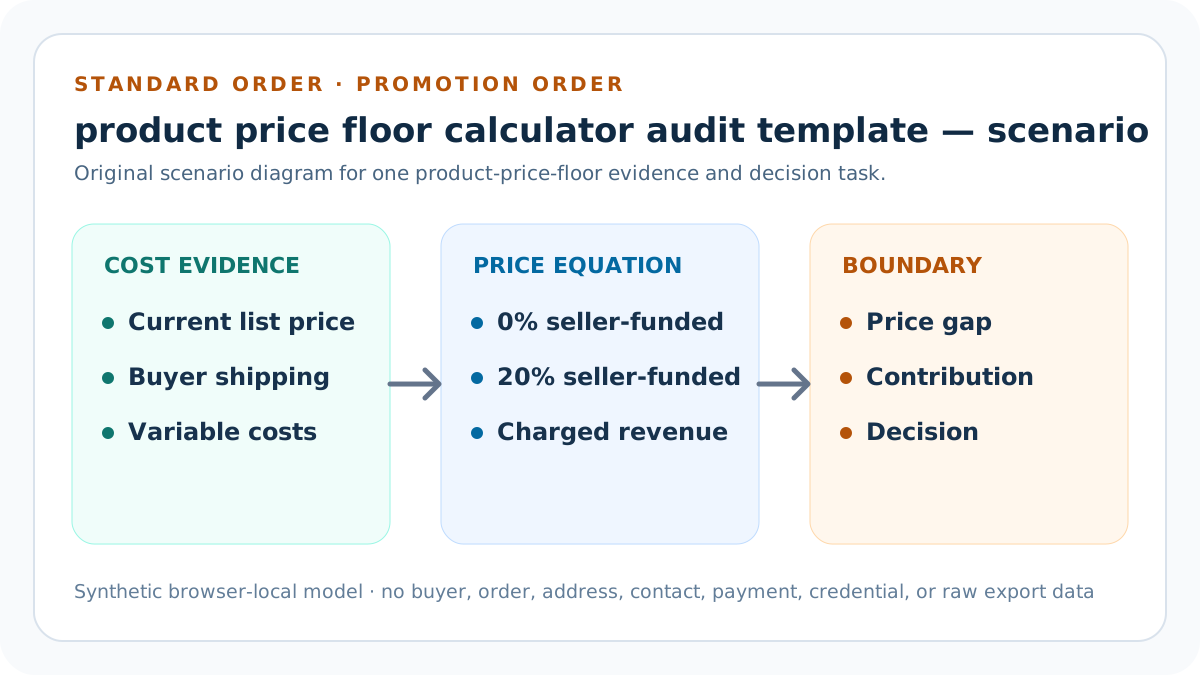
Worked control for assertion-level auditability
Run the standard, promotion Review, promotion Ready, and invalid-denominator fixtures while changing only the field discussed in this guide. Record exact before and after outputs and the rule that changed.
The control tests assertion-level auditability; it does not simulate a private customer, recommend a market price, or promise another seller will obtain a standalone and reversible price review packet.
Sensitivity and exception handling
Vary one cost, rate, shipping, discount, return, or target input at a time and preserve the resulting floor movement. When plausible evidence alternatives change the decision, investigate the disputed source rather than averaging incompatible values.
Block invalid quantity, negative inputs, discount at or above 100%, fee plus target at or above 100%, missing currency, period, or scope, and declared conflicts. A favorable current price cannot compensate for a broken inverse equation.
Forward-check the calculated floor
Insert the calculated target list price into the forward contribution equation. After discount and buyer-paid shipping, percentage fees and fixed variable costs should leave the target contribution percentage, subject only to display rounding.
Also forward-check the break-even list price with a zero target. If either assertion fails, preserve the packet, inspect fee base, shipping direction, discount reversal, and intermediate precision, then correct one accountable field.
Decision and bounded next action
Use Block before Review before Ready. Review a structurally valid current list price below target or producing negative contribution; Ready confirms only this seller-entered price-floor audit and change log.
Choose one source correction, price experiment, promotion test, packaging change, shipping test, target review, or no action. Define owner, feedback measure, observation window, stop condition, and rollback before scaling.
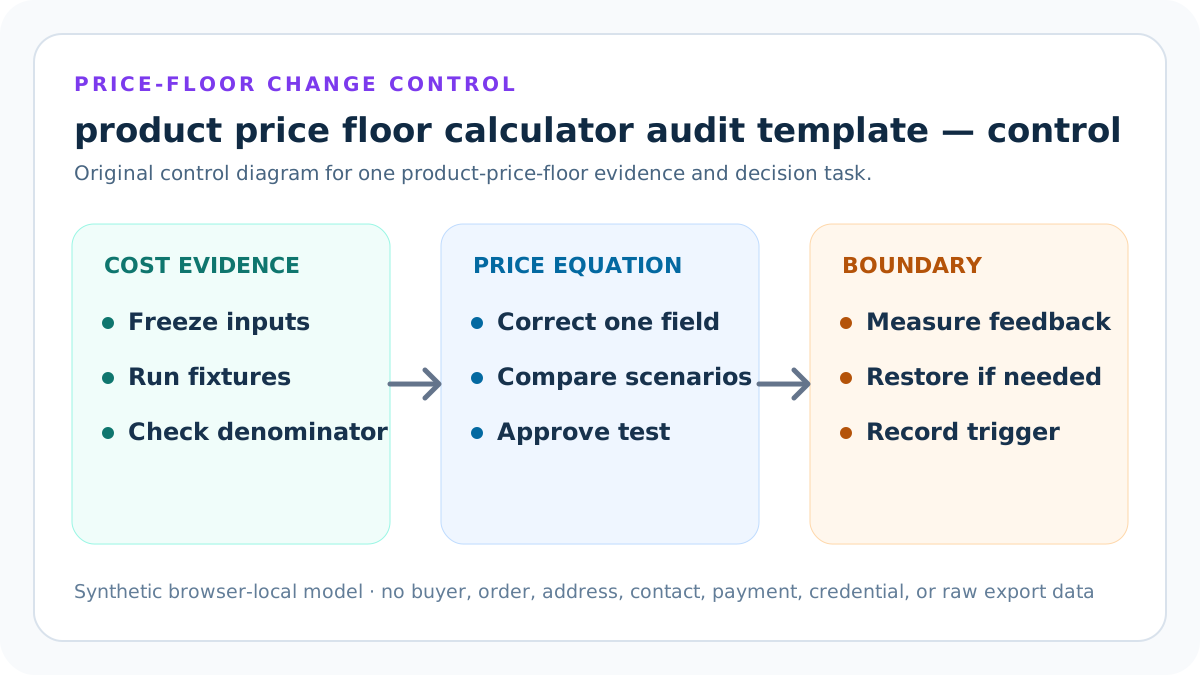
Verification, release, and feedback
Preserve the price-floor audit and change log, source pointers, fixtures, tests, build, content and similarity reports, release manifest, backup, and rollback identifier. Safe-stop on unexpected authentication, account, warning, or target context.
Verify arithmetic, decisions, canonical, Article and Breadcrumb schema, sources, four visuals, internal links, privacy, indexability, mobile layout, public response, and actual feedback. A green build cannot validate unsupported price evidence.
Limits, privacy boundary, and next step
This educational model excludes fixed overhead, owner compensation, financing, depreciation, income tax, accounting profit, demand, conversion, customer value, competitor response, and legal or platform permission. It does not guarantee traffic, ranking, advertising approval, revenue, or income.
Keep buyer names, emails, addresses, messages, order IDs, payment rows, bank details, tax identifiers, contacts, tokens, OAuth material, credentials, and raw exports outside the price-floor audit and change log. Verify current first-party evidence and obtain qualified advice when material.
Audit assertions and evidence keys
Give every input an assertion key: SCOPE-01 for one order grain, UNIT-01 through UNIT-03 for product, packaging, and labor, ORDER-01 through ORDER-05 for fulfillment, fixed fee, acquisition, expected loss, and other cost, and REVENUE-01 through REVENUE-03 for current price, discount, and buyer shipping. Store source pointer, effective date, unit, currency, owner, and confidence beside each key.
Give every equation a separate key: COST-EXT for quantity extension, LOSS-EXP for expected severity, DEN-TARGET for fee-plus-target remainder, REV-REQ for required charged revenue, PRICE-TARGET for discount reversal, PRICE-BE for zero-target break-even, and GAP-CURRENT for current-price distance. A total cannot pass when one component assertion fails.
Change-log rows, approvals, and restoration proof
Each change-log row needs timestamp, assertion key, prior value, proposed value, unit, source, reason, requester, reviewer, expected output movement, affected routes or SKUs, release identifier, and rollback reference. Keep the rejected value and reason; overwriting history makes later reconciliation and incident review impossible.
Closure evidence must reproduce the supported fixtures, show the corrected assertion, compare exact before and after target floors, name the approved bounded action, and attach feedback or a no-action conclusion. Restoration proof must show that the previous packet, public route state, calculation behavior, and privacy boundary can be recovered after a critical regression.
Sources and further reading
- Seller Profit Guard methodology: Evidence precedence, browser-local fixtures, deterministic decisions, validation, correction, release, and rollback.
- Seller Profit Guard data privacy: Local-first boundaries for seller, customer, order, payment, contact, credential, and raw export data.
- OpenStax: Contribution margin and contribution margin ratio: Primary managerial-accounting definition of contribution as sales less variable costs and the ratio against the same sales base; reviewed 2026-07-30.
- OpenStax: Break-even and target profit: Primary target-profit and contribution-ratio algebra used to validate the inverse-price structure; reviewed 2026-07-30.
- U.S. Small Business Administration: Break-even point: Official contribution-margin formula and mixed-cost separation guidance; reviewed 2026-07-30.
- IRS Publication 334: Tax Guide for Small Business: Primary U.S. tax context showing why an operating price-floor estimate is not taxable income or an accounting determination.
Related Seller Profit Guard tools
- Open the Product Price Floor Calculator: Solve for standard and promotion list-price floors from one order-variable cost contract.
- Calculate contribution from an observed price: Run the forward contribution equation after setting or observing a price.
- Version SKU costs: Maintain product, packaging, labor, fulfillment, and expected-loss inputs.
- Estimate return-window loss: Build expected loss from affected-order frequency and unrecovered severity.
- Calculate break-even ROAS: Translate contribution before ads into an acquisition boundary.
- Read the methodology: Review evidence, privacy, calculation, release, correction, and rollback controls.
- Review data privacy: Keep private seller and buyer data outside public content.
- Product Price Floor Formula and Inputs: Continue with a distinct formula, example, source, threshold, comparison, operating, interpretation, or audit task.
- Standard Product Price Floor Example: Continue with a distinct formula, example, source, threshold, comparison, operating, interpretation, or audit task.
- Promotion Product Price Floor Example: Continue with a distinct formula, example, source, threshold, comparison, operating, interpretation, or audit task.
- Product Price Floor Calculation Mistakes: Continue with a distinct formula, example, source, threshold, comparison, operating, interpretation, or audit task.
- Product Price Floor Data Sources: Continue with a distinct formula, example, source, threshold, comparison, operating, interpretation, or audit task.
Next step: Open the Product Price Floor Calculator.
This is operational planning help, not tax, accounting, legal, financial, or platform-policy advice. Review the Terms and disclaimer, and verify current platform rules and fee assumptions before changing prices.