How to set safe decision thresholds for Etsy tag changes
Last updated: 2026-07-29
Written and reviewed by Seller Profit Guard Editorial Team.
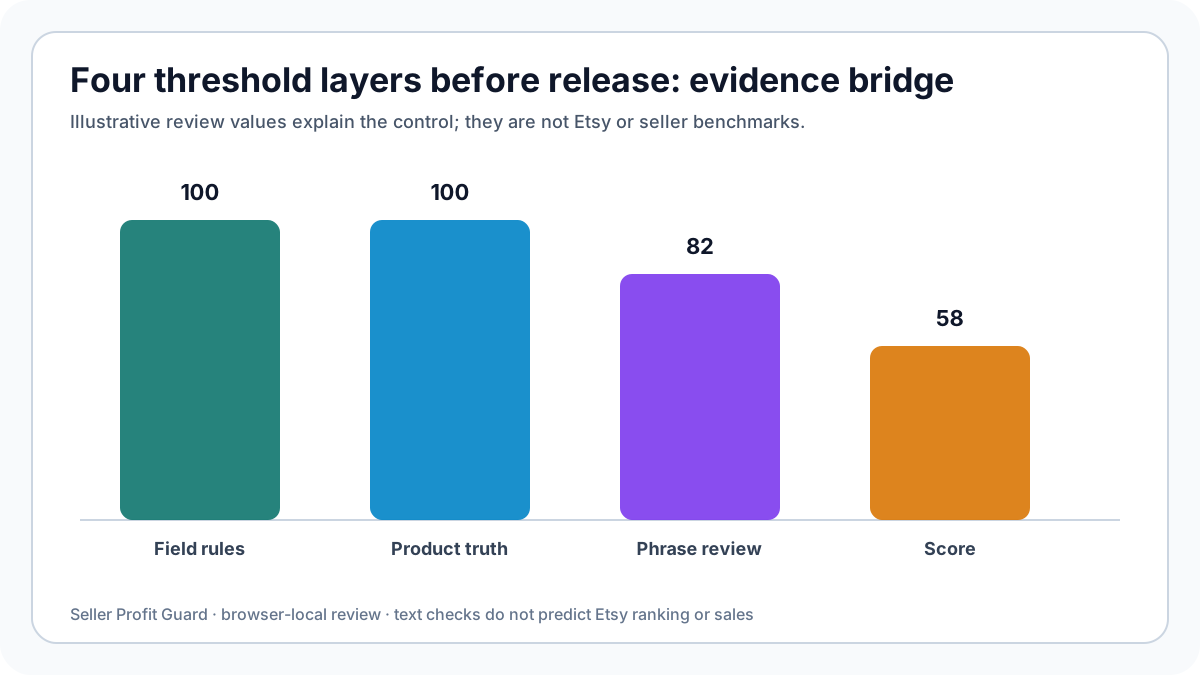
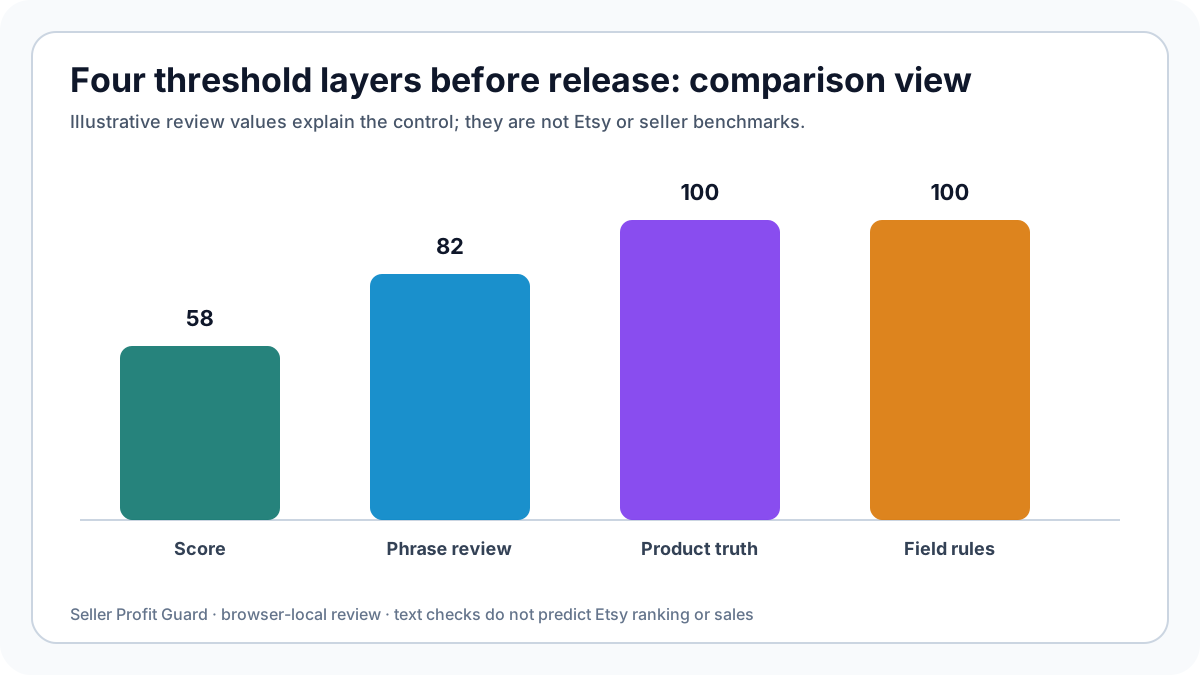
A safe Etsy tag decision uses four threshold layers: hard field and truth gates, a mechanical review threshold for duplication and variety, an evidence threshold for acting on Shop Stats, and a rollback threshold after release. No score should override inaccurate product facts, policy risk, wrong language, missing context, or an unrecoverable prior tag set.

Which conditions are hard stop gates?
Block release when the set exceeds 13 tags, any tag exceeds 20 characters, required text cannot be parsed reliably, a phrase uses unsupported edge characters, or an exact duplicate occupies another slot. These rules are directly testable against the current Etsy Help limits.
Also block when a phrase is inaccurate, irrelevant, misleading, unsupported across variations, in the wrong shop language, potentially infringing, prohibited, or outside the operator's review authority. Those are not mechanical score deductions; they are product and policy gates.
Finally, stop when the operator cannot identify the intended listing, category, attributes, prior tag set, or rollback path. A syntactically clean candidate should not be published under wrong-profile, missing-context, login, CAPTCHA, or platform-warning ambiguity.
| Layer | Pass evidence | Failure action |
|---|---|---|
| Field | 13 slots, ≤20 chars | Correct |
| Truth | Phrase-source map | Remove |
| Context | Exact listing | Stop |
| Evidence | Declared window | Hold |
| Rollback | Preserved set | No release |
What belongs in a mechanical review threshold?
After hard gates, evaluate multi-word coverage, repeated terms, exact category or attribute duplication, verified product-fact phrase coverage, title-concept overlap, and evidence-note presence. These signals prioritize human review; they are not platform requirements beyond the documented hard rules.
Do not choose a universal score such as 80 as a publish command. Instead, define issue-specific acceptance: every exact duplicate resolved or justified, every repeated term reviewed, every field duplicate replaced or retained with a reason, every proposed phrase mapped to a product fact or supported buyer context, and baseline evidence preserved.
A seller may responsibly keep a repeated product noun when distinct buyer phrases require it, or keep an exact attribute phrase when it is the clearest query language. The exception record names the phrase, evidence, owner, and next review rather than hiding the deviation inside a total score.

When is Shop Stats evidence mature enough to act?
A correction for inaccuracy does not need a traffic threshold; fix the factual problem. An optimization experiment does need a declared evidence rule. Choose comparable dates, the same listing scope, adequate exposure for the decision, and a stable surrounding context. Record when data is sparse or privacy-filtered.
Avoid a universal minimum-impression number because traffic, conversion, seasonality, and decision risk differ. Define the observation needed to distinguish keep, rollback, extend, or inconclusive. A phrase-level matching hypothesis may use search-term evidence; a commercial decision also needs visits, orders, conversion context, and retained economics.
Do not use personalized self-search position as the threshold. Etsy explicitly points sellers toward Shop Stats, while search results can vary by shopper context. Public rank checks can supplement diagnosis but should not become the sole release or rollback signal.
How should stress tests change the decision?
Test a representative set, a sparse-evidence case, a mixed-variation listing, a regional-language alternative, a category-change scenario, and a high-seasonality window. A candidate that depends on one uncertain product claim or one transient search term should remain held.
Remove the highest-volume estimated phrase and ask whether the set still covers the item coherently. Remove a structured attribute and ask whether a tag now becomes essential. Change the market or shop language assumption and inspect regional phrasing. These tests expose fragile decisions that a fixed score hides.
Stress testing does not mean filling slots with every alternative. It records what would make the approved set invalid: product change, category remap, new attribute, rights concern, search-term mismatch, or material decline in qualified engagement.
Which rollback thresholds should be written before release?
Rollback immediately for factual inaccuracy, policy or rights concern, wrong listing publication, variation mismatch, buyer confusion, or an interface save that differs from the approved set. These triggers override favorable traffic observations.
For performance, define a mature window and a material threshold relative to the preserved baseline, while recording price, photos, inventory, ads, promotions, seasonality, and review changes. Use aggregate evidence and avoid causal wording unless a credible test design supports it.
Every threshold record ends with owner, review date, old set, approved set, exception list, effective time, and exact restoration steps. A candidate without a tested rollback is not ready even when its mechanical review is clean.
Which evidence should support this decision-threshold design?
Preserve the exact 13-slot tag set before editing and keep the review grain at one listing. Record the most specific category, relevant attributes, verified public product facts, listing title, description lead, first-photo promise, shop language, aggregate Etsy Search visits and search terms, change date, and planned comparison window. A shop-wide keyword export is not a substitute for listing-level context.
Separate platform guidance, seller facts, and observed performance. Etsy's current public guidance supports using all 13 relevant slots, multi-word phrases up to 20 characters, specific categories and attributes, tag variety, and Shop Stats review. It does not prove demand for a phrase, establish a fixed ranking weight, or guarantee that replacing one tag will increase traffic or sales.
Freeze the prior tags, proposed tags, checker version, source-access date, listing settings, comparison dates, and a privacy-safe fingerprint. Record whether a candidate phrase came from Shop Stats, the seller's verified product vocabulary, Etsy's own interface, or a separate research process. Search suggestions and third-party estimates remain leads to validate, not facts to copy blindly.
- Use public product facts and aggregate observations only.
- Keep each phrase accurate for every affected variation.
- Separate category and attribute coverage from tag-slot coverage.
- Change a bounded set and declare the feedback window.
- Preserve the old set and an exact rollback path.
Privacy and policy boundaries for this decision-threshold design
A tag review needs listing text and aggregate search observations, not buyer identity. Do not paste names, email addresses, postal addresses, order IDs, message text, personalization requests, payment data, tracking numbers, private search histories, or raw listing and order exports into the public checker, public articles, analytics events, feedback forms, email drafts, or community posts.
Keep downloaded listing or Shop Stats files in the approved private environment. Extract only the public phrases and aggregate comparison fields needed for the review, then apply access, retention, and deletion rules. Public examples in this cluster are fictional. Seller Profit Guard runs the quick checker in the browser and does not require Etsy credentials.
Accuracy, intellectual-property, and policy review remain seller responsibilities. A mechanically valid tag can still be irrelevant, misleading, infringing, prohibited, or inconsistent with a variation. Stop when a proposed material, origin, maker, brand, compatibility, certification, health, recipient, occasion, or production-method phrase cannot be verified from the actual item and current policy.
How should the Etsy Tag / Keyword Checker be used for this decision-threshold design?
Enter the complete comma- or line-separated tag set, the most specific category phrase, relevant attribute phrases, verified product-fact phrases, related listing title, and an optional privacy-safe Shop Stats or change note. The checker counts slots, validates the 20-character rule and allowed edge characters, finds exact duplicates, measures multi-word use, and surfaces repeated terms.
The tool also highlights exact category or attribute duplication, reports how many entered product-fact phrases appear in the tag corpus, shows title-concept overlap, and records whether an evidence note exists. Those are deterministic string checks. They do not know search volume, semantic equivalence, product truth, trademark rights, ranking probability, conversion quality, or whether a phrase is useful in a particular market.
Read issues and next steps before the score. Preserve the old tag set, verify every candidate against the product and surrounding listing fields, change one listing or a controlled group, and compare mature aggregate Shop Stats. Roll back when the approved stop rule is met. Do not cycle tags daily to chase personalized search results or an arbitrary perfect score.
- Preserve the current 13-slot set and listing context.
- Verify category, attributes, product facts, and shop language.
- Run the deterministic limit, variety, and coverage review.
- Route each phrase to the field where it adds unique value.
- Release one bounded change with evidence and rollback.
Sources and further reading
- Etsy Help: How to Use Tags to Get Found in Search: Current field limits, allowed characters, and Etsy's explanation of tag-to-query matching.
- Etsy Seller Handbook: Keywords 101: Current guidance for all 13 tags, multi-word phrases, variety, categories, attributes, regional phrases, Shop Stats, and shop language.
- Etsy Seller Handbook: How Etsy Search Works: Official explanation of holistic query matching, relevancy, ranking, personalization, listing quality, and Shop Stats context.
- Etsy Seller Handbook: Search Optimization Checklist: Official category, attribute, tag, title, description, image, and search-visibility review guidance.
- Etsy Seller Handbook: Add Categories to Your Listings: Current explanation that specific categories act as tags and can unlock relevant attributes.
- Etsy Seller Policy: Current accuracy, representation, intellectual-property, privacy, spam, and search-manipulation boundaries.
- Seller Profit Guard methodology: Evidence hierarchy, local-first privacy, deterministic checks, uncertainty, change control, and non-advice limits.
Related Seller Profit Guard tools
- Open the Etsy Tag / Keyword Checker: Review tag limits, variety, listing-field duplication, product-fact coverage, and evidence context.
- Check the Etsy listing title: Keep the item noun and objective traits readable while tags carry additional relevant phrases.
- Review the variation and SKU checklist: Keep tag claims aligned with the materials, sizes, styles, and options a buyer can actually select.
- Use the listing QA checklist: Connect public listing language with cost, variation, SKU, and price records.
- Read the editorial policy: See how sources, corrections, reviews, and publication controls are handled.
- Read the local-first methodology: Keep buyer data, raw exports, and private search evidence outside public tools and articles.
- Etsy Tag Checker: Six Inputs That Matter: Continue the Etsy tag evidence, phrase-routing, release, and rollback workflow.
- Etsy Tag Checker Example: Gift Listing: Continue the Etsy tag evidence, phrase-routing, release, and rollback workflow.
- Etsy Tag Checker for a Style-Led Listing: Continue the Etsy tag evidence, phrase-routing, release, and rollback workflow.
- 9 Etsy Tag Checker Mistakes to Avoid: Continue the Etsy tag evidence, phrase-routing, release, and rollback workflow.
- Reliable Data for an Etsy Tag Checker: Continue the Etsy tag evidence, phrase-routing, release, and rollback workflow.
Next step: Open the Etsy Tag / Keyword Checker.
This is operational planning help, not tax, accounting, legal, financial, or platform-policy advice. Review the Terms and disclaimer, and verify current platform rules and fee assumptions before changing prices.