Ten markup and margin mistakes to correct
Last updated: 2026-07-30
Written and reviewed by Seller Profit Guard Editorial Team.
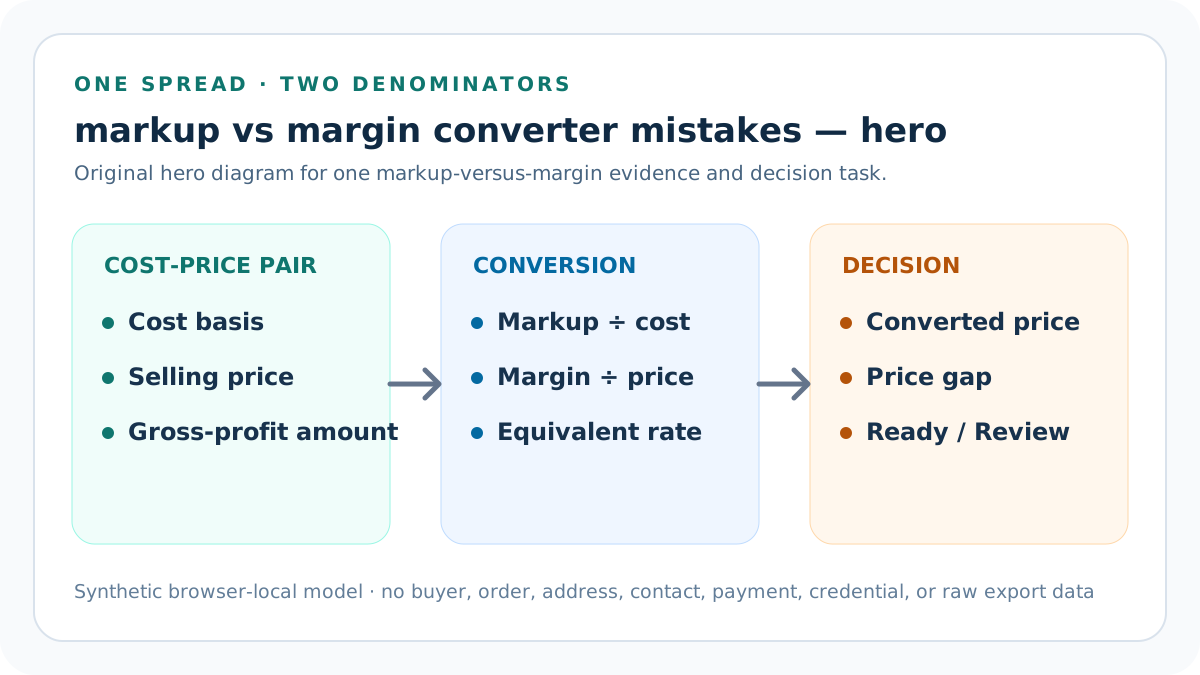
Markup and margin become unreliable when sellers swap denominators, mix unit and order grains, use a pre-discount price against post-discount cost, hide cost components, enter 40 as 0.40 or the reverse, multiply cost by one plus a margin, allow a 100% margin denominator, reuse rounded equivalents, compare different currencies, or call arithmetic a market strategy.
Mistake 1: swapped labels
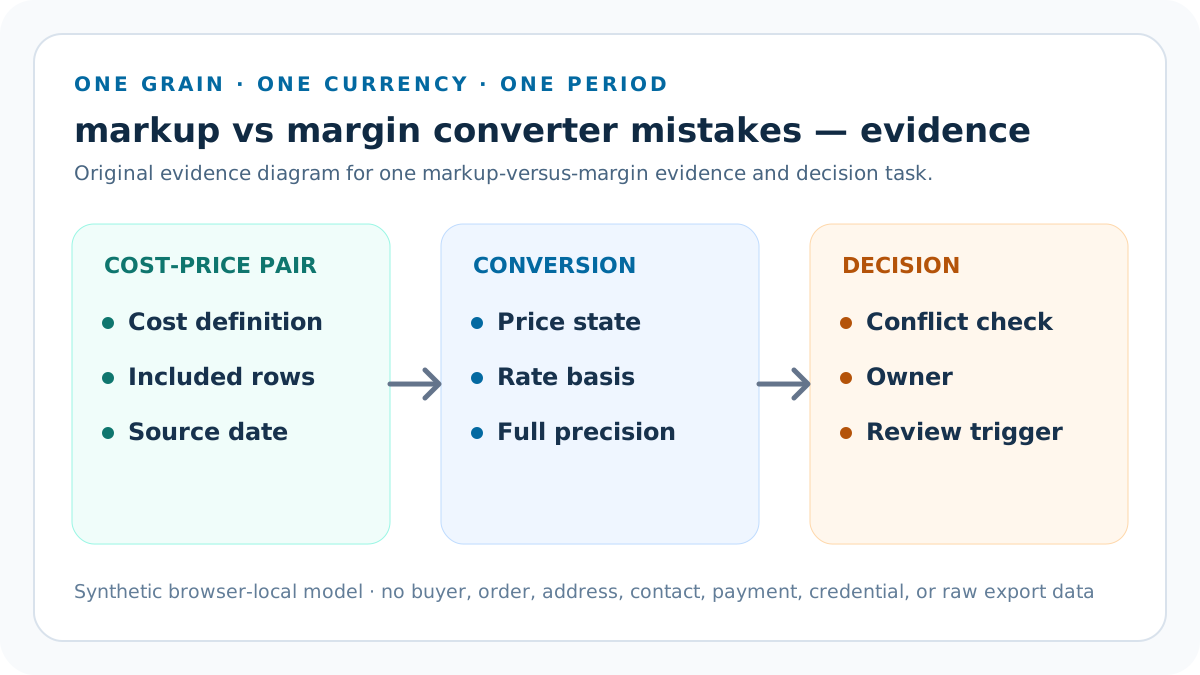
A cost denominator is markup; a selling-price denominator is margin. This row belongs to the denominator defect register. Preserve the original value, unit, denominator label, calculation grain, currency, effective month, source class, owner, and confidence rather than keeping only a rounded percentage.
For one-field error diagnosis, checkpoint 1 must pass before it supports a corrected conversion without compensating assumptions. Recalculate from the source pair, compare full-precision and displayed results, and correct the accountable field instead of offsetting it with an unrelated favorable assumption.
Mistake 2: mixed grain
One-unit cost cannot support a bundle or monthly revenue denominator. This row belongs to the denominator defect register. Preserve the original value, unit, denominator label, calculation grain, currency, effective month, source class, owner, and confidence rather than keeping only a rounded percentage.
For one-field error diagnosis, checkpoint 2 must pass before it supports a corrected conversion without compensating assumptions. Recalculate from the source pair, compare full-precision and displayed results, and correct the accountable field instead of offsetting it with an unrelated favorable assumption.
Mistake 3: hidden discount state
List price, checkout price, and retained revenue are different evidence states. This row belongs to the denominator defect register. Preserve the original value, unit, denominator label, calculation grain, currency, effective month, source class, owner, and confidence rather than keeping only a rounded percentage.
For one-field error diagnosis, checkpoint 3 must pass before it supports a corrected conversion without compensating assumptions. Recalculate from the source pair, compare full-precision and displayed results, and correct the accountable field instead of offsetting it with an unrelated favorable assumption.
Mistake 4: incomplete cost basis
A merchandise-only cost must not be described as fully loaded order cost. This row belongs to the denominator defect register. Preserve the original value, unit, denominator label, calculation grain, currency, effective month, source class, owner, and confidence rather than keeping only a rounded percentage.
For one-field error diagnosis, checkpoint 4 must pass before it supports a corrected conversion without compensating assumptions. Recalculate from the source pair, compare full-precision and displayed results, and correct the accountable field instead of offsetting it with an unrelated favorable assumption.
Mistake 5: percent scaling
Store 40% as 0.40 inside the equation, not 40. This row belongs to the denominator defect register. Preserve the original value, unit, denominator label, calculation grain, currency, effective month, source class, owner, and confidence rather than keeping only a rounded percentage.
For one-field error diagnosis, checkpoint 5 must pass before it supports a corrected conversion without compensating assumptions. Recalculate from the source pair, compare full-precision and displayed results, and correct the accountable field instead of offsetting it with an unrelated favorable assumption.
Mistake 6: wrong price inverse
Margin-derived price uses division by one minus margin, not cost times one plus margin. This row belongs to the denominator defect register. Preserve the original value, unit, denominator label, calculation grain, currency, effective month, source class, owner, and confidence rather than keeping only a rounded percentage.
For one-field error diagnosis, checkpoint 6 must pass before it supports a corrected conversion without compensating assumptions. Recalculate from the source pair, compare full-precision and displayed results, and correct the accountable field instead of offsetting it with an unrelated favorable assumption.
Mistake 7: impossible denominator
A margin at or above 100% cannot yield a finite positive price from positive cost. This row belongs to the denominator defect register. Preserve the original value, unit, denominator label, calculation grain, currency, effective month, source class, owner, and confidence rather than keeping only a rounded percentage.
For one-field error diagnosis, checkpoint 7 must pass before it supports a corrected conversion without compensating assumptions. Recalculate from the source pair, compare full-precision and displayed results, and correct the accountable field instead of offsetting it with an unrelated favorable assumption.
Mistakes 8–10
Avoid repeated rounding, mixed currencies or periods, and unsupported claims about demand or accounting profit. This row belongs to the denominator defect register. Preserve the original value, unit, denominator label, calculation grain, currency, effective month, source class, owner, and confidence rather than keeping only a rounded percentage.
For one-field error diagnosis, checkpoint 8 must pass before it supports a corrected conversion without compensating assumptions. Recalculate from the source pair, compare full-precision and displayed results, and correct the accountable field instead of offsetting it with an unrelated favorable assumption.
Worked control for one-field error diagnosis
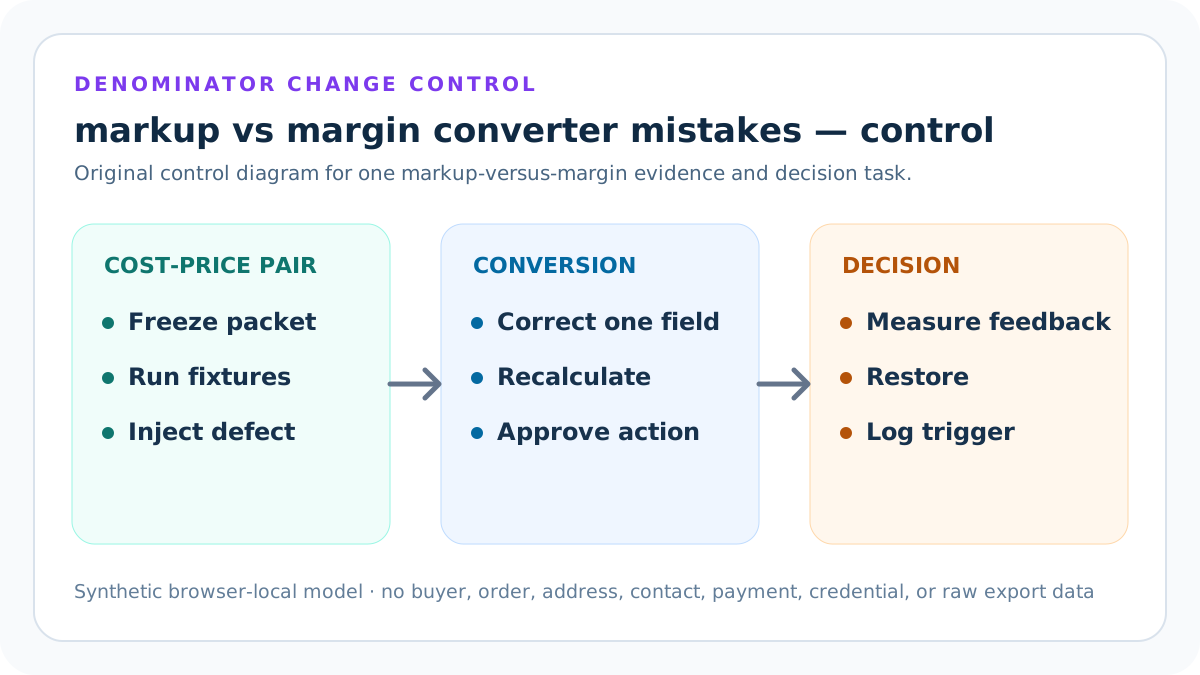
Run markup, margin, current-price-clear, invalid-margin, invalid-basis, and declared-conflict fixtures while changing only the field discussed in this guide.
The control verifies one-field error diagnosis. It does not classify costs automatically, reproduce a private order, recommend a market price, or promise a corrected conversion without compensating assumptions.
Reconciliation and sensitivity
Recalculate observed markup and margin directly from the same cost-price pair, then reconstruct price from the entered branch. The equivalent rate and reconstructed price must agree within full-precision tolerance before display rounding.
Vary one cost-basis row, price state, entered rate, or basis at a time. If a plausible alternative changes Review to Ready, resolve the disputed source or preserve separately named scenarios rather than averaging incompatible evidence.
Block conditions and safe correction
Block nonpositive cost, nonpositive price, unsupported basis, negative target rate, margin at or above 100%, invalid currency, invalid month, missing scope, or any declared conflict. Structural errors cannot be compensated by a high price.
Correct one named field, preserve the rejected value and reason, rerun supported and broken fixtures, and compare exact before and after outputs. A repair that requires hidden offsets elsewhere is not isolated enough to approve.
Bounded decision and action
Use Block before Review before Ready. Review means valid arithmetic but a current price below the entered rate's converted price. Ready means only that the current price clears this declared cost and denominator contract.
Choose one source correction, basis clarification, price experiment, cost action, or explicit no-action conclusion. Define owner, observation window, feedback measure, stop condition, and restoration trigger before changing a public price.
Verification and release controls
Preserve the denominator defect register, source pointers, deterministic fixtures, tests, build, SEO and content audits, similarity evidence, screenshots, release manifest, backup, and rollback identifier.
Verify canonical, Article and Breadcrumb schema, sources, four explanatory visuals, internal links, privacy, indexability, mobile layout, public response, and live calculation behavior. A green build cannot validate unsupported source evidence.
Limits and privacy boundary
This arithmetic model does not determine accounting profit, taxable income, cash flow, fixed-overhead recovery, customer value, competitor response, demand, conversion, ranking, traffic, advertising approval, revenue, or income.
Keep buyer names, emails, addresses, order IDs, payment rows, bank details, tax identifiers, contacts, tokens, OAuth material, credentials, and raw exports outside the denominator defect register. Public examples remain synthetic.
Evidence log and review trigger
Store packet ID, nonprivate product alias, cost-basis definition, included and excluded rows, cost, price state, entered rate, basis, currency, period, scope, source dates, outputs, decision, conflicts, reviewer, and rollback reference.
Recalculate when supplier cost, freight, duty, packaging, labor, discount state, refund state, bundle quantity, currency conversion, or rate policy changes. Do not rewrite history; create a dated successor row.
Next related calculation
Use the contribution margin calculator when multiple order-variable costs must be subtracted from net revenue. Use the product price floor calculator when fees, discounts, buyer shipping, return loss, and a contribution target must be solved inversely.
Use the listing cost library to version SKU costs before comparing products. A denominator conversion is only as comparable as the cost definition and price state supplied to it.
Defect injection matrix
Clone the supported fixture and inject one defect at a time: swap the label, change unit grain, use a discounted price against full list cost, omit landed cost, scale 40 as 40 instead of 0.40, multiply by one plus margin, enter 100% margin, reuse rounded rates, mix currencies, or claim market proof.
Record the incorrect result, expected failed assertion, single-field repair, corrected result, owner, and restoration reference. Reject compensating changes that conceal the original defect.
denominator defect register completion test
A complete packet lets an independent reviewer reproduce a corrected conversion without compensating assumptions from the declared cost, price, entered rate, and explicit basis without private data or hidden spreadsheet state.
Closure requires exact arithmetic, source alignment, privacy-safe examples, a non-compensating decision, bounded language, one approved next step or no-action conclusion, feedback ownership, and a recoverable prior state.
Swapped-label defect proof
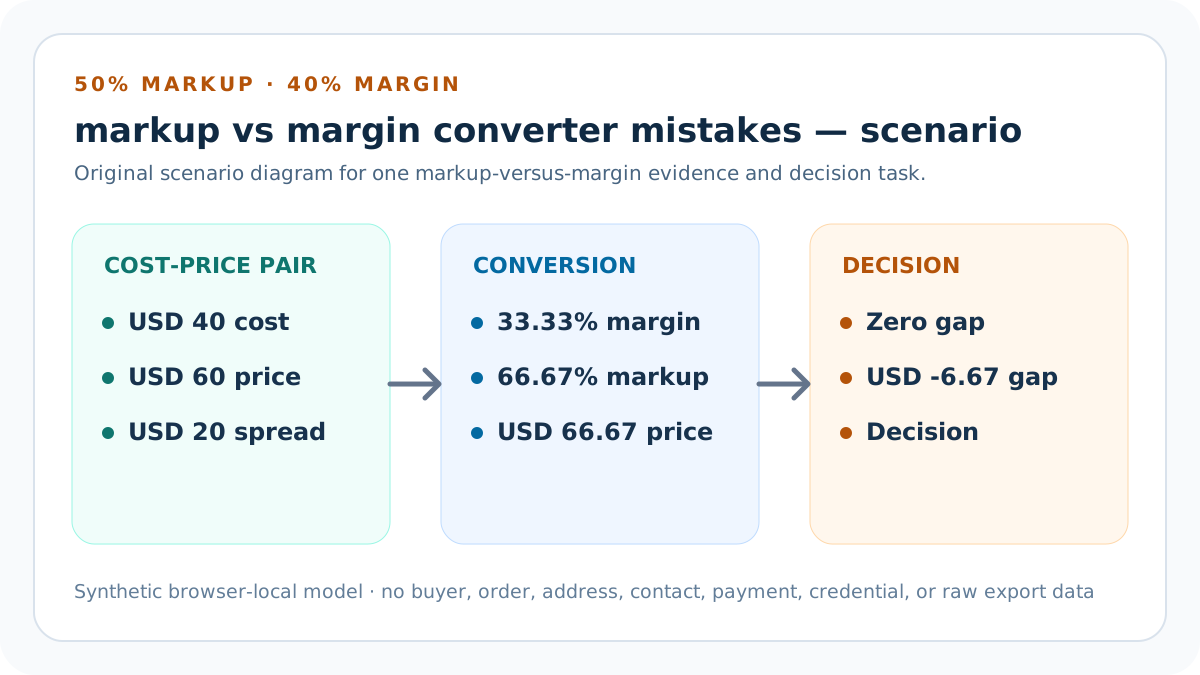
Start with USD 40 cost and USD 60 price. The correct spread is USD 20, markup is 50%, and margin is 33.33%. Swap only the two output labels and show that the numbers remain arithmetically calculated but semantically false.
Repair the labels without changing any numeric input. This defect demonstrates why formula names are part of the calculation contract rather than decorative interface copy.
Mixed-grain defect proof
Compare a USD 40 one-unit cost with a USD 120 three-unit bundle price and observe the misleading 200% markup. Then extend cost to USD 120 for the same three units and show that the spread and rates collapse to zero.
The repair changes calculation grain, not pricing performance. Preserve quantity and scope beside both cost and price so the same defect cannot return under a different product alias.
Wrong-inverse defect proof
Apply 40% margin incorrectly as USD 40 × 1.40 = USD 56. The resulting observed margin is only 28.57%. Then apply the correct inverse USD 40 ÷ 0.60 = USD 66.67 and reproduce 40% margin.
Record the USD 10.67 price understatement caused solely by the wrong inverse. Do not compensate by changing cost or choosing a lower target.
Rounding-loop defect proof
Convert 50% markup to the full-precision one-third margin, then reconstruct USD 60 exactly from USD 40. Repeat with the displayed 33.33% and quantify the small reconstructed-price difference.
Store the original entered rate and full-precision equivalent separately. Display rounding is acceptable for communication but must never become the new authoritative input through repeated conversions.
Interpretation defect proof
Take a structurally correct Ready packet and append the unsupported sentence that the product is profitable and customers will buy. The arithmetic remains green while the interpretation assertion fails.
Repair the language to state that current price clears the entered arithmetic boundary. Route accounting profit, tax, demand, and conversion questions to their own evidence and reviewers.
Sources and further reading
- Seller Profit Guard methodology: Calculation contracts, evidence precedence, deterministic fixtures, validation, correction, release, and rollback.
- Seller Profit Guard data privacy: Local-first boundaries for seller, buyer, order, payment, contact, credential, and raw export data.
- IRS Publication 334 (2025): Primary U.S. context for net receipts, cost of goods sold, gross profit, and the selling-price denominator; this converter does not make a tax determination.
- OpenStax markup guidance: Primary educational source for markup on cost and retail price equal to cost times one plus markup.
- SBA break-even point guidance: Primary U.S. small-business source for the contribution-margin denominator and separation of fixed and variable costs.
Related Seller Profit Guard tools
- Open the Markup vs Margin Converter: Convert one rate with an explicit cost or selling-price denominator.
- Solve a product price floor: Include discount, buyer shipping, fees, order-variable costs, expected loss, and a contribution target.
- Calculate contribution margin: Run a forward order-level contribution equation from observed revenue and variable costs.
- Version SKU costs: Maintain dated product, packaging, labor, fulfillment, and expected-loss evidence.
- Check bundle margin: Compare a bundle selling price with combined item and order costs.
- Read the methodology: Review evidence, calculation, privacy, testing, release, correction, and rollback.
- Review data privacy: Keep private seller and buyer data outside public content.
- Markup vs Margin Formulas and Inputs: Continue with a distinct formula, example, source, threshold, comparison, operating, interpretation, or audit task.
- Markup vs Margin Worked Example: Continue with a distinct formula, example, source, threshold, comparison, operating, interpretation, or audit task.
- Price-Based Margin Conversion Example: Continue with a distinct formula, example, source, threshold, comparison, operating, interpretation, or audit task.
- Reliable Markup and Margin Data Sources: Continue with a distinct formula, example, source, threshold, comparison, operating, interpretation, or audit task.
- Safe Markup and Margin Decision Thresholds: Continue with a distinct formula, example, source, threshold, comparison, operating, interpretation, or audit task.
Next step: Open the Markup vs Margin Converter.
This is operational planning help, not tax, accounting, legal, financial, or platform-policy advice. Review the Terms and disclaimer, and verify current platform rules and fee assumptions before changing prices.