Free shipping threshold for a mixed-cart order
Last updated: 2026-07-29
Written and reviewed by Seller Profit Guard Editorial Team.
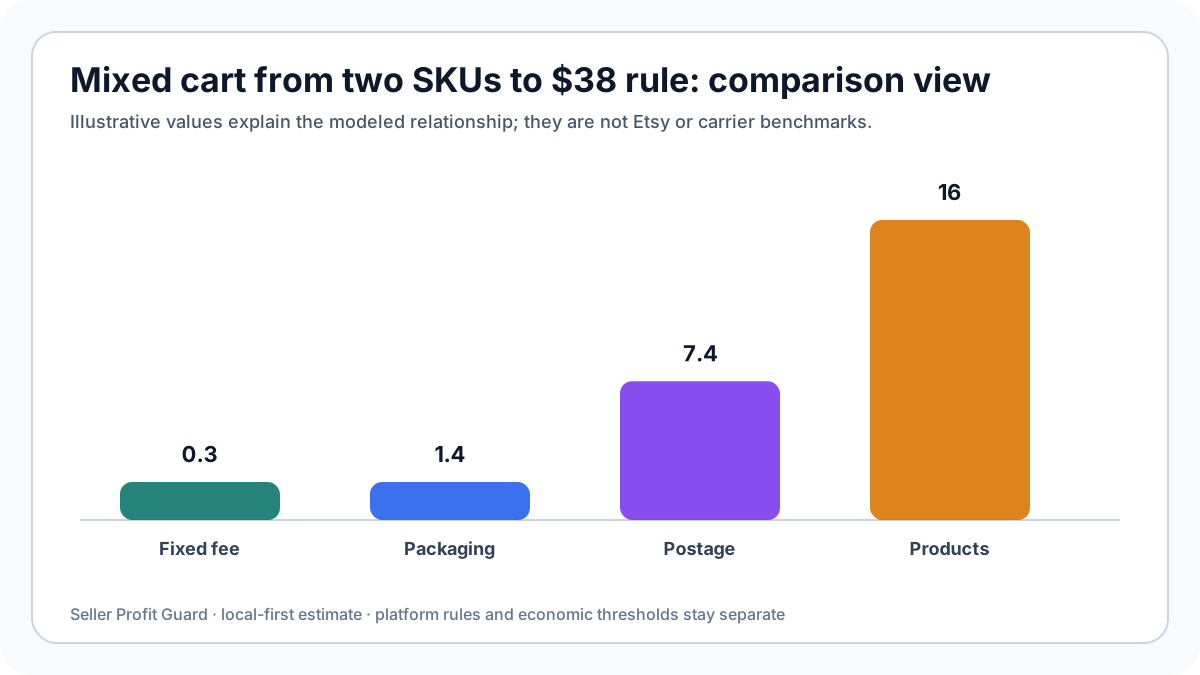
A mixed cart containing two products with $16 total product cost, $7.40 shipping, $1.40 packaging, a $0.30 fixed fee, 8.5% percentage fees, and a 25% target margin has a $37.75 threshold. A $38 rule barely passes, so product mix and parcel consolidation must be verified.

How is a mixed-cart threshold built?
Use a public dummy cart with a $9 product and a $7 product. Consolidated postage is $7.40, combined packaging is $1.40, and the fixed fee is $0.30. Dollar costs total $25.10. With 8.5% percentage fees and a 25% target, 66.5% of revenue remains. The result is $25.10 / 0.665 = $37.7444, displayed as $37.74 or $37.75 depending on rounding method; use at least $38 operationally.
At $38, percentage fees are $3.23 and contribution is $9.67, equal to 25.45% of revenue. The rule has only $0.17 of contribution above an exact 25% target, so it is sensitive to small cost errors. A packaging adjustment, extra insert, label correction, or slightly different product mix can erase that headroom.
The tool accepts one product-cost number, so the operator must calculate the cart's combined product cost before entry. Label the input as a cart scenario. Do not enter average order value as product cost or assume two items always double a one-item cost.
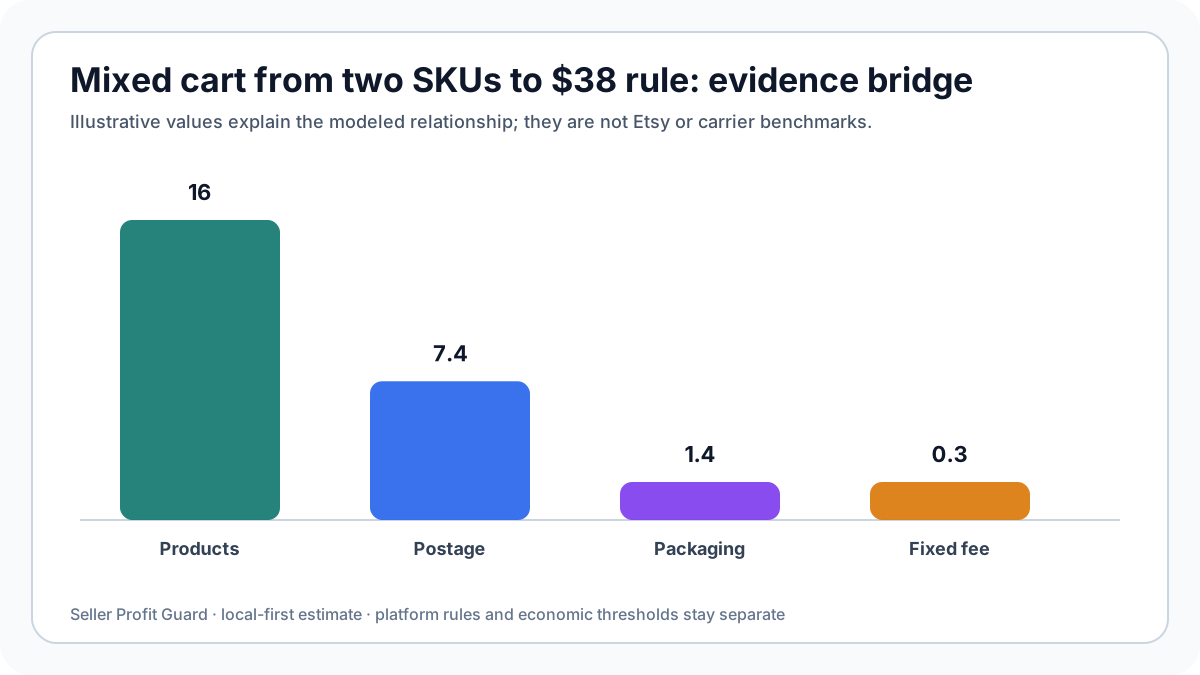
| Mixed-cart component | Value | Reason |
|---|---|---|
| Product A | $9.00 | SKU cost |
| Product B | $7.00 | SKU cost |
| Consolidated shipping | $7.40 | Observed parcel cohort |
| Combined packaging | $1.40 | Actual package bill |
| Fixed fee | $0.30 | Scoped per order |
| Threshold | $37.75 | Before upward rule rounding |
Why can cart composition break a shop-wide rule?
Two $19 items can reach a $38 threshold with very different economics. Two lightweight prints may share a mailer and modest product cost. A mug plus a framed print may require a larger box, protective material, dimensional weight, and separate handling. The same checkout total does not imply the same numerator.
Build a cart matrix from likely combinations: low-cost/light, high-cost/light, low-cost/heavy, high-cost/heavy, fragile, customized, and international. Use observed order frequencies to prioritize review, but preserve rare severe cases as exceptions. A weighted average can support planning; it cannot make a structurally different package safe.
If product cost rises with order value, the simple threshold equation may not have one stable solution for the whole catalog. Model discrete baskets or contribution per added item. The rule should direct buyers toward carts that create shipping efficiency, not merely any cart above a revenue number.

How should parcel consolidation be credited?
Consolidation is real only when two items fit the same package, service, weight tier, and operational flow. Compare the combined label and packaging with the sum of two separate shipments. The difference is potential shipping efficiency. Do not credit a theoretical saving when fragile separation, production timing, warehouse location, personalization approval, or carrier limits force multiple parcels.
In the dummy example, separate shipments might cost $5.80 and $5.20 while one combined parcel costs $7.40, creating $3.60 of label efficiency. That efficiency helps the threshold. If the products ship from different locations, the combined assumption disappears and dollar costs rise to $28.70, producing a threshold above $43.
Record the consolidation rate observed among qualifying orders. If only 60% consolidate, use separate scenarios or a weighted planning estimate with a visible limitation. The public offer should not promise a fulfillment pattern that operations cannot reproduce.
What rule can control mixed-cart uncertainty?
Use a threshold plus product eligibility when one number cannot protect every basket. Eligible lightweight products can count toward the offer; oversized or high-cost items can use a separate profile or price. Alternatively, choose a higher threshold that passes a documented adverse mix, but verify that likely buyers can reach it without creating a more expensive basket.
Add a margin buffer above the exact target when evidence is noisy. If the calculated floor is $37.75 and the adverse observed case is $42.60, a $38 rule is not conservative. The buffer should be tied to cost variance, not a round-number preference. Document the cohort, exception, review cadence, and rollback trigger.
After launch, compare qualifying cart distribution with the planning matrix. If high-cost or multi-parcel baskets exceed the expected share, pause or narrow the offer before waiting for a monthly average. A threshold is a control that requires feedback, not a one-time marketing badge.
- Threshold plus eligible-product scope.
- Separate profile for structural exceptions.
- Evidence-based buffer.
- Daily or weekly mix review after launch.
- Automatic rollback on material adverse drift.
Mixed-cart threshold questions
Can average order value replace the cart model? No. It is an outcome average, not a cost composition.
Should two items mean two fixed fees? Only if the fee is actually charged twice.
Can packaging be averaged? Only within a stable package cohort.
What if carts ship in two parcels? Enter the total seller-funded shipping and packaging for both.
What is the final decision? A bounded threshold and eligibility rule that passes representative and adverse basket fixtures.
Which evidence supports this mixed-cart free-shipping threshold?
Use current carrier or Etsy label receipts for postage, adjustments, insurance, and services; packaging purchase records for mailers, boxes, inserts, tape, and protective material; product or SKU records for the cost of goods; and the Etsy Payment Account for fees tied to actual orders. Use shipping profiles and the current listing only to describe what the buyer is offered. A profile does not prove the seller's final label cost.
Record the analysis period, currency, destination cohort, package class, included costs, excluded costs, fee assumption, fixed fee, target margin, calculator version, and source dates. Reconcile a small public dummy example by hand before applying the result to a catalog. A file fingerprint proves that an input did not change; it does not prove that the input represents the next order mix.
Keep official platform rules separate from business assumptions. Etsy's US free-shipping guarantee can apply to qualifying US-bound orders of $35 or more after it is enabled, while the calculator derives a shop-specific economic threshold from entered costs and rates. Neither value proves conversion lift, tax treatment, carrier eligibility, or profit on every destination.
- Prefer actual labels and adjustments over advertised rate estimates.
- Segment heavy, remote, international, upgraded, fragile, and mixed-cart orders when costs differ.
- Treat fee percentages and target margin as explicit editable assumptions.
- Recalculate after carrier, package, fee, product-cost, or offer changes.
- Verify tax, accounting, legal, and platform-policy questions separately.
Privacy and commercial sensitivity for mixed-cart free-shipping threshold
The threshold calculation needs costs, rates, a package or cart scenario, and a target margin. Buyer names, email addresses, phone numbers, delivery addresses, order IDs, messages, personalization, and payment credentials are unnecessary. Use aggregate destination zones or public dummy locations rather than exposing a buyer's exact address. Seller Profit Guard runs this quick calculation in the browser and does not need an Etsy login.
Supplier prices, package dimensions, negotiated carrier rates, product mix, margin targets, and exception rules can reveal commercial strategy even without buyer data. Keep detailed worksheets in controlled storage. Public reports should use rounded dummy numbers, aggregate ranges, redacted product names, and non-reversible fingerprints. Never paste a private order row or label into an article, analytics event, ticket, email draft, or community post.
How to apply this mixed-cart free-shipping threshold in the calculator
Open the Free Shipping Threshold Calculator and enter product cost, seller-funded shipping, packaging, the combined percentage fee assumption, fixed fee, and target margin. The tool adds the four fixed-dollar costs, subtracts the fee and target-margin shares from one, and divides the cost total by the remaining revenue share. It reports no safe threshold when the denominator is zero or negative.
Round the result upward to a practical cart rule, then rerun at least a representative, adverse, and mixed-cart case. Confirm that the products likely to reach the threshold can actually produce the modeled cost mix. The output is a planning estimate, not an Etsy setting, carrier quote, conversion forecast, accounting profit statement, or promise that every qualifying order is profitable.
- Define one destination, package, product-mix, and offer cohort.
- Enter evidence-backed dollar costs and editable percentage assumptions.
- Hand-check the formula and round upward rather than down.
- Stress-test heavy, distant, upgraded, discounted, and mixed-cart cases.
- Publish only a bounded rule with owner, review date, exception, and rollback.
Sources and further reading
- Etsy Help: How to Offer Free Shipping: Official Etsy guidance for the US $35 free-shipping guarantee, shipping profiles, smart pricing, upgrades, and domestic versus international offers.
- Etsy Fees & Payments Policy: Official policy for transaction, payment-processing, Offsite Ads, regulatory, currency-conversion, shipping-label, and other seller charges.
- Etsy Help: How to Set Up Calculated Shipping: Official explanation of how origin, destination, package weight, dimensions, mail class, and package preferences affect calculated shipping.
- Etsy Help: How to Ship Your Items: Official shipping-profile, label, policy, and competitive-shipping overview for Etsy sellers.
- Seller Profit Guard calculation methodology: Definitions for contribution, editable assumptions, evidence hierarchy, local-first processing, uncertainty, and decision limits.
Related Seller Profit Guard tools
- Open the Free Shipping Threshold Calculator: Calculate the minimum order value that can absorb seller-funded shipping while preserving an editable target margin.
- Review Etsy shipping margin mistakes: Separate platform guarantees from economic thresholds and inspect funding, package, variation, replacement, and international cases.
- Calculate break-even ROAS and return loss: Add acquisition and expected incident loss after the shipping threshold is understood.
- Use the Etsy profit calculator: Validate the threshold against actual order revenue, fees, SKU cost, shipping, and margin evidence.
- Read the local-first methodology: Understand formulas, assumptions, privacy, evidence quality, and non-advice limits.
- Free Shipping Threshold Formula: 6 Inputs: Continue the free-shipping threshold evidence and decision workflow.
- Free Shipping Threshold: $26.32 Example: Continue the free-shipping threshold evidence and decision workflow.
- Free Shipping Threshold: 12 Costly Mistakes: Continue the free-shipping threshold evidence and decision workflow.
- Free Shipping Threshold Data: 7 Sources: Continue the free-shipping threshold evidence and decision workflow.
- Free Shipping Rules: Break-Even vs Target: Continue the free-shipping threshold evidence and decision workflow.
Next step: Open the Free Shipping Threshold Calculator.
This is operational planning help, not tax, accounting, legal, financial, or platform-policy advice. Review the Terms and disclaimer, and verify current platform rules and fee assumptions before changing prices.