How to interpret markup and margin conversions
Last updated: 2026-07-30
Written and reviewed by Seller Profit Guard Editorial Team.
Gross-profit amount is price minus the declared cost basis. Observed markup divides it by cost; observed margin divides it by price. Equivalent rate restates the percentage on the other denominator. Converted price reconstructs the target, and price gap compares that boundary with current price. None proves accounting profit, tax, demand, or customer acceptance.
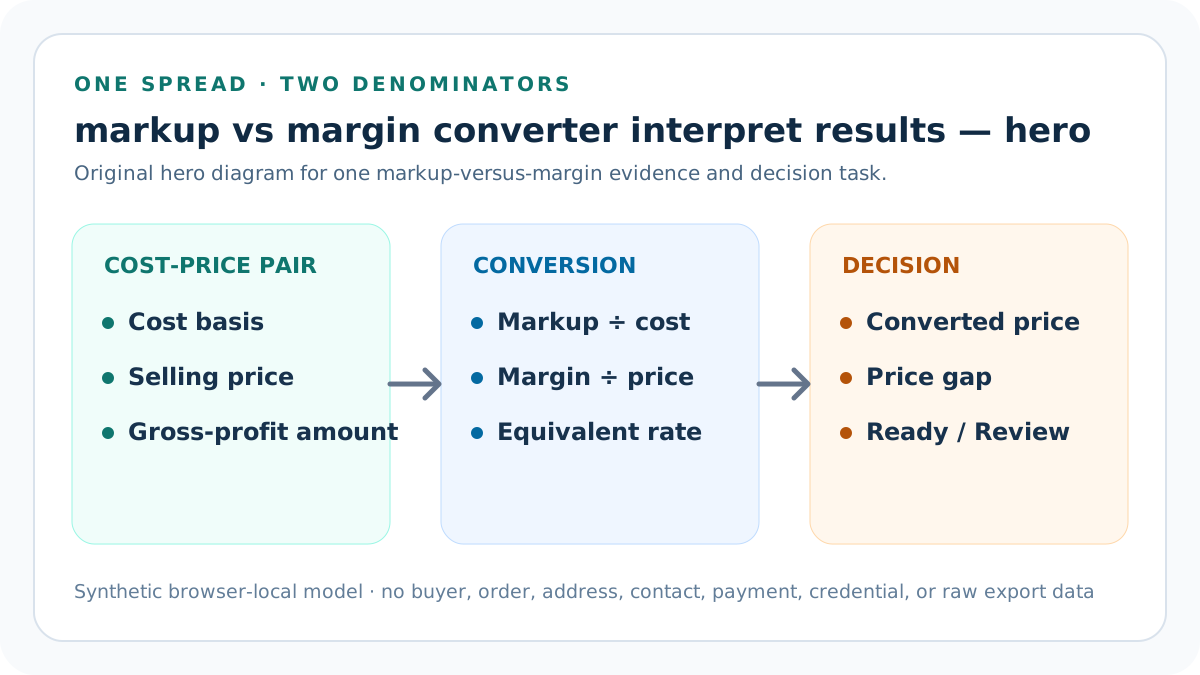
Read gross-profit amount
Treat it as the spread against the declared basis, not whole-business profit. This row belongs to the bounded conversion interpretation card. Preserve the original value, unit, denominator label, calculation grain, currency, effective month, source class, owner, and confidence rather than keeping only a rounded percentage.
For result meaning and uncertainty, checkpoint 1 must pass before it supports an arithmetic conclusion without market overclaim. Recalculate from the source pair, compare full-precision and displayed results, and correct the accountable field instead of offsetting it with an unrelated favorable assumption.
Read observed markup
This percentage answers how large the spread is relative to cost. This row belongs to the bounded conversion interpretation card. Preserve the original value, unit, denominator label, calculation grain, currency, effective month, source class, owner, and confidence rather than keeping only a rounded percentage.
For result meaning and uncertainty, checkpoint 2 must pass before it supports an arithmetic conclusion without market overclaim. Recalculate from the source pair, compare full-precision and displayed results, and correct the accountable field instead of offsetting it with an unrelated favorable assumption.
Read observed margin
This percentage answers how large the spread is relative to selling price. This row belongs to the bounded conversion interpretation card. Preserve the original value, unit, denominator label, calculation grain, currency, effective month, source class, owner, and confidence rather than keeping only a rounded percentage.
For result meaning and uncertainty, checkpoint 3 must pass before it supports an arithmetic conclusion without market overclaim. Recalculate from the source pair, compare full-precision and displayed results, and correct the accountable field instead of offsetting it with an unrelated favorable assumption.
Read equivalent rate
Use it to translate language without changing cost or price. This row belongs to the bounded conversion interpretation card. Preserve the original value, unit, denominator label, calculation grain, currency, effective month, source class, owner, and confidence rather than keeping only a rounded percentage.
For result meaning and uncertainty, checkpoint 4 must pass before it supports an arithmetic conclusion without market overclaim. Recalculate from the source pair, compare full-precision and displayed results, and correct the accountable field instead of offsetting it with an unrelated favorable assumption.
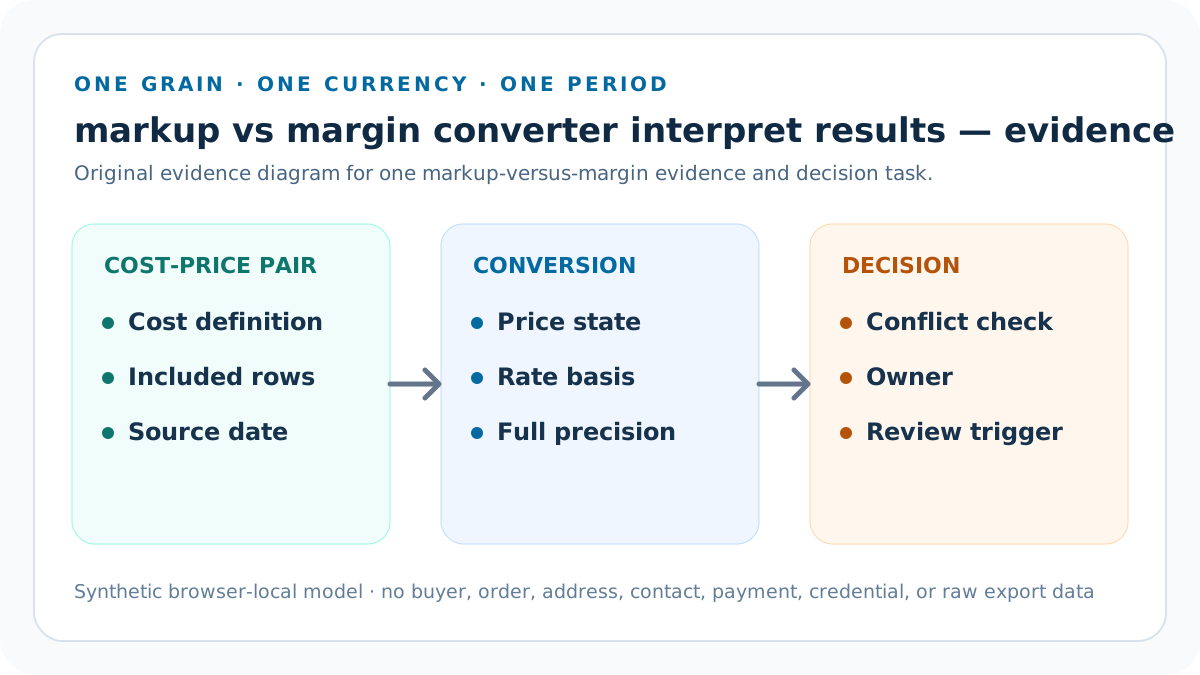
Read converted price
This is the price consistent with the entered rate and basis. This row belongs to the bounded conversion interpretation card. Preserve the original value, unit, denominator label, calculation grain, currency, effective month, source class, owner, and confidence rather than keeping only a rounded percentage.
For result meaning and uncertainty, checkpoint 5 must pass before it supports an arithmetic conclusion without market overclaim. Recalculate from the source pair, compare full-precision and displayed results, and correct the accountable field instead of offsetting it with an unrelated favorable assumption.
Read current-price gap
Positive clears the arithmetic boundary; negative quantifies the shortfall. This row belongs to the bounded conversion interpretation card. Preserve the original value, unit, denominator label, calculation grain, currency, effective month, source class, owner, and confidence rather than keeping only a rounded percentage.
For result meaning and uncertainty, checkpoint 6 must pass before it supports an arithmetic conclusion without market overclaim. Recalculate from the source pair, compare full-precision and displayed results, and correct the accountable field instead of offsetting it with an unrelated favorable assumption.
Respect precision
Preserve full-precision equations and round only displayed communication. This row belongs to the bounded conversion interpretation card. Preserve the original value, unit, denominator label, calculation grain, currency, effective month, source class, owner, and confidence rather than keeping only a rounded percentage.
For result meaning and uncertainty, checkpoint 7 must pass before it supports an arithmetic conclusion without market overclaim. Recalculate from the source pair, compare full-precision and displayed results, and correct the accountable field instead of offsetting it with an unrelated favorable assumption.
Choose a bounded action
Verify the most decision-sensitive source before changing a public price. This row belongs to the bounded conversion interpretation card. Preserve the original value, unit, denominator label, calculation grain, currency, effective month, source class, owner, and confidence rather than keeping only a rounded percentage.
For result meaning and uncertainty, checkpoint 8 must pass before it supports an arithmetic conclusion without market overclaim. Recalculate from the source pair, compare full-precision and displayed results, and correct the accountable field instead of offsetting it with an unrelated favorable assumption.
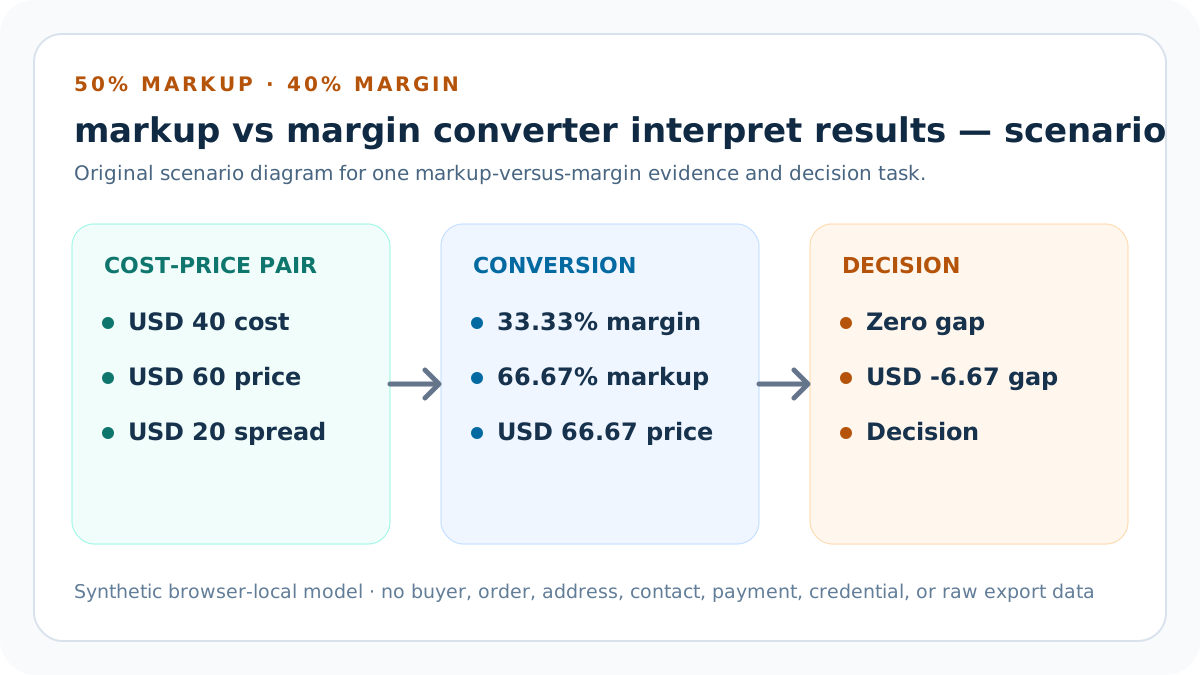
Worked control for result meaning and uncertainty
Run markup, margin, current-price-clear, invalid-margin, invalid-basis, and declared-conflict fixtures while changing only the field discussed in this guide.
The control verifies result meaning and uncertainty. It does not classify costs automatically, reproduce a private order, recommend a market price, or promise an arithmetic conclusion without market overclaim.
Reconciliation and sensitivity
Recalculate observed markup and margin directly from the same cost-price pair, then reconstruct price from the entered branch. The equivalent rate and reconstructed price must agree within full-precision tolerance before display rounding.
Vary one cost-basis row, price state, entered rate, or basis at a time. If a plausible alternative changes Review to Ready, resolve the disputed source or preserve separately named scenarios rather than averaging incompatible evidence.
Block conditions and safe correction
Block nonpositive cost, nonpositive price, unsupported basis, negative target rate, margin at or above 100%, invalid currency, invalid month, missing scope, or any declared conflict. Structural errors cannot be compensated by a high price.
Correct one named field, preserve the rejected value and reason, rerun supported and broken fixtures, and compare exact before and after outputs. A repair that requires hidden offsets elsewhere is not isolated enough to approve.
Bounded decision and action
Use Block before Review before Ready. Review means valid arithmetic but a current price below the entered rate's converted price. Ready means only that the current price clears this declared cost and denominator contract.
Choose one source correction, basis clarification, price experiment, cost action, or explicit no-action conclusion. Define owner, observation window, feedback measure, stop condition, and restoration trigger before changing a public price.
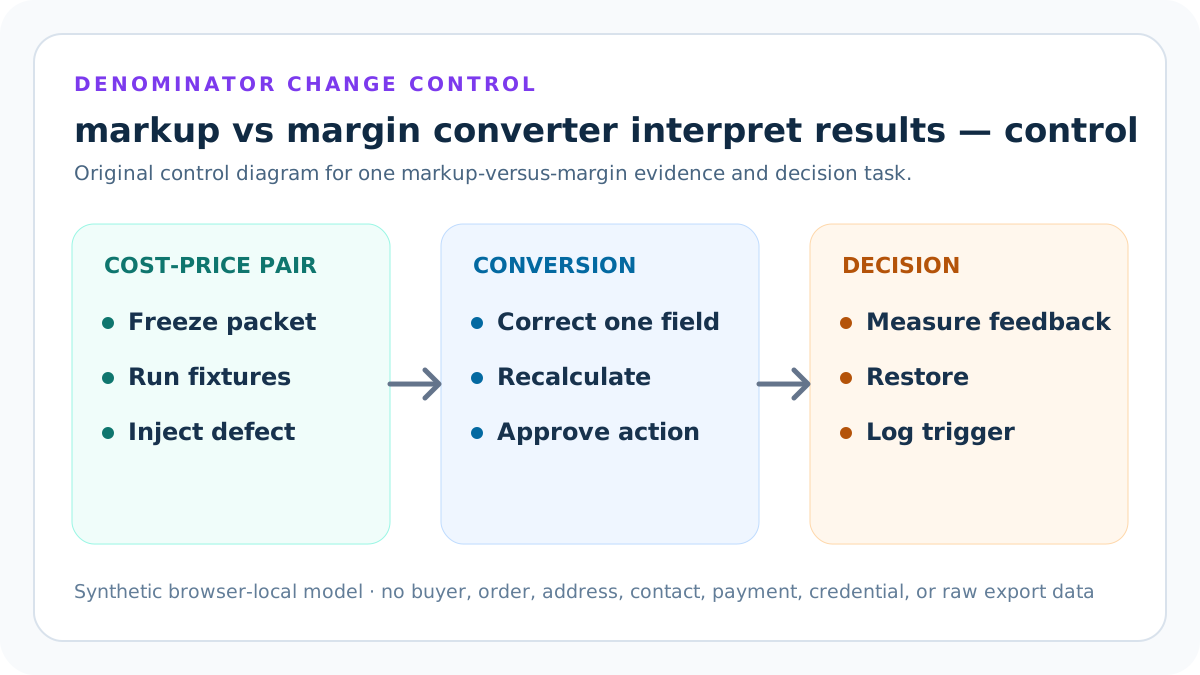
Verification and release controls
Preserve the bounded conversion interpretation card, source pointers, deterministic fixtures, tests, build, SEO and content audits, similarity evidence, screenshots, release manifest, backup, and rollback identifier.
Verify canonical, Article and Breadcrumb schema, sources, four explanatory visuals, internal links, privacy, indexability, mobile layout, public response, and live calculation behavior. A green build cannot validate unsupported source evidence.
Limits and privacy boundary
This arithmetic model does not determine accounting profit, taxable income, cash flow, fixed-overhead recovery, customer value, competitor response, demand, conversion, ranking, traffic, advertising approval, revenue, or income.
Keep buyer names, emails, addresses, order IDs, payment rows, bank details, tax identifiers, contacts, tokens, OAuth material, credentials, and raw exports outside the bounded conversion interpretation card. Public examples remain synthetic.
Evidence log and review trigger
Store packet ID, nonprivate product alias, cost-basis definition, included and excluded rows, cost, price state, entered rate, basis, currency, period, scope, source dates, outputs, decision, conflicts, reviewer, and rollback reference.
Recalculate when supplier cost, freight, duty, packaging, labor, discount state, refund state, bundle quantity, currency conversion, or rate policy changes. Do not rewrite history; create a dated successor row.
Next related calculation
Use the contribution margin calculator when multiple order-variable costs must be subtracted from net revenue. Use the product price floor calculator when fees, discounts, buyer shipping, return loss, and a contribution target must be solved inversely.
Use the listing cost library to version SKU costs before comparing products. A denominator conversion is only as comparable as the cost definition and price state supplied to it.
Interpretation ladder
Read structure first, then cost-price spread, observed rates, entered basis, equivalent rate, converted price, price gap, and decision. Stop at the first failed layer instead of promoting a downstream number whose upstream evidence is invalid.
Use proportional language: calculated, consistent with, below the entered boundary, or sensitive to a named cost basis. Avoid optimal, profitable business, safe market price, guaranteed conversion, tax-correct, or customer-approved.
bounded conversion interpretation card completion test
A complete packet lets an independent reviewer reproduce an arithmetic conclusion without market overclaim from the declared cost, price, entered rate, and explicit basis without private data or hidden spreadsheet state.
Closure requires exact arithmetic, source alignment, privacy-safe examples, a non-compensating decision, bounded language, one approved next step or no-action conclusion, feedback ownership, and a recoverable prior state.
Meaning of the cost-price spread
The gross-profit amount is a subtraction result against the declared cost basis. If the basis contains merchandise only, the spread is before every omitted variable and fixed cost. If the basis is broader, the label must name that scope.
Do not rename the spread net profit, cash generated, taxable income, or owner earnings. Those measures require additional revenues, costs, timing, and accounting treatment.
Meaning of observed markup
Observed markup answers how large the current spread is relative to cost. It is useful for cost-multiple language and price reconstruction, but it does not state what share of selling price remains.
A high markup can coexist with a much lower margin because selling price is the larger denominator. Compare observed markup only across records that share a cost-basis definition.
Meaning of observed margin
Observed margin answers how large the current spread is relative to selling price. It is bounded below 100% for positive cost and price, but that mathematical boundary does not define a commercially appropriate target.
A product-level margin does not automatically cover fixed overhead or portfolio losses. State whether the selected cost basis already includes order-variable costs before drawing an operating conclusion.
Meaning of equivalent rate
Equivalent rate changes the denominator language while preserving the same cost and price. It is not a second target, an uplift, or an improvement. A 50% markup and 33.33% margin can be exactly the same economic observation.
Use full precision for identity checks and round only the displayed percentage. Reentering a rounded equivalent can produce a small price difference that reflects communication rounding rather than business change.
Meaning of converted price and gap
Converted price is the price implied by the entered rate at the declared cost basis. Current-price gap measures distance from that arithmetic boundary. Neither value contains demand, competitor, tax, fee, or customer-value evidence unless those elements are explicitly present in the cost or separate decision process.
A positive gap supports Ready only after structure and sources pass. A negative gap supports Review, not an automatic price increase. The seller may instead correct cost, revise scope, clarify the target, or document a strategic exception.
Uncertainty language ladder
Say the calculator returned, the packet is consistent with, the current price is below, or the result is sensitive to a named cost row. These statements match observable arithmetic and declared evidence.
Avoid profitable, optimal, safe, competitive, customer-approved, tax-compliant, guaranteed, or proven demand. Those claims require evidence outside the converter and often a different qualified reviewer.
Sources and further reading
- Seller Profit Guard methodology: Calculation contracts, evidence precedence, deterministic fixtures, validation, correction, release, and rollback.
- Seller Profit Guard data privacy: Local-first boundaries for seller, buyer, order, payment, contact, credential, and raw export data.
- IRS Publication 334 (2025): Primary U.S. context for net receipts, cost of goods sold, gross profit, and the selling-price denominator; this converter does not make a tax determination.
- OpenStax markup guidance: Primary educational source for markup on cost and retail price equal to cost times one plus markup.
- SBA break-even point guidance: Primary U.S. small-business source for the contribution-margin denominator and separation of fixed and variable costs.
Related Seller Profit Guard tools
- Open the Markup vs Margin Converter: Convert one rate with an explicit cost or selling-price denominator.
- Solve a product price floor: Include discount, buyer shipping, fees, order-variable costs, expected loss, and a contribution target.
- Calculate contribution margin: Run a forward order-level contribution equation from observed revenue and variable costs.
- Version SKU costs: Maintain dated product, packaging, labor, fulfillment, and expected-loss evidence.
- Check bundle margin: Compare a bundle selling price with combined item and order costs.
- Read the methodology: Review evidence, calculation, privacy, testing, release, correction, and rollback.
- Review data privacy: Keep private seller and buyer data outside public content.
- Markup vs Margin Formulas and Inputs: Continue with a distinct formula, example, source, threshold, comparison, operating, interpretation, or audit task.
- Markup vs Margin Worked Example: Continue with a distinct formula, example, source, threshold, comparison, operating, interpretation, or audit task.
- Price-Based Margin Conversion Example: Continue with a distinct formula, example, source, threshold, comparison, operating, interpretation, or audit task.
- Markup vs Margin Conversion Mistakes: Continue with a distinct formula, example, source, threshold, comparison, operating, interpretation, or audit task.
- Reliable Markup and Margin Data Sources: Continue with a distinct formula, example, source, threshold, comparison, operating, interpretation, or audit task.
Next step: Open the Markup vs Margin Converter.
This is operational planning help, not tax, accounting, legal, financial, or platform-policy advice. Review the Terms and disclaimer, and verify current platform rules and fee assumptions before changing prices.