Seller Profit Guard · How it works · CSV privacy
Etsy variation naming checker for labels, photos, prices, and SKUs
Enter the buyer-facing variation axes and option values, then map the current selector text, appearance-linked photos, total prices, and unique SKU combinations. The checker returns seven deterministic checks plus a Ready, Revise, Hold, or Block decision without logging in to Etsy or storing buyer and order data.
Maintained by Seller Profit Guard Editorial Team. Last reviewed: 2026-07-25.
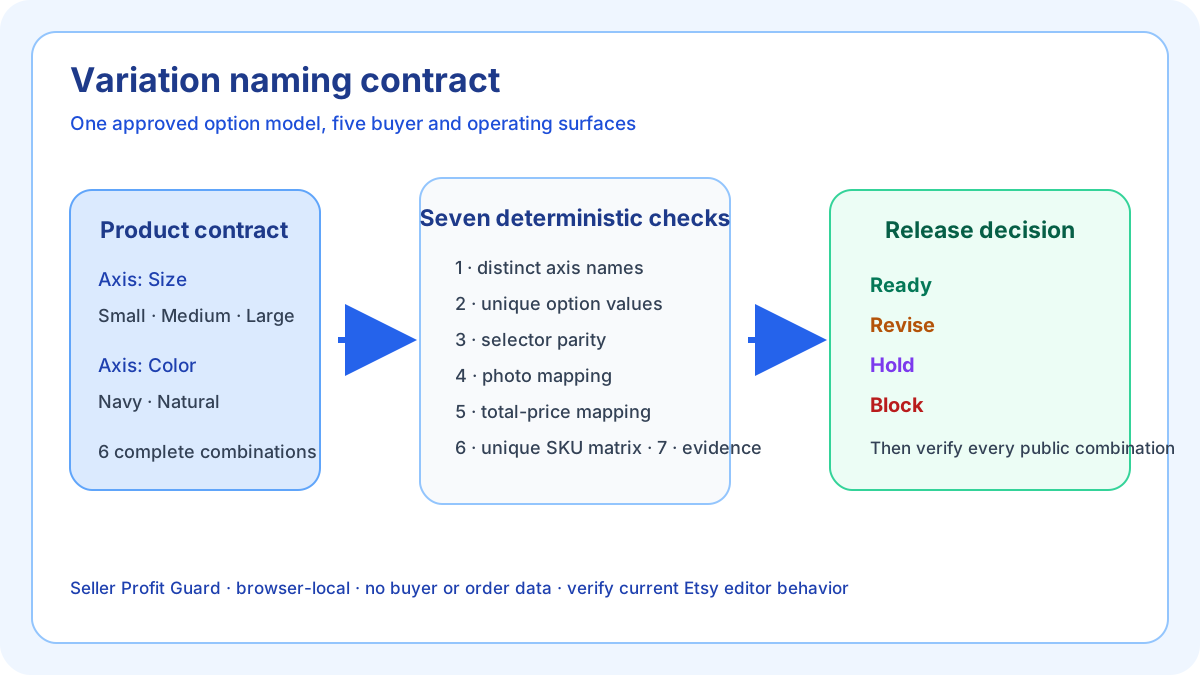
What the Etsy variation naming checker reviews
This tool reviews the language and mappings behind a physical Etsy listing with selectable options. It asks whether the variation axes have distinct buyer-readable names, whether each axis has unique values, whether the public selector reproduces those labels, and whether appearance, price, and SKU records cover the correct values or complete combinations.
The output is deliberately narrower than a general listing audit. It does not decide which product options a seller should offer, retrieve the live editor, change inventory, or calculate variation-level profit. It identifies internal contradictions that can make a buyer choose one label while a photo, total price, receipt, fulfillment record, or SKU means something else.
- Use one or two distinct buyer-readable variation axes.
- Keep option values unique within each axis.
- Match the public selector to the approved product record.
- Map appearance values to truthful photos.
- Map price-changing values to total prices.
- Give every complete combination one unique SKU.
Start with a product option contract
Freeze the approved product options before editing the listing. For a tote bag, the axes may be Size and Color; values may be Small, Medium, Large and Navy, Natural. The contract should also state which axis changes appearance, which changes total price, whether quantity or processing differs, and how complete combinations connect to inventory records.
Do not infer the source of truth from the existing dropdown. A stale public selector may be the defect under review. Use current product specifications, measurement sheets, approved color or material samples, price records, SKU inventory, processing profiles, and the listing editor as separate evidence layers. Preserve the before state and reviewer date.
Use clear and distinct variation axis names
A variation name should tell the buyer what decision is being made. Size, Color, Finish, Material, Chain length, Pack quantity, or Orientation can be clear when they match the product. Generic labels such as Option, Choice, Type, or Style force buyers to decode the values and can become especially confusing when a listing has two selectors.
Etsy's current help documentation says physical listings can use variations for up to two item attributes and that available built-in variations depend on the selected category. A custom variation can be created when an appropriate built-in choice is unavailable, but custom variations do not provide the same Etsy search-filter behavior. Verify the live editor rather than inventing a platform limit.
Keep option values unique, comparable, and unit-aware
Values must be unique within their axis and use the same comparison frame. A Size axis should not mix Small, 12 inches, With pocket, and Navy. A Chain length axis should retain units for every value. A Material axis should name actual selectable materials rather than promotional adjectives or internal production codes.
The checker requires at least two unique values for every declared axis and compares them with the buyer-view text. It cannot judge whether Small fits a particular person, whether Navy is color-accurate, or whether a material claim is substantiated. Measurements, photos, product records, and claims evidence remain separate controls.
Match the current buyer selector exactly
Copy the public axis names and values into the buyer-view field using a privacy-safe test listing or current public view. Every approved name and option should appear. Missing values, renamed values, retired options, inconsistent units, punctuation that changes meaning, or a selector that combines two concepts should trigger a revision before broad changes.
A successful editor save does not prove parity. Preview behavior can differ from the published listing, and Etsy notes that some variation price and quantity differences may not appear accurately in preview. Inspect the published buyer path after release, select each available combination, and keep rollback values ready.
Link appearance-changing values to the right photos
Declare the axis whose values materially change appearance, such as Color, Finish, Pattern, or Material, then list the photo mapping for every value. Navy should point to the approved Navy item rather than a generic lifestyle image; Natural should not inherit a photo of another fabric. Record not applicable only when no selector changes visible appearance.
Etsy allows eligible photos to be linked to a variation so the selected image follows the buyer's choice. Current capacity and eligibility can change, and an older handbook article may not match the current editor. This checker therefore tests completeness of seller-entered mappings without hard-coding an upload count or claiming every value must have a separate photo.
Treat each variation price as the total buyer price
Declare the axis whose values change price, then record the current total price for every value. Etsy's current variation help states that a variation price is the total price for that version, not an add-on amount. A Medium value at $32 means the selected item price is $32 under that mapping; it should not be represented as base price plus $32.
This tool checks that every named price-changing value appears in the mapping. It does not validate currency, domestic or global price settings, discounts, taxes, fees, or profitability. Use the profit and variant-risk tools for economics, and inspect the buyer-facing selected price plus receipt behavior after publication.
Give every complete combination one unique SKU
With Size values Small, Medium, Large and Color values Navy, Natural, the expected combination count is six. Each combination should have one unique SKU such as TOTE-S-NV or TOTE-M-NA. A code reused across two combinations weakens cost, inventory, fulfillment, returns, and profit analysis even when the buyer labels look clear.
The checker builds the Cartesian combination count from the entered option values, then verifies that each complete combination appears exactly once and that the SKU codes are unique. It does not query inventory or confirm the code stored by Etsy. Compare the result with the current listing editor and downstream inventory record.
Separate variations from personalization and custom work
Use variations when buyers choose from a finite set of base-item versions and those choices affect inventory, total price, SKU, photos, quantity, or processing. Etsy's current Custom options guidance separately supports up to five focused fields—text box, list of options, or file upload—for personalization inputs. Its own decision boundary says variations are appropriate when an option affects inventory, price, or SKU; a Custom options field is not a substitute for an inventory-bearing product variant.
A Material axis with Silver and Gold can be a variation; exact engraving text usually belongs in a focused Custom options text box. A bounded font choice may belong in a Custom options list when it does not create a distinct inventory state. Do not create a vague Custom variation value and then collect unbounded requirements elsewhere. A one-buyer design request belongs in the private custom-listing workflow. Cluster‑017 audits those personalization fields as a separate job.
Interpret Ready, Revise, Hold, and Block literally
Ready means all seven checks pass, no known issue is declared, and the evidence note is current. Revise means an axis, value set, selector, photo map, price map, or SKU matrix is incomplete or inconsistent. Hold means the structural mappings pass but the source note is missing. Block means the seller has declared an unresolved ambiguous, stale, duplicate, or mismatched variation record.
A Ready result is not proof of listing eligibility, search visibility, inventory accuracy, margin, fulfillment accuracy, conversion, fewer returns, or revenue. It means only that the seller-entered naming and mapping contract is internally coherent enough for bounded public verification.
Release safely and verify the selected buyer path
Save the current axes, values, order, photos, prices, quantities, processing profiles, SKUs, selector screenshots, and a rollback identifier. Apply one approved change set to the correct listing and account. Safe-stop on login or CAPTCHA ambiguity, a platform warning, wrong profile, or missing target context.
After publication, choose every option combination on mobile and desktop. Confirm visible names, selected photo, total price, availability, processing promise, cart and receipt choices, and internal SKU mapping. Restore the prior configuration if a critical path differs from the approved contract. Search and conversion signals are later measurements, not same-day proof.
- Freeze the product option contract and public before state.
- Run complete and deliberately broken fixtures.
- Repair the exact label or mapping layer.
- Back up editor values and linked assets.
- Publish one bounded variation change set.
- Select every public combination or restore the backup.
Limitations, privacy, and responsible use
The checker runs locally on seller-entered text. It does not need buyer names, addresses, messages, order IDs, receipts, raw CSV files, account credentials, OAuth data, or private personalization content. Use aliases and synthetic combinations in testing. Keep sensitive operational records in their approved private system.
Seller Profit Guard is independent and unaffiliated with Etsy. The checker does not retrieve or alter Etsy data, inspect linked photos, verify material or price truth, validate tax or legal treatment, reproduce every marketplace rule, or predict ranking, clicks, conversion, sales, returns, AdSense approval, or income. It provides operational QA, not legal, tax, accounting, inventory, accessibility, search, or marketplace-policy advice.
Sources and further reading
- Etsy Help: How to add variations: Current official variation attributes, prices, quantities, processing profiles, SKUs, photos, custom variations, visibility, and buyer behavior.
- Etsy Help: How to create a listing: Current official price, quantity, SKU, category, and physical-listing variation context.
- Etsy Help: Processing profiles and variation-level timing: Current official variation-level processing-profile behavior and made-to-order timing definitions.
- Etsy Help: Personalized listings: Current official Custom options field types, five-field limit, test-limited text-box pricing, and the inventory-versus-personalization boundary.
- Etsy Help: Custom items: Current official distinction between public listing variations and private one-buyer custom listings.
- Etsy Seller Policy effective July 9, 2026: Official accuracy, listing representation, content, privacy, and seller-responsibility boundaries.
- Seller Profit Guard methodology: Evidence hierarchy, privacy boundary, uncertainty labels, verification, correction, and rollback controls.
Related Seller Profit Guard tools
- Etsy CSV profit calculator: Run a local order profit check with editable fee and SKU cost assumptions.
- Payment reconciliation tool: Compare order rows with statement activity and flag unmatched rows.
- SKU cost library: Save or import material, labor, packaging, shipping, and target margin assumptions.
- Variant risk checker: Find missing SKUs and variation cost risks before a listing scales.
- Etsy title checker: Review listing-title clarity, repetition, keyword chains, and mobile scanning.
- Etsy tag checker: Review all 13 tag slots for duplicates, repeated meaning, and truthful coverage.
- Free shipping threshold calculator: Estimate when a shipping subsidy can still meet a target margin.
- Return window loss estimator: Model expected reverse shipping, restock work, recovery, and replacement loss.
- Etsy Ads break-even calculator: Estimate target-safe Etsy Ads spend, ACOS, and ROAS after fees, fulfillment, and expected return loss.
- CSV data privacy: Understand what the local-first workflow needs and what it does not need.
- Etsy Variation Naming Formula and Inputs: Define axes, values, selector text, photo and total-price maps, complete SKU combinations, known issues, and a dated evidence contract.
- Etsy Variation Names: Size and Color Example: Follow a tote bag with three sizes and two colors from the product option contract through photos, total prices, six SKUs, release, and recovery.
- Etsy Material and Personalization Options: Separate set-list material choices from buyer-entered engraving instructions, then audit photos, prices, SKUs, processing, and public behavior.
- 12 Etsy Variation Naming Mistakes: Diagnose ambiguous axes, mixed values, unit drift, stale selectors, wrong photos, add-on prices, missing combinations, duplicate SKUs, and unsafe releases.
- Evidence Sources for Etsy Variations: Map axes, values, measurements, photos, prices, quantities, processing, SKU combinations, editor state, and buyer behavior to current authority.
- Etsy Variation Naming: Ready to Block: Apply non-compensating Ready, Revise, Hold, and Block gates to axes, values, selector parity, photos, total prices, SKUs, and evidence.
- Etsy Size and Color vs Material and Personalization: Compare a Cartesian size-and-color matrix with fixed material choices plus buyer-entered engraving at the same evidence grain.
- Weekly Etsy Variation Naming Routine: Turn product, editor, buyer-view, photo, price, processing, and SKU changes into a risk-based evidence, release, and recovery loop.
- How to Read an Etsy Variation Naming Report: Interpret seven structural checks, combination counts, mapping states, decisions, uncertainty, and next actions without false precision.
- Etsy Variation Naming Audit Template: Use a privacy-safe before-state, evidence, fixture, release, public verification, exception, rollback, and measurement record.
Use the interactive tool
Enable JavaScript to open the calculator and process browser-local inputs. The explanatory content and source links remain available without JavaScript.
Related guide: Build the variation option contract before editing.
This tool provides operating estimates, not tax, accounting, legal, financial, or marketplace-policy advice. Verify current official sources and your own records before changing prices or operations.