Seller Profit Guard · How it works · CSV privacy
Etsy listing claims checker for evidence-backed product copy
Use this browser-local Etsy listing claims checker to map each material, origin, size, process, performance, compatibility, environmental, certification, guarantee, health, or safety statement to its public surface, evidence, qualification, visual context, risk boundary, and dated approval before a claim reaches an Etsy listing.
Maintained by Seller Profit Guard Editorial Team. Last reviewed: 2026-07-30.
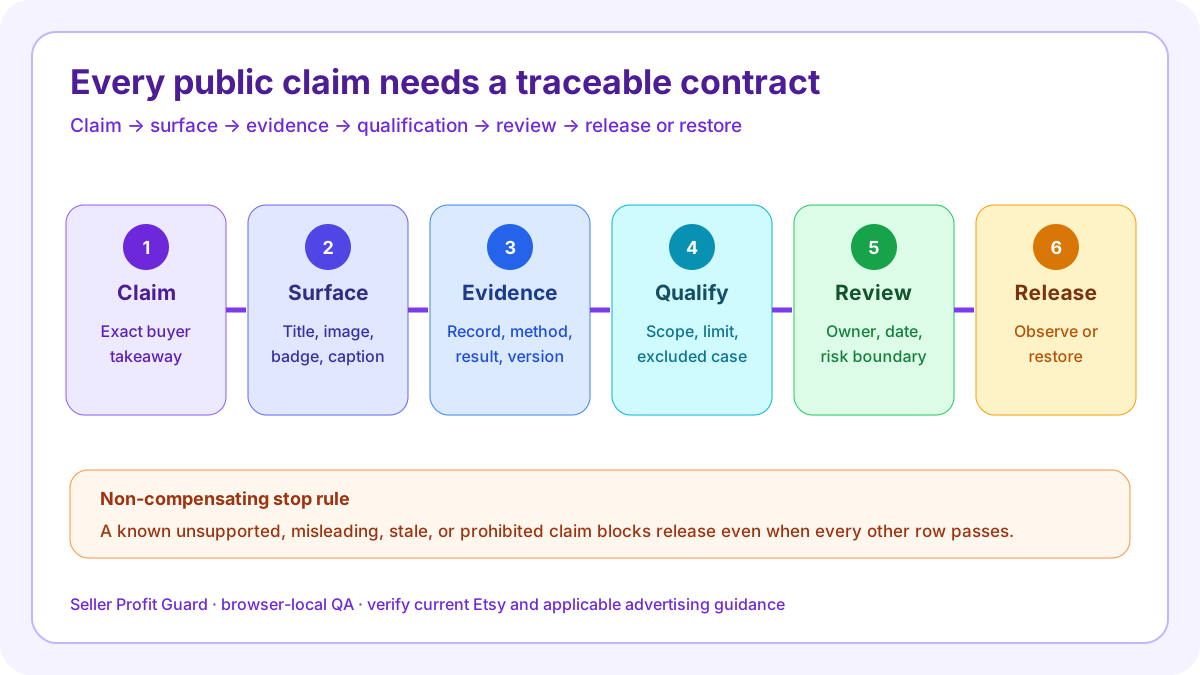
What the Etsy listing claims checker reviews
The checker converts a seller-entered claim packet into eight visible decisions. It freezes one listing version, parses a strict five-column claim manifest, and evaluates component and origin records, performance or compatibility testing, image and caption implications, disclosures, high-risk categories, and a dated approval note. It rejects malformed or duplicate rows rather than silently dropping extra columns or letting repeated claims inflate the packet.
This is not the same job as the Etsy Description Clarity Checker. A description can answer dimensions, processing, care, policy, and personalization questions while still containing an unsupported material badge or an image that implies a result. Claims QA follows every express or implied statement across title, description, attributes, images, captions, badges, highlights, video, and other public surfaces.
- Freeze one listing candidate and exact review date.
- Enter one claim, type, public surface, evidence, and qualification per row.
- Separate component materials from whole-item statements.
- Record test method, measured result, model, tolerance, and limitation.
- Reconcile images, props, captions, badges, and excluded items.
- Escalate health, safety, environmental, certification, and guarantee claims.
- Block seller-identified unsupported or prohibited statements.
Start with a claim manifest, not a writing score
Write one row with exactly five columns as `claim | type | surface | evidence | qualification`. The claim is the exact public meaning, not only the sentence copied from the description. The type identifies the evidence family. The surface records where a buyer encounters it. Evidence names the accountable record, and qualification states the limitation that must remain visible with the claim. Extra columns, duplicate claim-type-surface rows, and unresolved terms such as “not tested,” “stale,” or “cannot verify” stop the manifest.
A pendant fixture can contain three independent rows: “sterling silver pendant” as a component-material statement, “18 mm diameter” as a measured size statement, and “hand engraved” as a process statement. Combining them into one row hides which record supports which wording and makes a partial failure difficult to repair or roll back.
Review express and implied claims together
An express claim appears in words: “waterproof,” “fits 13-inch laptops,” or “made in Vermont.” An implied claim can arise from the full presentation. A laboratory-style badge, a medical symbol, a pristine outdoor scene, an “eco” icon, a comparison chart, or a photo of five pieces beside a one-piece offer can communicate a promise even when the exact sentence is absent.
Record the likely buyer takeaway at the same grain as the public surface. Do not limit review to searchable text. The checker asks for an image and caption reconciliation because a truthful description cannot neutralize an unsupported badge or a visual quantity implication that appears before the qualification.
Separate materials and components precisely
A component claim should identify the part it describes. If a pendant is sterling silver and its chain is stainless steel, “sterling silver necklace” can imply that both components share the same material. The evidence packet should retain the current SKU specification, supplier or maker record, batch or receipt reference, component map, and any test or measurement relevant to the public wording.
The worked fixture therefore uses “sterling silver pendant with stainless-steel chain.” It keeps the limitation beside the material claim rather than burying it in care text. The checker does not assay metal or authenticate a supplier document; it checks whether the seller has made the component boundary and accountable source explicit.
Substantiate size, fit, performance, and compatibility
Objective performance and compatibility statements need a method that can reproduce the claimed boundary. For a laptop sleeve, record the interior dimensions, measurement tool, tolerance, tested device or rigid dummy, closure and seam condition, test date, reviewer, and excluded models. “Fits devices up to 13.0 × 9.0 × 0.7 inches” is narrower and testable; “fits all 13-inch laptops” is not.
Do not upgrade a limited observation into a stronger result. A splash test does not establish waterproof performance, a drop on carpet does not establish shock protection, and one device does not establish universal compatibility. If no performance claim is used, record that boundary explicitly so later copy or imagery does not silently reintroduce it.
Match images, captions, badges, and props to the evidence
Review the finished item, detail views, scale image, variation images, packaging, lifestyle scenes, captions, overlays, comparison cards, and video. Identify which claim each surface communicates and whether it shows the actual candidate or a clearly labeled example. Etsy's current image requirements generally expect original images of the finished product, subject to specified exceptions.
A ruler image can support a measured dimension only when the photographed component and unit are clear. A decorative laptop, chain, storage pouch, gift box, or plant can imply inclusion unless the package boundary is visible. Remove an unsupported badge instead of hoping that a distant disclaimer will correct the stronger first impression.
Place qualifications where the claim is encountered
A qualification should be understandable, prominent enough for the public surface, and close to the statement it limits. “Pendant is sterling silver; chain is stainless steel” belongs beside the material claim. A measured compatibility envelope belongs with the fit statement. An AI-use or production-partner disclosure belongs in the listing controls and public explanation where Etsy requires it.
Do not use a broad footer to cure a specific headline, badge, or image implication. The checker records the disclosure map separately because material, origin, environmental, medical, performance, and comparative language can require different limitations. It does not decide whether any disclosure is legally sufficient in a particular jurisdiction.
Escalate high-risk and prohibited claim categories
Health, disease, safety, environmental, origin, certification, guarantee, comparative, and test-proven statements deserve a non-compensating review boundary. Etsy's current Medical Claims policy blocks disease-treatment claims, statements that replace or compare a product with medication or medical treatment, listed sensitive-health claims, and regulatory-approval claims for supplements or similar products. FTC substantiation guidance separately states that objective express or implied advertising claims require a reasonable basis before dissemination.
The tool cannot determine the applicable law, evidence standard, certification status, scientific validity, or professional scope. Any entered health, safety, environmental, certification, guarantee, or comparative row therefore requires a dated decision by a named qualified, compliance, legal, or scientific reviewer role. The checker blocks the explicit Etsy categories before scoring; testimonials and disclaimers do not make a prohibited medical claim acceptable.
Treat broad environmental language as a specific evidence problem
Unqualified terms such as “green,” “eco-friendly,” or “sustainable” can imply broad benefits that a narrow material fact does not support. FTC Green Guides summaries advise against broad, unqualified general environmental-benefit claims and emphasize clear, prominent qualification. Replace a global adjective with the specific attribute, scope, comparison basis, and limitation that records can support.
For example, “mailing box contains 80% post-consumer recycled fiber according to the current supplier specification” is a bounded packaging statement. It does not establish that the product, supply chain, shipping, or entire shop is environmentally preferable. Keep the specification version and review date, and remove the claim when the supplier record or package changes.
Use Ready, Revise, Hold, and Block without compensation
Ready requires all eight checks, one to twelve unique five-column claim rows, current resolved evidence, visible qualifications, reconciled visuals, a human-review boundary, and an exact dated approval that names the reviewer role, decision, and rollback copy. Revise means one or more layers are malformed, duplicated, incomplete, inconsistent, unresolved, or too broadly qualified. Hold is appropriate when the structure is present but a necessary authority or dated approval remains unresolved.
Block applies whenever the seller lists a declared prohibited defect or the checker detects a current prohibited medical category: disease treatment, prevention, mitigation, cure, diagnosis, treatment substitution, a listed sensitive-health statement, or supplement regulatory approval. One prohibited claim in an image, one untested waterproof badge, or one whole-item material statement known to be inaccurate overrides a high aggregate score. A Ready result permits backup and public QA; it does not certify truth, compliance, ranking, conversion, or marketplace approval.
Release one bounded claim packet with rollback
Before editing a listing, preserve the current title, description, attributes, images, captions, badges, video, disclosures, SKU specification, evidence register, test record, reviewer decision, and rollback identifier. Confirm the correct account and listing. Safe-stop on login or CAPTCHA ambiguity, a platform warning, wrong profile, missing target context, or an unexpected editor state.
Change only the approved claim packet. Inspect the public desktop and mobile listing, compare every surface with the manifest, and confirm that qualifications remain visible. Restore the prior approved state when a claim, image, attribute, or disclosure diverges. Search impressions and sales are later measurements, not same-day proof that a claim is supported.
- Freeze the listing version and public surfaces.
- Build the claim-to-evidence manifest.
- Reconcile components, tests, images, and qualifications.
- Run the complete and deliberately broken fixtures.
- Back up the listing and evidence packet.
- Release once, verify publicly, or restore.
Evidence, privacy, and responsible-use limits
Use listing aliases, public wording, component summaries, non-sensitive record references, synthetic measurements, and aggregate observations. Do not enter buyer names, email addresses, addresses, messages, order IDs, receipts, payment data, supplier credentials, private certificates, unreleased designs, tokens, OAuth material, or raw CSV rows into the public tool, content workspace, analytics, or reports.
Seller Profit Guard is independent and unaffiliated with Etsy or the FTC. This checker provides operational QA, not legal, regulatory, scientific, medical, safety, certification, environmental, intellectual-property, marketplace-policy, or advertising advice. Rules and interfaces can change. Review current official sources and obtain qualified advice when a claim creates material risk.
Sources and further reading
- Etsy Seller Policy: Current accuracy, origin, materials, components, disclosure, legal, and misleading-content responsibilities.
- Etsy Creativity Standards: Current made, designed, handpicked, sourced, AI-disclosure, and human-contribution boundaries.
- Etsy Listing Image Requirements: Current original finished-product image expectations and stated exceptions.
- Etsy Prohibited Items Policy: Current prohibited-item and medical drug-claim boundaries.
- Etsy Medical Claims Policy: Current medical-claim examples and the rule that a disclaimer does not make a prohibited claim acceptable.
- FTC Advertising Substantiation Policy Statement: Official reasonable-basis framework for objective express and implied claims before dissemination.
- FTC Environmental Claims: Green Guides Summary: Official summary for specific environmental claims and clear qualifications.
- Seller Profit Guard methodology: Evidence hierarchy, privacy-safe fixtures, deterministic decisions, uncertainty, verification, correction, and rollback.
Related Seller Profit Guard tools
- Etsy CSV profit calculator: Run a local order profit check with editable fee and SKU cost assumptions.
- Payment reconciliation tool: Compare order rows with statement activity and flag unmatched rows.
- SKU cost library: Save or import material, labor, packaging, shipping, and target margin assumptions.
- Variant risk checker: Find missing SKUs and variation cost risks before a listing scales.
- Etsy title checker: Review listing-title clarity, repetition, keyword chains, and mobile scanning.
- Etsy tag checker: Review all 13 tag slots for duplicates, repeated meaning, and truthful coverage.
- Free shipping threshold calculator: Estimate when a shipping subsidy can still meet a target margin.
- Return window loss estimator: Model expected reverse shipping, restock work, recovery, and replacement loss.
- Etsy Ads break-even calculator: Estimate target-safe Etsy Ads spend, ACOS, and ROAS after fees, fulfillment, and expected return loss.
- CSV data privacy: Understand what the local-first workflow needs and what it does not need.
- Etsy Listing Claims Checker: 9 Inputs: Define the listing boundary, claim rows, evidence families, visual reconciliation, qualifications, risk review, and approval record.
- Etsy Material Claim: A Component Example: Follow a pendant, chain, size, and engraving statement from component records through public wording, images, approval, and rollback.
- Etsy Compatibility Claim: A Sleeve Example: Test a laptop-sleeve fit statement without turning one measured envelope into universal compatibility, waterproofing, or shock protection.
- 14 Etsy Listing Claim Mistakes to Block: Find material, performance, image, environmental, origin, health, certification, qualification, and evidence defects before publication.
- Etsy Claim Evidence: Source Hierarchy: Choose product records, measurements, tests, public surfaces, current platform policy, regulator guidance, and human approval at the right grain.
- Etsy Claim Decisions: Ready to Block: Set non-compensating Ready, Revise, Hold, and Block thresholds for claim rows, evidence, qualifications, visuals, risk, and approval.
- Material vs Compatibility Claims on Etsy: Compare a mixed-metal necklace and measured laptop-sleeve fit statement at the same claim, evidence, qualification, review, and rollback grain.
- A Weekly Etsy Claim Review Routine: Run trigger-based evidence refresh, fixtures, approval, bounded release, public verification, correction, and measurement without rewriting stable listings.
- How to Read an Etsy Claim Score: Interpret eight checks, claim count, decision, evidence status, issue list, and next actions without treating the result as truth or legal certification.
- Etsy Claim Audit Template and Fields: Record listing identity, claims, evidence, tests, visuals, qualifications, risk, approval, release, public observation, rollback, and review triggers.
Use the interactive tool
Enable JavaScript to open the calculator and process browser-local inputs. The explanatory content and source links remain available without JavaScript.
Related guide: Build the claim-evidence matrix before editing public copy.
This tool provides operating estimates, not tax, accounting, legal, financial, or marketplace-policy advice. Verify current official sources and your own records before changing prices or operations.