Seller Profit Guard · How it works · CSV privacy
Etsy description clarity checker for buyer questions and claim evidence
Paste a privacy-safe Etsy description, then enter verified product facts, dimensions, processing, care, policy, and personalization requirements. The checker reports six separate clarity checks, seller-identified unsupported claims, and a ready, revise, hold, or block decision. It does not generate copy, verify a claim, or predict ranking.
Maintained by Seller Profit Guard Editorial Team. Last reviewed: 2026-07-25.
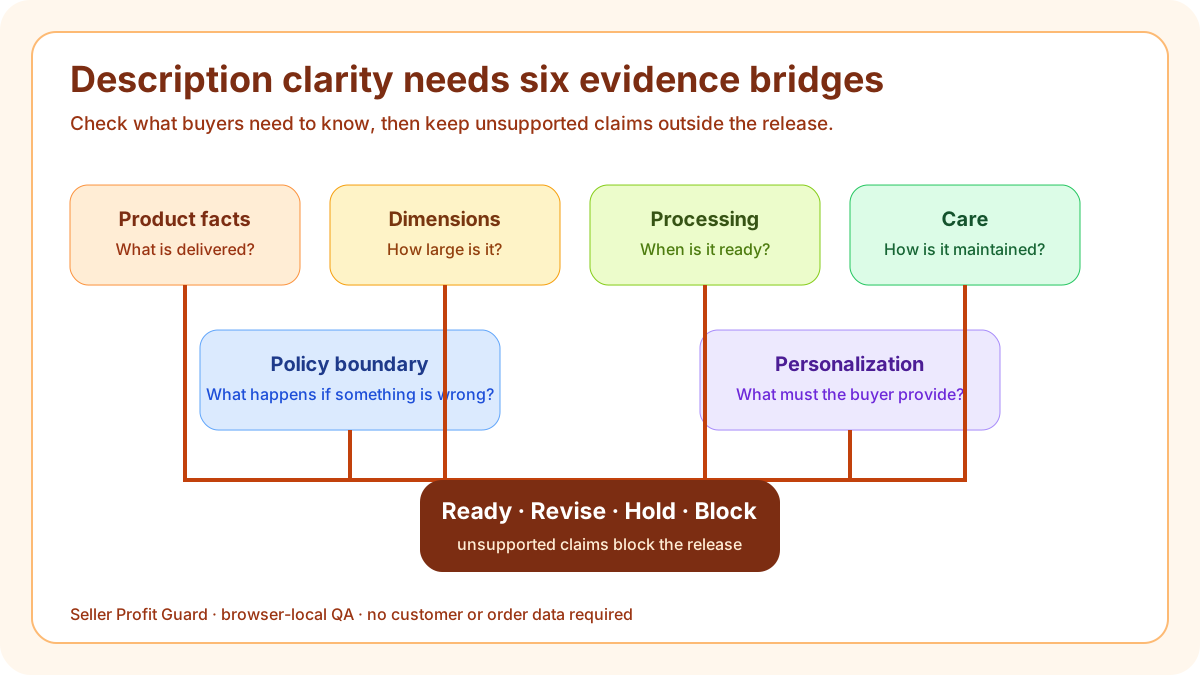
What the Etsy description clarity checker reviews
The checker compares the public description with six seller-entered evidence groups: objective product facts, dimensions or size, the current processing profile, required care, the relevant policy boundary, and personalization instructions. It also keeps a separate field for claims the seller knows are not currently supported. This structure identifies which buyer question is unanswered instead of giving a vague writing score.
Use it after category, attributes, variations, and the product specification are stable. A description cannot make an inaccurate product record true. The page is deliberately separate from title and tag tools: titles and tags help discovery and quick recognition, while the description must explain the actual deliverable, ordering choices, fulfillment expectation, and limitations in enough detail for an informed purchase.
- Compare copy with verified product facts.
- Check dimensions and option ranges.
- Reconcile processing copy with the live profile.
- Expose care, policy, and personalization gaps.
- Block seller-identified unsupported claims.
Lead with the decision-critical information
Etsy's Seller Handbook recommends an inverted-pyramid description: put the most important item information first, use short paragraphs or bullets, and answer the questions a buyer is likely to ask. For a personalized necklace, the opening should establish what is sold, the objective material, what the buyer can customize, the main size, and how to submit the order details before moving into styling ideas or brand narrative.
The checker does not reward a particular word count. A long paragraph can still fail if it hides the chain lengths or conflicts with the processing profile. A shorter description can pass when it covers every material decision clearly and points to the correct marketplace controls. Readability, evidence, and buyer action are more useful than repeating keywords.
How the six clarity checks work
Product facts, dimensions, care, policy, and personalization are evaluated by normalized coverage against the description. Processing is compared directly with the entered listing profile because an otherwise polished paragraph is misleading when it promises one business day while the live made-to-order profile says five to seven. Each layer remains visible so one strong section cannot conceal another unresolved question.
Coverage is only a deterministic review signal. The checker cannot tell whether sterling silver, a measurement, a care instruction, or a return statement is factually true. The seller must obtain those facts from the product specification, measurement sheet, production process, tested care method, and current shop policies. Missing authority produces a hold or revision, not an invented answer.
| Check | Best evidence | Buyer question |
|---|---|---|
| Product facts | SKU specification | What exactly will I receive? |
| Dimensions | Measurement sheet | How large is it? |
| Processing | Current processing profile | When will it be ready? |
| Care | Tested material guidance | How should I maintain it? |
| Policy | Current shop policy | What happens if there is a problem? |
| Personalization | Live custom fields | What must I provide? |
Use the ten-field evidence contract
Keep the public description separate from the nine records used to test it: verified product facts, required dimensions, description processing promise, current processing profile, care instructions, policy boundary, personalization requirements, unsupported claims, and the dated evidence note. Do not paste the same description into every field. That would create artificial agreement without an independent source of truth.
Product facts should come from the current SKU or production specification. Dimensions need a measurement record. Processing needs the wording buyers see and the active physical-listing profile. Care should reflect the actual material and tested handling. Policy language should point to the current shop boundary. Personalization must match the live custom fields. The evidence note should name those sources and include an explicit YYYY-MM-DD review date.
| Field | Authority | Failure signal |
|---|---|---|
| Product facts | SKU specification | Missing or negated fact |
| Dimensions | Measurement record | Omitted size or option |
| Processing | Description and live profile | Conflicting time |
| Care | Material-specific handling | Generic or absent |
| Policy | Current shop policy | Stale promise |
| Personalization | Live custom fields | Unusable buyer input |
| Claims | Claim-specific evidence | Seller-declared unsupported claim |
| Evidence | Dated source register | Missing YYYY-MM-DD |
Explicit contradictions override keyword coverage
Token coverage alone can produce a dangerous false pass. A sentence such as “this item is not sterling silver” contains the words sterling and silver, but it directly contradicts a required sterling-silver product fact. The checker now tests seller-entered product-fact and dimension phrases for common negation patterns and returns Block when it finds one. The contradiction remains visible as a named output rather than disappearing inside a blended score.
This is a bounded deterministic safeguard, not full natural-language reasoning. It catches direct patterns such as not, no, without, and does not include before a multi-word required phrase. A human must still review indirect conflicts, qualifiers, units, translations, image text, and claims elsewhere in the listing. When a contradiction is detected, correct the product record or public copy and rerun the same fixture before any publication step.
Audit the first 80 words separately
Etsy's current description guidance recommends an inverted pyramid, with the most important item information first. The checker therefore reports how much of the verified product-fact vocabulary appears in the first 80 words. This opening metric does not add keyword-stuffing points and does not replace the six buyer-question checks. It is a diagnostic for descriptions that eventually mention the facts but bury them under brand story, occasion language, or decorative prose.
If opening product-fact coverage is low, move one or two decision-critical facts forward: what the item is, the objective material or file type, the principal size, and the action a buyer must take. Keep the language natural. Do not copy the title verbatim, repeat every tag, or front-load unsupported benefits. Recheck mobile readability because the opening is the part buyers are most likely to see before expanding more text.
Handle physical and digital processing honestly
Etsy currently describes processing profiles for physical items and states that digital listings do not have processing profiles. For a physical made-to-order product, compare the description promise with the active profile, including the time required to create the custom item before carrier handoff. A one-day promise paired with a five-to-seven-business-day profile remains a revision issue even when every other field is complete.
For a digital listing, do not invent a physical processing profile merely to satisfy the checker. Record both processing fields as not applicable for the digital workflow, then audit instant-download or made-to-order delivery using the relevant digital-file controls. This exception is explicit and does not waive product, file, personalization, policy, claim, or dated-evidence review.
Personalized necklace worked example
The passing fixture sells one made-to-order sterling-silver birth-flower necklace. The description identifies the necklace and material, states an 18 mm pendant and 16-, 18-, or 20-inch chain choices, asks for one flower and the exact engraving name, gives a three-to-five-business-day processing window, explains dry-cloth care, and states the relevant personalized-item return boundary.
Those facts are checked against a current SKU specification, measurement sheet, personalization fields, processing profile, care record, and shop policy. The fixture earns six passes only because the entered copy and evidence align. It does not prove metal purity, suitability for a particular wearer, guaranteed delivery, search placement, conversion, or policy eligibility.
Made-to-order timing must agree everywhere
Etsy explains that processing time is the time needed to prepare an order before handing it to the carrier; for a custom order, it includes the time required to create the item. Record the same operational window in the description and the live processing profile. Do not substitute a carrier transit estimate for production time or promise a needed-by date that the workflow has not accepted.
If the description says ships tomorrow and the live profile says five to seven business days, the checker marks the processing layer for review. Fix the source of truth first, then update the public copy and inspect the buyer view. Changing only the sentence can leave checkout expectations, estimated delivery, and the actual production queue misaligned.
Separate objective facts from unsupported claims
Objective facts include measured dimensions, observed construction, documented material, included components, current file types, and a tested processing step. Subjective language such as beautiful or perfect can be recognizable marketing opinion, but medical, safety, certification, performance, durability, allergen, environmental, or guaranteed-result claims require an authority appropriate to the exact claim.
The unsupported-claims field is intentionally seller-declared. Enter every claim that lacks current evidence; any listed claim creates a block so it cannot be averaged away by complete dimensions or care copy. The tool does not scan all marketplace policies or decide that an unlisted statement is safe. A human reviewer must still inspect the entire listing, images, and applicable official rules.
Personalization instructions should produce usable input
Etsy's current personalization workflow lets sellers request focused information through custom fields. The description should tell buyers exactly what to enter, how spelling and capitalization will be used, which options belong in structured selectors, and what happens when required information is missing. One field should not combine unrelated questions that are difficult to validate or fulfill.
For the necklace fixture, the buyer selects one flower and enters the exact engraving name. Chain length belongs in a variation, not in an unstructured message. If a proof or approval step exists, state its timing and decision boundary without promising private communication that the workflow cannot deliver. The public description and live personalization controls should tell the same ordering story.
Care and policy language need the right authority
Care instructions should come from the actual material, finish, construction, and tested handling process. A generic jewelry-care paragraph can be wrong for plated, oxidized, painted, porous, bonded, or mixed-material items. If no care is required, record that decision explicitly rather than leaving the field blank and treating absence as proof.
Policy copy should summarize the boundary that materially affects this item and direct the buyer to the current shop policy where appropriate. It must not contradict the active return, exchange, cancellation, damage, or customization rules. Preserve the policy version and review date so a later change can trigger a bounded description refresh instead of leaving stale promises across many listings.
Use ready, revise, hold, and block correctly
Ready means all six entered requirements are covered and a dated evidence note exists. Revise means one or more buyer questions or operational alignments remain incomplete. Hold means the text covers the entered requirements but the evidence note is not current enough to support release. Block means the seller has identified at least one claim without current evidence.
These are operating decisions, not content-quality probabilities. A ready result does not certify Etsy compliance or guarantee that a buyer will convert. A revise result does not mean every sentence must be rewritten. Correct the specific failed layer, rerun the same fixture, and compare the output before changing title, tags, category, price, or advertising.
Release and verify one bounded description change
Save the prior description, processing profile, personalization fields, policy reference, and evidence version. Confirm the correct account and listing, then edit only the approved description-related fields. Inspect mobile and desktop for opening facts, bullets, dimensions, variants, personalization controls, processing expectation, care, policies, image consistency, and working links.
Safe-stop on login or CAPTCHA ambiguity, a platform warning, wrong profile, missing target context, or an unexpected listing. Roll back when the public page conflicts with the approved copy or a required control disappears. A successful editor save is not enough; the buyer-facing page and the preserved restoration state close the change.
- Freeze the current copy and dependent controls.
- Run one complete and one deliberately incomplete fixture.
- Resolve unsupported claims before editing.
- Apply one approved copy and control change set.
- Inspect the public buyer view on mobile and desktop.
- Record the verified state or restore the backup.
What this checker cannot prove
The checker does not access Etsy, fetch a listing, rewrite prose, test legal or policy compliance, validate material composition, assess accessibility for every buyer, interpret private messages, or predict impressions, ranking, clicks, conversion, sales, refunds, or AdSense approval. It evaluates only the privacy-safe text and evidence categories entered in the browser.
Verify current Etsy Help, Seller Handbook, legal policies, the actual listing editor, and the seller's own product records before publication. Seller Profit Guard is unaffiliated with Etsy. This is operational listing QA, not legal, tax, accounting, medical, safety, intellectual-property, accessibility, marketplace-compliance, or ranking advice.
Sources and further reading
- Etsy Seller Handbook: 5 tips for writing listing descriptions: Official description guidance covering information priority, scannability, buyer questions, natural language, and related links.
- Etsy Seller Handbook: Handy item listing checklist: Official checklist emphasizing complete descriptions, exact dimensions, materials, process, and buyer-question review.
- Etsy Help: How to offer personalized listings: Official custom-field workflow and guidance to collect focused personalization information.
- Etsy Help: Processing times and ship-by dates: Official processing-profile definition and made-to-order timing boundary.
- Etsy Help: How to create a listing: Official current listing fields for description, item options, personalization, physical items, and digital files.
- Seller Profit Guard methodology: Evidence hierarchy, privacy boundary, uncertainty labels, corrections, verification, and rollback controls.
Related Seller Profit Guard tools
- Etsy CSV profit calculator: Run a local order profit check with editable fee and SKU cost assumptions.
- Payment reconciliation tool: Compare order rows with statement activity and flag unmatched rows.
- SKU cost library: Save or import material, labor, packaging, shipping, and target margin assumptions.
- Variant risk checker: Find missing SKUs and variation cost risks before a listing scales.
- Etsy title checker: Review listing-title clarity, repetition, keyword chains, and mobile scanning.
- Etsy tag checker: Review all 13 tag slots for duplicates, repeated meaning, and truthful coverage.
- Free shipping threshold calculator: Estimate when a shipping subsidy can still meet a target margin.
- Return window loss estimator: Model expected reverse shipping, restock work, recovery, and replacement loss.
- Etsy Ads break-even calculator: Estimate target-safe Etsy Ads spend, ACOS, and ROAS after fees, fulfillment, and expected return loss.
- CSV data privacy: Understand what the local-first workflow needs and what it does not need.
- Etsy Description Clarity Formula: 10 Inputs: Define the exact inputs, coverage checks, evidence requirements, and precedence rules for a reproducible Etsy description clarity review.
- Etsy Description Checker: Personalized Example: Follow a personalized sterling-silver necklace from product evidence through description checks, buyer instructions, release, and rollback.
- Etsy Description Checker for Made-to-Order Items: Review a made-to-order ceramic sign with production stages, personalization inputs, proof decisions, dimensions, care, and timing evidence.
- 12 Etsy Description Mistakes That Create Risk: Diagnose twelve Etsy description defects involving buried facts, units, timing, customization, care, policies, claims, and rollback.
- Evidence Sources for Etsy Listing Descriptions: Map every description claim to the product record, measurement sheet, processing profile, care test, policy, editor, and official source.
- Etsy Description Ready, Revise, Hold, Block: Set explicit ready, revise, hold, and block thresholds for buyer information, evidence, contradictions, and unsupported claims.
- Personalized vs Made-to-Order Description QA: Compare a personalized necklace and made-to-order ceramic sign at the same buyer-question grain without erasing their different workflows.
- Weekly Etsy Description Evidence Routine: Operate a risk-based description review using changed-listing sampling, source refresh, fixtures, bounded edits, public checks, and rollback.
- How to Read Etsy Description Checker Results: Interpret six clarity checks and ready, revise, hold, or block decisions without claiming truth, compliance, ranking, or conversion.
- Etsy Description Audit Checklist and Log: Use a privacy-safe checklist for before copy, evidence, six checks, unsupported claims, approval, public verification, and rollback.
Use the interactive tool
Enable JavaScript to open the calculator and process browser-local inputs. The explanatory content and source links remain available without JavaScript.
Related guide: Build the description evidence contract before editing.
This tool provides operating estimates, not tax, accounting, legal, financial, or marketplace-policy advice. Verify current official sources and your own records before changing prices or operations.