Seller Profit Guard · How it works · CSV privacy
SKU naming generator
Generate two distinct, reversible canonical SKU proposals from a dated approved codebook and synthetic variant attributes. The browser-local tool checks nine operating confirmations, exact and case-insensitive uniqueness evidence, separate canonical and alias length budgets, a seller-set utilization review threshold, reserved identifiers, dates, mappings, ambiguous characters, privacy, migration readiness, and open conflicts; hard failures mask the proposed codes.
Maintained by Seller Profit Guard Editorial Team. Last reviewed: 2026-07-31.
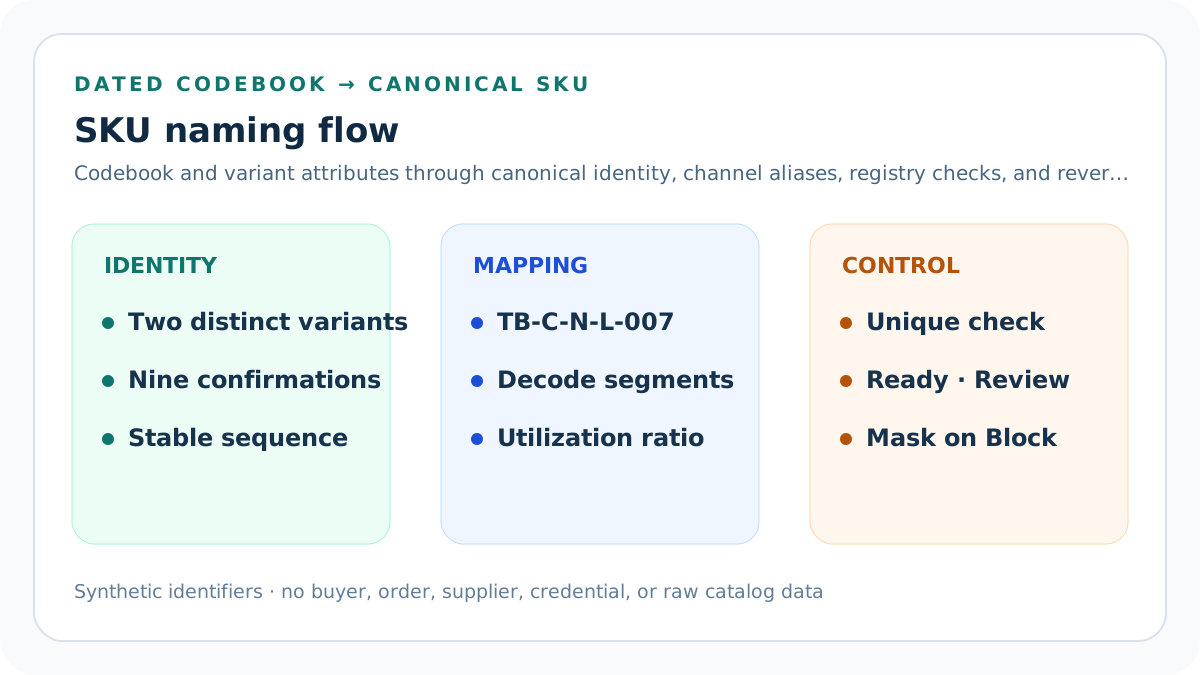
Start with one canonical variant identity
Create the canonical SKU for one sellable product variant, not for a buyer, order, listing visit, warehouse bin, or temporary campaign. The same physical and commercial variant should resolve to the same canonical identifier wherever the operating system supports that relationship.
A channel alias is a mapping to the canonical SKU, not evidence that a second product exists.
Separate SKU from barcode and GTIN
A seller controls an internal SKU. A barcode field or manufacturer-assigned GTIN answers a different identification job. Shopify and Square explicitly distinguish the fields, so copying one identifier into the other can break scanning, reporting, fulfillment, or external product matching.
This generator creates neither a barcode image nor a GS1 identifier.
Write the codebook before generating codes
Define every family, material, color, size, and channel abbreviation as CODE=meaning. Keep one meaning per code and one code per intended attribute within the declared catalog scope. The codebook is the decoding contract that makes a short SKU reversible.
Unmapped or conflicting codes block a final proposal.
Choose a conservative separator
This model accepts a hyphen or underscore because those patterns are broadly readable and appear in official platform examples. Etsy warns that symbols such as commas or slashes can confuse software. The final import target, label printer, spreadsheet, ERP, POS, and 3PL still require direct validation.
Do not assume every integration accepts the same punctuation.
Keep the highest-value segment first
Place the segment staff most often use to identify or retrieve an item near the beginning. For a small handmade catalog that may be product family, followed by material, color, size, and a stable sequence.
A code that mirrors one current shelf layout can become misleading after a storage move.
Use a stable sequence
A numeric sequence prevents two visually similar variants from collapsing onto one code and gives the scheme room to grow. Pad the sequence to a declared width and never silently shrink or recycle it.
The sequence is an internal identity component, not an order number.
Generate the canonical SKU
Normalize approved codes to uppercase alphanumeric segments, retain the declared separator, then join family, material, color, size, and sequence. The tool checks required segments, numeric sequence width, declared maximum length, duplicate proposals, and entered reserved values.
The browser cannot inspect the seller's real catalog unless the seller enters a redacted reserved list.
Generate optional channel aliases
For systems that require channel-specific identifiers, prepend an approved channel code to the same canonical core. Preserve a one-to-one alias table so Etsy, Shopify, Square, a 3PL, or another endpoint can be reconciled back to one internal variant.
Do not create channel aliases when the same canonical SKU is accepted across channels.
Check every variant for uniqueness
Shopify states that each product and variant should have its own unique SKU, while Etsy and Square also describe seller-controlled item or variation codes. Compare proposals case-insensitively with active, archived, reserved, and pending codes before import.
A generator cannot reserve a code in an external system.
Keep canonical and location identity separate
Shopify recommends using the same SKU for the same variant across locations and tracking inventory by location separately. Do not append a warehouse or shelf code unless the operating model intentionally treats it as a different inventory identity.
Location belongs in a mapped field when it changes independently.
Keep option labels and SKU codes separate
A buyer-facing variation label such as Natural or Large can be translated into a compact internal code such as N or L. Preserve the full option value in the product system and the mapping in the codebook.
An SKU should not replace truthful listing variation details.
Avoid ambiguous characters
Etsy specifically recommends avoiding letters such as O and I because staff can mistake them for digits. The calculator moves a structurally valid proposal using those characters to Review instead of pretending the code is unreadable in every environment.
Test printed labels, screens, scanners, and fonts before approval.
Set a canonical length budget
Shopify recommends short SKUs and gives no more than 16 characters as an example. This tool makes the canonical and alias limits explicit, rather than claiming one global platform maximum.
A seller may choose a different supported limit after checking every connected system.
Protect room for catalog growth
Estimate future product families, materials, colors, sizes, and sequences before freezing the pattern. A two-digit sequence that works for twenty variants can exhaust quickly; a verbose family description can consume the entire integration limit.
Growth capacity is a design check, not a forecast of sales.
Do not encode private records
Never place buyer names, emails, addresses, order IDs, supplier contracts, private costs, staff identities, tokens, passwords, or payment data inside an SKU. Codes often appear on labels, invoices, exports, integrations, customer screens, or support records.
Use internal access-controlled references for private evidence.
Test simple-catalog scenario A
The synthetic proposal TB-C-N-L-007 decodes to Tote bag, Canvas, Natural, Large, sequence 007. It uses no channel alias because the scenario assumes the canonical code is accepted directly.
The proposal remains synthetic until checked against the seller's private registry.
Test multi-channel scenario B
The synthetic canonical SKU TB-C-B-M-008 decodes to Tote bag, Canvas, Black, Medium, sequence 008. Optional aliases ET-TB-C-B-M-008 and SH-TB-C-B-M-008 map Etsy and Shopify endpoints back to that canonical core.
Aliases do not justify separate inventory counts.
Read Ready, Review, and Block
Ready means both entered scenarios are complete, mapped, length-bounded, unique within the entered registry, and free of declared conflicts. Review flags a structurally valid readability risk. Block covers missing mappings, duplicate or reserved values, invalid sequences, unsupported separators, length failures, incomplete evidence, or open conflicts.
No state authorizes an import or migration.
Date the evidence contract
Record a real platform-and-integration source review date plus a codebook effective date that is not later than the review date. The period must use YYYY-MM and the scope must name the comparable variant registry and alias boundary.
A stale or malformed evidence packet blocks the proposal instead of producing apparently precise identifiers.
Confirm nine operating controls
Confirm registry coverage, code mapping, exact and case-insensitive uniqueness, endpoint length and character limits, privacy exclusion, migration and rollback preparation, alias-to-canonical mapping, retired-code reservation, and current platform-limit review.
Every confirmation must be yes; the generator cannot infer private operating evidence.
Review length utilization before exhaustion
Compare the longest canonical and alias proposal with separate declared limits. A structurally valid proposal at or above the seller's 50% to 100% review threshold moves to Review so the team can examine growth headroom without inventing a universal maximum.
The ratio is a capacity signal, not proof that an endpoint accepts the code.
Mask blocked proposals
When a hard gate fails, the calculator withholds canonical strings, decoded paths, aliases, and utilization results. This prevents an invalid or incomplete packet from being copied into a catalog merely because partial arithmetic was still possible.
Correct the complete evidence packet and rerun it; do not reconstruct a blocked code from error text.
Preserve an old-to-new mapping
A naming cleanup needs a private mapping from every old SKU to its proposed canonical SKU, channel aliases, product variant, status, owner, validation result, and rollback value. Never overwrite an active code before downstream references are reconciled.
Historical orders and reports may depend on retired identifiers.
Audit imports outside the browser
Export a current catalog from each connected system, keep the original file private, check exact and case-insensitive uniqueness, validate required columns, test a small reversible batch, then compare inventory and order references before expanding.
This public tool does not ingest or store the raw file.
Coordinate labels and scanners
Print test labels at the actual size, verify font distinction, delimiter visibility, barcode-field separation, scanner behavior, and staff lookup. A code that is valid text can still fail operationally on a thermal label or narrow POS display.
Document the device, template, and test date.
Coordinate ERP, POS, 3PL, and marketplace rules
Record each endpoint's accepted characters, length, case behavior, uniqueness scope, required fields, archive behavior, and update process. The strictest confirmed requirement may determine the shared canonical format.
Do not infer compatibility from a successful preview alone.
Treat archived codes as reserved
Square documents that an auto-generated SKU is not reused after its item is deleted. A seller-managed system should similarly retain retired codes when historical reports, returns, exchanges, support, or integrations may reference them.
Recycling can turn an old record into the wrong current product.
Version the codebook
Record the codebook version, effective date, owner, reviewer, catalog scope, systems tested, exceptions, reserved ranges, and migration packet. A later code meaning change must not silently reinterpret historical SKUs.
Preserve the prior version and restoration instructions.
Use aggregate QA evidence
Public reports need only counts, synthetic examples, status totals, and redacted evidence pointers. They do not need real SKUs tied to private product economics, suppliers, buyers, orders, or internal locations.
Keep the private registry outside active public content.
Monitor duplicates and unmapped codes
After each catalog change, scan for missing SKUs, exact duplicates, case-only collisions, unmapped segments, length exceptions, alias or canonical mismatches, and retired-code reuse. Assign each exception an owner and correction deadline.
A zero-error report is evidence only for the checked export and time.
Plan rollback before migration
Retain the original export, tested transformation, old-to-new mapping, import summary, validation results, approval, and restore procedure. Start with a small cohort whose inventory and order references can be checked independently.
Stop when counts or relationships fail to reconcile.
Interpret the output narrowly
The generated string proves only that entered codes can be joined under the declared rule and checked against the entered registry. It does not prove external uniqueness, product truth, inventory accuracy, integration support, warehouse location, barcode validity, or fulfillment readiness.
Treat the result as a proposal requiring catalog evidence.
Release content and tooling safely
Before public release, run typecheck, unit and integration tests, build, static SEO, content depth, answer-first, internal-link, image, schema, similarity, mobile, strict-404, backup, deployment, purge, and live checks.
Keep the complete cluster noindex until its ordered production release.
Measure without causal overclaim
Track indexability, crawl discovery, page impressions, engaged organic landings, tool starts, completed decisions, content-to-tool clicks, qualified intent, and errors at Day 0, 7, 14, and 28. Search and analytics delays prevent same-day causal claims.
Do not manufacture engagement or ad clicks.
Sources and further reading
- Seller Profit Guard methodology: Evidence versions, formulas, privacy, correction, release, and rollback.
- Seller Profit Guard data privacy: Local-first boundaries for catalog, buyer, order, supplier, credential, and raw-record data.
- Shopify Help: Using SKUs to manage your inventory: Reviewed July 31, 2026: official uniqueness, short-code, separator, variation, same-variant-across-locations, case-sensitive matching, integration, and barcode-field boundaries.
- Etsy Help: How to Use SKU for Your Inventory: Reviewed July 31, 2026: official seller-defined inventory codes, search, multi-channel use, short-code recommendation, ambiguous-character warning, and comma or slash caution.
- Etsy Help: How to Add Variations for Your Listings: Reviewed July 31, 2026: official buyer-facing variation and variation-level inventory context; labels remain separate from internal SKU architecture.
- Square Support: Automatically generate SKUs: Reviewed July 31, 2026: official internal identifier, unique missing-variation generation, deleted auto-SKU non-reuse, and manufacturer-set GTIN boundary.
- Square Support: Create and edit item options and variations: Reviewed July 31, 2026: official option-set and item-variation operating context.
- Square Support: Bulk import items: Reviewed July 31, 2026: official variation-level import and pre-change export context for a reversible private catalog update.
- GS1: GTIN, barcode, EAN, and UPC differences: Reviewed July 31, 2026: official distinction between a globally assigned GTIN and the barcode data carrier that can encode it.
Related Seller Profit Guard tools
- Etsy CSV profit calculator: Run a local order profit check with editable fee and SKU cost assumptions.
- Payment reconciliation tool: Compare order rows with statement activity and flag unmatched rows.
- SKU cost library: Save or import material, labor, packaging, shipping, and target margin assumptions.
- Variant risk checker: Find missing SKUs and variation cost risks before a listing scales.
- Etsy title checker: Review listing-title clarity, repetition, keyword chains, and mobile scanning.
- Etsy tag checker: Review all 13 tag slots for duplicates, repeated meaning, and truthful coverage.
- Free shipping threshold calculator: Estimate when a shipping subsidy can still meet a target margin.
- Return window loss estimator: Model expected reverse shipping, restock work, recovery, and replacement loss.
- Etsy Ads break-even calculator: Estimate target-safe Etsy Ads spend, ACOS, and ROAS after fees, fulfillment, and expected return loss.
- CSV data privacy: Understand what the local-first workflow needs and what it does not need.
- SKU Naming Generator Formula and Inputs: Build reversible canonical SKUs from a codebook, variant attributes, sequence, length limits, reserved values, and optional channel aliases.
- SKU Naming Generator Worked Example: Follow a simple tote-bag variant from codebook and attributes to TB-C-N-L-007, decoding, uniqueness review, and approval evidence.
- SKU Naming for a Multi-Channel Catalog: Create one canonical variant code plus Etsy and Shopify aliases without duplicating the underlying inventory identity or counts.
- SKU Naming Mistakes and Corrections: Correct duplicate, unmapped, overlong, location-bound, channel-fragmented, ambiguous, recycled, and private-data SKU patterns.
- SKU Naming Generator Data Sources: Map product attributes, codebook, existing identifiers, aliases, platform limits, labels, integrations, and history to reviewable evidence.
- Safe SKU Naming Decision Thresholds: Separate blocking identity failures, readability review, target-system compatibility, uniqueness, mapping, migration, and release thresholds.
- SKU Naming: Simple vs Multi-Channel: Compare one canonical-only catalog with a canonical-plus-alias catalog at the same codebook, variant, sequence, length, and evidence grain.
- Weekly SKU Naming Operating Routine: Run a repeatable catalog review across missing codes, duplicates, mappings, aliases, retired values, labels, integrations, exceptions, and rollback.
- How to Interpret SKU Naming Results: Read canonical codes, aliases, mappings, lengths, reserved checks, and status without claiming catalog, barcode, or integration proof.
- SKU Naming Generator Audit Template: Audit variant identity, codebook, canonical codes, channel aliases, uniqueness, length, history, integrations, labels, migration, and restoration.
Use the interactive tool
Enable JavaScript to open the calculator and process browser-local inputs. The explanatory content and source links remain available without JavaScript.
Related guide: Define a reversible codebook, canonical identity, aliases, uniqueness rule, length budget, evidence packet, and rollback boundary.
This tool provides operating estimates, not tax, accounting, legal, financial, or marketplace-policy advice. Verify current official sources and your own records before changing prices or operations.