Seller Profit Guard · How it works · CSV privacy
Seller Overhead Allocation Calculator
A seller overhead allocation calculator adds recurring monthly software, workspace, equipment, utilities, professional services, insurance, licenses, and other indirect costs. It divides the total by expected completed orders and active SKUs, then shows category shares and the gap to a seller-owned overhead-per-order target.
Maintained by Seller Profit Guard Editorial Team. Last reviewed: 2026-07-31.
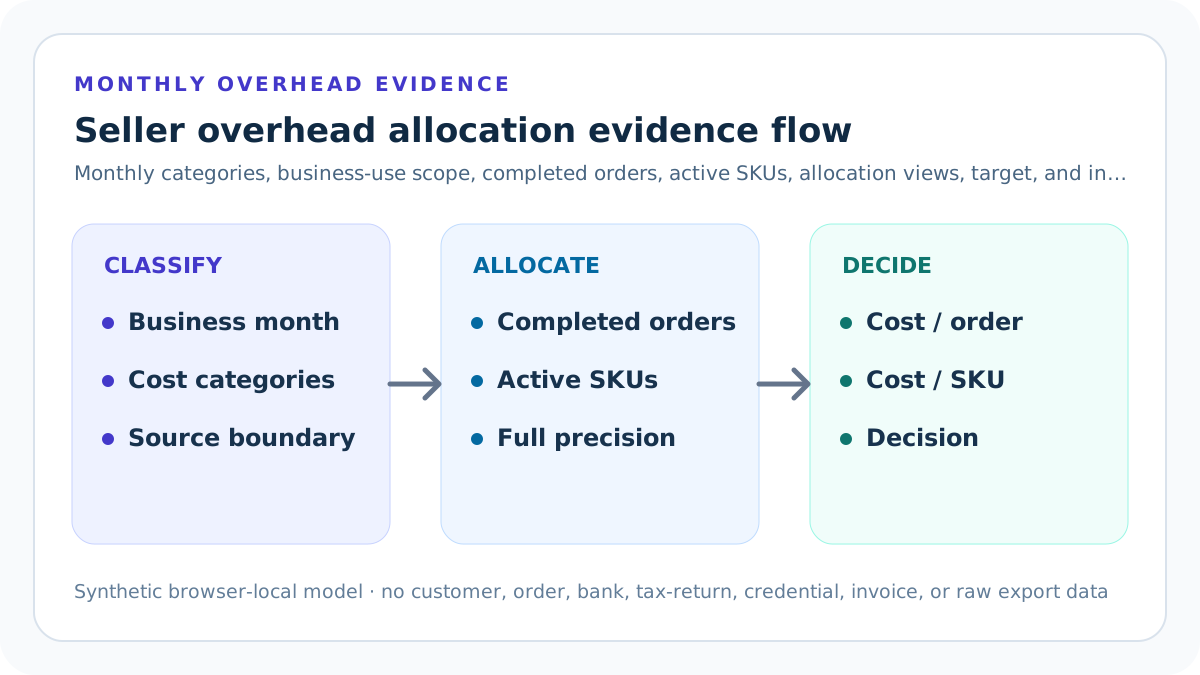
Define one monthly operating boundary
Choose one seller business, one currency, one YYYY-MM month, one recurring-cost convention, one completed-order definition, and one active-SKU definition. The numerator and both denominators must describe the same operating boundary.
Do not combine a household, a second company, a future expansion, and current marketplace operations in one packet. Separate personal use, owner-specific items, taxes, financing, inventory, direct product cost, and one-time projects before allocation.
Classify recurring overhead before adding it
Recurring overhead is an indirect operating resource that supports the business over a period but is not assigned here as a physical or transactional cost of one specific order. The tool provides named categories so software, workspace, equipment allocation, utilities, services, insurance, licenses, and other amounts remain visible.
Classification is an internal management assumption, not a tax or accounting conclusion. Some costs are fixed within one range, semi-variable, directly attributable, prepaid, capitalized, depreciated, mixed personal and business, or one-time. Preserve those questions in the evidence packet rather than forcing them into a favorable category.
Enter software and subscription overhead
Include current recurring applications that support the declared business scope: storefront, design, bookkeeping, inventory, analytics, communications, security, storage, or another evidenced service. Use the monthly amount for the selected period and prevent the same invoice from appearing in multiple categories.
An annual plan needs a documented monthly management allocation if the model uses monthly grain. The allocation does not change cash timing or tax treatment. Free trials, credits, refunds, seat changes, and personal-use portions require separate notes.
Define workspace overhead carefully
Workspace may include eligible rent, studio, storage, coworking, or a seller-owned internal allocation under the declared convention. Record location, business-use scope, effective dates, included services, and whether utilities or insurance are already embedded.
Do not copy an entire household payment into the calculator without a defensible business-use boundary. This tool cannot determine home-office eligibility, deductibility, fair rent, lease treatment, or personal allocation.
Build a monthly equipment allocation
Equipment allocation is a seller-entered management amount for tools, computers, printers, fixtures, or other durable resources supporting the month. State the original resource, useful operating horizon, residual assumption, maintenance boundary, and why the amount belongs in this decision view.
The value is not tax depreciation, amortization, capitalization, book value, or resale value. Use qualified accounting and current official guidance for those determinations. Keep equipment repairs, consumables, leases, financing, and purchase cash flow separately labeled.
Separate utilities and communications
Record the business-use portion of electricity, internet, phone, hosting, and similar recurring services under one documented rule. When usage varies materially with production, preserve low, expected, and high cases or split the variable component from the fixed access component.
The SBA notes that fixed and variable classification depends on how a cost behaves. A monthly bill can still vary with activity. Do not call every monthly payment fixed merely because it arrives on a schedule.
Add professional services at the correct period
Include recurring bookkeeping, legal, compliance, consulting, payroll administration, or another professional service only when it supports the declared month and business scope. Separate project work, disputed invoices, pass-through amounts, and services tied directly to one product or transaction.
IRS Publication 334 provides U.S. context for business expenses but this management allocation does not decide whether a service is ordinary, necessary, deductible, capitalized, or reported on a specific form.
Add insurance, licenses, and permits without duplication
Use the monthly management amount for current coverage, licenses, permits, registrations, or memberships supporting the modeled business. Record policy or authorization period, geographic scope, covered activity, renewal, refund, and any portion already included elsewhere.
A twelve-month payment may be divided for this operating view, but the division does not establish accounting recognition or tax treatment. Exclude personal coverage and inactive permissions unless the business deliberately retains them and documents why.
Use other overhead only with a component list
Other recurring overhead is not a plug. Attach a list of component name, amount, source, business purpose, recurrence, period, and reason it does not fit a named category. Large or growing other amounts should be split into a new visible category before decisions are made.
Never use other overhead to absorb unexplained cash differences, missing inventory, owner withdrawals, loan principal, sales tax collected, customer refunds, or direct order costs. Those require separate reconciliation.
Choose the completed-order denominator
Expected completed orders are the positive whole orders anticipated within the same month and business scope. Use completed orders rather than items, units, listings, visits, leads, carts, or gross transactions unless the operating decision explicitly defines another denominator.
Forecast volume makes the result a planning scenario. After month close, replace it with aggregate completed-order evidence and preserve cancellations, refunds, returns, partial fulfillments, wholesale orders, and multi-unit orders as separately defined populations.
Choose the active-SKU denominator
Active SKUs are distinct sellable stock-keeping units supported during the month under the seller's chosen operating definition. Exclude archived, duplicate, test, draft, and unrelated SKU records unless they genuinely consume the recurring resources being allocated.
Equal overhead per active SKU is a portfolio management view, not evidence that every SKU caused the same cost. A low-volume custom SKU and high-volume standard SKU may need activity-based analysis before product-level decisions.
Calculate total monthly overhead
Add the seven category values at full precision. The default fixture combines USD 95 software, 300 workspace, 80 equipment, 70 utilities, 100 services, 55 insurance and licenses, and 50 other overhead for USD 750.
Reconcile the category total to the management packet, not necessarily to bank cash movement. Prepayments, accruals, refunds, financing, mixed-use items, inventory purchases, taxes, and timing differences can make cash paid differ from the monthly operating view.
Calculate overhead per completed order
Divide total recurring monthly overhead by expected completed orders. USD 750 across 120 orders produces USD 6.25 per order. The same numerator across 600 orders produces USD 1.25, illustrating denominator sensitivity rather than a guaranteed economy of scale.
A lower quotient can result from an optimistic forecast. It does not prove the business is more profitable, efficient, liquid, or viable. Preserve forecast range and later replace it with observed aggregate volume.
Calculate overhead per active SKU
Divide the same monthly numerator by active SKUs supported. USD 750 across 24 SKUs produces USD 31.25 per active SKU; across 30 SKUs it produces USD 25. This view describes portfolio breadth under an equal allocation rule.
Do not add both overhead per order and overhead per SKU to the same product price: they allocate the same numerator across different denominators. Choose the view appropriate to the decision or build a separate activity-based model.
Read expected orders per active SKU
Divide expected orders by active SKUs. The default produces 5 expected orders per active SKU; the high-volume scenario produces 20. Review begins only below the seller-entered minimum, because portfolio strategy determines whether a lower ratio signals dormant SKUs or a deliberate long tail.
This is an average, not a SKU forecast. Inspect actual order distribution, seasonal listings, launch items, custom products, and shared resource consumption before retiring or repricing a SKU.
Compare the seller-owned target
Target headroom equals the entered overhead-per-order threshold minus calculated overhead per order. Positive headroom clears that one management boundary; negative headroom identifies the full-precision gap that requires review.
The target does not prove price, break-even, contribution, accounting profit, cash sufficiency, tax compliance, or acceptable workload. State who owns it, what decision it supports, and when it expires.
Read category concentration
Each category share divides its full-precision amount by total modeled overhead. Review begins when the largest category exceeds the seller-entered maximum share, so classification, business-use scope, source freshness, and denominator sensitivity receive attention.
Concentration is not automatically waste. Workspace, software, insurance, or professional services may be necessary for the chosen business model. Use the threshold to form an evidence question rather than an automatic cancellation rule.
Apply Block, Review, and Ready precedence
Block blank or nonfinite values, negative categories, no positive recurring overhead, non-whole or nonpositive order or SKU denominators, invalid seller thresholds, a nonpositive target, invalid currency, month, or source-review date, vague business scope, incomplete evidence confirmations, or declared conflicts. Invalid evidence cannot be offset by a favorable quotient.
After structure passes, Review overhead above target, expected orders per active SKU below the seller-entered minimum, or a category above the seller-entered maximum share. Ready means only that the planning packet is structurally valid and clears those versioned management gates.
Build a privacy-safe overhead packet
Record category, aggregate monthly amount, protected source pointer, recurrence, business-use convention, evidence month, source-review date, currency, owner, denominator source, seller-owned thresholds, reviewer, expiry trigger, and unresolved conflicts. Confirm classification, business use, timing, denominators, capacity, target purpose, one-month grain, and accounting boundaries before exposing results.
Keep customer, order, payment, employee, credential, bank, tax-return, private invoice, contract, home-address, and raw export data outside public pages and screenshots. A reviewer should reproduce the aggregate calculation without receiving protected records.
Test, release, observe, and correct
Reproduce low-volume Ready, high-volume Ready, high-volume Review, configurable SKU-activity and concentration Reviews, incomplete-confirmation Block, and invalid-structure Block fixtures. Test blank, nonfinite, negative, whole-number, date, threshold, currency, month, scope, and declared-conflict boundaries.
Before release, preserve local and remote backups and a rollback identifier. Verify typecheck, full tests, integration, build, static SEO, schema, noindex or index state, images, links, mobile behavior, live scenarios, and restoration. Record Day 0/7/14/28 evidence without claiming same-day causality.
Choose the next action from the decision
If Block, repair classification, source, denominator, target, context, or conflict. If Review, isolate cost category, volume assumption, active-SKU scope, or target. If Ready, use the result as one versioned input to a broader pricing and operating review.
At month close, replace forecasts with comparable aggregates and explain every material variance. Preserve the previous packet so a later reviewer can distinguish a real cost or volume change from an allocation-rule change.
Sources and further reading
- Seller Profit Guard methodology: Comparable-grain evidence, deterministic calculations, validation, correction, release, and rollback.
- Seller Profit Guard data privacy: Local-first boundaries for seller, customer, order, payment, personnel, credential, invoice, tax-return, and raw export data.
- IRS Publication 334 (2025): Primary U.S. small-business context for business expenses and record questions; this calculator does not determine deductibility or accounting treatment.
- IRS: What kind of records should I keep?: Primary U.S. recordkeeping context for summaries and supporting documents; this calculator stores no private records and does not determine substantiation.
- U.S. Small Business Administration: Break-even point calculator: Official context distinguishing fixed, variable, semi-variable, monthly, quarterly, annual, and one-time cost assumptions.
Related Seller Profit Guard tools
- Etsy CSV profit calculator: Run a local order profit check with editable fee and SKU cost assumptions.
- Payment reconciliation tool: Compare order rows with statement activity and flag unmatched rows.
- SKU cost library: Save or import material, labor, packaging, shipping, and target margin assumptions.
- Variant risk checker: Find missing SKUs and variation cost risks before a listing scales.
- Etsy title checker: Review listing-title clarity, repetition, keyword chains, and mobile scanning.
- Etsy tag checker: Review all 13 tag slots for duplicates, repeated meaning, and truthful coverage.
- Free shipping threshold calculator: Estimate when a shipping subsidy can still meet a target margin.
- Return window loss estimator: Model expected reverse shipping, restock work, recovery, and replacement loss.
- Etsy Ads break-even calculator: Estimate target-safe Etsy Ads spend, ACOS, and ROAS after fees, fulfillment, and expected return loss.
- CSV data privacy: Understand what the local-first workflow needs and what it does not need.
- Seller Overhead Allocation Formula and Inputs: Define recurring monthly cost categories, completed orders, active SKUs, target, currency, evidence month, scope, and allocation boundaries.
- Low-Volume Seller Overhead Allocation Example: Reproduce USD 750 of recurring monthly overhead across 120 completed orders and 24 active SKUs, with a USD 7 per-order target.
- High-Volume Seller Overhead Allocation: Allocate the same USD 750 monthly recurring overhead across 600 completed orders and 30 active SKUs with a USD 2 per-order target.
- Seller Overhead Allocation Mistakes: Correct direct-cost leakage, mixed periods, duplicate invoices, personal use, false denominators, stale forecasts, double allocation, and overclaims.
- Reliable Seller Overhead Allocation Data: Map recurring categories, business-use scope, monthly normalization, completed orders, active SKUs, target, currency, and period to evidence.
- Safe Seller Overhead Allocation Thresholds: Apply business scope, classification, category, denominator, target, context, concentration, uncertainty, privacy, and rollback gates.
- Low- vs High-Volume Overhead Allocation: Compare 120-order and 600-order months without hiding recurring-cost, step-cost, active-SKU, target, forecast, or business-scope changes.
- Seller Overhead Allocation Operating Routine: Run a recurring intake, classification, source, denominator, forecast, exception, approval, release, correction, and month-close control loop.
- How to Interpret Seller Overhead Allocation: Read total overhead, per-order and per-SKU allocations, orders per SKU, category shares, target headroom, decision state, and uncertainty safely.
- Seller Overhead Allocation Audit Template: Audit business scope, cost categories, business use, monthly normalization, denominators, targets, privacy, formulas, content, release, and rollback.
- Shopify Plan Fee Allocation Formula and Inputs: Define the fixed plan charge, billing cycle, closed period, two cost centers, allocation basis, aggregates, thresholds, and evidence before assigning cost.
- Shopify Plan Fee Allocation Example for a Low-Volume Group: Calculate a low-volume cost center's share, allocated charge, per-order amount, per-unit amount, threshold state, and reconciliation.
Use the interactive tool
Enable JavaScript to open the calculator and process browser-local inputs. The explanatory content and source links remain available without JavaScript.
Related guide: Define recurring categories, monthly grain, order and SKU denominators, target, and decision boundaries.
This tool provides operating estimates, not tax, accounting, legal, financial, or marketplace-policy advice. Verify current official sources and your own records before changing prices or operations.