Seller Profit Guard · How it works · CSV privacy
Influencer campaign payback calculator
Compare one sponsored post with a multi-asset fixed-fee influencer campaign. Model dated terms, creator fee, usage rights, approved deliverables, samples, paid amplification, mature retained attributed orders, contribution, conservative reuse, retained-order rate, reuse-share ceiling, break-even and target orders, and headroom without exposing creator or buyer data.
Maintained by Seller Profit Guard Editorial Team. Last reviewed: 2026-07-31.
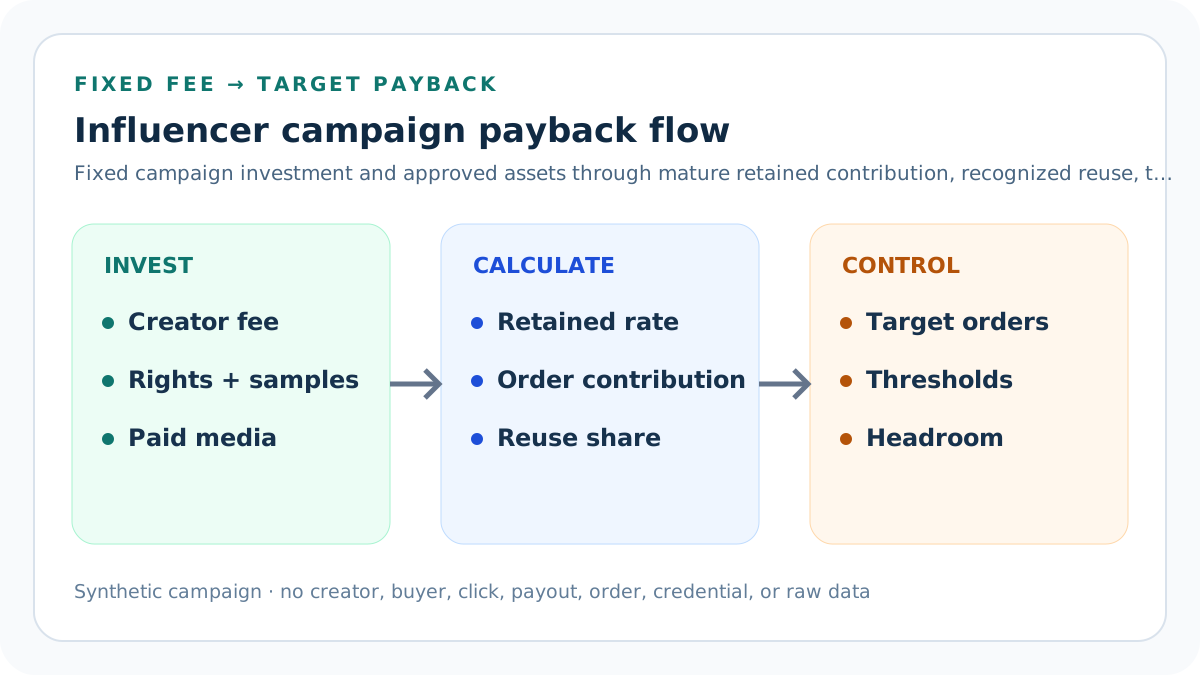
Freeze one fixed-fee campaign
Record platform, market, campaign, creator cohort, product set, currency, deliverables, approval rule, publication window, usage-rights scope, attribution convention, outcome-maturity window, and cost version.
Do not blend affiliate-only commissions, gifted seeding, unrelated creators, open deliverables, multiple currencies, or evergreen brand spend.
Separate fixed compensation
Enter the contracted creator fee for the exact sponsored post or multi-asset packet.
Do not substitute rate-card value, unpaid proposal, performance commission, or retail product value.
Price usage rights independently
Record contracted licensing, whitelisting, partnership-ad, editing, territory, duration, renewal, exclusivity, and likeness-rights cost included in the campaign.
A public post does not automatically grant paid reuse rights.
Count contracted deliverables
Use the exact number of posts, videos, stories, stills, cutdowns, or other assets promised in the signed scope.
A vague content bundle cannot support a per-approved-asset result.
Count delivered and approved assets
Use assets that meet the declared acceptance rule after required revisions.
Submitted, published, approved, usable for paid media, and licensed assets can be different states.
Cost samples and product seeding
Multiply fulfilled sample units by current product cost plus incremental packaging and shipping.
Retail value, requested samples, canceled shipments, recovered inventory, and fulfilled cost are different measures.
Add paid amplification
Include billed campaign spend deliberately assigned to the fixed-fee content recovery target.
Do not mix unspent budget, organic reach, or platform-attributed sales with billed media cost.
Add other campaign cost
Include agency, briefing, editing, localization, compliance review, tracking, or production cost that belongs to the packet.
Classify reusable infrastructure separately and avoid double-counting labor.
Define retained attributed orders
Use one declared platform or seller attribution convention after cancellation, refund, return, dispute, duplicate, and reporting windows mature.
Reported attribution does not prove creator causality or incrementality.
Use contribution per retained order
Enter contribution after ordinary product, fulfillment, fee, commission, discount, advertising, and adverse-outcome costs but before this fixed campaign investment.
Revenue and GMV are not campaign-recovery contribution.
Document reusable asset value
Use a supported avoided-production or licensed-reuse value for assets actually approved and usable in the declared scope.
Do not treat speculative future reach, media value, or creator rate-card value as cash recovery.
Apply a reuse recognition rate
Recognize only the evidence-supported share of documented reusable asset value.
A conservative percentage keeps uncertain future reuse from erasing current cash cost.
Cap recognized reuse share
Compare recognized reusable value with complete campaign investment and enforce a seller-owned maximum percentage.
A valid campaign above the ceiling moves to Review instead of allowing speculative value to dominate cash recovery.
Set a retained-attribution floor
Divide mature retained attributed orders by mature attributed orders and compare the result with a seller-owned minimum.
A low retained rate can expose refund, return, dispute, targeting, or attribution-quality risk even when total payback is positive.
Calculate complete campaign investment
Add creator fee, usage rights, fulfilled sample cost, paid amplification, and other campaign cost.
Keep fixed-fee recovery separate from order commissions already included in per-order contribution.
Calculate retained contribution
Multiply mature retained attributed orders by contribution per retained order.
Do not use views, clicks, gross orders, or open carts as the payback numerator.
Calculate recognized reuse value
Multiply documented reusable asset value by its recognition rate.
Recognition is a bounded seller assumption, not accounting income or cash received.
Calculate contribution credit
Add retained-order contribution and recognized reuse value.
Keep the two components visible so reuse cannot hide weak order recovery.
Calculate break-even orders
Subtract recognized reuse from campaign investment, divide the remainder by positive per-order contribution, and round upward.
The exact quotient remains useful for sensitivity; the whole number is the operational threshold.
Calculate target payback orders
Apply the seller-entered contribution buffer to complete campaign investment before subtracting recognized reuse and dividing by per-order contribution.
A target buffer is not a guaranteed return.
Calculate target headroom
Subtract buffered campaign investment from contribution credit.
Positive unbuffered payback can still miss the seller target.
Calculate cost per retained order
Divide complete campaign investment by observed mature retained attributed orders.
Report unavailable when there are no retained orders instead of dividing by impressions.
Calculate cost per approved asset
Allocate creator, rights, sample, and other production cost across delivered approved assets, keeping paid amplification separate.
This is an asset-production view, not a creator quality score.
Validate one sponsored post
The synthetic post costs USD 1,040 including fee, rights, sample, amplification, and review. Thirty-five retained orders produce USD 1,050 contribution; USD 100 recognized reuse yields USD 58 target headroom.
The 5% target requires 34 retained orders.
Validate a multi-asset campaign
The synthetic four-asset packet costs USD 3,430. One hundred four retained orders produce USD 3,120 contribution; USD 500 recognized reuse yields USD 18.50 target headroom.
The 5% target requires 104 retained orders.
Stress attributed orders
Reduce retained attributed orders while leaving cost, contribution, asset approval, and reuse recognition unchanged.
A structurally valid packet below target moves to Review.
Stress reuse recognition
Set recognized reuse to zero when assets are not yet approved, licensed, or used.
The order-only threshold shows whether future reuse is masking weak campaign recovery.
Verify deliverables before final payback
Require contracted and delivered approved asset counts to reconcile at the declared acceptance scope.
Incomplete delivery or disputed rights blocks a closed campaign result.
Use Block, Review, and Ready
Block invalid counts, nonpositive contribution, unreconciled deliverables, incomplete evidence, or declared conflicts. Review a valid packet below buffered payback.
Ready means both entered scenarios clear their declared target under aggregate assumptions; it does not approve a creator, contract, attribution model, campaign, content, payment, or ad spend.
Respect disclosure and platform rules
FTC guidance and platform policies require clear material-connection disclosures and truthful endorsements; platform declaration tools do not replace applicable legal duties.
Verify the current jurisdiction, platform, product category, audience, content format, and agreement before publication.
Protect creator and customer data
Use synthetic fixtures, aggregate measures, redacted pointers, access controls, and retention rules.
Keep creator identities, handles, emails, contracts, rates, buyer records, order IDs, click IDs, payout data, credentials, tokens, and raw exports outside public pages and logs.
Preserve the evidence ledger
Store each cost, asset count, approval state, rights term, attribution rule, contribution value, reuse basis, owner, date, reviewer, formula version, and uncertainty.
Never overwrite a failed or incomplete campaign packet.
Set stop and correction criteria
Name asset-delivery, disclosure, approval, rights, cost, attribution, return, contribution, paid-media, and policy signals that pause, correct, or restore the prior campaign state.
A calculator cannot monitor or change creator content or platform settings.
Release and restore safely
Run formula, content, similarity, SEO, image, link, browser, mobile, privacy, canonical, schema, strict-404, sitemap, and rollback gates.
Measure Day 0/7/14/28 without claiming same-period causality.
Sources and further reading
- Seller Profit Guard methodology: Evidence versions, formulas, privacy, correction, release, and rollback.
- Seller Profit Guard data privacy: Local-first boundaries for creator, buyer, order, advertising, contract, payment, and raw-record data.
- FTC: Disclosures 101 for Social Media Influencers: Reviewed July 31, 2026: official material-connection, clear-disclosure, placement, truthfulness, and audience-context guidance.
- FTC: Endorsement Guides — What People Are Asking: Reviewed July 31, 2026: official advertiser review, monitoring, material-connection, platform-tool, and endorsement-compliance context.
- YouTube Help: Add paid product placements, sponsorships & endorsements: Reviewed July 31, 2026: official paid-promotion declaration, platform-policy, and local-law responsibility boundaries.
- Google Ads Help: Creator partnerships boost: Reviewed July 31, 2026: official creator-video linking, organic metrics, experiment guidance, and advertiser responsibility for sufficient usage rights.
- YouTube Creator Partnerships Open Call program policies: Reviewed July 31, 2026: one program-specific example of asset selection, rights, likeness, a 180-day usage period, and advertiser review; it is not a universal campaign contract.
Related Seller Profit Guard tools
- Etsy CSV profit calculator: Run a local order profit check with editable fee and SKU cost assumptions.
- Payment reconciliation tool: Compare order rows with statement activity and flag unmatched rows.
- SKU cost library: Save or import material, labor, packaging, shipping, and target margin assumptions.
- Variant risk checker: Find missing SKUs and variation cost risks before a listing scales.
- Etsy title checker: Review listing-title clarity, repetition, keyword chains, and mobile scanning.
- Etsy tag checker: Review all 13 tag slots for duplicates, repeated meaning, and truthful coverage.
- Free shipping threshold calculator: Estimate when a shipping subsidy can still meet a target margin.
- Return window loss estimator: Model expected reverse shipping, restock work, recovery, and replacement loss.
- Etsy Ads break-even calculator: Estimate target-safe Etsy Ads spend, ACOS, and ROAS after fees, fulfillment, and expected return loss.
- CSV data privacy: Understand what the local-first workflow needs and what it does not need.
- Influencer Campaign Payback Formula and Inputs: Build fixed-fee influencer payback from complete investment, approved assets, retained contribution, reuse recognition, and target headroom.
- Influencer Campaign Payback Example: One Sponsored Post: Follow one sponsored post through creator fee, rights, sample, media, retained contribution, recognized reuse, and target payback.
- Influencer Campaign Payback for a Multi-Asset Campaign: Model a four-asset campaign with larger creator fee, rights, samples, paid amplification, approved assets, reuse, and target recovery.
- Influencer Campaign Payback Mistakes and Corrections: Correct fixed-fee campaign errors involving incomplete costs, gross orders, disputed assets, speculative reuse, attribution, and target math.
- Influencer Campaign Payback Data Sources: Map creator fees, rights, assets, samples, media, retained contribution, attribution, reuse, and maturity to reviewable evidence.
- Influencer Campaign Payback Decision Thresholds: Separate cash break-even, buffered target payback, order-only recovery, reusable-asset credit, and evidence failure thresholds.
- Influencer Payback: One Post vs Multi-Asset Campaign: Compare one sponsored post with a four-asset campaign at the same contribution, attribution, maturity, rights, and target grain.
- Weekly Influencer Campaign Payback Routine: Run a repeatable fixed-fee campaign review across assets, rights, costs, attribution, returns, contribution, reuse, exceptions, and rollback.
- How to Interpret Influencer Campaign Payback: Read payback orders, target headroom, cost per retained order, cost per asset, and reuse value without causal or accounting overclaim.
- Influencer Campaign Payback Audit Template: Audit fixed compensation, rights, deliverables, samples, media, attribution, contribution, reuse, thresholds, disclosure, and change history.
Use the interactive tool
Enable JavaScript to open the calculator and process browser-local inputs. The explanatory content and source links remain available without JavaScript.
Related guide: Define fixed campaign investment, approved deliverables, retained contribution, conservative reuse, target payback, and evidence boundaries.
This tool provides operating estimates, not tax, accounting, legal, financial, or marketplace-policy advice. Verify current official sources and your own records before changing prices or operations.