Seller Profit Guard · How it works · CSV privacy
Exchange order loss calculator
Estimate the incremental seller loss and remaining original-order contribution for one defined size, color, variant, or product exchange. Reconstruct original contribution, add return and second-fulfillment costs, subtract verified payment, fee-credit, and returned-inventory recovery, then compare loss with a seller-owned maximum.
Maintained by Seller Profit Guard Editorial Team. Last reviewed: 2026-07-31.
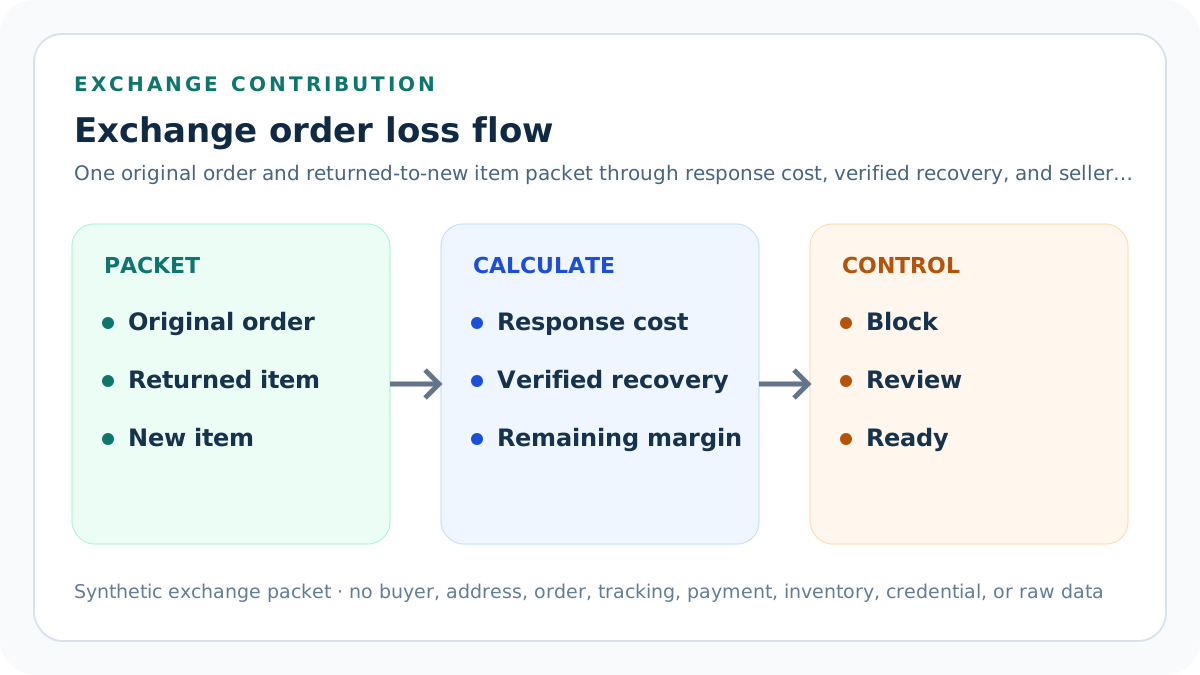
Freeze one exchange packet
Start with one fulfilled physical order, one returned-item set, one exchange-item set, one reason and mapping, one currency, one policy version, one evidence period, and one responsibility context.
Do not blend several exchanges, partial returns, refunds, replacements, upsells, markets, or inventory locations. Packet mixing hides balances, shipping, fee, recovery, and fulfillment state.
Separate eligibility from contribution
Current policy, promise, platform workflow, market rules, and applicable legal review determine whether an exchange may be offered or required. This calculator starts after that authority is documented.
A positive contribution estimate cannot deny rights, change an earlier promise, authorize a collection, delay a refund, reserve inventory, or release exchange fulfillment.
Record the exact item mapping
Name the returned SKU, variant, size, color, quantity, and condition plus the new SKU, variant, size, color, quantity, and fulfillment responsibility.
Size exchange, color exchange, same-price variant exchange, lower-price product exchange, and upgrade are economically different. A vague exchange label is not reproducible evidence.
Reconstruct original merchandise revenue
Multiply original item quantity by original unit selling price for only the items in the exchange packet.
Do not substitute current price, replacement price, list price, tax, gift card value, or the whole order when only one line is exchanged.
Add original buyer-paid shipping
Include the original shipping amount allocated to the packet under one documented convention.
Buyer shipping is original order revenue, not a recovery from the exchange. Keep tax and duties outside unless the model is explicitly extended.
Reconstruct original product cost
Multiply original item quantity by the versioned direct product cost that applied to the original fulfilled item.
Do not overwrite historical cost with the new item's cost or a current supplier quote. Both item packets need their own cost evidence.
Subtract original outbound shipping
Use the original fulfilled parcel charge or a documented allocation for the exchanged item packet.
The second outbound shipment is an incremental exchange cost and must not replace the first shipment in original contribution.
Subtract original fees
Record platform and payment fees actually borne by the original order packet before exchange credits or new debits.
Keep listing, transaction, processing, advertising, currency, regulatory, tax-on-fee, and other layers traceable rather than applying a remembered blended rate.
Calculate original contribution
Original contribution equals original merchandise and shipping revenue minus original product cost, original outbound shipping, and original fees.
This is the bounded order contribution available before exchange response cost. It is not accounting profit, taxable income, or cash balance.
Price seller-paid return shipping
Enter the final seller-borne reverse-logistics charge for the defined returned-item packet.
Keep customer-paid postage, issued labels, used labels, carrier scans, adjustments, pickup, and final billed charges separate.
Price exchange-item product cost
Multiply exchange quantity by the direct cost of the specific new SKU or variant being fulfilled.
A size exchange may have equal product cost; a material, bundle, or premium product exchange may not. Use versioned item evidence.
Price exchange outbound shipping
Enter the second fulfillment's actual or carefully documented shipping cost at the declared package and service grain.
Do not assume it equals the original outbound charge. Weight, dimensions, destination, carrier, service, and timing can differ.
Price exchange packaging
Include the mailer, box, cushioning, tape, label, insert, protective material, and consumables required for the exchange fulfillment.
Do not duplicate reusable materials or omit extra packaging created by a different product size or fragility.
Price exchange handling
Record seller work for authorization, instructions, support, receipt, inspection, inventory routing, balance review, picking, packing, and fulfillment.
Use a documented labor or activity-cost convention. Owner time is not automatically free, and unrelated restocking work belongs in its own model.
Add exchange fee debits
Enter additional platform or payment fees caused by new customer payment, invoicing, order editing, shipping, or exchange processing when verified.
Do not infer a debit from a headline rate. Use the actual fee base, status, currency, and effective rule.
Add customer refund
When the defined exchange balance requires money returned to the customer and authority permits it, enter the amount actually due or paid under the selected state.
Keep estimated, due, initiated, succeeded, failed, reversed, and disputed refunds separate. This calculator does not authorize the refund.
Recognize verified fee credits
Subtract only platform or payment credits supported by current transaction evidence.
Pending, expected, assumed, or ineligible credits remain outside recognized recovery. Cap the credit to original fees plus entered new debit.
Recognize additional customer payment
Subtract only a verified exchange balance collected from the customer for a higher-priced item or other permitted amount.
A displayed amount due, invoice, payment link, authorization, failed capture, or promised payment is not collected recovery.
Recognize returned-inventory recovery
Enter conservative verified recovery from the physically returned item after receipt, inspection, condition grading, safety, and authority review.
Do not use original retail price or automatically assume full product cost recovery. Restocking, resale, liquidation, parts, supplier return, or disposal need separate evidence.
Calculate gross response cost
Add return shipping, exchange product cost, second outbound shipping, packaging, handling, added fee debit, and customer refund.
This isolates incremental seller cost created by the exchange packet without double-counting original order cost.
Calculate verified recovery
Add fee credit, collected additional customer payment, and returned-inventory recovery.
Keep customer payment and inventory recovery distinct. They are different evidence states, timing risks, and operational owners.
Calculate incremental exchange loss
Subtract verified recovery from gross exchange response cost. Negative loss can be valid when verified additional payment and recovery exceed incremental cost.
A negative modeled loss does not establish a permitted upsell, customer benefit, successful payment, or accounting gain.
Calculate contribution after exchange
Subtract incremental exchange loss from original contribution before exchange.
This shows whether the original order packet still contributes after the exchange. It does not combine lifetime customer value, retention, or future purchases.
Set a maximum exchange-loss target
Enter a dated seller-owned maximum incremental loss for the product or exchange class. Target headroom equals maximum minus modeled loss.
Do not loosen the target after seeing a preferred result without recording owner, rationale, cohort, effective date, and affected decisions.
Set a contribution-retention floor
Divide contribution after exchange by positive original contribution and compare the result with a dated seller minimum. The default synthetic packet retains 22.41% of its original contribution.
A nonpositive original contribution cannot produce a useful retention rate and routes to Review even if the absolute loss maximum is loose.
Set a recovery-concentration ceiling
Divide verified fee credit, collected customer payment, and returned-inventory recovery by gross exchange response cost. The default synthetic packet has a 34.78% recovery share.
A high share is not invalid, but it makes the conclusion sensitive to payment reversal, fee-credit timing, inspection, condition, disposition, and realized inventory value.
Require nine dated evidence confirmations
Confirm the original order, returned item, exchange item, shipping and handling, balance and refund, fee credit, inventory recovery, source lineage, and planning boundary against a real source-review date.
A narrative that looks plausible but lacks current responsible-owner confirmation Blocks monetary outputs instead of quietly treating missing states as zero.
Validate finite values and whole quantities
Reject blank, NaN, infinite, fractional-quantity, negative, impossible-date, invalid-threshold, weak-scope, and incompatible evidence before calculation.
The scope must name one fulfilled physical order, returned item, exchange item, fulfillment state, and currency without exposing private operational records.
Use Block, Review, and Ready
Block means the exchange packet or evidence structure is invalid. Review means loss, contribution retention, recovery concentration, or positive-contribution controls need attention. Ready means all entered arithmetic controls pass.
Ready is arithmetic readiness only. Exchange eligibility, customer rights, balance collection, refund, inventory, and fulfillment still require authorized workflow state.
Validate the size-exchange example
A USD 55 original gross amount less USD 15 product cost, USD 6 shipping, and USD 5 fees leaves USD 29 original contribution.
USD 34.50 gross exchange response cost less USD 12 returned-inventory recovery creates USD 22.50 loss, USD 6.50 remaining contribution, and USD 2.50 target headroom.
Stress a product exchange
A higher-cost new product, larger second shipment, packaging, handling, and added fees can produce USD 27.50 loss even after USD 10 additional customer payment and USD 12 inventory recovery.
The result misses a USD 25 target and routes to Review. It does not decide whether the product exchange should be offered.
Protect exchange and customer data
Keep buyer names, addresses, emails, messages, order IDs, tracking, labels, invoices, payments, refunds, inventory accounts, credentials, and raw records in authorized systems.
Use exchange-packet aliases, redacted evidence pointers, aggregate cost evidence, access controls, retention rules, and approved synthetic fixtures in public artifacts.
Reconcile operational states
Track requested, approved, received, inspected, processed, payment due, paid, refund due, refunded, released, fulfilled, delivered, restocked, and closed separately.
Financial and inventory results can change when only part of a return is processed or an exchange item is released before payment. Never collapse the state machine.
Release and restore safely
Preserve local and remote backups plus a rollback identifier. Run typecheck, tests, integration, build, content, duplicate, SEO, image, link, browser, mobile, keyboard, privacy, and restore checks.
After release, verify status, canonical, indexability, schema, answers, tool scenarios, assets, strict 404, sitemap policy, events, and Day 0/7/14/28 evidence. Restore on regression.
Sources and further reading
- Seller Profit Guard methodology: Exchange-packet grain, incremental contribution, evidence versions, privacy, correction, release, and rollback.
- Seller Profit Guard data privacy: Local-first boundaries for buyer, address, message, tracking, label, payment, refund, inventory, and raw-order data.
- Etsy Help: Set Return Policies on Listings: Official physical-listing return and exchange policy context.
- Shopify Help: Creating and processing returns and exchanges: Official returned-item, exchange-item, partial-processing, balance, payment, refund, inventory, release, and fulfillment context.
- Shopify Help: Returns and exchanges: Official distinction between refund, return, and alternative-item exchange workflows.
- Shopify Help: Return and cancellation rules: Official return window, fee, market, and policy-version context.
Related Seller Profit Guard tools
- Etsy CSV profit calculator: Run a local order profit check with editable fee and SKU cost assumptions.
- Payment reconciliation tool: Compare order rows with statement activity and flag unmatched rows.
- SKU cost library: Save or import material, labor, packaging, shipping, and target margin assumptions.
- Variant risk checker: Find missing SKUs and variation cost risks before a listing scales.
- Etsy title checker: Review listing-title clarity, repetition, keyword chains, and mobile scanning.
- Etsy tag checker: Review all 13 tag slots for duplicates, repeated meaning, and truthful coverage.
- Free shipping threshold calculator: Estimate when a shipping subsidy can still meet a target margin.
- Return window loss estimator: Model expected reverse shipping, restock work, recovery, and replacement loss.
- Etsy Ads break-even calculator: Estimate target-safe Etsy Ads spend, ACOS, and ROAS after fees, fulfillment, and expected return loss.
- CSV data privacy: Understand what the local-first workflow needs and what it does not need.
- Exchange Order Loss Formula and Inputs: Define original contribution, exchange response cost, verified recovery, remaining contribution, evidence states, decision target, and authority boundaries.
- Size Exchange Loss Worked Example: Work a size-exchange example from original contribution through second fulfillment, inventory recovery, remaining contribution, and target headroom.
- Product Exchange Cost Scenario: Model a higher-cost product exchange with a different SKU, parcel, handling load, fee debit, verified customer payment, recovery, and target outcome.
- Exchange Order Loss Calculation Mistakes: Diagnose mixed packets, rewritten costs, duplicate shipping, free handling, premature credits, unpaid balances, false recovery, and authority errors.
- Exchange Order Loss Data Sources: Map every exchange-loss input to original order, shipment, fee, return, new-item, payment, refund, inventory, policy, and workflow evidence.
- Exchange Loss Decision Thresholds: Set evidence blocks, maximum loss, remaining-contribution, uncertainty, payment, recovery, inventory, service, policy, release, and rollback controls.
- Size vs Product Exchange Cost Comparison: Compare size and product exchanges at the same original-order grain while isolating new-item cost, parcel, handling, balance, recovery, and target differences.
- Weekly Exchange Loss Review Routine: Run a privacy-safe exchange loop for packet creation, item mapping, shipping, balances, inventory, calculation, correction, release, and rollback.
- Interpret Exchange Order Loss Results: Read original contribution, response cost, verified recovery, incremental loss, remaining contribution, target headroom, evidence state, and uncertainty safely.
- Exchange Loss Audit Checklist and Change Log: Use an exchange packet checklist and dated change log for evidence, formulas, fixtures, privacy, release, live checks, corrections, and rollback.
Use the interactive tool
Enable JavaScript to open the calculator and process browser-local inputs. The explanatory content and source links remain available without JavaScript.
Related guide: Define the exchange packet, incremental loss, remaining contribution, target, and authority boundaries.
This tool provides operating estimates, not tax, accounting, legal, financial, or marketplace-policy advice. Verify current official sources and your own records before changing prices or operations.