Seller Profit Guard · How it works · CSV privacy
Etsy refund fee reconciliation calculator
Use this browser-local calculator for one seller-funded Etsy Payments refund issued through Shop Manager before 180 elapsed days. Confirm dated payment, refund, cancellation, fee-credit, cost, recovery, and exclusion evidence; reconcile transaction, processing, listing, and seller-fee-tax credits separately; then calculate final contribution and refund impact.
Maintained by Seller Profit Guard Editorial Team. Last reviewed: 2026-07-30.
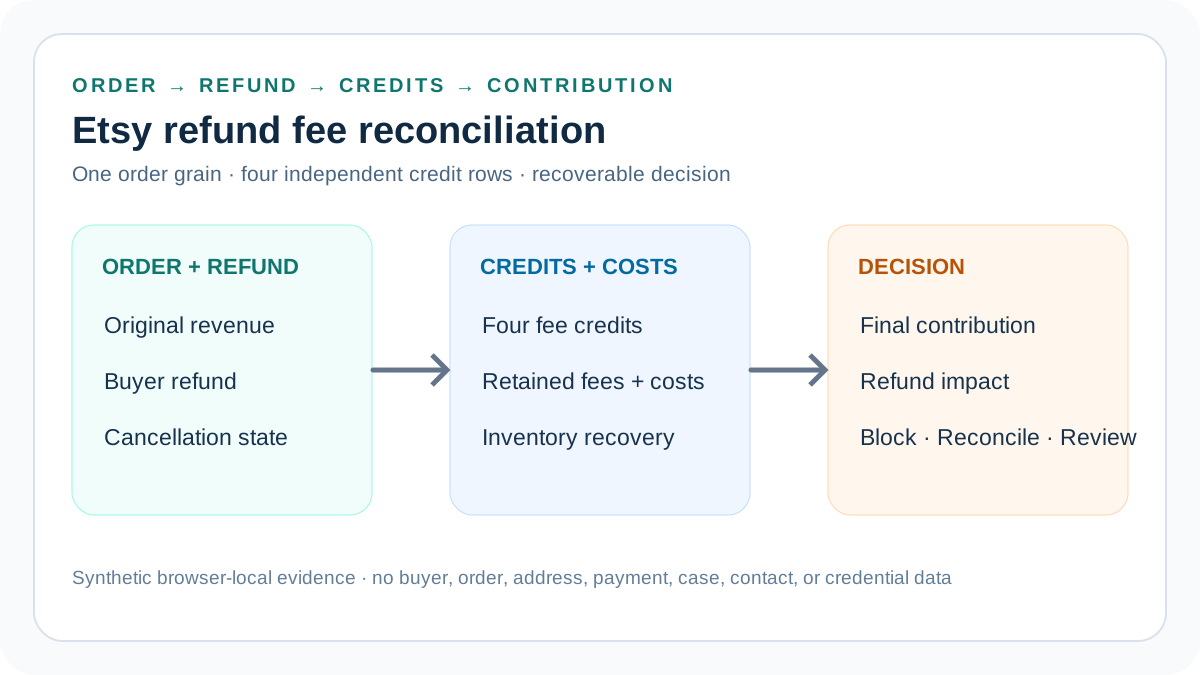
What this Etsy refund fee reconciliation calculator solves
A refund changes more than the buyer-facing payment. It can create separate Payment account credits for transaction and Etsy Payments processing fees, and a canceled transaction can also create a listing-fee credit. Seller-fee tax, retained service fees, product cost, outbound shipping, return shipping, handling, and inventory recovery need their own rows.
This calculator answers a narrow operational question: after one documented buyer refund, what revenue remains, which fee credits should be expected, whether actual rows reconcile, what marketplace and direct costs remain, and how the final order contribution differs from its original pre-refund contribution.
Confirm the standard seller-funded refund contract
This calculator is intentionally limited to one seller-funded Etsy Payments order refund issued through Etsy Shop Manager. Confirm the original payment method, refund channel, seller funding, cancellation status, same-event fee-credit rows, same-order direct and recovery costs, and exclusion of cases, Etsy-funded Purchase Protection, chargebacks, and external refunds.
Use the exact scope “One seller-funded Etsy Payments order refund.” A broader Payment account total, multi-order statement, Etsy-funded protection refund, case reimbursement, chargeback, standalone PayPal refund, or private external repayment follows a different evidence trail and blocks this contract.
Use three dates and enforce the pre-180-day boundary
Record a valid YYYY-MM-DD review date for Etsy's current refund guidance, the original Etsy Payments processing date, and the Shop Manager refund date. The refund date cannot precede payment processing and must occur before 180 elapsed days for the standard in-product refund path modeled here.
A packet at 179 elapsed days can continue if every other gate passes; a packet at exactly 180 elapsed days blocks. This date calculation is a validation boundary, not proof that an order is refundable, a button is available, a buyer has legal rights, or Etsy will post a particular credit.
Freeze one original order grain
Start with one original order evidence packet, not total shop sales or a mixed statement period. Enter original item revenue, buyer-paid shipping, and gift-wrap revenue in one Payment account currency. The tool adds those components into the original revenue base and preserves them as the ceiling for each refund component.
Use synthetic values or privacy-safe internal pointers during review. Never paste buyer names, addresses, messages, order numbers, payment details, or raw exports into a public route. An order alias, period, source class, and reviewer are enough to make the arithmetic reconstructable without exposing customer data.
Separate item, shipping, and gift-wrap refunds
Enter the buyer refund as item, shipping, and gift-wrap components. The calculator blocks a component above its original counterpart and blocks a total refund above original order revenue. This prevents a plausible total from hiding an impossible component allocation or a row copied from another order.
A full refund equals original order revenue within the model; a positive refund below that amount is partial. Those labels describe only the entered amounts. They do not decide whether a refund is legally required, permitted by shop policy, covered by Etsy Purchase Protection, connected to a case, or successfully received.
Keep refund and cancellation separate
Etsy's seller Help distinguishes issuing a refund from canceling a transaction. The calculator therefore asks whether the transaction was also canceled instead of inferring cancellation from a full refund. Enter yes or no from accountable order-state evidence; an unknown answer blocks the packet.
Cancellation controls the expected listing-fee credit in this model. When cancellation is confirmed, the entered original listing fee becomes expected credit. Without cancellation, expected listing credit is zero. An unexpected actual listing credit still requires row-level reconciliation rather than changing the cancellation answer.
Calculate expected transaction-fee credit
The expected transaction-fee credit equals the entered refunded revenue base multiplied by the entered transaction-fee rate. The default fixture uses 6.5%, but the rate remains editable because the operator must verify current rules, order scope, channel, refund timing, currency, and account evidence.
Compare the expected transaction credit with its own actual Payment account row. Do not net it with processing, listing, tax, reserve, or case activity. A difference above tolerance returns Reconcile even when total fee credits or final contribution happen to look acceptable.
Model processing-fee credit explicitly
Etsy states that transaction and processing fees for refunded transactions are automatically credited when the refund is issued through Shop Manager. Partial-refund presentation, fixed components, taxes, timing, and statement labels still require actual evidence, so the tool does not silently reuse the transaction-fee percentage.
Enter the original processing fee and an expected percentage of that original fee. A full-refund fixture can use 100%; a partial fixture can use a documented proportional assumption. The actual processing credit cannot exceed the original processing fee and must reconcile independently within tolerance.
Reconcile listing and seller-fee tax credits
Listing-fee credit is conditioned on confirmed cancellation in this model. Seller-fee tax or withholding-tax credit is a separate seller-entered expectation because jurisdiction, invoice treatment, calendar month, tax type, and statement period can change whether and when a credit appears.
Enter the original seller-fee tax charged before entering expected and actual seller-fee-tax credits. Neither credit may exceed the original tax within tolerance. The calculator compares listing and tax credits independently and does not determine VAT, sales tax, withholding, return filing, or legal eligibility.
Keep other marketplace fees visible
Enter any other original marketplace fees that remain after the refund, such as an advertising or service fee that current evidence does not credit. The tool combines original transaction, processing, listing, tax, and other marketplace fee rows, then subtracts actual fee credits to calculate retained marketplace fees.
Do not assume every Etsy service fee reverses because transaction and processing credits do. Etsy's Fees and Payments Policy describes service-fee limits and many fee categories with different bases. A retained fee needs its own label, source, date, amount, and accounting review rather than being hidden in product cost.
Calculate direct, return, and recovery costs
Product cost and original outbound shipping remain part of the original order economics. Add return shipping and refund-handling cost once, then subtract a supportable recoverable inventory value. The tool blocks inventory recovery above the entered original product cost because that would create unsupported profit from a returned unit.
Recovery value is not automatically equal to product cost. Product condition, customization, perishability, damage, restocking work, resale discount, and future demand can reduce it. Preserve the inspection or cost-record pointer and keep speculative future resale outside actual cash and Payment account evidence.
Trace the full-refund worked example
The default synthetic order contains USD 80 item revenue and USD 8 shipping. It refunds all USD 88 through the modeled Shop Manager channel, confirms cancellation, expects USD 5.72 transaction credit, USD 2.89 processing credit, and USD 0.20 listing credit, and reconciles the same actual rows.
Original marketplace fees total USD 8.81 and original direct costs total USD 28, producing USD 51.19 original contribution. After the refund, USD 30 direct and handling costs minus USD 18 recovered inventory value leave USD 12 net retained cost. Final contribution is negative USD 12 and refund impact is negative USD 63.19.
Trace the partial-refund scenario
The partial fixture keeps the same original order but refunds only USD 40 item revenue. Shipping remains retained, the transaction is not canceled, expected transaction credit is USD 2.60, processing credit uses an explicit 45.4545% share of the original fee, and expected listing credit is zero.
With USD 48 retained revenue, remaining marketplace fees, original direct costs, USD 1 handling, and no inventory recovery, final contribution is about USD 14.10. The refund-related impact is about negative USD 37.09. This demonstrates allocation; it does not certify Etsy's actual partial fixed-fee or tax treatment.
Read Block, Reconcile, Review, and Ready
Block covers negative or over-refunded values, invalid percentages, unknown cancellation, impossible fee credits or inventory recovery, unsupported refund channel, missing currency or period, and declared evidence conflicts. Reconcile covers any transaction, processing, listing, or seller-fee tax credit difference above tolerance.
Review covers a fully reconciled packet whose negative refund impact exceeds the seller-owned contribution-loss ceiling. Ready confirms only the entered refund, cancellation, fee-credit, cost, recovery, currency, period, and threshold evidence. It is not approval to issue a refund or close a case.
Use tolerance without hiding row drift
Tolerance applies independently to each of the four fee-credit differences. It can absorb minor display rounding, but it must not hide a wrong order, another currency, different statement period, external refund, missing cancellation, partial fixed-fee issue, seller-fee tax mismatch, or duplicated credit.
When a row differs, preserve expected and actual values, source labels, timestamps, and the first accountable correction. Do not widen tolerance until a total passes. After correction, rerun the mismatch fixture and ensure the prior packet can be restored byte-for-byte if the new evidence is later rejected.
Handle refunds outside the standard path
Etsy notes that standard Etsy Payments refunds generally have a time boundary and that refunds outside Etsy or after the supported window may not receive Etsy seller-fee credits. Chargebacks, cases, Purchase Protection coverage, insufficient Payment account funds, card charges, external payment methods, and buyer refund method can also change the evidence trail.
Declare those conditions instead of forcing them into the default formula. The calculator does not authenticate eligibility or perform an action. When the refund channel is not identified as Etsy Shop Manager, it blocks automatic fee-credit expectations until separate policy and statement evidence supports a different treatment.
Move the result into the complete fee stack
After the four credit rows reconcile, carry retained marketplace fees and final contribution into the Etsy Fee Stack Calculator and Seller Profit Guard. Preserve the original order alias, refund period, actual credit rows, and cost-recovery policy so credited fees are not subtracted twice.
Refund impact is a change in contribution, not the buyer refund amount, bank deposit, amount due, taxable profit, or cash-flow guarantee. Combine it with aggregate return rates only under a documented denominator and period. Never extrapolate one unusual case into a shop-wide loss assumption without comparable evidence.
Test current, boundary, and broken packets
Keep deterministic tests for the USD 88 full-refund Review, USD 40 partial-refund Ready, independent transaction and processing differences, the exact 180-day Block, invalid evidence, impossible seller-fee-tax credits, and blank or non-finite numbers. Tests must cover cancellation-conditioned listing credit, four independent differences, costs, recovery ceiling, final contribution, and decision precedence.
A regression that allows refund above original revenue, infers cancellation, accepts an Etsy-funded protection refund, crosses the 180-day boundary, nets all credits, credits listing fee without cancellation, accepts impossible recovery, loses the one-order scope, or describes Ready as approval must fail before release.
Release and recover the complete cluster
Before release, retain narrow local and remote backups plus a rollback identifier. Run syntax and SVG validation, typecheck, unit and integration tests, production build, SEO/AEO, content and similarity audits, browser interaction, canonical and schema checks, image loading, and 390-pixel mobile QA.
Publish the parent tool and ten support guides as one ordered cluster. Add self-canonicals, indexability, sitemap entries, guide-hub and tool backlinks together, purge only changed URLs and assets, verify public HTTP and behavior, and restore after a critical live failure.
Privacy, independence, and professional limits
Seller Profit Guard is independent and unaffiliated with Etsy. This browser-local worksheet does not retrieve account data, issue refunds, cancel transactions, contact buyers, decide cases, value legal rights, determine tax, reproduce every fee-credit rule, or guarantee timing, inventory recovery, ranking, traffic, approval, revenue, or income.
Keep buyer names, emails, addresses, messages, order and listing IDs, payment rows, case records, bank details, account notices, tax identifiers, contacts, tokens, OAuth material, credentials, and raw exports outside public pages. Verify current Etsy evidence and obtain qualified accounting, tax, legal, or customer-service advice when material.
Sources and further reading
- Etsy Refund Help: Full and partial refund steps, refund funding, transaction and processing credits, cancellation distinction, listing credit, and timing boundary.
- Etsy Fees and Payments Policy: Transaction-fee base, service-fee limits, Payment account treatment, and withholding-tax refund timing.
- Etsy Payments Policy: Seller-issued partial and full refund fee recalculation and the no-credit boundary for Etsy-funded full protection refunds.
- Etsy Purchase Protection for Sellers: Seller eligibility context and the boundary between Etsy-funded protection refunds and seller-funded refunds.
- Etsy Payment Account Help: Refund, fee, tax, statement, amount due, reserve, and available-funds evidence.
- Etsy Cancellation Help: Cancellation evidence and its separation from a refund.
- Seller Profit Guard methodology: Evidence hierarchy, privacy-safe fixtures, deterministic decisions, bounded release, correction, and rollback.
Related Seller Profit Guard tools
- Etsy CSV profit calculator: Run a local order profit check with editable fee and SKU cost assumptions.
- Payment reconciliation tool: Compare order rows with statement activity and flag unmatched rows.
- SKU cost library: Save or import material, labor, packaging, shipping, and target margin assumptions.
- Variant risk checker: Find missing SKUs and variation cost risks before a listing scales.
- Etsy title checker: Review listing-title clarity, repetition, keyword chains, and mobile scanning.
- Etsy tag checker: Review all 13 tag slots for duplicates, repeated meaning, and truthful coverage.
- Free shipping threshold calculator: Estimate when a shipping subsidy can still meet a target margin.
- Return window loss estimator: Model expected reverse shipping, restock work, recovery, and replacement loss.
- Etsy Ads break-even calculator: Estimate target-safe Etsy Ads spend, ACOS, and ROAS after fees, fulfillment, and expected return loss.
- CSV data privacy: Understand what the local-first workflow needs and what it does not need.
- Etsy Refund Fee Reconciliation Formula: Reconcile original revenue, buyer refund, cancellation, four fee-credit rows, retained costs, inventory recovery, and final contribution.
- Full Etsy Refund Fee Worked Example: Trace a synthetic USD 88 full refund through fee credits, cancellation, retained costs, inventory recovery, and contribution impact.
- Partial Etsy Refund Fee Scenario: Model a USD 40 item-only partial refund with proportional fee credits, no cancellation, retained revenue, and final contribution.
- 12 Etsy Refund Reconciliation Errors: Correct errors involving order grain, components, cancellation, four fee-credit rows, retained costs, inventory recovery, timing, and privacy.
- Etsy Refund Fee Evidence Sources: Map original order, refund, cancellation, fee credits, tax, retained costs, inventory recovery, channel, currency, and period to evidence.
- Safe Etsy Refund Decision Thresholds: Set non-compensating Block, Reconcile, Review, and Ready gates for refund amounts, cancellation, fee credits, costs, recovery, and loss.
- Full vs Partial Etsy Refund Comparison: Compare full and partial refunds on one synthetic order and isolate refund amount, cancellation, fee credits, retained revenue, and recovery.
- Weekly Etsy Refund Reconciliation Routine: Run a repeatable refund review from order and refund evidence through fee credits, costs, contribution, approval, and recovery.
- How to Read Etsy Refund Results: Interpret decision, refund type and share, four fee-credit differences, retained revenue, fees, costs, final contribution, impact, and limits.
- Etsy Refund Reconciliation Audit Template: Audit original order, refund, cancellation, expected and actual fee credits, retained fees, costs, recovery, contribution, approval, and rollback.
Use the interactive tool
Enable JavaScript to open the calculator and process browser-local inputs. The explanatory content and source links remain available without JavaScript.
Related guide: Build the order-level refund and fee-credit worksheet before changing contribution assumptions.
This tool provides operating estimates, not tax, accounting, legal, financial, or marketplace-policy advice. Verify current official sources and your own records before changing prices or operations.