Seller Profit Guard · How it works · CSV privacy
Etsy production partner disclosure checker for accurate seller and partner roles
Record the item's applicable designed-by-seller or buyer-personalized sourced path, the seller's qualifying contribution, the outside partner's physical-production role, an exact buyer-readable title and location, every listing association, the actual dispatch origin, known conflicts, and dated evidence. Eight deterministic checks return Ready, Revise, Hold, or Block.
Maintained by Seller Profit Guard Editorial Team. Last reviewed: 2026-07-30.
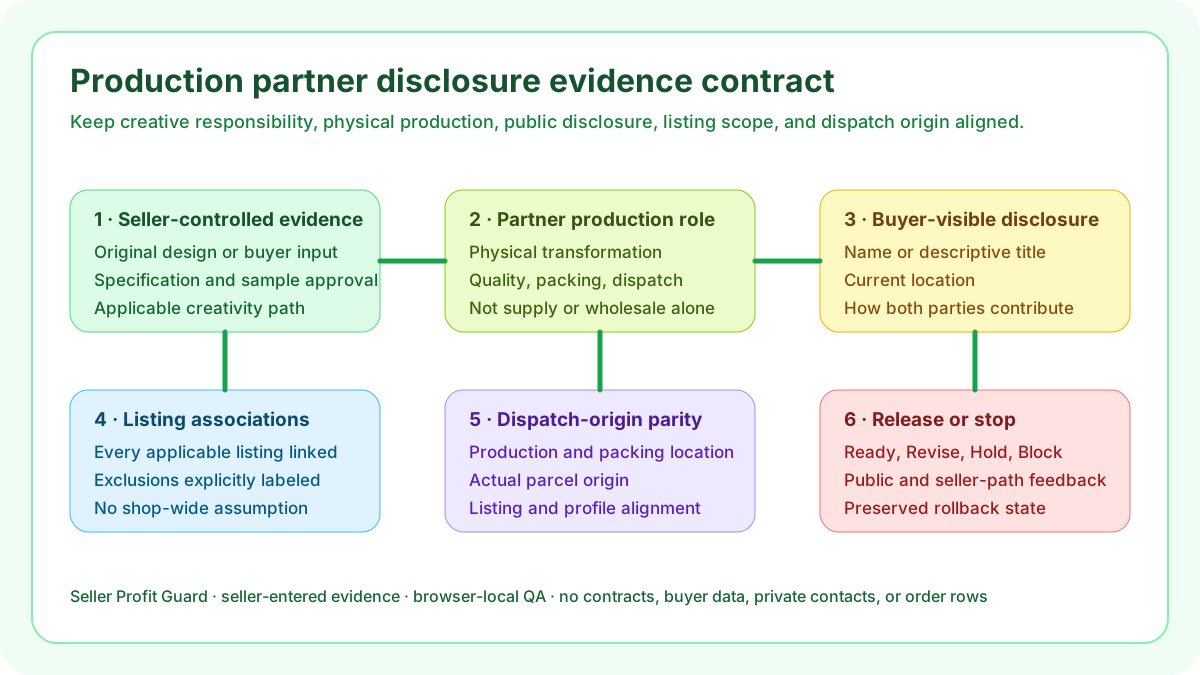
What the Etsy production partner disclosure checker reviews
This browser-local tool reviews the evidence packet behind a production-partner disclosure. It separates the seller's qualifying original design or buyer-personalization contribution from what an outside business physically produces, then checks whether the partner's buyer-visible title and location, public relationship description, applicable listing links, and dispatch origin agree with that operating reality.
The checker is intentionally narrower than an Etsy eligibility decision. It cannot determine whether an item is allowed, approve a partner, inspect labor conditions, detect reselling, verify intellectual-property ownership, or reproduce Etsy's internal review. It helps a seller find missing or contradictory disclosure records before a bounded public change and final review against current Etsy rules.
- Identify the qualifying item and seller contribution.
- Describe the partner's physical-production work.
- Record a buyer-readable partner title and location.
- Explain both roles in the public description.
- Link every applicable physical listing.
- Reconcile production and dispatch origin.
- Block known missing, stale, or non-qualifying records.
First decide whether the outside business is a production partner
Etsy currently describes a production partner as an outside company or individual that physically produces a qualifying item. The current Help boundary covers items designed by the seller and sourced items produced with a buyer's unique text or image. It distinguishes those paths from the seller or shop team, material suppliers, wholesalers, retailers, white-label businesses, OEM/ODM businesses, and limited assistance on an item primarily made by the seller. Classification comes before disclosure-field polish.
A print-on-demand business producing a tote from the seller's original illustration can fit the production-partner path. A wholesaler supplying a ready-made generic tote for resale does not become a qualifying production partner because the shop writes an attractive description. A workshop that performs only a limited step may need separate analysis rather than automatic inclusion.
Prove the seller's qualifying design or personalization contribution
Record the qualifying path and artifact the seller controls. For a designed item, that may be an original illustration, pattern, product design, engineering specification, or approved sample. For a sourced item, record the buyer's unique text or image, how it is applied to the physical product, and which configuration and listing decisions the seller controls.
Use versioned design files, specification records, sample approvals, or a privacy-safe internal alias instead of vague statements such as “we made this.” The checker only tests whether a concrete seller role was entered. A passing phrase does not prove originality, ownership, item eligibility, or policy compliance; those questions require current source evidence and responsible human review.
Describe the partner's physical-production role precisely
List the work the outside business actually performs: printing, cutting and sewing, casting, machining, binding, engraving, embroidery, fabrication, quality control, packing, or dispatch. Separate physical production from material supply, software, marketing, photography, bookkeeping, generic fulfillment, or a ready-made product purchase.
A useful role statement names the input, transformation, output, and handoff. For example, “The partner prints our approved illustration on the specified canvas tote, checks the finished print, packs the item, and dispatches it” is testable. “They help with products” conceals the production boundary and should remain Revise.
Use an accurate public title, name, and location
Etsy's current partner workflow permits a seller to show the partner's name or use a public descriptive title that tells buyers what kind of business it is. Record the current buyer-visible value exactly. “Apparel printer,” “book printer,” “small-batch jewelry fabricator,” or another factual role is more useful than “production helper.”
Add the partner's current city and wider location using the platform's supported location field. Preserve the source, review date, and privacy boundary. The checker expects a role and location in one entered record, but it cannot confirm that the place exists, that the correct Etsy option was selected, or that the partner still performs the work.
Explain how the seller and partner work together
The public relationship description should let a buyer distinguish creative authorship from physical production. State what the seller designs, specifies, or approves; what the partner makes; why that capability is used; and the type of service supplied. Do not imply that the seller hand-makes an item when the partner performs the physical production.
Avoid marketing filler and undisclosed role transfer. “We draw every botanical illustration and approve the tote specification; our Charlotte printing partner prints, checks, packs, and dispatches the finished item” carries operational meaning. A description that only praises quality or speed can pass no responsibility test.
Link the partner only to applicable listings
Build a listing-association register using privacy-safe listing aliases. Every physical listing made by that partner should be explicitly marked linked, while digital downloads, supplies, vintage items, seller-made products, or products made by another partner should be marked not applicable or routed to their correct record.
Do not bulk-attach one partner to the entire shop merely to eliminate missing rows. Equally, do not rely on the shop About section alone when applicable listings lack their required association. The checker expects at least one linked listing and explicit treatment of exclusions so the denominator can be reviewed rather than guessed.
Reconcile production location with shipping origin
Current Etsy guidance tells sellers to keep shipping locations accurate when a partner dispatches the product. Record where the item is produced, where it is packed, which location actually dispatches it, and which origin appears in the relevant listing or shipping profile. Do not substitute the seller's home location when the parcel originates elsewhere.
Production, storage, dispatch, return handling, and the seller's business address can be different places. The checker looks for an explicit dispatch relationship and a geographic record; it does not calculate transit, tax, customs, origin labeling, delivery estimates, or legal obligations. Verify each of those separately where relevant.
Apply the correct finished-product image rule
Etsy's current Listing Image Requirements distinguish several production-partner paths. A unique seller-designed physical item made by a partner generally needs a real photo of the physical end product. An original seller design printed onto a base item may use a stock mockup within Etsy's stated exception. For a buyer-personalized item, the first image must show a finished customized example rather than a blank product or placeholder.
Record which path applies and reconcile the live first image, remaining gallery, product specification, and disclosure packet. This text-only checker cannot inspect image pixels or decide whether an exception applies, so the separate Photo Coverage Checklist and a human public-view review remain required.
Treat print-on-demand and specialist fabrication separately
A print-on-demand relationship commonly starts with a seller-created graphic and ends with the partner printing, packing, and dispatching a finished product. The evidence packet should preserve the original design, blank-product specification, print method, approved sample, partner profile, listing association, dispatch origin, and current public description.
Specialist fabrication can involve patterns, drawings, measurements, material specifications, tooling, samples, and a separate finishing or dispatch path. The public disclosure may need more precise language about who designed the object and who fabricated it. A passing POD fixture cannot automatically approve a jewelry caster, cut-and-sew studio, or book printer.
Use Ready, Revise, Hold, and Block without compensation
Ready requires all eight checks, no declared disclosure conflict, and current evidence. Revise identifies missing item-path, seller-role, partner-role, public identity, relationship-description, listing-association, or dispatch-origin structure. Hold means that structure is complete but the evidence note is incomplete. Block means the seller already knows a record is missing, inaccurate, stale, contradictory, or non-qualifying.
One known wholesaler misclassified as a partner, wrong dispatch origin, or unlinked applicable listing cannot be offset by polished prose elsewhere. A Ready result permits backup and public QA; it does not certify Etsy policy compliance, labor conditions, originality, intellectual property, product truth, delivery, ranking, conversion, revenue, refunds, or AdSense approval.
Verify the public and operational paths after editing
Before any public change, preserve the current partner profile, title or name, location, description, internal relationship answers, listing associations, About-section presentation, shipping origins, delivery profiles, source packet, approval, and rollback identifier. Confirm the correct account and target listing. Safe-stop on login or CAPTCHA ambiguity, a platform warning, wrong profile, or missing target context.
After a bounded release, inspect the partner information from applicable listings and the shop About section on mobile and desktop. Verify listing associations and dispatch origin in the seller workflow. Restore the prior state when public or operational behavior differs from the approved packet. Search visibility and sales are later observations, not same-day proof.
- Classify the outside business and item path.
- Freeze seller-design and partner-production evidence.
- Map public identity, location, description, listings, and origin.
- Run complete and deliberately broken fixtures.
- Back up the current partner and listing records.
- Release one bounded disclosure set and verify or restore.
Evidence, privacy, and responsible-use limits
Use internal product and partner aliases, design versions, specification dates, public profile text, listing aliases, and aggregate review records. Do not paste private contracts, partner contacts, bank details, tax records, buyer names, emails, addresses, messages, order rows, receipts, payment data, credentials, tokens, OAuth records, or raw CSV files into this tool, content workspace, analytics, or public report.
Seller Profit Guard is independent and unaffiliated with Etsy. This checker provides operational QA, not legal, tax, customs, labor, intellectual-property, accounting, privacy, fulfillment, search, or marketplace-policy advice. Etsy rules and interfaces can change; review the current official sources and the actual account before relying on a disclosure decision.
Sources and further reading
- Etsy Help: Working with production partners: Current production-partner definition, exclusions, profile fields, listing associations, public description, location, About section, and shipping-origin guidance.
- Etsy Creativity Standards: Current made, designed, handpicked, and sourced creativity paths plus production-partner disclosure boundaries.
- Etsy Seller Policy: Seller Policy effective July 9, 2026: accurately represent how, by whom, and where an item is made and dispatched.
- Etsy Listing Image Requirements: Current finished-product image rules for seller-designed, printed-design, and buyer-personalized production-partner paths.
- Etsy ethical expectations for production partners: Current seller due-diligence expectations and Etsy's stated non-approval boundary for production partners.
- Etsy Help: How to create a listing: Current listing workflow and applicable production-partner association requirement.
- Seller Profit Guard methodology: Evidence hierarchy, privacy boundary, deterministic fixtures, uncertainty, verification, correction, and rollback controls.
Related Seller Profit Guard tools
- Etsy CSV profit calculator: Run a local order profit check with editable fee and SKU cost assumptions.
- Payment reconciliation tool: Compare order rows with statement activity and flag unmatched rows.
- SKU cost library: Save or import material, labor, packaging, shipping, and target margin assumptions.
- Variant risk checker: Find missing SKUs and variation cost risks before a listing scales.
- Etsy title checker: Review listing-title clarity, repetition, keyword chains, and mobile scanning.
- Etsy tag checker: Review all 13 tag slots for duplicates, repeated meaning, and truthful coverage.
- Free shipping threshold calculator: Estimate when a shipping subsidy can still meet a target margin.
- Return window loss estimator: Model expected reverse shipping, restock work, recovery, and replacement loss.
- Etsy Ads break-even calculator: Estimate target-safe Etsy Ads spend, ACOS, and ROAS after fees, fulfillment, and expected return loss.
- CSV data privacy: Understand what the local-first workflow needs and what it does not need.
- Etsy Production Partner Disclosure Inputs: Define item path, seller design, partner production, public identity and location, relationship copy, listing links, dispatch origin, issues, and evidence.
- Etsy POD Production Partner Example: Follow an original botanical tote through print-on-demand production, partner profile, listing links, dispatch origin, release, and recovery.
- Etsy Specialist Fabrication Partner Example: Model seller-designed jewelry made by a specialist fabricator, with drawings, samples, finishing boundaries, public disclosure, and dispatch evidence.
- 13 Etsy Production Partner Disclosure Mistakes: Diagnose supplier misclassification, vague roles, stale locations, missing listing links, wrong origins, unsupported claims, and unsafe edits.
- Evidence Sources for Etsy Production Partners: Map original design, product specifications, partner work, public profile, listing associations, dispatch origin, and feedback to accountable sources.
- Etsy Production Partner: Ready to Block: Apply non-compensating Ready, Revise, Hold, and Block gates to item path, seller role, partner work, public disclosure, listing links, origin, and evidence.
- Etsy POD vs Specialist Fabrication Disclosure: Compare original-art print on demand with specialist fabrication across authorship, production, public profile, listing scope, origin, and rollback.
- Weekly Etsy Production Partner Routine: Turn design, product, partner, facility, listing, About, fulfillment, policy, and public changes into a bounded evidence and recovery loop.
- How to Read an Etsy Production Partner Report: Interpret eight checks, Ready, Revise, Hold, Block, known issues, evidence gaps, limitations, and the next responsible action without false precision.
- Etsy Production Partner Audit Template: Record item path, seller design, partner work, public profile, listings, origin, sources, fixtures, approval, verification, rollback, and privacy controls.
Use the interactive tool
Enable JavaScript to open the calculator and process browser-local inputs. The explanatory content and source links remain available without JavaScript.
Related guide: Build the production-partner disclosure packet before editing.
This tool provides operating estimates, not tax, accounting, legal, financial, or marketplace-policy advice. Verify current official sources and your own records before changing prices or operations.