Seller Profit Guard · How it works · CSV privacy
Etsy Offsite Ads margin calculator for attributed orders
Use this browser-local calculator to estimate contribution on one attributed Etsy Offsite Ads order. Verify attribution, build the applicable fee base, apply the seller’s current 15% or 12% rate and $100 USD per-order cap, then subtract other Etsy fees, product and direct labor, packaging, shipping, variable costs, and expected return loss.
Maintained by Seller Profit Guard Editorial Team. Last reviewed: 2026-07-30.
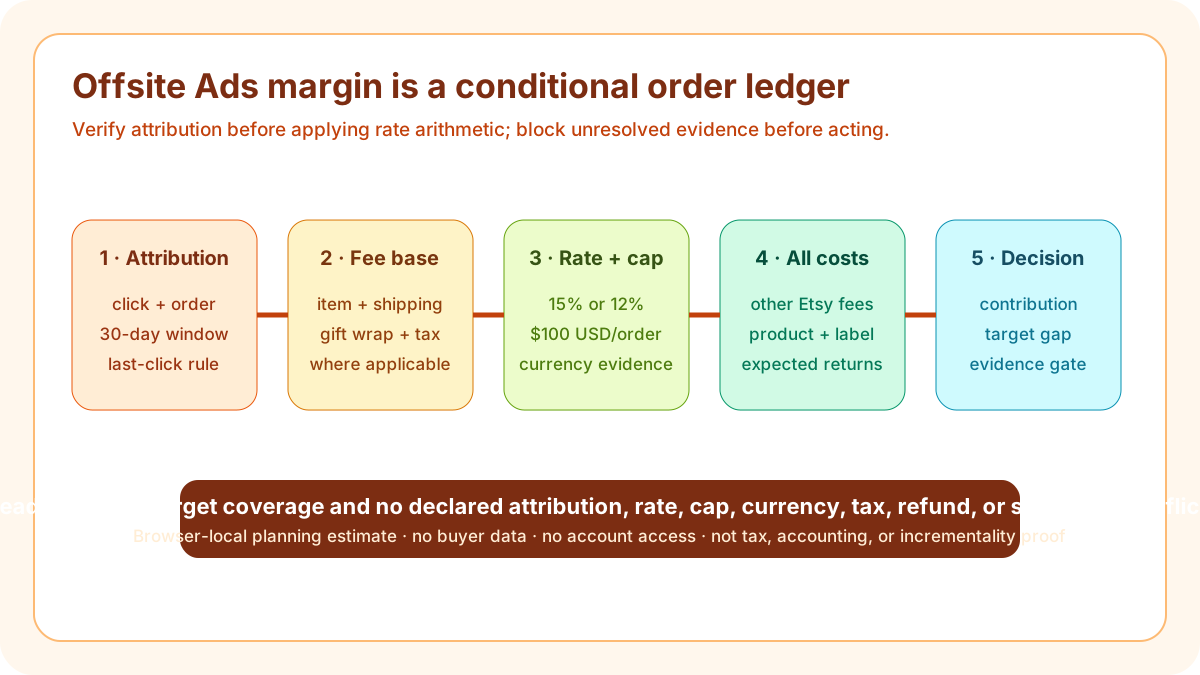
What this Offsite Ads margin calculator solves
This tool isolates the economic consequence of one Etsy order already classified as attributed to Offsite Ads. It calculates the advertising fee from a seller-entered fee base and current applicable rate, applies an entered per-order cap, then subtracts other Etsy fees and order-variable costs to show retained contribution, margin, and target gap.
It is not the broader Etsy fee-stack calculator, the main Seller Profit Guard, or a Payment account reconciliation. The fee stack itemizes every marketplace layer, Profit Guard combines complete SKU economics, and reconciliation compares modeled rows with actual statements. This focused tool answers whether an attributed order still clears an owned contribution target.
Verify attribution before applying any rate
Etsy currently states that an order can be attributed when a buyer clicks an Offsite Ad and buys from the shop within 30 days. The calculator requires an explicit dashboard confirmation, qualifying click date, order date, and final-click channel. It recomputes the calendar-day interval and blocks an order before the click, after day 30, or with a non-offsite final click.
The calculator does not retrieve the seller dashboard or authenticate attribution. Use a synthetic fixture in public tests and an approved private-system pointer for a real sample. If click timing, order timing, attribution label, final-click treatment, refund state, or statement row conflicts, list the issue and keep the decision at Block.
Select the current 15 or 12 percent state
Etsy currently publishes a 15 percent standard rate for applicable attributed orders while an under-threshold shop remains enrolled and a 12 percent discounted rate after a shop meets the governing sales threshold and must participate for its lifetime. The calculator pairs 15 percent with the exact under-threshold-enrolled status and 12 percent with threshold-met-lifetime status. A mismatched pair blocks the result.
The 12 percent rate is not a coupon the seller selects per order. Etsy's policy describes continuing participation after qualification. Record the account's effective rate evidence and month. The threshold uses Etsy's defined 365-day method and is not current-month payout, revenue after fees, cash deposit, or this calculator's order revenue.
Build the attributable fee base
Enter item revenue, buyer-paid shipping, gift-wrap revenue, and any separately charged paid personalization as four visible rows. Add only tax that current policy says belongs in this seller's applicable Offsite Ads fee base. Do not hide personalization inside an unexplained item total or substitute payout, deposit, item price alone, or a monthly sales total.
The interface adds the entered components into one transparent fee base. Every nonzero tax amount needs a source, jurisdiction, order date, currency, and reviewer. A zero should mean documented non-applicability, not an omitted field. Reconcile the actual fee base with the Payment account when the order settles.
Apply the percentage and $100 USD per-order cap
The tool multiplies the entered fee base by 15 or 12 percent, converts the current $100 USD reference cap with the seller-entered model-currency-per-USD value, and uses the lower amount. The cap applies to one attributed order, not a monthly account total.
For a non-USD model, preserve the exchange evidence that maps $100 USD to the model or statement currency. A reference other than the current USD 100 value or a nonpositive conversion blocks the result. The output exposes the uncapped fee, converted cap, applied fee, and cap state.
Import every other Etsy fee without double counting
The focused calculator accepts one reconciled subtotal for other Etsy fees. That subtotal can include listing or sold-renewal charges, transaction fee, payment processing, currency conversion, regulatory operating fee, seller-service tax, and other valid order rows. Build it with the itemized fee-stack tool or the actual statement.
Do not place the Offsite Ads fee inside that subtotal and also let this calculator derive it. Do not use a generic blended marketplace percentage or copy the $4.725 fixture into another bank country, order type, currency, quantity, tax status, or refund state. Preserve the source rows even when the interface displays a single imported amount.
Subtract direct costs and expected return loss
Enter current product and direct labor, packaging, shipping label, other order-variable cost, and expected return loss. Buyer-paid shipping is revenue while the carrier label is cost. Keeping them separate preserves the fee base and makes a shipping subsidy visible instead of hiding it inside net shipping.
Use a current SKU bill of materials, completed labor evidence, packaging purchase allocation, carrier record, insurance, fulfillment, and privacy-safe return-loss estimate. Contribution remains before unentered overhead, owner pay, income tax, depreciation, inventory timing, reserves, chargebacks, and other business costs.
Reproduce the 15 percent default fixture
The default fixture uses a $40 item and $5 buyer-paid shipping, verified attribution, no gift wrap, no paid-personalization add-on, no applicable tax in the fee base, a 15 percent rate, and a $100 USD cap. The fee base is $45, the uncapped fee is $6.75, and the cap does not change it.
Other Etsy fees are $4.725. Product and direct labor are $12, packaging is $1.50, and the shipping label is $5. Total deductions are $29.975, leaving $15.025 full-precision contribution, displayed as $15.03 and 33.4 percent margin. The $12 target is cleared by $3.025.
Compare the same order at 12 percent
Change only the applicable rate to 12 percent. The advertising fee becomes $5.40, and with every other row unchanged, contribution becomes $16.375, displayed as $16.38. The $1.35 contribution difference equals three percentage points of the $45 fee base.
This arithmetic does not establish eligibility, opt-out rights, attribution accuracy, buyer incrementality, or a better-performing ad. Preserve the effective account-rate evidence separately. Compare low-margin, high-shipping, discounted, personalized, cross-currency, and expected-return cases before using one fixture to change a real SKU.
Use Ready, Revise, Stop, and Block correctly
Ready means contribution meets the target and the dashboard attribution, final click, 30-day interval, exact rate-status pair, currency, cap reference, conversion, evidence date, and actual fee all reconcile. Reconcile means modeled and observed Offsite Ads fees differ beyond tolerance. Revise means nonnegative contribution below target. Stop means loss. Block overrides unsafe evidence.
These decisions authorize only a next verification step. They do not authenticate an Etsy order, certify a tax base, calculate payout, approve participation, prove advertising incrementality, or guarantee profit, traffic, ranking, conversion, income, qualified email intent, or AdSense approval. A high score cannot compensate for missing attribution or statement evidence.
Test the cap and deliberately broken evidence
Keep five deterministic fixtures: the $45 order at 15 percent, the same order at 12 percent, a $55 order with a separate $10 paid-personalization row, a $1,000 fee base at 15 percent where the uncapped $150 fee is limited to $100, and a broken fixture with unresolved attribution, cap-currency, and refund evidence. The broken fixture must return Block.
Focused tests verify contribution, margin, rate comparison, cap behavior, target gap, display rounding, and Block precedence. Browser QA should exercise defaults, changed rate, cap case, declared issues, reset, keyboard labels, 390-pixel mobile layout, staged noindex, canonical metadata, original visual, source links, and privacy-safe output.
Reconcile, release, and recover one bounded packet
For a real order, compare attributed status, fee base, applied rate, Offsite Ads row, other Etsy fees, refunds, credits, tax, currency, reserve, payout timing, and direct costs against approved private evidence. Classify each difference before correcting the accountable field. Never force a planning fixture to match an unexplained statement total.
Before public release, preserve narrow local and remote backups plus a rollback identifier. Run typecheck, unit and integration tests, build, SEO/AEO and similarity audits, browser and mobile QA, then keep the complete cluster noindex until its ordered release. After release, verify HTTP, canonical, indexability, images, links, sitemap, tool behavior, E2E, and strict 404; roll back critical failures.
Privacy, independence, and professional boundaries
Seller Profit Guard is independent and unaffiliated with Etsy. Program terms, rates, threshold calculations, attribution, partners, tax treatment, currencies, account interfaces, refunds, and Payment account behavior can change. Verify current official Etsy sources and the seller's actual account before a material decision.
Keep buyer names, emails, addresses, messages, order IDs, payment rows, bank details, tax identifiers, labels, tokens, OAuth material, credentials, and raw CSV outside public pages, analytics, reports, and feedback. This local calculator is an operating estimate, not attribution, legal, tax, accounting, payout, or income advice. Seek qualified advice when appropriate.
Sources and further reading
- Etsy Help: How Offsite Ads Work: Current attribution window, rates, cap, enrollment, threshold, dashboard, and last-click boundary.
- Etsy Fees and Payments Policy: Controlling attributed-order, rate, fee-base, threshold, tax, currency, cap, opt-out, and participation policy.
- Etsy Advertising and Marketing Policy: Current program terms and seller responsibilities.
- Etsy Fees and Taxes Overview: Current advertising-fee summary and surrounding marketplace fee boundaries.
- Etsy Help: Use Etsy Stats: Current seller traffic-source and Offsite Ads attribution observations.
- Seller Profit Guard methodology: Evidence hierarchy, privacy-safe fixtures, deterministic decisions, bounded release, verification, correction, and rollback.
Related Seller Profit Guard tools
- Etsy CSV profit calculator: Run a local order profit check with editable fee and SKU cost assumptions.
- Payment reconciliation tool: Compare order rows with statement activity and flag unmatched rows.
- SKU cost library: Save or import material, labor, packaging, shipping, and target margin assumptions.
- Variant risk checker: Find missing SKUs and variation cost risks before a listing scales.
- Etsy title checker: Review listing-title clarity, repetition, keyword chains, and mobile scanning.
- Etsy tag checker: Review all 13 tag slots for duplicates, repeated meaning, and truthful coverage.
- Free shipping threshold calculator: Estimate when a shipping subsidy can still meet a target margin.
- Return window loss estimator: Model expected reverse shipping, restock work, recovery, and replacement loss.
- Etsy Ads break-even calculator: Estimate target-safe Etsy Ads spend, ACOS, and ROAS after fees, fulfillment, and expected return loss.
- CSV data privacy: Understand what the local-first workflow needs and what it does not need.
- Etsy Offsite Ads Margin Formula and Inputs: Calculate an attributed Etsy order with the applicable rate, cap, fee base, other fees, direct costs, return loss, and contribution target.
- Etsy Offsite Ads 15% Fee: Worked Example: Reproduce a $45 attributed Etsy order under the 15% rate, then trace the ad fee, other fees, direct costs, contribution, margin, and target gap.
- Etsy Offsite Ads 12% Margin Scenario: Model the same attributed Etsy order at the current 12% rate, document eligibility evidence, and compare contribution without assuming opt-out rights.
- 12 Etsy Offsite Ads Margin Mistakes: Diagnose attribution, rate, fee-base, cap, currency, other-fee, shipping, refund, cost, rounding, target, and incrementality errors.
- Reliable Etsy Offsite Ads Margin Data: Map attribution, applicable rate, fee base, cap, actual ad fee, other Etsy fees, direct costs, returns, and target to accountable sources.
- Etsy Offsite Ads Margin Decision Thresholds: Set break-even, target, stress, and evidence thresholds for attributed Etsy orders without treating a positive contribution as automatic approval.
- Etsy Offsite Ads Margin: 15% vs 12%: Compare Etsy Offsite Ads 15% and 12% attributed-order scenarios at identical revenue, fee base, cap, other fees, costs, and target.
- Weekly Etsy Offsite Ads Margin Routine: Run a privacy-safe weekly loop for attributed orders, sources, rates, costs, refunds, calculator fixtures, statement reconciliation, and action logs.
- How to Read Etsy Offsite Ads Margin: Interpret fee base, uncapped fee, cap, contribution, margin, target gap, Ready, Revise, Stop, and Block without claiming profit or incrementality.
- Etsy Offsite Ads Margin Audit Template: Use a field-level audit checklist and change log for attribution, rates, fee base, cap, fees, costs, returns, expected output, actual rows, and rollback.
Use the interactive tool
Enable JavaScript to open the calculator and process browser-local inputs. The explanatory content and source links remain available without JavaScript.
Related guide: Build the attributed-order worksheet before changing price or participation assumptions.
This tool provides operating estimates, not tax, accounting, legal, financial, or marketplace-policy advice. Verify current official sources and your own records before changing prices or operations.