Seller Profit Guard · How it works · CSV privacy
Etsy listing renewal cost calculator
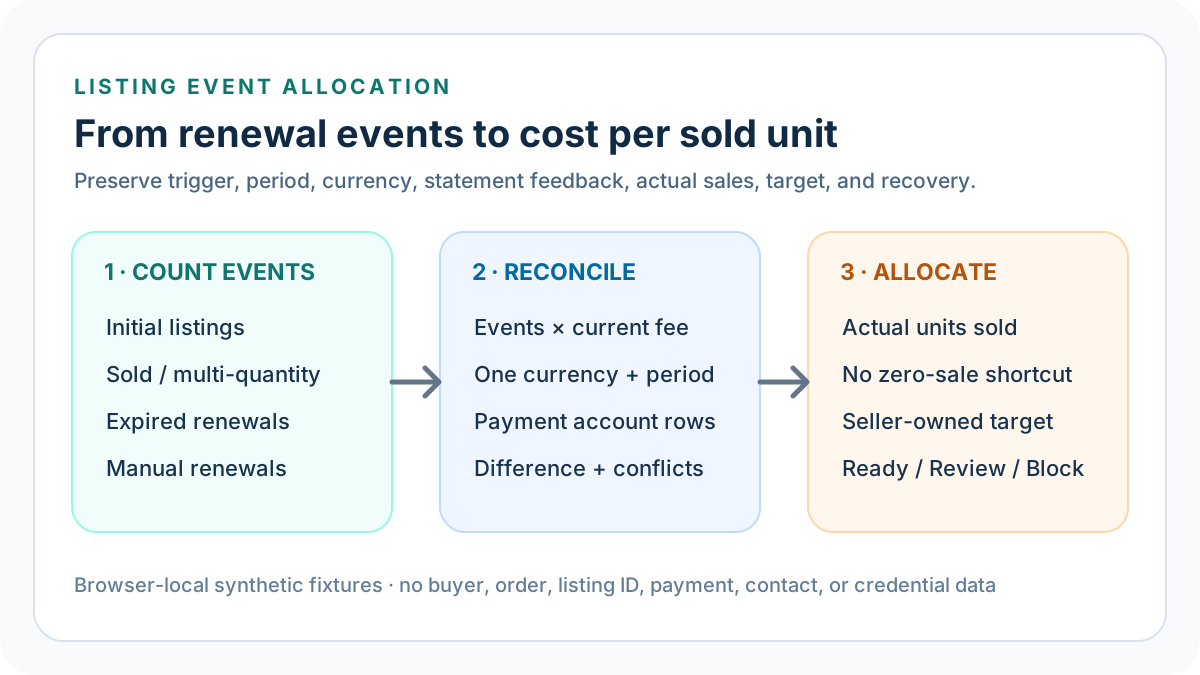
Use this browser-local calculator to reconcile five distinct Etsy.com fee families—initial listing, multi-quantity, auto-renew sold, auto-renew expired, and manual renewal—to separate Payment account rows in one dated period. It converts Etsy's current $0.20 USD rule into the model currency, allocates the verified subtotal across actual sold units, and never invents a denominator when sales are zero.
Maintained by Seller Profit Guard Editorial Team. Last reviewed: 2026-07-30.
What this listing renewal calculator solves
Etsy listing fees are event-based. A seller can incur an initial listing fee, an auto-renew-sold fee, an additional multi-quantity fee, an auto-renew-expired fee, or a manual renewal fee. The amount may be the same while the trigger and operating meaning differ.
This calculator answers one narrow question: how much listing and renewal cost did the units actually sold in a documented period absorb? It does not calculate the complete Etsy fee stack, accounting profit, inventory demand, search performance, or whether a listing should automatically renew.
Use the current Etsy listing-fee rule as an editable input
Etsy currently publishes a $0.20 USD fee to create or renew an Etsy.com listing. The policy says the fee is incurred whether or not the item sells, editing has no listing fee, and Etsy.com listings expire after four months. The calculator requires the current official USD amount rather than accepting an unsupported substitute.
For a non-USD Payment account, Etsy explains that each listing fee is converted when it is reflected in the Payment account and that the market rate can change. Enter a same-period effective model-currency-per-USD rate for each event family, derived from the fee rows in that family. Never apply one current or remembered rate across older events, and never relabel $0.20 as another currency.
Count the initial listing event once
Count each Etsy.com listing first published inside the review period as one initial listing event. A quantity of ten does not create ten listing fees when the listing is published under Etsy's current multiple-quantity examples. The remaining fee events depend on what sells and how the listing renews.
Editing an existing listing is not a listing-fee event under the current policy. Keep title, photo, description, price, variation, inventory, and other edits outside the numerator unless an actual renewal or channel event posts a fee that is supported by current evidence.
Separate auto-renew-sold and multi-quantity events
When a buyer purchases part of a listing quantity and quantity remains, Etsy can automatically renew the listing and post an auto-renew-sold fee. When multiple quantities sell in one transaction, additional quantities can post a multi-quantity fee. Preserve the actual event labels rather than collapsing them into a generic renewal count.
Etsy's current quantity-ten example charges $0.20 initially and $1.80 for the nine additional quantities sold. That produces ten fee events and $2.00 total for ten units. A remaining-quantity auto-renew-sold event is a separate family and must not be hidden inside those nine rows.
Keep expired and manual renewals distinct
An Etsy.com listing expires after four months under the current general rule. If automatic renewal is enabled, renewal can start another four-month period and post another listing fee even when no unit sold. That cost belongs in the numerator for the period in which it posted.
Manual renewal is a seller-initiated event and should have its own count. A sold-out renewal, expired renewal, manual renewal, and auto-renew-sold event may share the current USD 0.20 amount, but separating triggers supports accountable setting and portfolio decisions.
Reproduce the slow-moving default fixture
The default uses Etsy.com scope, dated source and statement evidence, confirmed renewal settings and per-family conversion evidence, one initial event, one auto-renew-expired event, no multi-quantity or auto-renew-sold event, no manual renewal, one unit sold, and 1:1 USD rates for all event families. Two events produce a USD 0.40 modeled subtotal.
The initial and expired actual rows are each USD 0.20, so both families reconcile within the USD 0.01 tolerance. Dividing by one actual unit sold produces USD 0.40 per sold unit. Against the seller-entered USD 0.25 target, the calculator returns Review.
Reproduce the multi-quantity bestseller fixture
Set one initial event, nine multi-quantity events, zero auto-renew-sold, expired, or manual events, ten actual units sold, ten expected units, USD 0.20 in the actual initial row, and USD 1.80 in the actual multi-quantity row. The modeled subtotal is USD 2.00.
Dividing USD 2.00 by ten units yields USD 0.20 per sold unit, which is at or below the default USD 0.25 target. Ready requires both actual row families to reconcile independently; offsetting family errors cannot pass because a correct grand total does not authenticate incorrect event labels.
Preserve zero-sale exposure without a fake denominator
If the review period contains listing or renewal fees but no sold units, the incurred subtotal remains real. Actual cost per sold unit is not defined. The calculator reports “No sold-unit denominator” and Review instead of dividing by one, expected sales, inventory quantity, views, favorites, or a future period.
The separate planned cost per expected unit can still support a forecast, but it must remain labeled planning. A projected sale cannot retroactively create an actual denominator or convert a zero-sale period into a completed allocation.
Match the numerator and denominator to one period
The listing and renewal event rows, Payment account subtotal, currency conversion, tax or credit adjustments, sold-unit aggregate, and review dates must describe the same evidence window. Combining this month's sales with last quarter's renewal fees creates a ratio that no source can reproduce.
Enter exact YYYY-MM-DD period start, period end, and review date. The start cannot follow the end, and the review must cover the end. Also confirm the renewal settings, event inventory, and Etsy.com scope exceptions before the arithmetic can advance.
Reconcile actual Payment account rows before allocation
Multiply the converted fee by each valid event count, then compare every modeled family with its own actual Payment account row. The initial, multi-quantity, auto-renew-sold, auto-renew-expired, and manual rows remain independently observable.
Any family difference above tolerance returns Reconcile, even when overstatement in one row offsets understatement in another and the grand total matches. Investigate labels, counts, conversion timing, taxes, credits, private listing scope, Pattern, Square, statement timing, and rounding without forcing the expected model to equal the statement.
Use Block, Reconcile, Review, and Ready correctly
Block means required evidence is invalid or unresolved: a rule other than the current $0.20 USD source value, nonpositive conversion, negative or fractional event counts, negative actual rows, missing currency, wrong Etsy.com scope, invalid dates, unconfirmed settings or exclusions, or declared conflicts. Block outranks a favorable target result.
Reconcile means the context is valid but expected and actual fee subtotals differ beyond tolerance. Review means the rows reconcile but zero units sold or actual cost per sold unit exceeds the seller-owned target. Ready means the allocation reconciles, has a valid denominator, and meets the target.
Move the reconciled row into broader profit analysis
After the listing-fee subtotal and sold-unit allocation reconcile, move the row into the Etsy Fee Stack Calculator. Add transaction, bank-country processing, Offsite Ads, conversion, regulatory, seller-fee tax, refunds, credits, and other valid marketplace layers.
Then move the verified fee stack into Seller Profit Guard with product, direct labor, packaging, shipping label, return loss, discounts, and contribution target. Never call listing renewal cost total Etsy cost or accounting profit, even when it is the only cost changing in the current review.
Test, release, and recover the complete cluster
Keep four deterministic fixtures: slow listing at USD 0.40 per sold unit, quantity-ten bestseller at USD 0.20 per sold unit, zero-sale period with no denominator, and three declared conflicts that force Block. Tests must preserve integer event counts, event sum, reconciliation difference, target, period, and decision precedence.
Before release, retain narrow local and remote backups and a rollback identifier. Run syntax, typecheck, unit and integration tests, build, SEO/AEO, content and similarity audits, browser and 390-pixel mobile QA, then release the complete cluster in order. Roll back any critical live failure.
Privacy, independence, and professional limits
Seller Profit Guard is independent and unaffiliated with Etsy. Listing fees, expiration, renewal options, multiple-quantity presentation, private listings, Pattern, Square, taxes, credits, conversion, and Payment account labels can change. Verify current official Etsy sources and the seller's actual account before a material decision.
Keep buyer names, emails, addresses, messages, order IDs, listing IDs, payment rows, bank details, tax identifiers, tokens, OAuth material, credentials, and raw CSV outside public pages, analytics, reports, and feedback. This browser-local allocation is operating guidance, not legal, tax, accounting, inventory, payout, demand, or income advice.
Sources and further reading
- Etsy Multiple Quantity Listing Fees: Current initial, additional-quantity, remaining-quantity, sellout, fee-label, and currency-conversion examples.
- Etsy Fees and Taxes Overview: Current listing, expired renewal, sold renewal, private listing, four-month, and surrounding fee boundaries.
- Etsy Renew or Hide Listings: Current automatic and manual renewal behavior, charge, date reset, and sold-out handling.
- Etsy Fee Basics: Current listing, sold renewal, multi-quantity, and Payment account distinctions.
- Etsy Fees and Payments Policy: Controlling fee, expiry, renewal, quantity, currency, tax, and seller-responsibility policy.
- Etsy Payment Account Help: Actual fee, tax, credit, conversion, statement, balance, and payout-period reconciliation context.
- Seller Profit Guard methodology: Evidence hierarchy, privacy-safe fixtures, deterministic decisions, bounded release, correction, and rollback.
Related Seller Profit Guard tools
- Etsy CSV profit calculator: Run a local order profit check with editable fee and SKU cost assumptions.
- Payment reconciliation tool: Compare order rows with statement activity and flag unmatched rows.
- SKU cost library: Save or import material, labor, packaging, shipping, and target margin assumptions.
- Variant risk checker: Find missing SKUs and variation cost risks before a listing scales.
- Etsy title checker: Review listing-title clarity, repetition, keyword chains, and mobile scanning.
- Etsy tag checker: Review all 13 tag slots for duplicates, repeated meaning, and truthful coverage.
- Free shipping threshold calculator: Estimate when a shipping subsidy can still meet a target margin.
- Return window loss estimator: Model expected reverse shipping, restock work, recovery, and replacement loss.
- Etsy Ads break-even calculator: Estimate target-safe Etsy Ads spend, ACOS, and ROAS after fees, fulfillment, and expected return loss.
- CSV data privacy: Understand what the local-first workflow needs and what it does not need.
- Etsy Listing Renewal Cost Formula: Allocate Etsy listing and renewal fees with event counts, actual sold units, expected sales, Payment account evidence, currency, period, and target.
- Slow-Moving Etsy Listing Renewal Example: Trace a slow Etsy listing through one initial fee, one expired renewal, one sale, a USD 0.40 subtotal, and a USD 0.40 cost per sold unit.
- Multi-Quantity Etsy Listing Fee Example: Allocate one listing fee plus nine reconciled multi-quantity events across ten units without adding unsupported auto-renew or expiry events.
- 12 Etsy Listing Renewal Cost Mistakes: Correct Etsy listing-fee allocation errors involving quantity, renewal triggers, zero sales, period alignment, currency, credits, taxes, and fee scope.
- Etsy Listing and Renewal Fee Data Sources: Map Etsy listing fees, renewal triggers, sold units, currency, statement rows, taxes, credits, periods, and targets to reliable evidence.
- Safe Etsy Listing Renewal Cost Thresholds: Set event, reconciliation, sold-unit, target, zero-sale, currency, period, and evidence thresholds for Etsy listing renewal decisions.
- Slow vs Fast Etsy Listing Renewal Costs: Compare a slow listing and a multi-quantity bestseller at the same fee-row grain to isolate expiry exposure, sell-through, and cost per sold unit.
- Weekly Etsy Listing Renewal Cost Routine: Run a privacy-safe routine for listing events, renewal settings, sold units, Payment account fees, zero-sale exposure, decisions, and rollback.
- How to Read Etsy Listing Renewal Cost: Interpret fee events, subtotals, actual differences, sold-unit allocations, planning ratios, targets, and decisions without false precision.
- Etsy Listing Renewal Cost Audit: Audit listing event rows, sold units, currency, period, modeled and actual fees, decisions, corrections, approvals, and rollback evidence.
Use the interactive tool
Enable JavaScript to open the calculator and process browser-local inputs. The explanatory content and source links remain available without JavaScript.
Related guide: Build the listing-event worksheet before changing renewal settings or price.
This tool provides operating estimates, not tax, accounting, legal, financial, or marketplace-policy advice. Verify current official sources and your own records before changing prices or operations.