Seller Profit Guard · How it works · CSV privacy
Etsy fee stack calculator for itemized order contribution
Use this browser-local Etsy fee stack calculator to separate item, shipping, and gift-wrap revenue from listing and renewal charges, transaction fee, bank-country payment processing, attributed Offsite Ads, currency conversion, regulatory fee, seller-fee tax, product and fulfillment costs, retained contribution, margin, target gap, and unresolved evidence before changing price or advertising.
Maintained by Seller Profit Guard Editorial Team. Last reviewed: 2026-07-30.
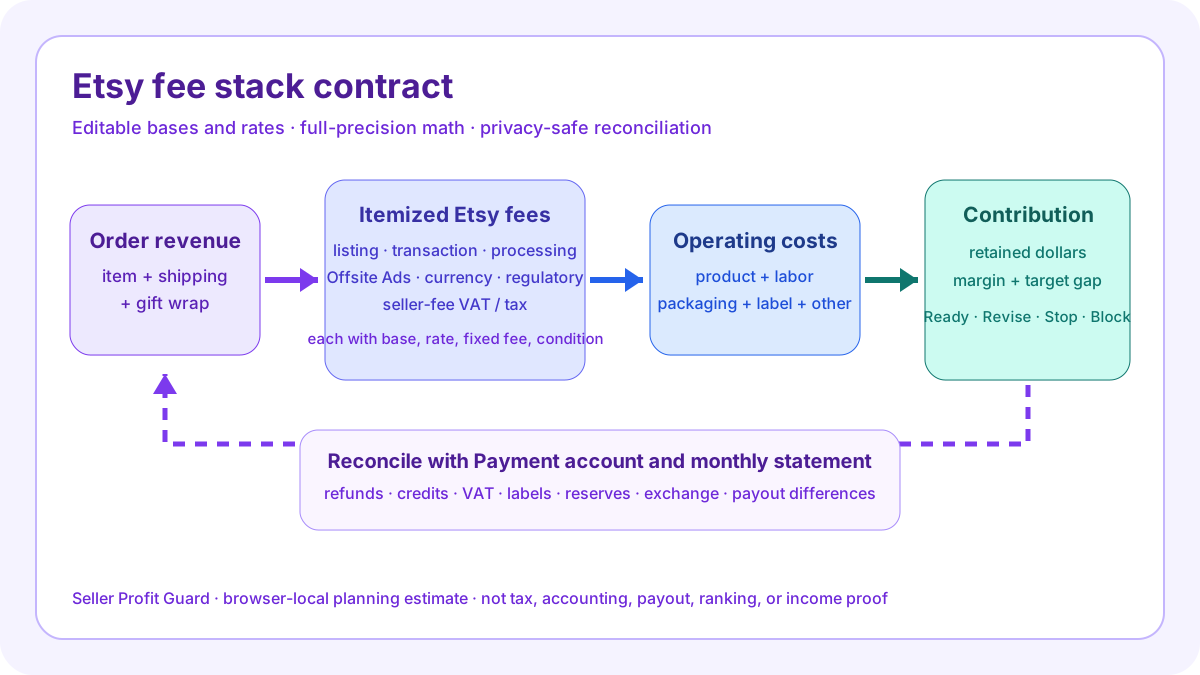
What the Etsy fee stack calculator models
The calculator models one seller-defined order. Revenue begins with item price, buyer-paid shipping, and gift wrap. It then itemizes listing or sold-renewal charges, transaction fee, Etsy Payments processing percentage and fixed amount, Offsite Ads when attributed, currency conversion when the shop and Payment account currencies differ, a seller-location regulatory rate, and tax or VAT from a separately documented eligible seller-fee base.
It finishes by subtracting product and labor, packaging, shipping-label, and other order-variable costs. The result is an estimated contribution amount, contribution margin, and distance from a seller-entered contribution target. It is deliberately different from the static Etsy fee reference, the Payment account reconciliation tool, and the full Profit Guard: one supplies current reference boundaries, one checks actual statement rows, and one adds the broader SKU economics.
Define one order and its account context
Freeze one order scenario before entering rates: seller bank country, domestic or international processing classification, listing currency, Payment account currency, payout currency, order status, quantity, Offsite Ads attribution, refund or credit state, VAT or tax treatment, source date, and reviewer. A United States domestic order and a cross-currency European order cannot safely share one unlabeled default.
The calculator cannot retrieve these settings. Use a synthetic alias in public work and approved private systems for real reconciliation. Do not paste buyer names, emails, addresses, messages, order IDs, payment data, bank details, tax identifiers, shipping labels, tokens, OAuth material, credentials, or raw CSV rows into content, analytics, reports, or feedback.
Build the order-revenue base
Enter item price, buyer-paid shipping, and gift-wrap charge as separate amounts. Their sum is the calculator's order revenue. Etsy's current transaction-fee guidance applies the published rate to the total order amount and expressly includes charged shipping and gift wrapping. This is why subtracting shipping before calculating the transaction row understates the modeled fee.
Keep seller-collected tax as a separate payment-processing base adjustment. Etsy says processing can include applicable sales tax charged on the listing, while tax Etsy collects and remits may appear differently. The tool does not decide which tax belongs in the base. Verify the actual order, bank-country page, and Payment account treatment before using a nonzero amount.
Model listing, renewal, and quantity fees
Etsy currently publishes a $0.20 USD listing fee and explains additional sold-renewal or multi-quantity behavior. Enter the number of listing, renewal, or multi-quantity fee events separately from quantity sold. One unit and one event in the domestic fixture produce $0.20; five units do not automatically mean five fee events. Actual events depend on initial listing coverage, extra quantities, remaining inventory, and renewal state.
Fixed listing charges can be converted into the Payment account currency at the market rate when reflected in the account. Preserve the published source amount, source currency, actual converted statement amount, and exchange observation separately. Do not permanently hard-code a converted value from last month's statement.
Calculate the Etsy transaction fee
The current reference rate is 6.5 percent of the eligible order total. The calculator multiplies item, buyer-paid shipping, and gift wrap by the editable rate. It retains full precision internally and rounds only for display, so a $45 fixture produces $2.925 and displays $2.93 without changing downstream arithmetic.
Store rate, base, source URL, access date, currency, order grain, and calculated amount in the evidence packet. A transaction fee is distinct from payment processing, listing charges, Pattern charges, regulatory fees, taxes, advertising, labels, and operating costs. Combining them prevents a later reviewer from explaining a statement difference.
Select the correct payment processing row
Etsy Payments processing is a percentage plus a fixed amount and varies by the location of the seller's bank account. Some countries distinguish domestic from international orders. The default fixture uses the current United States domestic row of 3 percent plus $0.25 USD, but every field remains editable and should be replaced for another seller location.
The calculator applies the percentage to order revenue plus the explicit seller-collected-tax adjustment, then adds the fixed amount. It does not choose a bank country, detect an international order, convert the fixed fee, or apply VAT automatically. Verify the current country table, account setting, order type, fixed-fee currency, and actual statement.
Apply Offsite Ads only to attributed orders
Etsy currently describes a 15 percent fee for attributed orders when the shop has always made less than $10,000 USD in a consecutive 365-day period and a 12 percent rate after reaching the threshold, with a published $100 USD per-order cap. Enrollment and opt-out status also depend on that revenue history.
Use zero for a documented non-attributed planning scenario. Use 12 or 15 only when modeling the applicable attributed state, and keep the cap editable because currency context and statement conversion matter. The calculator does not determine attribution, enrollment, threshold status, eligibility, or whether an ad caused an incremental sale.
Model currency conversion without mixing exchange events
Etsy currently states that a 2.5 percent currency-conversion fee applies when the shop listing currency differs from the Payment account currency. That seller fee is different from a buyer display-currency conversion, conversion of a fixed USD fee into an account currency, and a bank or Payoneer charge at withdrawal.
Name listing, Payment account, fixed-fee source, payout, and bank-receipt currencies. Apply the entered conversion rate only to the documented seller conversion case, then reconcile the Payment account statement exchange rate. Stress product and fulfillment costs separately when they use another currency; the platform conversion row does not describe the seller's entire exchange exposure.
Add regulatory and seller-fee tax rows
Etsy currently lists regulatory operating fees for sellers in selected countries and applies the location-specific rate to item price plus shipping and gift wrap. The eligible country list and percentages can change. Enter zero only after confirming the seller location is currently outside the rule or the specific order is not subject to it.
VAT or other tax on seller services depends on location, registration, invoice rules, and fee type. Enter a plain-language scope, the eligible seller-fee base supported by the current invoice or local rule, and the applicable rate. The calculator multiplies only that documented base; it does not assume every modeled fee is taxable. For example, Etsy's current Texas guidance says only the transaction-fee row is currently subject to Texas sales tax and only 80 percent of that fee is taxable. Local rates and future fee coverage can differ, so review current Etsy guidance, the actual invoice, registration status, and qualified advice when material.
Subtract product and fulfillment costs after marketplace fees
Enter product and direct labor, packaging, shipping-label, and other order-variable costs independently. Buyer-paid shipping remains revenue while the carrier label remains cost. Combining them as net shipping can be useful in a separate report, but it should not erase the transaction and processing bases inside a fee audit.
Use current SKU bills of material, completed labor time, packaging purchase allocations, carrier records, insurance, fulfillment, and other attributable evidence. Do not interpret contribution as final profit when overhead, owner pay, income tax, reserves, return loss, chargebacks, depreciation, inventory timing, and other business costs remain outside the entered packet.
Reproduce the $45 domestic fixture
The default fixture uses a $40 item, $5 buyer-paid shipping, one $0.20 listing-fee event, a 6.5 percent transaction rate, and United States domestic processing at 3 percent plus $0.25. It records USD for model, listing, and Payment account currencies; no Offsite Ads attribution; no regulatory region; no seller currency conversion; no applicable seller-fee tax scope; a July 30, 2026 source review; and a $4.725 observed Payment account fee total.
The transaction row is $2.925, processing is $1.60, and total modeled Etsy fees are $4.725. Product and labor are $12, packaging is $1.50, and the label is $5. $45 minus $4.725 minus $18.50 equals $21.775, displayed as $21.78 contribution and 48.4 percent margin. The $15 target is cleared by $6.78.
Use Ready, Reconcile, Revise, Stop, and Block correctly
Ready means the entered assumptions produce contribution at or above the target, current supported fee conditions agree, and the observed fee total matches within tolerance. Reconcile means the arithmetic runs but a current rate, conditional combination, country row, currency state, regulatory row, or Payment account total differs. Revise means contribution is nonnegative but below target. Stop means the order loses money. Block overrides the number for invalid inputs, missing required context, an undated packet, or declared unresolved evidence.
These decisions authorize only the next verification action. Ready does not authenticate inputs, reproduce a payout, settle taxes, approve a price or advertisement, certify policy compliance, or prove ranking, conversion, income, or revenue. A high score cannot compensate for a known evidence mismatch.
Reconcile the estimate with the Payment account
After a real sale settles, compare listing, transaction, processing, Offsite Ads, currency, regulatory, VAT, label, refund, credit, reserve, deposit, and payout rows in the Payment account and monthly statement. Match periods and currencies before treating a difference as a formula defect.
Classify each difference as base, rate, fixed amount, quantity, currency, tax, attribution, refund, credit, reserve, timing, rounding, operating cost, or payout. Preserve both the estimate and actual observation. Correct only the accountable row instead of inserting an unexplained miscellaneous percentage.
Run supported and deliberately broken fixtures
Keep the clean $45 domestic case as a deterministic fixture. Add a cross-currency case with explicit currencies and a broken case with the wrong processing country, missing attributed fee, unresolved refund credit, impossible percentage, or declared currency mismatch. The broken case must not return Ready.
Focused tests should verify full-precision arithmetic, financial half-up display rounding, listing-fee events independent of quantity, fee caps, zero conditional rows, current reference mismatches, observed-total reconciliation, contribution, margin, target gap, and Block precedence. Browser QA should exercise Ready, Reconcile, Block, reset, mobile layout, canonical metadata, staged indexability, original images, and privacy-safe output.
Release, verify, and roll back one bounded packet
Before production, create narrow local and remote backups with a rollback identifier. Confirm the exact route, release manifest, indexability, sitemap, internal links, assets, source dates, tests, and target environment. Safe-stop on login or CAPTCHA ambiguity, platform warning, wrong profile, missing context, or an unexpected production state.
After release, verify the parent tool and all ten support pages on desktop and mobile, rerun clean and broken fixtures, inspect canonical and schema, confirm HTTP 200 and intended sitemap inclusion, and purge only changed URLs and assets. Restore the prior packet if a critical calculation, route, image, indexability, or public observation differs.
Responsible-use and independence limits
Seller Profit Guard is independent and unaffiliated with Etsy. Platform fees, country tables, currencies, taxes, advertising rules, interfaces, and Payment account behavior can change. Verify current official sources and the seller's actual account before making a material decision; obtain qualified tax, accounting, or legal advice when appropriate.
This browser-local calculator is an operating estimate, not a marketplace statement, payout ledger, tax return, financial statement, guarantee, or income claim. Use it to expose assumptions, find the next evidence gap, and move a verified itemized stack into SKU-level profit analysis. Keep private data in approved systems.
Sources and further reading
- Etsy Fees and Taxes Overview: Current listing, transaction, payment, advertising, conversion, regulatory, VAT, deposit, and other fee boundaries.
- Etsy Payment Processing Fees: Current bank-country percentages, fixed fees, domestic and international distinctions, fee bases, refunds, and deposit-fee references.
- Etsy Currency Conversion Fees: Current 2.5 percent seller conversion rule and statement exchange-rate context.
- Etsy Regulatory Operating Fee: Current eligible seller locations, rates, bases, and VAT note.
- Etsy Offsite Ads: Current attribution, 12 and 15 percent rates, enrollment boundary, threshold, and policy links.
- Etsy Multiple-Quantity Fees: Current listing, sold-renewal, multi-quantity, expiry, and fixed-fee conversion mechanics.
- Etsy VAT on Seller Fees: Current seller-service VAT and invoice context.
- Seller Profit Guard methodology: Evidence hierarchy, privacy-safe fixtures, deterministic decisions, bounded release, verification, correction, and rollback.
Related Seller Profit Guard tools
- Etsy CSV profit calculator: Run a local order profit check with editable fee and SKU cost assumptions.
- Payment reconciliation tool: Compare order rows with statement activity and flag unmatched rows.
- SKU cost library: Save or import material, labor, packaging, shipping, and target margin assumptions.
- Variant risk checker: Find missing SKUs and variation cost risks before a listing scales.
- Etsy title checker: Review listing-title clarity, repetition, keyword chains, and mobile scanning.
- Etsy tag checker: Review all 13 tag slots for duplicates, repeated meaning, and truthful coverage.
- Free shipping threshold calculator: Estimate when a shipping subsidy can still meet a target margin.
- Return window loss estimator: Model expected reverse shipping, restock work, recovery, and replacement loss.
- Etsy Ads break-even calculator: Estimate target-safe Etsy Ads spend, ACOS, and ROAS after fees, fulfillment, and expected return loss.
- CSV data privacy: Understand what the local-first workflow needs and what it does not need.
- Etsy Fee Stack Formula and Input Contract: Model account context, listing events, transaction, processing, ads, currency, regulatory, tax, cost, and reconciliation layers.
- Etsy Fees on a $45 Order: Worked Example: Reproduce a domestic US planning fixture from order revenue through listing, transaction, processing, cost, and contribution rows.
- Etsy Cross-Currency Fee Example: Separate listing currency, Payment account currency, bank-country processing, conversion, regulatory, and statement exchange-rate evidence.
- 12 Etsy Fee Calculation Mistakes: Block wrong fee bases, stale country rates, double-counted shipping, missing attribution, quantity renewals, currency, VAT, refunds, and credits.
- Reliable Sources for Every Etsy Fee Input: Map each fee rate, base, currency, attribution, quantity, tax, cost, refund, and credit to the authority that owns it and its refresh trigger.
- Etsy Fee Stack Decision Thresholds: Separate break-even, target contribution, adverse fee cases, unresolved evidence, and actual-statement reconciliation before acting.
- Domestic vs Cross-Currency Etsy Fees: Compare domestic and cross-currency orders with identical revenue, fee, cost, currency, evidence, decision, and cash-bridge columns.
- Weekly Etsy Fee Stack Reconciliation: Run a trigger-based loop for official rate sources, account settings, sample orders, cost records, calculator fixtures, statement rows, and corrections.
- How to Read an Etsy Fee Stack Result: Interpret itemized fees, contribution, margin, target gap, decision, rounding, assumptions, exclusions, and next action without false precision.
- Etsy Fee Stack Audit Template and Log: Record order scope, fee bases, rates, fixed amounts, currencies, sources, costs, fixtures, actual rows, differences, approvals, and rollback.
Use the interactive tool
Enable JavaScript to open the calculator and process browser-local inputs. The explanatory content and source links remain available without JavaScript.
Related guide: Build the itemized fee worksheet before changing price or ads.
This tool provides operating estimates, not tax, accounting, legal, financial, or marketplace-policy advice. Verify current official sources and your own records before changing prices or operations.