Seller Profit Guard · How it works · CSV privacy
Etsy deposit fee calculator
Use this browser-local calculator to classify one scheduled Etsy Payments deposit as held, fee-bearing, or fee-free. It applies both the additional deposit minimum and the current daily disbursement threshold, validates Etsy's nine-country table, reconciles fee and tax separately, and compares monthly fee exposure with a less frequent schedule.
Maintained by Seller Profit Guard Editorial Team. Last reviewed: 2026-07-30.
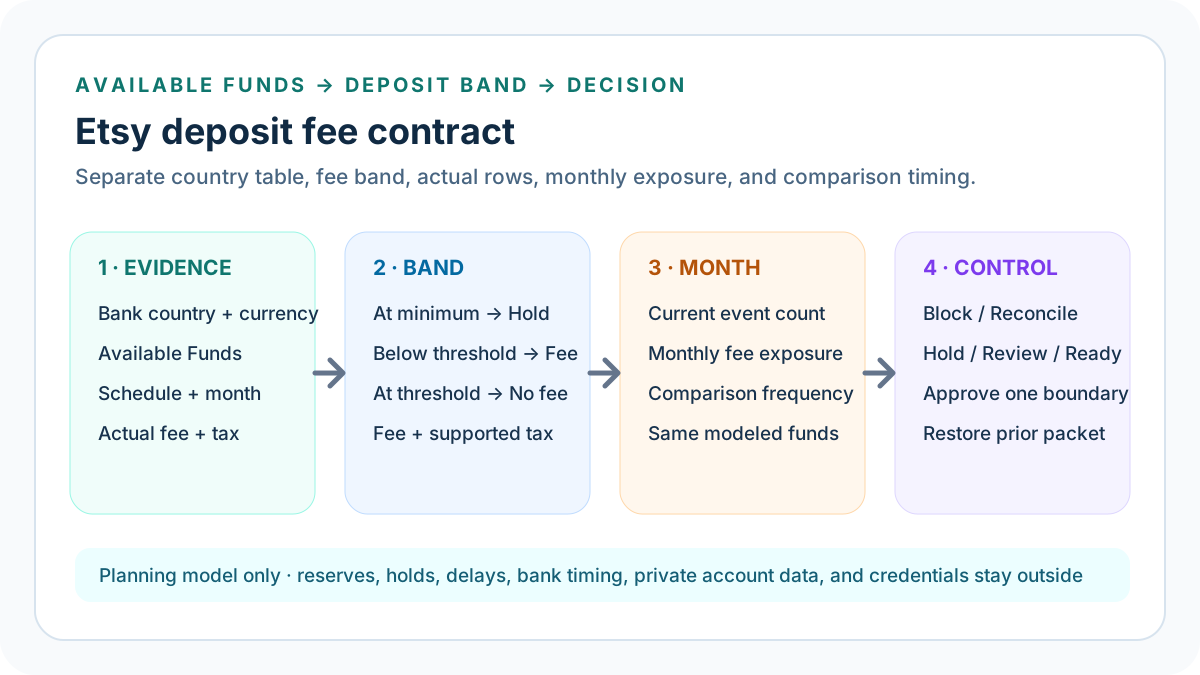
What this Etsy deposit fee calculator solves
Etsy currently documents additional deposit minimums, daily disbursement thresholds, fee thresholds, and fixed deposit fees for certain Etsy Payments bank countries. If Available Funds do not exceed the additional minimum, the funds are not modeled as sent. A daily amount below its daily threshold is also held. A non-daily amount above the minimum but below the fee threshold can incur a fixed fee; at or above the threshold, the model applies no fixed deposit fee.
The calculator answers a narrow operational question: how one scheduled amount falls into the current country band, whether modeled fee and fee tax agree with actual Payment account rows, what repeated events could cost in one month, and how the same modeled monthly funds behave under a less frequent schedule.
Start with bank account country and currency
Use the country of the bank account connected to Etsy Payments, not buyer location, shop language, listing currency, or delivery destination. The calculator contains the current additional deposit-minimum table for Indonesia, Israel, Malaysia, Mexico, Morocco, the Philippines, South Africa, Türkiye, and Vietnam.
Country, currency, deposit minimum, fee threshold, and fixed fee must match the same current Etsy row. A mismatch blocks the packet rather than allowing a familiar number from another country to produce a plausible result.
Confirm a dated one-deposit evidence contract
Record valid YYYY-MM-DD dates for the official country table and the Available Funds observation, and require the source review to be on or after the funds evidence date. Confirm the bank account country, one current country-table row, Available Funds, current and comparison schedules, reserve/hold/delay/bank-change/returned-deposit review, and same-event actual fee and fee-tax rows.
The scope must remain exactly one scheduled Etsy Payments deposit. Blank or non-finite numbers, negative funds or actual rows, negative tolerance, malformed currency, incomplete confirmations, invalid dates, and a broader Payment account or statement scope block the result before a favorable schedule comparison can appear.
Use Available Funds, not sales or account balance
Available Funds are the amount eligible for the modeled deposit after relevant Payment account activity. Sales revenue, current balance, expected payout, and bank receipt can differ because fees, taxes, refunds, reserves, holds, delays, and new activity change the amount before processing.
Record one accountable observation or a clearly labeled average for the evidence period. The calculator does not retrieve Etsy data and cannot prove the amount will remain unchanged until a scheduled payment is initiated.
Separate daily minimums from additional deposit minimums
Etsy publishes daily deposit thresholds by bank-account currency. For the nine current deposit-fee countries, that daily threshold equals the country's fee threshold, while the smaller additional deposit minimum still controls non-daily eligibility.
The calculator applies both rules: a daily amount below the threshold returns Hold, while a weekly, biweekly, or monthly amount above the additional minimum but below the fee threshold can be fee-bearing. Reserves, holds, delays, and other account conditions remain separate evidence constraints.
Classify the Held band
When Available Funds are at or below the entered additional deposit minimum, the calculator returns Hold and models no bank deposit or fixed deposit fee. This follows Etsy's wording that funds must be above or exceed the applicable minimum.
Hold is not a loss and does not mean the funds disappeared. It means this entered event does not clear the minimum in the simple model. Later sales, refunds, fees, reserves, holds, delays, schedule dates, and policy can change the next observation.
Classify the fee-bearing band
For weekly, biweekly, or monthly schedules, when Available Funds exceed the additional deposit minimum but remain below the fee threshold, the calculator applies the current fixed deposit fee. A daily amount in the same numeric range is held instead.
Reconcile fixed fee and fee-tax rows separately. Etsy's Payments Policy describes deposit fees as tax-exclusive where applicable, so one combined debit cannot explain whether the fee or its tax differs.
Classify the fee-free band
When Available Funds are at or above the fee threshold, the model applies no fixed deposit fee. The threshold boundary uses the public description that deposits below the fee threshold incur the fee.
Fee-free describes only this modeled fixed deposit fee. Payment processing, transaction, advertising, conversion, regulatory, seller-fee tax, reserve, bank, Payoneer, or other costs remain separate.
Trace the Malaysia weekly example
The default synthetic fixture uses Malaysia, a weekly schedule, MYR 300 Available Funds, MYR 9 deposit minimum, MYR 400 fee and daily threshold, and MYR 8 fixed deposit fee. MYR 300 is above the additional minimum and below the fee threshold, so this weekly event is fee-bearing. A daily MYR 300 event would be held.
With zero modeled fee tax, the bank-deposit estimate is MYR 292. An actual MYR 8 fee and MYR 0 tax reconcile within MYR 0.01 tolerance. These values are a public regression fixture, not a real seller or bank record.
Project monthly fee exposure
Four identical modeled weekly events at MYR 8 each produce MYR 32 monthly fee exposure. The default seller-owned ceiling is MYR 30, so the reconciled packet returns Review.
Expected event count is an editable planning assumption. Etsy schedules, weekends, holidays, reserves, holds, delays, bank changes, refunds, new sales, and Available Funds can alter how many deposits actually occur.
Compare a monthly schedule at the same monthly funds
The comparison holds modeled monthly Available Funds constant at MYR 1,200. One monthly event is MYR 1,200, above the MYR 400 threshold, so its modeled deposit fee is zero.
The arithmetic difference from four weekly MYR 300 events is MYR 32. This is not a recommendation or guarantee: a less frequent schedule may delay cash access, and the tool does not value liquidity, forecast sales, or control Etsy settings.
Reconcile fee and fee-tax rows
Compare modeled and actual fixed deposit fees as one row, then modeled and actual VAT or similar tax as another. Differences beyond tolerance return Reconcile before schedule comparison or threshold interpretation.
Do not widen tolerance to hide a wrong country table, mixed currency, returned-deposit refund, fee-tax issue, reserve, hold, delay, or statement-period mismatch. Declare the issue and resolve its evidence.
Read Block, Reconcile, Hold, Review, and Ready
Block covers unsupported country rows, mismatched table values, invalid amounts, rates, periods, schedules, event counts, currencies, or declared conflicts. Reconcile covers actual-row drift. Hold covers minimum failure. Review covers reconciled monthly fee exposure above the seller ceiling.
Ready confirms only the entered country table, event band, actual rows, comparison inputs, and threshold. It does not authenticate an account, guarantee payment, validate a bank receipt, determine tax, or prove profit.
Account for reserves, holds, and delays
Etsy may apply Payment account reserves, holds, or deposit delays, and a bank-detail change can create a security waiting period. These conditions can reduce Available Funds or alter timing without changing the public fixed deposit-fee table.
Record such conditions as explicit evidence conflicts or exclusions. Do not edit the fee threshold until a timing or risk-control difference disappears from the arithmetic.
Handle returned-deposit fee refunds
Etsy's Payments Policy states that deposit fees are refunded if a deposit is returned to the seller's Payment account. Preserve the original deposit fee and the later refund as separate dated observations when available.
A later refund does not prove the original band was wrong. Netting the two into one zero row destroys timing, evidence, and the ability to reconcile or restore a specific event.
Move the result into the complete fee stack
After fee and fee-tax rows reconcile, carry monthly deposit-fee exposure into the Etsy Fee Stack Calculator under a documented allocation policy. Keep the underlying deposit event count, schedule, and source date so the cost is not counted twice.
Then combine the reconciled stack with product, labor, packaging, shipping, returns, and target contribution in Seller Profit Guard. A deposit fee is an operating cash-transfer cost, not revenue, payout, contribution, accounting profit, or taxable income.
Test current, boundary, and broken packets
Keep deterministic tests for Malaysia MYR 300 weekly Review, MYR 300 daily Hold, MYR 400 threshold Ready, MYR 9 minimum Hold, all nine official country rows, stale source evidence, and a wrong MYR 9 fee plus declared conflicts producing Block.
A regression that uses sales as Available Funds, accepts a country mismatch, charges at the threshold, sends funds at the minimum, nets tax into the fee, or treats schedule savings as guaranteed cash must fail before release.
Release and recover the complete cluster
Before release, retain narrow local and remote backups plus a rollback identifier. Run syntax and SVG validation, typecheck, unit and integration tests, production build, SEO/AEO, content and similarity audits, browser interaction, canonical and schema checks, image loading, and 390-pixel mobile QA.
Publish the parent tool and ten support guides as one ordered cluster. Add self-canonicals, indexability, sitemap entries, guide-hub and tool backlinks together, purge only changed URLs and assets, verify public HTTP and behavior, and restore after a critical live failure.
Privacy, independence, and professional limits
Seller Profit Guard is independent and unaffiliated with Etsy. This browser-local model does not retrieve account data, change a schedule, authenticate Available Funds, reproduce every reserve, hold, delay, refund, holiday, instant transfer, Payoneer rule, tax, bank process, or future policy.
Keep buyer names, emails, addresses, messages, order and listing IDs, bank details, payment rows, account notices, tax identifiers, contacts, tokens, OAuth material, credentials, and raw exports outside public pages. Verify Etsy settings and obtain qualified accounting, tax, legal, or cash-management advice when material.
Sources and further reading
- Etsy Deposit Help: Current schedules, daily minimums, additional country minimums, fee thresholds, deposit fees, reserves, holds, delays, and timing.
- Etsy Payments Policy: Available Funds, disbursement minimums, deposit fees, fee tax boundary, returned-deposit refunds, reserves, holds, and delays.
- Etsy Fees and Taxes Help: Deposit-fee applicability to Etsy Payments sellers in supported countries and the minimum-to-threshold band.
- Etsy Deposit Amount Help: Monthly statement, sales, fees, taxes, refunds, and Payment account activity used to calculate deposits.
- Etsy Payments Help: Etsy Payments eligibility and additional minimum, fee-threshold, and deposit-fee concepts.
- Seller Profit Guard methodology: Evidence hierarchy, privacy-safe fixtures, deterministic decisions, bounded release, correction, and rollback.
Related Seller Profit Guard tools
- Etsy CSV profit calculator: Run a local order profit check with editable fee and SKU cost assumptions.
- Payment reconciliation tool: Compare order rows with statement activity and flag unmatched rows.
- SKU cost library: Save or import material, labor, packaging, shipping, and target margin assumptions.
- Variant risk checker: Find missing SKUs and variation cost risks before a listing scales.
- Etsy title checker: Review listing-title clarity, repetition, keyword chains, and mobile scanning.
- Etsy tag checker: Review all 13 tag slots for duplicates, repeated meaning, and truthful coverage.
- Free shipping threshold calculator: Estimate when a shipping subsidy can still meet a target margin.
- Return window loss estimator: Model expected reverse shipping, restock work, recovery, and replacement loss.
- Etsy Ads break-even calculator: Estimate target-safe Etsy Ads spend, ACOS, and ROAS after fees, fulfillment, and expected return loss.
- CSV data privacy: Understand what the local-first workflow needs and what it does not need.
- Etsy Deposit Fee Formula and Inputs: Classify an Etsy Payments deposit from Available Funds, country minimum, fee threshold, fixed fee, tax, schedule, actual rows, and evidence.
- Malaysia Etsy Deposit Fee Worked Example: Trace a synthetic Malaysia weekly deposit through the current MYR 9 minimum, MYR 400 threshold, MYR 8 fee, and monthly exposure.
- Monthly Etsy Deposit Fee Scenario: Compare the same synthetic monthly Available Funds under one monthly deposit and show when aggregation moves above the fee threshold.
- 12 Etsy Deposit Fee Errors and Fixes: Correct Etsy deposit errors involving bank country, Available Funds, minimums, thresholds, schedules, taxes, reserves, holds, refunds, and timing.
- Etsy Deposit Fee Evidence Sources: Map bank country, Available Funds, minimum, threshold, fee, tax, schedule, reserves, holds, and actual rows to reliable evidence.
- Safe Etsy Deposit Fee Decision Thresholds: Set non-compensating Block, Reconcile, Hold, Review, and Ready gates for Etsy deposit table, amount, rows, and monthly exposure.
- Weekly vs Monthly Etsy Deposit Fees: Compare weekly and monthly Etsy deposit-fee scenarios at the same monthly Available Funds and identify which boundary drives the result.
- Monthly Etsy Deposit Fee Review Routine: Run a repeatable deposit review from Etsy table and schedule evidence through Available Funds, actual rows, comparison, approval, and rollback.
- How to Read Etsy Deposit Fee Results: Interpret deposit band, modeled fee and tax, bank deposit, actual differences, monthly exposure, schedule comparison, savings, and limits.
- Etsy Deposit Fee Audit Template: Audit country table, Available Funds, schedule, fee band, tax, actual rows, comparison, correction, approval, release, and rollback.
Use the interactive tool
Enable JavaScript to open the calculator and process browser-local inputs. The explanatory content and source links remain available without JavaScript.
Related guide: Build the country deposit-band worksheet before changing schedule assumptions.
This tool provides operating estimates, not tax, accounting, legal, financial, or marketplace-policy advice. Verify current official sources and your own records before changing prices or operations.