Seller Profit Guard · How it works · CSV privacy
Etsy attribute coverage checker for listing QA
Enter one current Etsy category, its genuinely relevant attribute pairs, selected values, verified product facts, listing language, variations, and a dated evidence note. The checker returns exact coverage plus a Pass, Correct, Hold, or Block decision for missing fields, mismatches, conflicts, unsupported values, duplicate keys, malformed rows, and fixed-versus-variable overlap.
Maintained by Seller Profit Guard Editorial Team. Last reviewed: 2026-07-25.
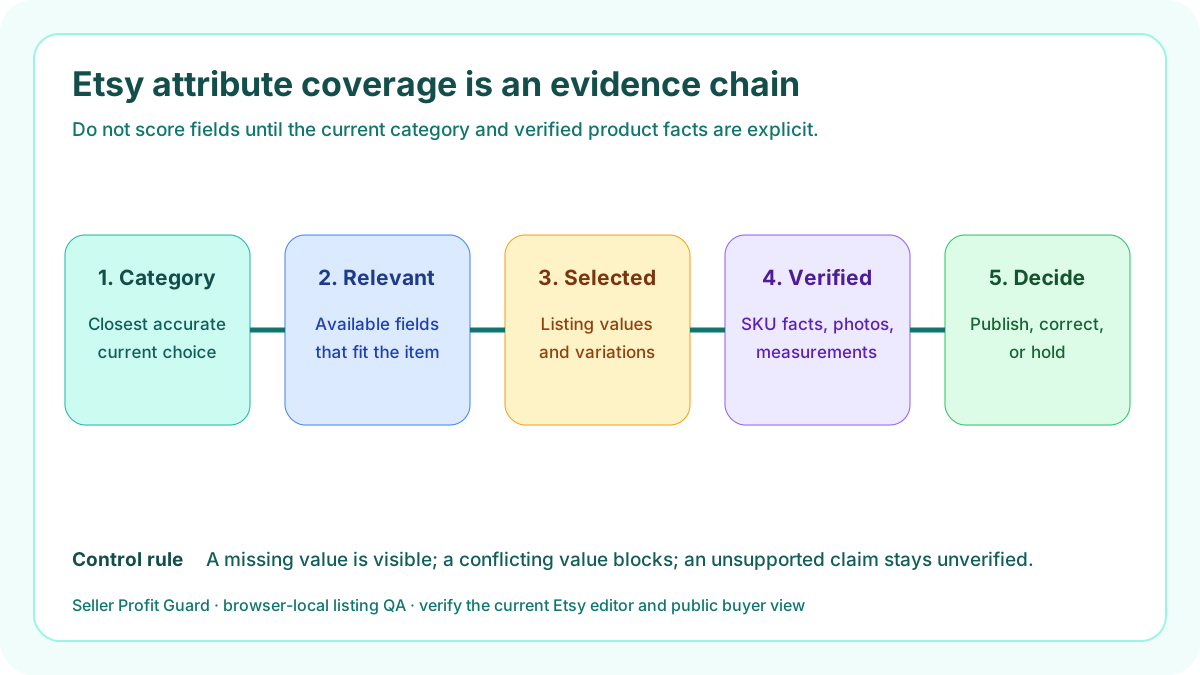
Why the category must come before attribute coverage
Etsy states that the selected category determines which attributes are available. A coverage score therefore needs one current category and the options shown for that category; it cannot use a universal checklist copied from another product. Choose the closest accurate category in the live listing editor, then record only attributes that genuinely describe the item.
A category change is material because it can change attributes, variations, filters, and the marketplace sections where the item appears. Re-run the review after changing category instead of assuming the earlier field set still applies. The checker does not recommend a category from keywords and does not access an Etsy account.
- Confirm the physical or digital item type.
- Choose the closest accurate category in the current editor.
- Copy the relevant attribute names and values.
- Separate selected values from verified product facts.
- Re-run the review after any category change.
How the exact coverage calculation works
Write each relevant and selected attribute as a key and value, such as “material: sterling silver.” Exact coverage is the number of relevant key-value pairs that match the selected listing values divided by the total relevant pairs entered. Missing keys and mismatched values remain visible instead of being averaged into one reassuring score.
The denominator is seller-declared because Etsy can expose different fields by category, market, interface, and date. Include every relevant option that makes sense for the item, but do not invent a value merely to make the coverage percentage reach 100%. An honest not-applicable decision is safer than an unsupported material, color, occasion, sustainability, or recipient claim.
What is the exact input contract?
Use one key-value pair for each field, separated by commas, semicolons, or new lines. The first colon separates the normalized lowercase key from its value: “material: sterling silver” and “primary color: silver.” Variation choices stay after the colon and use vertical bars, such as “length: 16 inches | 18 inches | 20 inches.”
Relevant attributes define the declared denominator. Selected attributes reproduce the current editor. Verified facts describe the actual product or SKU scope. Variations identify buyer-selectable dimensions. Title and tags provide a limited visibility check, while the evidence note names the source and an explicit YYYY-MM-DD review date.
The parser reports malformed rows and duplicate keys instead of silently discarding or overwriting them. Keep one value per fixed key. When two records disagree, resolve the source conflict; do not list the same key twice and rely on entry order to choose a winner.
| Input | Authority | Required control |
|---|---|---|
| Category | Current Etsy editor | One closest accurate category |
| Relevant pairs | Category options plus product relevance | Explicit denominator |
| Selected pairs | Current listing | One fixed value per key |
| Verified facts | Product specification or observation | Same SKU scope |
| Variations | Current buyer options | Pipe-separated values |
| Evidence note | Review record | Source plus YYYY-MM-DD |
How are Pass, Correct, Hold, and Block assigned?
Pass requires a category, at least one relevant pair, exact selected-to-relevant matches, matching product facts for every selected value, no duplicate or malformed rows, no fixed field overlapping a multi-value variation, and a dated evidence note.
Correct identifies repairable structure: a missing relevant key, a selected value that differs from the declared relevant value, a duplicate key, or malformed key-value syntax. Hold means the pairs align but a selected value lacks product evidence or the evidence note lacks an explicit date. Block applies when category scope is absent, no relevant denominator exists, a selected value conflicts with a verified fact, or a fixed value conflicts with live variations.
The numerical score supports triage but never cancels a decision condition. A high coverage percentage cannot offset a factual contradiction. Read the decision, exact coverage, exception outputs, and evidence maturity together.
Worked jewelry listing example
Suppose a pendant-necklace listing has four relevant fields: primary color, material, style, and recipient. The seller selects silver, sterling silver, minimalist, and adults, and the current SKU specification supports all four. The checker returns 4/4 exact coverage with no fact conflict.
The title “Sterling Silver Birth Flower Necklace, 18 Inch” and tags such as “silver necklace” and “minimalist jewelry” communicate several important facts without copying every structured field. Length remains a variation with 16-, 18-, and 20-inch values, so it should not also be represented as one fixed selected length attribute when that would contradict buyer options.
| Review layer | Entered value | Decision |
|---|---|---|
| Category | Pendant necklaces | Use current category fields |
| Relevant attributes | 4 declared pairs | Denominator is explicit |
| Selected and verified | 4 exact pairs | No conflict |
| Variation | Three lengths | Keep multi-value dimension |
| Title and tags | Selected facts only | Readable, not duplicated |
What does the default 4/4 fixture prove?
The default pendant-necklace fixture declares primary color silver, material sterling silver, style minimalist, and recipient adults. Those same four pairs appear in the selected map and verified fact record. The category is recorded, the evidence note is dated 2026-07-28, and length remains a three-value variation rather than one fixed attribute.
The result is 4/4 exact coverage, 100% coverage, no missing or mismatched relevant value, no fact conflict, no unverified selected value, no duplicate key, no malformed row, and no fixed-variation overlap. The review decision is Pass.
That fixture proves deterministic calculator behavior only. It does not prove that every real pendant necklace has those four relevant fields, that the product is sterling silver, or that the selected category is optimal. Replace every default with evidence from the current listing and exact SKU.
Home-decor listings need a different evidence map
A wall-hanging or textile listing may expose room, orientation, primary color, material, style, dimensions, or sustainability-related fields rather than jewelry attributes. The seller evidence may come from a bill of materials, production specification, finished measurements, care test, and current photographs. Reusing a jewelry checklist would create both missing fields and irrelevant claims.
For one-of-a-kind or variable handmade items, record the permitted range and explain it in buyer-facing copy. If color varies naturally, do not claim an exact shade that photographs and production records cannot support. If Etsy offers no exact value, its help guidance says to choose the closest relevant option and use truthful tags where a more specific buyer term matters.
Detect selected values that conflict with product facts
The checker compares selected key-value pairs with the verified product-fact map. If the listing says “primary color: gold” while the fact record says “primary color: silver,” it reports a conflict. Resolve the source fact, selected attribute, photos, title, description, tags, and variation labels together; changing only one surface leaves the buyer experience inconsistent.
A selected field without a matching fact is labeled unverified, not automatically false. Verify it against the SKU record, supplier specification, production notes, measurement, or the physical item. Do not use buyer search demand as proof that a material, certification, compatibility, recipient, vintage date, or production claim is accurate.
Why duplicate and malformed rows are not harmless
A repeated key can hide a conflict if software keeps only the last value. For example, “material: sterling silver, material: gold” is not two facts; it is an unresolved contradiction. The checker preserves the first valid pair, reports the duplicate namespace and key, and assigns Correct rather than silently choosing one.
A row such as “style minimalist” lacks the required colon and cannot establish a key-value relationship. It is reported as malformed. Correct the syntax only after confirming that style is relevant and minimalist is the verified current value.
These are data-quality controls, not writing preferences. A deterministic audit must reconstruct its denominator and every comparison. Hidden overwrites and ignored rows make the displayed percentage unauditable.
Keep fixed attributes and variation dimensions coherent
Etsy allows variations for up to two item attributes, and available variation types depend on the category. A listing can vary by length or color, but one fixed selected value for that same dimension can contradict the options. The checker flags a fixed attribute that overlaps a multi-value variation dimension so the seller can inspect the current editor and buyer view.
Custom variations may help a buyer choose an option, but Etsy notes that buyers cannot filter search results by custom variations. Do not treat a custom label as a replacement for an accurate category attribute. Visible variation photos, price, quantity, processing profile, and SKU mapping need their own review outside this text checker.
How title, tags, attributes, and search evidence fit together
Etsy describes search matching as a holistic view of titles, tags, attributes, descriptions, first photos, reviews, and more. Attributes can contribute structured matching, while a readable title and varied, truthful tags communicate buyer language. Repeating every attribute exactly in every field wastes limited space and can make the listing harder to scan.
The checker counts verified fact values visible in the entered title or tags as a communication cue, not a ranking score. It has no keyword volume, personalized search, conversion, review, service, photo-quality, or account data. Preserve a dated baseline and use aggregate Shop Stats after a mature window instead of promising that filling one field will create traffic or sales.
Which evidence supports each attribute?
Use the current listing editor for the category and available attribute choices. Use a versioned product specification or bill of materials for composition, measurements for dimensions, the physical product and controlled photos for observable construction and representative color, supplier documentation for sourced claims, and the SKU or variation matrix for buyer options.
The editor defines available choices but cannot prove product truth. A photo can support visible color or construction but may be distorted by lighting. A supplier sheet can support composition only when it matches the current batch. Search terms and competitor listings never prove a material, certification, origin, compatibility, safety, or sustainability claim.
Record the authority, product scope, version, access date, reviewer, unresolved conflict, and next check. Etsy states that sellers are responsible for sustainability attributes and may need certification, so unsupported sustainability fields belong in Hold or Block, not in a keyword experiment.
How should attribute coverage be stress-tested?
Run four boundary fixtures before trusting a new workflow. First, remove one selected relevant field and confirm Correct. Second, select a value that conflicts with the verified product fact and confirm Block. Third, leave a selected value without a fact or remove the evidence date and confirm Hold. Fourth, repeat a key or omit the colon and confirm the parser reports the exact defect.
Also test a fixed attribute against a multi-value variation. If length is selected as 18 inches while buyers can choose 16, 18, or 20 inches, the tool should Block for overlap. If the current Etsy editor legitimately represents the field differently, preserve that evidence and update the input model rather than ignoring the warning.
Reset must restore the documented 4/4 Pass fixture. On a 390-pixel viewport, all inputs, warnings, outputs, reset controls, source links, and explanatory images must remain readable without horizontal overflow.
A safe review and rollback routine
Save the current category, attribute set, variation structure, title, tags, listing URL, product-fact version, and review date. Correct high-confidence factual conflicts first. Release one bounded listing or a small coherent group, verify the public buyer view and options, and record which fields changed.
Rollback when the wrong category, product, profile, attribute options, variation values, price, photos, or buyer-facing claim appears. Stop immediately on login or CAPTCHA ambiguity, a platform warning, a wrong profile, or missing target context. A saved edit is not proof that the intended listing is correct until the public view and current account record agree.
- Snapshot the current listing and fact record.
- Confirm category and available attributes.
- Resolve missing and conflicting values.
- Check fixed fields against variations.
- Verify title, tags, photos, and description.
- Publish one bounded change and inspect the buyer view.
- Retain a dated rollback record.
Common Etsy attribute coverage questions
Should every available attribute be filled? Etsy says to fill as many as make sense. The denominator should contain every relevant field for the product, not every field visible in another category and not a selectively small set chosen to manufacture 100%.
What if Etsy has no exact option? Etsy advises selecting the closest relevant available attribute and using a truthful tag for a more specific buyer term when useful. In this checker, document that normalization in the relevant pair and evidence note; do not convert a near match into an unsupported product fact.
Can an attribute replace a tag? Attributes and tags can both contribute to query matching, but they serve different structures. Use accurate attributes and varied truthful tags; do not mechanically repeat every attribute phrase in all fields.
Can a custom variation improve filtering? Etsy currently says buyers cannot filter search results by custom variations. A custom variation can support purchase choice but does not replace an available structured attribute.
Does 100% coverage improve ranking? The result has no ranking probability. Etsy describes search as holistic across listing and shop signals. Measure actual aggregate Shop Stats separately after a mature, controlled change.
What the checker cannot prove
The result cannot certify Etsy eligibility, policy compliance, search placement, traffic, conversion, intellectual-property rights, sustainability certification, material safety, or buyer suitability. It checks the consistency of seller-entered text. Current official guidance and the live listing editor remain authoritative for platform behavior.
Do not paste buyer details, private order exports, credentials, messages, or raw customer data. Product facts, category choices, and aggregate review notes are enough. The checker is unaffiliated with Etsy and is an operating QA aid, not legal, tax, accounting, safety, accessibility, or platform-compliance advice.
What should the seller do next?
Open one current listing and copy only privacy-safe aggregate or product-level facts. Record the category, relevant fields, selected values, verified facts, variations, title, tags, and a dated source note. Run the checker and save the decision plus exception outputs.
Resolve Block conditions before all other edits. Correct missing, mismatched, duplicate, or malformed entries. Hold when a value or review date lacks evidence. After a Pass, verify the intended account and buyer-facing listing, then record the approved changes and restoration values.
Use the ten linked support pages for the formal input model, jewelry fixture, home-decor contrast, defect diagnosis, source map, decision thresholds, cross-category comparison, weekly routine, interpretation boundaries, and audit template.
Sources and further reading
- Etsy Help: How to use attributes when listing an item: Official category-dependent attribute workflow and closest-relevant-option guidance.
- Etsy Help: How to create a listing: Official category, item details, attributes, tags, variations, and publishing workflow.
- Etsy Help: How to add variations: Official two-attribute variation limit, category dependency, custom-variation, photo, SKU, price, and quantity behavior.
- Etsy Seller Handbook: How Etsy Search Works: Official explanation of holistic query matching across listing fields and current ranking boundaries.
- Etsy Seller Handbook: The Ultimate Guide to Etsy Search: Official current overview connecting categories, attributes, titles, tags, conversion, service, and personalized search insights without promising results from one field.
- Seller Profit Guard methodology: Evidence hierarchy, privacy boundaries, editable assumptions, and correction controls.
Related Seller Profit Guard tools
- Etsy CSV profit calculator: Run a local order profit check with editable fee and SKU cost assumptions.
- Payment reconciliation tool: Compare order rows with statement activity and flag unmatched rows.
- SKU cost library: Save or import material, labor, packaging, shipping, and target margin assumptions.
- Variant risk checker: Find missing SKUs and variation cost risks before a listing scales.
- Etsy title checker: Review listing-title clarity, repetition, keyword chains, and mobile scanning.
- Etsy tag checker: Review all 13 tag slots for duplicates, repeated meaning, and truthful coverage.
- Free shipping threshold calculator: Estimate when a shipping subsidy can still meet a target margin.
- Return window loss estimator: Model expected reverse shipping, restock work, recovery, and replacement loss.
- Etsy Ads break-even calculator: Estimate target-safe Etsy Ads spend, ACOS, and ROAS after fees, fulfillment, and expected return loss.
- CSV data privacy: Understand what the local-first workflow needs and what it does not need.
- Etsy Attribute Coverage Formula: Exact Inputs: Build an exact Etsy attribute coverage formula from relevant category fields, selected values, verified facts, variations, titles, and tags.
- Etsy Attribute Checker: A 4/4 Jewelry Example: Follow a 4/4 pendant-necklace attribute review through category scope, exact pairs, product facts, title and tag visibility, and variations.
- Etsy Attribute Audit for a Wall Hanging: Audit a home-decor wall hanging with category-specific material, color, room, dimensions, natural variation, and a documented hold decision.
- 10 Etsy Attribute Coverage Mistakes to Correct: Diagnose ten Etsy attribute errors involving denominators, stale categories, unsupported values, fact conflicts, variations, duplication, and scope.
- Etsy Attribute Data Sources, Field by Field: Map Etsy attribute fields to the live editor, product specification, measurements, photos, supplier evidence, SKU records, and a dated change log.
- Set Safe Etsy Attribute Decision Thresholds: Define pass, correct, hold, and block thresholds for Etsy attribute coverage, factual conflicts, evidence maturity, and variation overlap.
- Jewelry vs Decor: Etsy Attribute Coverage: Compare jewelry and home-decor attribute reviews across category scope, exact values, evidence, variations, visibility, and release decisions.
- A Weekly Etsy Attribute Audit Routine: Run a weekly Etsy attribute audit with sampling, evidence refresh, exception ownership, bounded corrections, public-view checks, and rollback.
- Interpret Etsy Attribute Coverage Carefully: Read exact coverage, missing fields, conflicts, unsupported selections, variation overlap, and fact visibility without false precision or ranking claims.
- Etsy Attribute Audit Checklist and Change Log: Use a reusable Etsy attribute checklist and change log for scope, evidence, fixtures, approval, publication verification, feedback, and rollback.
Use the interactive tool
Enable JavaScript to open the calculator and process browser-local inputs. The explanatory content and source links remain available without JavaScript.
Related guide: Review variations and SKU consistency before publishing.
This tool provides operating estimates, not tax, accounting, legal, financial, or marketplace-policy advice. Verify current official sources and your own records before changing prices or operations.