Seller Profit Guard · How it works · CSV privacy
Volume Discount Calculator for Sellers
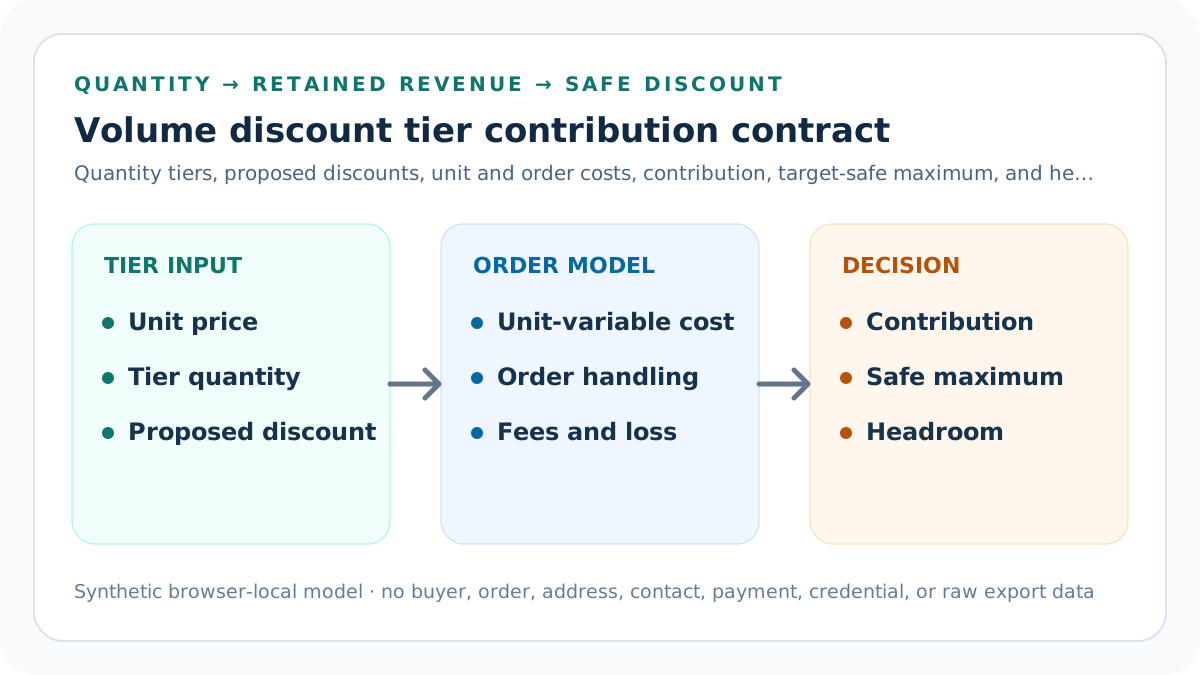
A volume discount calculator applies one proposed discount to each increasing quantity tier, extends unit-variable costs, adds per-order handling, fees, and expected loss, then reports contribution, contribution margin, the target-safe maximum discount, and discount headroom for every tier under one comparable seller-entered cost contract.
Maintained by Seller Profit Guard Editorial Team. Last reviewed: 2026-07-30.
What does a volume discount calculator measure?
A volume discount calculator tests several quantity tiers under one declared unit and order-cost contract. For every tier it applies the proposed percentage discount, calculates charged revenue, extends unit-variable cost by quantity, adds per-order costs and percentage fees, and reports contribution amount, contribution margin, and the remaining discount headroom.
The result is a contribution boundary for the entered tier. It does not demonstrate that buyers want the larger quantity, that stock and fulfillment can support it, that wholesale terms apply, or that the business earns accounting profit after fixed overhead, tax, financing, owner compensation, and working-capital effects.
Define one comparable product and tier contract
Use one product unit with the same list price, product-cost basis, unit-variable fulfillment cost, currency, and evidence period across the modeled tiers. The quantity row changes order size; the matching discount row changes retained product revenue. Keep buyer-paid shipping and per-order costs explicit rather than burying them in a unit average.
Run a separate packet when a wholesale-size order uses different packaging, carrier service, payment fee, sales channel, customer class, return rights, payment timing, or minimum-order rule. A mathematically larger quantity is not comparable when the commercial or fulfillment contract changes at the same time.
Align quantity tiers with proposed discounts
Enter increasing positive whole-number quantities and exactly one proposed discount for each quantity. The first quantity pairs with the first discount, the second with the second, and so on. The calculator Blocks missing, extra, duplicate, unordered, fractional, zero, or negative quantity rows instead of guessing a tier mapping.
Give each tier a stable nonprivate alias in the seller-owned evidence log, such as RETAIL-3 or CASE-12. A stable key prevents a later operator from comparing the twelve-unit cost evidence with a six-unit discount label after merchandising names or minimum-order language change.
Separate unit-variable from per-order cost
Unit product cost and unit-variable fulfillment cost multiply by the tier quantity. Product cost may include a current seller-owned standard or landed-cost basis. Unit fulfillment can include a material, pick, label, insert, or direct handling amount that truly repeats for each extra unit in the tier.
Per-order handling, packaging, fixed variable fees, expected loss, and other order-variable cost are added once to the tier order. Do not multiply them by quantity unless evidence proves the charge repeats per unit. This separation is what allows a larger order to spread genuine fixed order cost without inventing scale savings.
Calculate full-list and charged revenue
Full-list revenue equals unit list price multiplied by the tier quantity. Charged revenue equals full-list revenue multiplied by one minus the proposed discount, plus buyer-paid shipping. Record whether shipping is outside the product discount; if the checkout discounts shipping too, model that different revenue mechanism explicitly.
The generic calculator assumes the proposed percentage reduces seller-retained product revenue. Platform-funded benefits, negotiated rebates, post-purchase credits, tax, deposits, payment terms, and currency conversion require their own rows or separate scenarios. Do not treat catalog value as money the seller actually retains.
Calculate percentage fees and contribution
Apply the percentage marketplace and payment fee rate to charged revenue, then subtract percentage fees and the tier variable-cost pool from charged revenue. Contribution margin divides that contribution by charged revenue. Keep full precision through every intermediate calculation and round only the displayed money and percentage values.
Contribution is narrower than accounting profit. It is useful for comparing tier economics when cost roles are correct, but it does not automatically include rent, salaries, software, financing, income tax, owner compensation, unsold inventory, charge timing, or every customer-service and working-capital consequence.
Solve the target-safe maximum discount
Target-safe charged revenue equals the tier variable-cost pool divided by one minus the fee rate and seller-entered target contribution rate. Subtract buyer-paid shipping, divide the remaining product-revenue requirement by full-list revenue, and subtract that share from one to obtain the maximum target-safe discount.
The denominator must remain positive. A fee rate plus target rate at or above 100% Blocks because no positive revenue share remains for the entered variable-cost pool. Substitute the calculated discount into the forward equation and reproduce the target margin before accepting the inverse result.
Separate target-safe from break-even
Break-even maximum discount uses the same inverse equation with a zero contribution target. It is usually much larger than the target-safe maximum because it reserves no contribution for fixed business costs, risk, or owner policy. Display both boundaries but compare the proposed tier with the target-safe rate first.
Do not advertise the mathematical break-even rate as a recommended public offer. An order exactly at modeled break-even has no contribution buffer for input error, customer-service exceptions, carrier changes, damage, delayed payment, or any cost outside the narrow variable-cost contract.
Three-unit worked example
Use USD 30 unit list price, USD 10 product cost, USD 2 unit-variable fulfillment, three units, 10% discount, USD 4 handling, 8% percentage fee, USD 0.50 fixed fee, USD 1.50 expected loss, and USD 1 other order-variable cost. Full-list revenue is USD 90 and charged revenue is USD 81.
The variable-cost pool is USD 43 and percentage fees are USD 6.48. Contribution is USD 31.52 and contribution margin is 38.91%. With a 20% target, the target-safe maximum discount is 33.64%, leaving 23.64 percentage points above the proposed 10% tier discount.
Twelve-unit worked example
Keep the same unit and order contract, increase quantity to twelve, and propose a 20% discount. Full-list revenue becomes USD 360, charged revenue USD 288, variable-cost pool USD 151, and percentage fees USD 23.04. The larger tier spreads the same USD 7 fixed order-variable cost across more units.
Contribution is USD 113.96 and margin is 39.57%. The target-safe maximum discount is 41.74%, leaving 21.74 percentage points of headroom. This arithmetic does not prove that twelve units can use identical packaging, labor, shipping, expected loss, or customer terms; verify those before relying on the comparison.
Test a wholesale-size stress tier
A wholesale-size order may require a case carton, pallet handling, different pick sequence, freight quote, insurance, appointment fee, commercial invoice, credit terms, or higher damage severity. Replace the affected rows instead of calling the retail order-cost contract conservative without evidence.
Run at least one capacity and fulfillment stress case. If the proposed larger-tier discount clears the contribution target only while assuming retail packaging and instant payment, the result is not decision-ready. Keep payment timing and working capital outside the contribution output but visible in the approval note.
Read discount headroom correctly
Discount headroom is the target-safe maximum discount minus the proposed discount, expressed in percentage points. Positive headroom means the proposal remains below the modeled target boundary. Negative headroom measures the modeled rate overrun; it is not a recommendation to raise price or reduce discount without reviewing the driving evidence.
A tier can have positive contribution and still return Review because it misses the seller-owned target. Conversely, a large rate headroom can be misleading if unit costs, handling, fees, return loss, or wholesale fulfillment evidence are stale. Interpret the status after structural and evidence gates, not from one attractive percentage.
Apply Block, Review, and Ready precedence
Block blank, nonfinite, or negative required costs; nonpositive list price; row-count mismatch; duplicate or non-increasing quantities; non-whole quantities; discounts below zero or at least 100%; invalid fee or target rate; nonpositive target denominator; impossible source date; incomplete confirmations; invalid currency or month; insufficient scope; or any declared unresolved conflict.
After structure passes, Review every tier with nonpositive charged revenue, negative contribution, contribution margin below target, or proposed discount above its target-safe maximum. Ready means all entered tiers clear the bounded contribution contract; it does not authorize automatic price publication or wholesale acceptance.
Avoid quantity-tier calculation mistakes
Do not divide per-order handling across an optimistic quantity and then also subtract the full order charge. Do not multiply fixed fees by units, omit unit-variable labor, treat a case pack as identical retail fulfillment, pair quantities with the wrong discount rows, or compare discounts while changing product cost and shipping silently.
Avoid hidden mix changes. A twelve-unit order of one SKU differs from a twelve-unit assortment if items carry different costs, weights, pick paths, return severity, or eligibility. Use the bundle calculator for a defined mixed composition; use this volume tool when repeated quantity of one comparable unit is the controlling variable.
Source unit cost and fulfillment evidence
Use current SKU cost versions, supplier or landed-cost records, packaging standards, direct time studies, fulfillment invoices, purchased labels, or qualified quotes. Preserve included and excluded rows, units, currency, effective date, owner, confidence, and replacement trigger for every cost assumption.
Do not publish supplier-confidential documents or raw transaction rows. Store source pointers and nonprivate aliases in a protected evidence log. Public examples remain synthetic. Recalculate after supplier, packaging, labor, carrier, destination, fee, return, or product-spec changes rather than overwriting the old basis.
Source discount and fee evidence
Use the current checkout, price-list, wholesale sheet, or platform configuration for tier quantities, discount rates, funding, eligibility, and effective dates. Shopify's current B2B documentation illustrates why increment, minimum, maximum, and price-break rules belong to a variant-level contract; it permits up to ten price breaks and says the volume price becomes fixed rather than receiving the catalog's overall adjustment. Treat that as a Shopify-specific example, not a universal rule.
Separate seller-funded discounts from platform-funded promotions, coupons, rebates, negotiated credits, and payment-term adjustments. If fee treatment changes by customer, channel, country, payment method, or order value, create named scenarios instead of averaging mutually exclusive rules.
Map platform quantity rules before modeling contribution
For a platform-managed tier, record the variant, catalog or price list, customer class, minimum, maximum, increment, quantity break, resulting unit price, discount stacking behavior, and effective window. A quantity break must be evaluated at the same variant grain used by checkout; combining several variants to satisfy one threshold can create a false eligible tier.
Translate the resulting unit price into a seller-funded discount only after verifying the retained product revenue. Keep checkout eligibility and platform enforcement outside the generic arithmetic: the calculator tests contribution for the entered row, while the seller-owned evidence packet proves that the row can actually occur.
Complete the dated evidence confirmation contract
Enter a real source review date and answer yes only after verifying seven independent controls: the ordered tier schedule, current unit price and costs, complete once-per-order variable costs, percentage and fixed fee bases, capacity and fulfillment continuity, one order grain, and the boundary between contribution and accounting profit.
The calculator Blocks when any confirmation is missing. This is deliberate: a valid formula cannot rescue a price break paired with the wrong quantity, an expired unit cost, a fee applied to the wrong base, a large tier that changes the package or carrier contract, or an input packet mixing different dates and currencies.
Model expected loss without false precision
Expected loss per tier order can represent the affected-order rate multiplied by unrecovered severity, but the calculator accepts the resulting amount as one explicit input. Build it from comparable quantity-tier evidence for damage, missing units, partial returns, replacements, extra shipping, disposal, restocking, and confirmed recovery.
A larger order can have a different affected rate and much larger severity even when its per-unit return frequency appears stable. Keep frequency, severity, sample size, observation window, and recovery method visible. Use ranges when mature wholesale-size evidence does not yet exist.
Protect privacy and evidence scope
Do not paste buyer names, addresses, emails, messages, order IDs, payment details, bank data, credentials, private export rows, or supplier-confidential records into the public calculator, screenshots, support pages, community drafts, or feedback forms. Aggregate private evidence locally before entering non-identifying amounts.
The browser-local tool does not retrieve marketplace, checkout, inventory, carrier, accounting, or customer data. Operators remain responsible for source quality and classification. Preserve only the minimum nonprivate fields needed to reproduce the calculation and explain the decision.
Run a reversible tier decision
If a packet Blocks, repair the named structural or evidence field. If it Reviews, identify the exact tier and driver: unit cost, handling, fulfillment, fee, expected loss, target, or proposed discount. If it is Ready, choose one bounded action with an owner, observation window, stop condition, and restoration reference.
Do not change every tier, channel, and fulfillment process at once. Preserve the current price table and checkout behavior, release one reviewed change, observe aggregate contribution and operational exceptions, then close or restore. A clean calculation is necessary but not sufficient for a safe commercial experiment.
Maintain a quantity-tier audit log
Record packet ID, product alias, unit price, unit cost, unit fulfillment, ordered quantities, proposed discounts, buyer shipping, handling, fee, expected loss, other variable cost, target, currency, period, scope, formulas, outputs, status, issues, reviewer, approved action, and next trigger.
Attach deterministic fixtures, source references, full-precision calculations, displayed rounding, screenshots, release evidence, observed feedback, and rollback status. Never silently overwrite a prior tier decision. A dated change log makes it possible to explain why a former discount passed under older evidence.
What should you do after the calculation?
Use the result to identify which quantity tier needs evidence repair or commercial review. Compare same-grain tiers, then verify stock, fulfillment capacity, package limits, wholesale terms, payment timing, return exposure, and customer clarity separately before publishing a larger-quantity offer.
Use the contribution margin calculator for one observed order, the product price floor calculator when solving a list-price requirement, the bundle margin calculator for mixed components, and the listing cost library for versioned unit evidence. Recalculate on material triggers, not merely because a content calendar requests another update.
Sources and further reading
- Seller Profit Guard methodology: Calculation contracts, evidence precedence, validation, correction, release, and rollback.
- Seller Profit Guard data privacy: Local-first boundaries for seller, buyer, order, payment, contact, credential, and raw export data.
- Shopify quantity rules and volume pricing: Current first-party example of variant-level increments, minimums, maximums, up to ten price breaks, and fixed volume prices; confirm the actual platform, plan, variant, catalog, and discount interaction separately.
- U.S. Small Business Administration break-even guidance: Primary explanation of contribution margin as sale price minus variable cost divided by sale price.
- IRS Publication 334 (2025): Primary U.S. context for cost of goods sold and gross profit; this calculator does not make a tax determination.
- IRS Schedule C instructions (2025): Primary U.S. context for inventory and cost-of-goods-sold reporting boundaries.
Related Seller Profit Guard tools
- Etsy CSV profit calculator: Run a local order profit check with editable fee and SKU cost assumptions.
- Payment reconciliation tool: Compare order rows with statement activity and flag unmatched rows.
- SKU cost library: Save or import material, labor, packaging, shipping, and target margin assumptions.
- Variant risk checker: Find missing SKUs and variation cost risks before a listing scales.
- Etsy title checker: Review listing-title clarity, repetition, keyword chains, and mobile scanning.
- Etsy tag checker: Review all 13 tag slots for duplicates, repeated meaning, and truthful coverage.
- Free shipping threshold calculator: Estimate when a shipping subsidy can still meet a target margin.
- Return window loss estimator: Model expected reverse shipping, restock work, recovery, and replacement loss.
- Etsy Ads break-even calculator: Estimate target-safe Etsy Ads spend, ACOS, and ROAS after fees, fulfillment, and expected return loss.
- CSV data privacy: Understand what the local-first workflow needs and what it does not need.
- Volume Discount Formula and Inputs: Define increasing quantity rows, proposed discounts, unit and per-order costs, fees, contribution targets, and tier-safe discount equations.
- Three-Unit Volume Discount Example: Trace a three-unit tier from USD 90 full-list revenue and USD 43 variable cost to USD 31.52 contribution and a 33.64% safe discount.
- Wholesale-Size Volume Discount Tier: Model a twelve-unit or larger tier with changed packaging, handling, freight, payment terms, loss severity, capacity, and discount evidence.
- Volume Discount Calculation Mistakes: Correct tier-row, fixed-cost, unit-cost, discount, fee-base, fulfillment, expected-loss, rounding, comparison, and interpretation defects.
- Reliable Volume Discount Data Sources: Map unit price, unit costs, tier quantities, discounts, handling, fulfillment, fees, expected loss, and target margin to traceable evidence.
- Safe Volume Discount Decision Thresholds: Apply row, quantity, cost, rate, denominator, evidence, contribution, target, headroom, capacity, and reversibility gates.
- Three-Unit vs Twelve-Unit Discounts: Compare three-unit and twelve-unit tiers at one unit-cost and order-cost grain to isolate fixed-cost spreading and discount headroom.
- Weekly Volume Discount Review Routine: Run a recurring tier roster, source refresh, fixture, exception, capacity, approval, feedback, closure, and rollback process.
- How to Interpret Volume Discount Results: Read tier revenue, cost pool, contribution, margin, safe discount, break-even rate, and headroom without false precision.
- Volume Discount Audit Template: Record tier identity, cost roles, revenue, equations, outputs, boundaries, source evidence, approval, verification, feedback, and rollback.
Use the interactive tool
Enable JavaScript to open the calculator and process browser-local inputs. The explanatory content and source links remain available without JavaScript.
Related guide: Define tier quantities, discounts, unit and order costs, contribution, and safe discount boundaries.
This tool provides operating estimates, not tax, accounting, legal, financial, or marketplace-policy advice. Verify current official sources and your own records before changing prices or operations.